

PODCAST: The Attention War
Introduction: The Threshold of the Great Unraveling
The bell is already ringing. It is not a sound registered by the auditory nerve, but a tremor felt in the collective nervous system of a civilization stretched to its absolute cognitive limit. We stand at a threshold, a precipice where the cumulative weight of our technological advancements threatens to fracture the very vessel that created them: the human mind. This is not merely an ecological crisis of resources or an economic crisis of distribution; it is a cognitive crisis of coherence. We are witnessing the “Great Acceleration,” a period where the velocity of information has fundamentally outpaced the biological capacity of the human brain to process it, leading to a systemic unraveling of reality at every scale of existence.1
This phenomenon is not a metaphor. The “Attention War” is a literal, industrialized conflict waged for the capture, commodification, and manipulation of human consciousness. In the 21st century, attention has supplanted oil and data as the primary resource of the global economy. It is the finite substrate upon which all other human endeavors rest. Without attention, there is no economy, for consumption requires focus; there is no democracy, for citizenship requires deliberation; there is no love, for intimacy requires presence; and ultimately, there is no self, for identity is constructed from what we attend to.3
Yet, this most precious of resources is being strip-mined with ruthless efficiency by an “attention economy” that incentivizes the fragmentation of focus and the hijacking of human agency. The resulting landscape is one of “Algorithmic Collapse,” where the feedback loops between human behavior and machine learning create a downward spiral of outrage, polarization, and cognitive exhaustion. We are building a “distributed automaton,” a socio-technical super-organism that selects for impulsivity over reflection and noise over signal.1
The prevailing narrative of this collapse often frames it as a failure of individual willpower—a lack of digital discipline in the face of temptation. This framing is a dangerous oversimplification that obscures the structural reality of the conflict. We are not facing a fair fight. We are facing a profound asymmetry of power where individual biology, evolved for the slow rhythms of the savannah, is pitted against supercomputers and teams of behavioral psychologists designed to exploit the deepest vulnerabilities of our neural architecture.6 The “Slot Machine in a Billion Pockets” is not a glitch in the system; it is the fundamental design specification.6
To understand the stakes of this war, we must look beyond the surface level of “screen time” metrics and “digital detox” trends. We must descend into the architecture of the system itself—integrating the neuroscience of dopamine loops, the behavioral economics of variable rewards, the philosophy of agency, and the systems theory of emergent chaos. We must recognize that the “fractal” nature of reality implies that the disruption occurring at the level of the individual neuron ripples outward to shape the destiny of nations and the trajectory of the species.1
This report serves as a deep reconnaissance of the battlefield. It analyzes the mechanisms of capture that have turned the human mind into a resource extraction site, examines the costs of this fragmentation on our institutions, and outlines the geopolitical stakes of “cognitive sovereignty.” It ultimately proposes a counter-strategy: an “Attention Sovereignty Protocol” rooted in the integration of ancient wisdom and modern science—a path to reclaim the “space between thoughts” before the algorithmic noise drowns out the signal of our humanity forever.1
Part I: The Neuroscience of Capture – The Battlefield of the Mind
The human brain is an evolutionary marvel, an intricate prediction machine designed to navigate a world of scarcity. Its attentional systems evolved over millions of years to detect critical signals in a noisy environment: the snap of a twig indicating a predator, the flash of color indicating ripe fruit, the subtle facial micro-expression indicating social status. These systems are governed by delicate neurochemical loops that prioritize salience—the immediate, visceral relevance of a stimulus to survival. In the digital age, these ancient mechanisms have been hijacked by a technological environment that has cracked the code of human motivation.
The Dopamine Loop and Motivational Salience
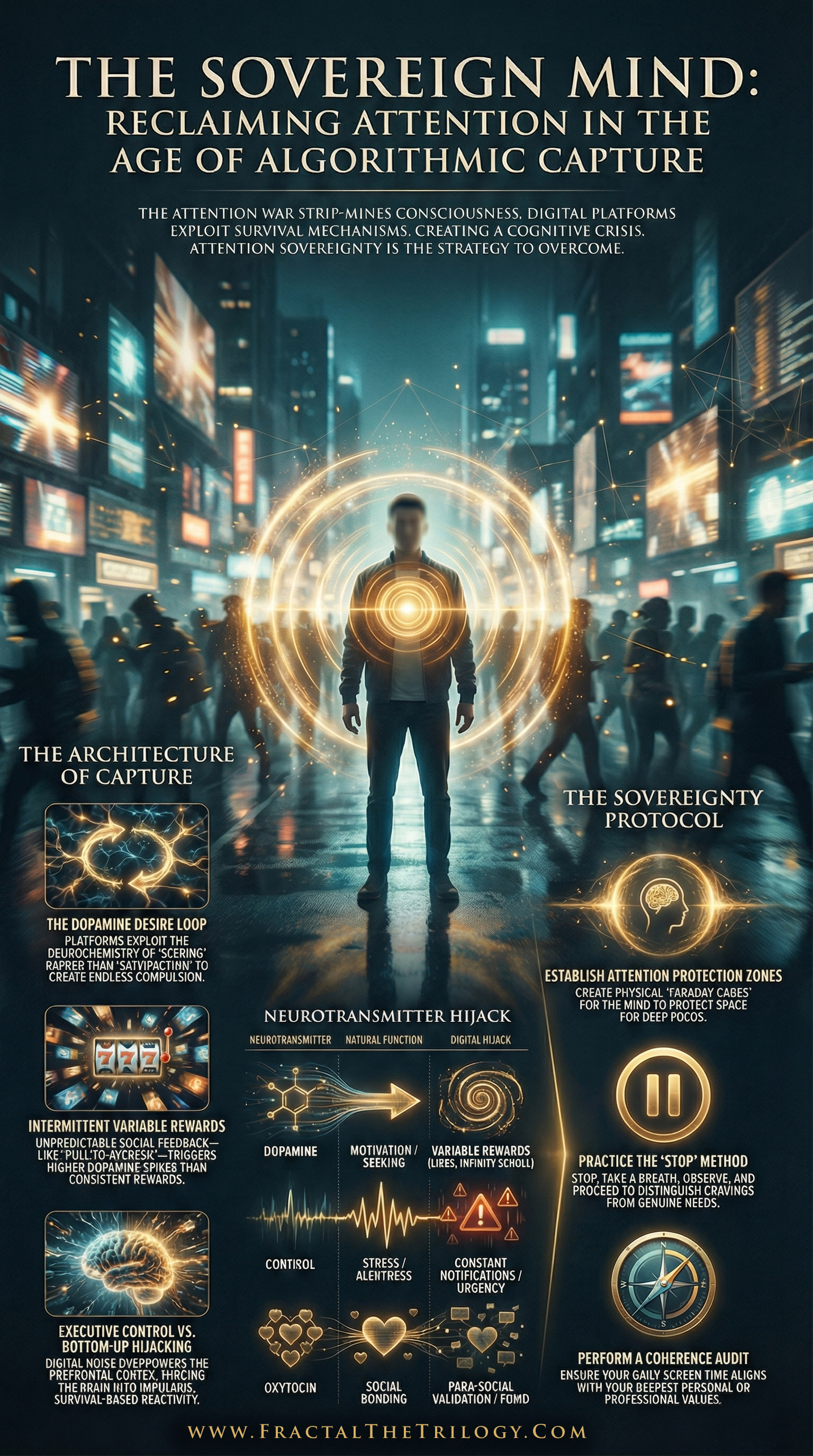
At the core of attention capture lies the dopamine system, specifically the mesolimbic pathway. Often popularly misunderstood as the “pleasure molecule,” dopamine is more accurately described as the neurotransmitter of desire, anticipation, and seeking. It drives the organism to pursue a reward, not necessarily to enjoy it. This distinction is crucial for understanding digital addiction. The attention economy does not need to make the user happy; it only needs to make the user want.8
Motivational salience coding dopamine neurons activate when an alerting stimulus is detected. This signal serves three primary functions: it orients attention toward the stimulus, engages cognitive resources to decipher its meaning, and increases motivation levels to act upon it. In a natural environment, this system is a survival mechanism. In a digital environment, it is a vulnerability. Every notification, every red badge, every haptic vibration acts as a “salience spike,” triggering a dopamine release that compels the brain to seek the potential reward hidden behind the alert. The brain interprets the smartphone not as a tool, but as a source of vital, high-salience information.8
This mechanism creates a “compulsion loop.” The brain learns to associate the device with the relief of uncertainty and the acquisition of social or informational rewards. Even in the absence of an external notification, the internal possibility of a reward—a new like, a message, a breaking news update—triggers a dopamine-driven urge to check. This behavior is not a conscious choice; it is a sub-cortical reflex driven by the basal ganglia. The “checker” is not seeking information per se; they are seeking the dopamine hit associated with the anticipation of information. This is the neural basis of the “Internet craving” phenomenon observed in behavioral economic studies.10
The Architecture of Variable Rewards
The most potent driver of this compulsion is the principle of “Intermittent Variable Rewards” (IVR). Derived from the foundational work of B.F. Skinner on operant conditioning, IVR posits that a behavior is most strongly reinforced when the reward follows the action unpredictably. If a rat presses a lever and receives a food pellet every time, it presses only when hungry (a fixed ratio schedule). However, if the rat receives a pellet only occasionally and unpredictably, it will press the lever compulsively, often to the point of exhaustion. The uncertainty of the reward spikes dopamine levels higher than the reward itself.
Social media platforms are the ultimate Skinner boxes. When a user executes the “pull-to-refresh” gesture, they are effectively pulling the lever of a slot machine. They do not know what they will receive. It might be a mundane photo, an irrelevant ad, or a high-dopamine social validation signal (a like from a romantic interest, a viral post). This unpredictability maximizes the release of dopamine, encoding the habit of scrolling deep into the neural circuitry. The “pull-to-refresh” animation itself—often a spinning wheel or a stretching icon—is designed to extend the moment of anticipation, heightening the neurochemical response.6
Technologists and ethicists like Tristan Harris have explicitly compared this mechanism to gambling infrastructure. The design is intentional and adversarial. The variability of content is not an accident of user-generated feeds; it is a calibrated feature to exploit the brain’s vulnerability to uncertain outcomes. This creates a state of “continuous partial attention,” where the brain is perpetually scanning the environment for the next “hit,” unable to settle into the deep, restorative state of rest or focus required for complex cognition.6
Executive Control vs. Bottom-Up Capture
To understand the battle for the mind, we must distinguish between two competing attentional systems:
- Top-Down (Goal-Directed) Attention: Mediated by the “Executive Control Network,” centered in the prefrontal cortex (PFC). This system allows us to direct focus toward long-term goals, filter out distractions, and override immediate impulses. It is the seat of “Cognitive Control” and human agency, allowing for planning and deliberation.12
- Bottom-Up (Stimulus-Driven) Attention: Mediated by the “Salience Network,” involving the amygdala and ventral striatum. This system reacts automatically and rapidly to sensory stimuli that are novel, threatening, or rewarding. It is a survival mechanism designed to override top-down focus when a tiger jumps from the bushes.
The Attention War is a conflict between these two systems. The digital environment is engineered to hyper-stimulate the bottom-up system, constantly triggering the salience network with bright colors, sudden movements (autoplay videos), and emotional triggers. This bombardment overwhelms the limited capacity of the top-down system. The PFC is evolutionarily new, energetically expensive, and easily fatigued. Constant interruptions and context-switching deplete “cognitive fuel,” leading to a state of “ego depletion.” Once the executive function is exhausted, the brain defaults to bottom-up reactivity. We become impulsive, emotional, and highly susceptible to manipulation.13
This state of “cognitive exhaustion” explains the phenomenon where intelligent, disciplined individuals find themselves “doom-scrolling” for hours late at night, despite a conscious intention to sleep. It is not a moral failing; it is a biological override. The “adversarial design” of the technology bypasses the user’s conscious intentions (what James Williams calls “Starlight” or “Sunlight” goals) and hooks directly into their immediate impulses (the “Spotlight” of attention).15
The Neuroplasticity of Distraction
The consequences of this capture extend far beyond the immediate moment of distraction. The brain is neuroplastic; it constantly rewires itself based on what it attends to. “Neurons that fire together, wire together.” Chronic exposure to rapid-fire, fragmented information trains the brain for distractibility. Neural pathways associated with sustained attention, deep reading, and complex analysis atrophy from disuse, while pathways associated with rapid switching, craving, and superficial processing are strengthened and myelinated.17
We are effectively rewiring the species to be less capable of deep thought, nuance, and sustained empathy. This is the “Great Acceleration” of cognitive degradation. As the systems of the world become increasingly complex, requiring higher levels of systems thinking and patience to navigate, the human capacity for those very traits is being eroded by the tools we use to interface with reality. We are entering a “Cognitive Crisis” where the complexity of our problems exceeds the attentional bandwidth available to solve them.1
Part II: Behavioral Economics and Addiction Design – The Incentives of Extraction
The neuroscience of capture describes the mechanism of the Attention War, but behavioral economics explains the motive. Why is the digital world designed to be addictive? The answer lies in the fundamental business model of the attention economy: the commodification of human time and consciousness as raw materials for extraction.
The Attention Economy: Time as Currency
In an information-rich world, attention becomes the scarce resource. As Nobel laureate Herbert Simon famously noted, “a wealth of information creates a poverty of attention.” In the digital ecosystem, user attention is the product sold to advertisers. Platforms like Facebook, Google, and TikTok are not “free”; the user pays with their time, their data, and their cognitive sovereignty. The true customer is the advertiser; the user is the resource being harvested.3
The economic incentive structure is brutally simple: Maximize Time on Device. Every second a user spends scrolling is a second of ad inventory generated and a second of behavioral data collected to refine predictive models. This creates a “Race to the Bottom of the Brain Stem,” where companies compete to develop increasingly aggressive and persuasive techniques to hijack the primitive instincts of the user. There is no incentive for a platform to say, “You’ve been here long enough, go spend time with your family.” The incentive is always to extract the next minute, the next click, the next scroll.3
This economic logic fundamentally misaligns the goals of the technology with the goals of the user. The user typically wants to connect with friends, stay informed, or be entertained. The platform wants addiction. This misalignment is the root of “adversarial design”—technologies that actively work against the best interests of the human being using them, prioritizing engagement metrics over human well-being.15
Addiction by Design: The Ludic Loop and Dark Patterns
Behavioral economics reveals how platforms exploit specific cognitive biases to maintain this extraction. The concept of “loss aversion”—the psychological reality that humans feel the pain of a loss twice as intensely as the pleasure of an equivalent gain—is leveraged through features like Snapchat streaks or Instagram “Stories” that disappear after 24 hours. These features create a manufactured urgency (FOMO – Fear Of Missing Out). If the user does not engage now, they lose social capital or the continuity of a relationship.11
The “Framing Effect” is used to manipulate user perception. LinkedIn, for example, notifies a user they are in the “top 1% of profiles,” triggering a dopamine hit of status validation and nudging them to engage further with the platform. These “nudges” are not neutral; they are carefully architected choice architectures designed to maximize extraction. The platform frames the engagement as professional development, while the underlying mechanic is status-seeking.11
Deepening this is the “Ludic Loop,” a state of absorption in a feedback cycle of action and reward, commonly observed in gambling behaviors. Social media platforms replicate this through “infinite scroll.” By removing “stopping cues”—the natural end of a page, a chapter, or a show—platforms eliminate the moment of choice where a user might decide to leave. The content flows endlessly, keeping the user in a trance-like state of consumption, often referred to as the “machine zone” in gambling literature. The user enters a flow state, but unlike the creative flow described by Csikszentmihalyi, this is a passive, extractive flow that depletes rather than regenerates psychic energy.6
The Legitimization of Passion Exploitation
The extraction of attention is paralleled by the extraction of labor in the gig and creator economies, a phenomenon behavioral economists term the “Legitimization of Passion Exploitation.” Platforms rely on user-generated content to function. By framing this labor as “self-expression,” “community building,” or a “labor of love,” platforms can extract massive amounts of value from users without monetary compensation.
Users invest hours creating videos, writing posts, and curating profiles, driven by the social rewards of “likes” and the distant promise of “influencer” status. They are effectively unpaid laborers in a digital factory, paid in dopamine rather than dollars. The platform extracts the surplus value of their creativity and attention, monetizing it through ads, while the users bear the costs of burnout and mental health degradation. This dynamic exploits the human need for meaning and validation, turning the pursuit of passion into a mechanism of economic capture.22
The Cost of “Free”: A Tragedy of the Cognitive Commons
The behavioral economic cost of this system is not just the time spent on the device; it is the opportunity cost of what that attention could have achieved. Attention is “psychic energy”—the fuel for consciousness, creativity, relationship building, and civic will. When this energy is siphoned off by platforms for commercial gain, it is unavailable for personal development, deep relationships, or complex problem-solving.
The attention economy creates a “tragedy of the commons” for the human mind. Just as unregulated grazing destroys a shared pasture, unregulated attention capture destroys the shared cognitive environment. We are polluting our inner worlds with noise, leaving us with a collective “poverty of attention” that bankrupts our ability to address the existential challenges of the 21st century.10
Part III: Philosophy of the Self – Agency and Freedom
If neuroscience defines the battlefield and economics defines the motive, philosophy defines the stakes. What is actually lost when attention is captured? It is not merely productivity or time; it is the self.
Attention as the Genesis of Self
Philosophers from William James to Iris Murdoch have argued that we are what we attend to. “My experience is what I agree to attend to,” wrote James. Attention is the mechanism by which we construct reality and our identity within it. It is the “essential phenomenon of will.” Without the ability to direct attention, there is no coherent self, only a bundle of reflexes responding to external stimuli.23
Simone Weil elevated attention to a spiritual and ethical dimension, famously stating that “attention is the rarest and purest form of generosity.” For Weil, attention is the capacity to suspend the ego and truly see the other—to grant them the “compliment of being real.” It is a form of prayer, a way of orienting the soul toward truth and the Good. To lose control of attention is to lose the capacity for love, for prayer, and for ethical action. If we cannot attend to the suffering of others because we are distracted by the trivial, we lose our moral humanity.24
In the context of the attention war, the capture of attention is an ontological crime. It is a violation of the self’s capacity to constitute itself. When our attention is fragmented by algorithms, our self becomes fragmented. We become “dividuals”—scattered data points processed by machines—rather than individuals with coherent narratives and moral agency.27
Cognitive Sovereignty
This leads to the critical concept of Cognitive Sovereignty: the right to mental self-determination. Just as political sovereignty defines the right of a nation to govern itself without external interference, cognitive sovereignty defines the right of the individual to govern their own attention, thoughts, and beliefs. It is the foundation of all other freedoms.7
In the digital age, cognitive sovereignty is under siege. “Adversarial designs” infiltrate the decision-making loop of the individual, inserting impulses and desires that are not their own. The user thinks they are choosing to scroll, but the choice was engineered long before they unlocked their phone. This erosion of agency threatens the foundation of liberal democracy, which presupposes a rational, autonomous citizen capable of making free choices. If we cannot control our attention, we cannot control our intentions. If we cannot control our intentions, we are not free.15
The Fractal Nature of Reality
Referencing the metaphysical framework of Fractal – The Awakening, reality itself can be understood as a “recursive unfolding of inquiry” shaped by observation. The text posits that “Reality collapses into form only at the moment of observation.” Therefore, the quality of our attention determines the quality of the reality we inhabit.
If our attention is scattered, fearful, and superficial, we collapse a reality that is chaotic, terrifying, and shallow. If our attention is deep, coherent, and loving, we collapse a reality that is resonant and meaningful. The “fractal” implies that this holds true at all scales: the chaotic mind creates a chaotic life, which contributes to a chaotic society. The “Attention War” is thus a war for the power to collapse reality itself. The “Guardians of Truth” in the narrative represent the struggle to protect this power from those who would use it for domination rather than awakening.1
Part IV: Systems Theory and Algorithmic Feedback Loops – The Automaton
The war is not static; it is a dynamic, evolving system. Systems theory provides the lens to understand how individual interactions with algorithms scale into global phenomena, creating emergent behaviors that no single actor intended or controls.
The Human-Algorithm Feedback Loop
Machine learning systems differ fundamentally from traditional software because they evolve based on the data they consume. This creates a “feedback loop”: the algorithm predicts what a user wants (e.g., outrage content), feeds it to them, the user engages (confirming the prediction), and the algorithm reinforces that pattern. Over time, the system optimizes for extreme engagement, narrowing the user’s worldview into a “filter bubble” or “echo chamber”.30
This is a cybernetic control loop where the human is the component being controlled. The algorithm is not “neutral”; it is an active agent maximizing an objective function (engagement). Because outrage, fear, and tribalism trigger a stronger neurochemical response (salience) than nuance or agreement, the system naturally selects for polarization. It is an “anger engine” fueled by the dopamine of moral righteousness.32
Emergence and Collective Chaos
In complex systems, simple rules at the micro-level (e.g., “maximize watch time”) can lead to complex, emergent behaviors at the macro-level (e.g., radicalization, conspiracy theories, social unrest, genocide). No engineer at YouTube explicitly programmed the algorithm to promote flat-earth theories or political extremism; these outcomes emerged as the optimal solution to the engagement problem. The system “learned” that this content keeps eyes on the screen.5
This phenomenon creates “Cognitive Entropy”—a disordering of the collective information environment. As feedback loops accelerate, the system becomes increasingly unstable. The “Great Acceleration” mentioned in Fractal describes this tipping point where the complexity of the system outstrips the control mechanisms, leading to “Algorithmic Collapse.” The predictive models fail because the feedback loops have pushed the system into chaotic, non-linear states that historical data can no longer predict. We are flying blind into a storm of our own making.1
The Automaton at Scale
We are witnessing the birth of a “distributed automaton”—a socio-technical super-organism composed of humans and algorithms coupled in tight feedback loops. This automaton does not care about truth, human well-being, ecological survival, or democratic stability. It cares only about the propagation of the signal (engagement).
This is the systems-level view of the Attention War. It is not just a conflict between companies and users; it is a runaway evolutionary process of information selection that is selecting against human coherence. To survive, we must introduce “negative feedback loops” (regulation, friction, consciousness) to dampen the runaway positive feedback loops of the attention economy.34
Part V: Level of Analysis 1 – The Individual (Inner Sovereignty)
The first casualty of the Attention War is the inner life of the individual. The fragmentation of attention results in a fragmentation of the soul, creating a population that is increasingly anxious, disconnected, and incapable of deep thought.
The Fragmentation of the Self
When attention is constantly interrupted, the “narrative self”—the coherent story of who we are—begins to disintegrate. We become a series of disjointed reactions to external stimuli, living in a perpetual “now” of distraction. We lose the “Space Between Thoughts,” the sanctuary where reflection, intuition, and identity reside.1
This leads to a sense of “ontological insecurity.” Without a stable attentional anchor, anxiety proliferates. The brain, deprived of the dopamine hits it has been trained to expect, experiences withdrawal symptoms manifesting as phantom vibrations, irritability, and “internet craving.” The user feels hollow, constantly reaching for the device to fill the void of the self.10
Cognitive Load and the Death of Deep Work
Cognitive Load Theory explains that working memory has a strictly limited capacity. “Context switching”—jumping between email, Slack, social media, and tasks—imposes a high “switch cost.” The brain must unload one context and load another, consuming glucose and time. Research shows it takes over 23 minutes to fully refocus after a distraction.35
In this environment, “Deep Work”—the ability to focus without distraction on a cognitively demanding task—becomes impossible. Yet, deep work is the only state in which complex value is created, mastery is achieved, and “flow” (psychic energy ordered towards a goal) is experienced. We are producing a generation of workers who are “busy” but not “productive,” constantly processing “shallow work” (emails, meetings) while their capacity for deep insight atrophies. The individual loses their competitive advantage in an AI economy that can automate shallow work instantly.14
The Spiritual Crisis
Ultimately, this is a spiritual crisis. As Fractal suggests, “The mind reflects. The soul witnesses.” When the mind is churned into a storm of noise, the soul’s witnessing capacity is obscured. We lose contact with the “Source,” the silent center of being.
The “Inner War” described in The Oracle 2.0 is the struggle to reclaim this center. It is a battle against the “Vice of Sloth” (refusal to engage deeply with life) and “Gluttony” (insatiable consumption of digital noise). The “Virtue of Temperance” becomes the digital discipline required to “balance the circuit with silence”. Without this discipline, the individual falls into nihilism, disconnected from meaning and driven only by the next algorithmic stimulus.1
Part VI: Level of Analysis 2 – The Organization (Culture and Productivity)
The costs of attention fragmentation scale up to the organizational level, creating cultures of distraction that erode value, innovation, and leadership capability.
Leadership Cognitive Overload
Modern leadership is characterized by “decision fatigue” and “cognitive overload.” Leaders are bombarded by high-velocity inputs from multiple channels. This “Input Velocity” and “Context Diversity” overwhelm the executive functions of the brain, leading to degraded decision quality.36
Under stress and cognitive load, leaders revert to heuristics and biases. They become “closed-minded and controlling,” losing the empathy and strategic foresight required for high-stakes decision-making. “Attention fragmentation” becomes a “cultural credibility issue.” A leader who cannot focus signals indifference. If the leader is checking their phone during a 1-on-1, they are eroding trust and psychological safety, signaling that the digital world is more real and important than the human one right in front of them.14
The Productivity Gap
Organizations face a widening “Productivity Gap” driven by the attention economy. While tools like Slack, Teams, and Zoom enable connectivity, they often destroy “cognitive endurance.” The constant “pings” create a culture of “responsiveness” that is mistaken for “effectiveness.” Employees are rewarded for being “always on,” leading to a state of chronic partial attention where no real work gets done until after hours, fueling burnout.
Studies show that organizations that protect attention through “Deep Work” protocols, “No-Meeting Wednesdays,” and asynchronous communication norms see higher output and employee satisfaction. Conversely, organizations that allow unregulated digital intrusion suffer from high turnover, burnout, and “performative work.” The ability to manage collective attention is becoming the defining competitive advantage of the 21st-century firm.35
High-Stakes Decision Making
In “High-Stakes Environments”—crises, mergers, geopolitical shifts—the quality of attention determines the survival of the organization. Leaders must be able to filter signal from noise, manage their own emotional regulation (a form of attentional control), and create “Attention Protection Zones” for their teams.
The “Coherence Framework” suggests that high-performance organizations align their culture, systems, and strategy. In the attention economy, this means aligning the informational environment with the cognitive limits of the humans within it. It requires “Attentional Leadership”—the deliberate stewardship of the organization’s collective mind to ensure that the “instructional core” or strategic focus is not diluted by fragmentation.39
Part VII: Level of Analysis 3 – Society (Democracy and Media Ecosystems)
At the societal level, the Attention War manifests as a threat to the very possibility of democracy, shared reality, and national security.
Cognitive Warfare and Geopolitics
“Cognitive Warfare” is the new domain of geopolitical conflict. It moves beyond “Information Warfare” (controlling data) to controlling how the brain processes data. Adversaries use the “human brain as the battlefield,” exploiting cognitive biases to sow discord, erode trust, and manipulate national narratives.41
This is “Hybrid Warfare” where memes are weapons and algorithmic amplification is artillery. State actors utilize “reflexive control” strategies—feeding information that leads a target to voluntarily make a decision that favors the attacker. By flooding the zone with noise (the “firehose of falsehood” strategy), they exhaust the collective attention of the adversary’s population, inducing “cognitive sovereignty” collapse. The goal is not just to deceive, but to disorient—to make the concept of truth seem irrelevant.43
We face a “Cognitive Arms Race.” Nations must now defend their “Cognitive Infrastructure”—the mental resilience and critical thinking capacity of their citizens—just as they defend their power grids. “Cognitive Sovereignty” becomes the supreme form of political freedom: the ability of a society to think for itself without external manipulation.41
The Fragmentation of the Public Sphere
Democracy relies on a “Public Sphere”—a shared space of attention where citizens can deliberate on common issues. The attention economy has fractured this sphere into “echo chambers” and “filter bubbles.” Algorithms maximize engagement by feeding users content that confirms their biases and demonizes the “other.”
This leads to “Public Sphere Fragmentation,” where there is no longer a shared “agenda-setting” mechanism. Society splits into parallel realities. Consensus becomes impossible because we are not just disagreeing on solutions; we are disagreeing on the facts themselves. This “epistemic chaos” undermines the legitimacy of democratic institutions and paves the way for authoritarianism, which offers the false comfort of simple, enforced order in a world of overwhelming complexity.46
Cognitive Anentropy and the Automated State
To counter this chaos, there is a rise in “Cognitive Anentropy”—the use of AI to impose order on social disorder. This leads to “Algorithmic Sovereignty,” where governance is outsourced to automated systems that manage populations through nudges and surveillance.
While this may stabilize the system, it comes at the cost of human freedom. The citizen becomes a “user,” managed by the state-as-platform. The risk is a “Brave New World” scenario where the population is amused into servitude, their attention captured by entertainment while their agency is stripped away. The “Attention War” determines who controls the narrative of civilization: free humans or optimizing algorithms.41
Part VIII: Counterpoints and Nuance
A robust analysis must address the counter-arguments to the “Attention War” thesis to avoid alarmism and provide a balanced perspective.
Counterpoint 1: “Attention is Personal Responsibility”
Argument: The “addiction” narrative infantilizes users. Adults have agency. No one forces you to open TikTok or check your email. We just need better digital literacy and willpower. We are not rats in a Skinner box; we are rational agents.
Nuance: While agency exists, it is fundamentally compromised by “asymmetric power.” It is the individual vs. a thousand engineers, behavioral psychologists, and a supercomputer. Behavioral economics proves that “nudges” bypass conscious choice. The “Legitimization of Passion Exploitation” 22 and the “Slot Machine” design 6 act on sub-cortical levels that precede conscious thought. Relying solely on “willpower” (a depletable resource) is a strategy guaranteed to fail against a system designed to deplete it. Personal responsibility is necessary but insufficient. We need systemic reform (regulation, design ethics) to create an environment where responsibility is possible. You cannot practice dietary responsibility in a food desert; you cannot practice attentional responsibility in a cognitive minefield.15
Counterpoint 2: “AI Will Curate Better”
Argument: AI is the solution to information overload, not just the cause. Intelligent agents will filter the noise, curate the relevant, and free our attention for higher-order thinking. AI can act as a “cognitive exoskeleton” protecting us from spam and irrelevance.
Nuance: AI can reduce load, but it introduces “Algorithmic Bias” and “Automation Bias.” If we outsource curation to AI, we outsource our judgment. The “Human-Algorithm Feedback Loop” suggests that AI will optimize for what we click (revealed preference), not what we need (normative preference), potentially reinforcing our worst instincts rather than our highest values. Furthermore, relying on AI for synthesis (like “AI Overviews” in search) creates a “closed loop” where we consume processed answers rather than engaging with primary sources, leading to a shallowing of knowledge. AI is a tool for “Cognitive Augmentation,” not replacement. The human must remain the “pilot” of the attention system, maintaining the “cognitive sovereignty” to evaluate the curator.49
Conclusion: The Attention Sovereignty Protocol
The Attention War is not a battle to be won once; it is a continuous practice of reclaiming the self from the machine. We need a new framework for living in the digital age—a protocol for “Cognitive Sovereignty.”
Based on the synthesis of The Oracle 2.0 wisdom and systems theory, we propose the Attention Sovereignty Protocol:
1. Signals (The Practice of Discernment)
- Concept: “Emotions are Messengers, Not Masters”.1 Recognize internal signals (anxiety, boredom, outrage) as data, not commands.
- Action: When the impulse to check a device arises, pause. Identify the signal. Is it a dopamine craving or a genuine need? Use the “STOP” method: Stop, Take a breath, Observe, Proceed.
- Systemic: Organizations must redesign “signals” (notifications) to be “calm technology”—informative but not demanding. Move from “Push” (interruptive) to “Pull” (intentional) communication protocols.
2. Boundaries (The Architecture of Love)
- Concept: “Boundaries Are Love in Form”.1 Protecting attention is an act of love for oneself and others.
- Action: Implement “Attention Protection Zones” (e.g., no phones in the bedroom, no email before 10 AM). Create “Faraday Cages” for the mind where deep work can occur without the possibility of interruption.
- Systemic: Leadership must model boundaries (“Right to Disconnect”). “Self-Respect is the Foundation of All Healthy Relationships”—this applies to our relationship with technology. Policies must protect off-hours to allow for cognitive regeneration.
3. Rituals (The Sanctification of Time)
- Concept: “Even the Digital Can Hold Ritual”.1 Re-enchant the interaction with technology.
- Action: Transform mindless scrolling into “Conscious Use.” Use “opening and closing ceremonies” for the workday to demarcate time. “Scroll like a ceremony”—with intention and a defined endpoint.
- Systemic: Reintroduce communal rituals of attention—shared silence, deep reading, face-to-face debate—to rebuild the “Public Sphere.” Establish organizational rituals that value depth over speed.
4. Coherence (The Integration of Self)
- Concept: “Reality Responds to Coherence”.1 Align the internal state (values) with external action (attention).
- Action: Conduct a “Coherence Audit.” Does your screen time reflect your life values? “Crown the soul. Let the mind serve the light that guides you”.52 Use technology to amplify your highest intent, not to distract from it.
- Systemic: Build “Coherent Organizations” where strategy, culture, and information systems reinforce focus rather than fragmentation. Ensure that the metrics of success (KPIs) value quality of thought, not just quantity of activity.
The New Renaissance
We stand at the “Threshold of the True Encounter”.1 The collapse of the old attentional order is painful, but it is also an invitation. The breaking of the system allows the light to enter. By reclaiming our attention, we do not just become more productive; we become more human. We evolve from being “users” to being “sovereigns” of our own consciousness.
The future belongs to those who can hold their gaze. The bell is ringing. It is calling us back to the “Space Between Thoughts.” The choice is yours: Will you be the distraction, or will you be the observer?
GONG. 1
Table 1: The Attention Sovereignty Matrix
Level of Analysis | Threat (The Capture) | Mechanism | Sovereignty Response (The Protocol) |
Individual | Fragmentation of Self | Dopamine Loops / Salience | Rituals & Boundaries: Deep Work, Digital Sabbaths, Mindfulness |
Organization | Productivity Gap / Burnout | Context Switching / Cog. Load | Signals & Coherence: Asynch Comm, No-Meeting Zones, Purpose Alignment |
Society | Democratic Erosion | Algorithmic Feedback / Polarization | Cognitive Sovereignty: Regulate Algorithms, Public Media Infrastructure, Digital Literacy |
Table 2: Neurochemical Drivers of the Attention Economy
Neurotransmitter | Natural Function | Digital Hijack | Consequence |
Dopamine | Motivation / Seeking | Variable Rewards (Likes, Refresh) | Compulsive Checking / Addiction |
Cortisol | Stress Response / Alert | Constant Notifications / Urgency | Chronic Anxiety / Burnout |
Oxytocin | Social Bonding / Trust | Para-social Interaction / Validation | False sense of connection / Isolation |
Serotonin | Satisfaction / Status | Gamified Status (Follower counts) | Depression / Comparison |
The Attention War is the defining conflict of our time. It is a war we cannot afford to lose, for the prize is the human mind itself.
Works cited
- FRACTAL – THE AWAKENING
- Is Civilisation on the Verge of Collapse? | by Joshua Fields | Medium, accessed February 17, 2026, https://medium.com/@joshfields/is-civilisation-on-the-verge-of-collapse-14ffa9cac6e4
- It’s Time to Redesign the Attention Economy (Part I) | by Tristan Harris | Thrive Global, accessed February 17, 2026, https://medium.com/thrive-global/its-time-to-redesign-the-attention-economy-f9215a2210be
- How the Attention Economy Hacks Our Attention – Psychology Today, accessed February 17, 2026, https://www.psychologytoday.com/us/blog/tough-choices/202210/how-the-attention-economy-hacks-our-attention
- 5.2: Introduction to Complex Systems | AI Safety, Ethics, and Society Textbook, accessed February 17, 2026, https://www.aisafetybook.com/textbook/introduction-to-complex-systems
- How Technology is Hijacking Your Mind — from a Magician and Google Design Ethicist | by Tristan Harris | Thrive Global | Medium, accessed February 17, 2026, https://medium.com/thrive-global/how-technology-hijacks-peoples-minds-from-a-magician-and-google-s-design-ethicist-56d62ef5edf3
- Why Is Cognitive Sovereignty Important in the Digital Age? → Question, accessed February 17, 2026, https://lifestyle.sustainability-directory.com/question/why-is-cognitive-sovereignty-important-in-the-digital-age/
- Dopamine in motivational control: rewarding, aversive, and alerting – PMC – NIH, accessed February 17, 2026, https://pmc.ncbi.nlm.nih.gov/articles/PMC3032992/
- Dopamine activity on the perceptual salience for recognition memory – Frontiers, accessed February 17, 2026, https://www.frontiersin.org/journals/behavioral-neuroscience/articles/10.3389/fnbeh.2022.963739/full
- Applying Behavioral Economic Theory to Problematic Internet Use: An Initial Investigation, accessed February 17, 2026, https://pmc.ncbi.nlm.nih.gov/articles/PMC6247424/
- Behavioral Economics Social Media: How the Field Influences Platforms – Renascence.io, accessed February 17, 2026, https://www.renascence.io/journal/behavioral-economics-social-media-how-the-field-influences-platforms
- Open and closed loops: A computational approach to attention and consciousness – PMC, accessed February 17, 2026, https://pmc.ncbi.nlm.nih.gov/articles/PMC3709102/
- Cognitive Control and Executive Function | Interview with David Badre | Thinking Tools Podcast 19 – YouTube, accessed February 17, 2026, https://www.youtube.com/watch?v=_npUIu4trkE
- Attention Fragmentation and the Modern Manager | by The Influence Journal – Medium, accessed February 17, 2026, https://medium.com/@TheInfluenceJournal/attention-fragmentation-and-the-modern-manager-e4f3634c7922
- Book Notes: “Stand Out of Our Light” – Matt Civico, accessed February 17, 2026, https://mattcivico.com/booknotes-stand-out-of-our-light-attention-economy/
- Stand Out of Our Light by James Williams | Goodreads, accessed February 17, 2026, https://www.goodreads.com/book/show/38364667-stand-out-of-our-light
- Mindfulness: multiply productivity through undivided attention | IESE Insight, accessed February 17, 2026, https://www.iese.edu/insight/articles/mindfulness-multiply-productivity-undivided-attention/
- A Complete Knowledge Base Of HUMAN 3.0 – Dan Koe, accessed February 17, 2026, https://thedankoe.com/letters/a-complete-knowledge-base-of-human-3-0/
- Ethics of the Attention Economy: The Problem of Social Media Addiction, accessed February 17, 2026, https://www.cambridge.org/core/journals/business-ethics-quarterly/article/ethics-of-the-attention-economy-the-problem-of-social-media-addiction/1CC67609A12E9A912BB8A291FDFFE799
- Design responsibly, not for addiction! – MIT AgeLab, accessed February 17, 2026, https://agelab.mit.edu/blog/design-responsibly-not-addiction
- Mihaly Csikszentmihalyi – Pursuit of Happiness, accessed February 17, 2026, https://www.pursuit-of-happiness.org/history-of-happiness/mihaly-csikszentmihalyi/
- Understanding Contemporary Forms of Exploitation: Attributions of Passion Serve to Legitimize the Poor Treatment of Workers – ResearchGate, accessed February 17, 2026, https://www.researchgate.net/publication/332517039_Understanding_Contemporary_Forms_of_Exploitation_Attributions_of_Passion_Serve_to_Legitimize_the_Poor_Treatment_of_Workers
- Clicks against Humanity (II) – Stand out of our Light – Cambridge University Press, accessed February 17, 2026, https://www.cambridge.org/core/books/stand-out-of-our-light/clicks-against-humanity/AEFBC38E23556ED0AB12D01456C0EBB7
- accessed February 17, 2026, https://www.seenandunseen.com/your-attention-rarest-and-purest-form-generosity#:~:text=It%20meant%20granting%20them%20the,and%20purest%20form%20of%20generosity%E2%80%9D.
- Your attention is the rarest and purest form of generosity | Seen & Unseen, accessed February 17, 2026, https://www.seenandunseen.com/your-attention-rarest-and-purest-form-generosity
- Simone Weil on Attention and Grace – The Marginalian, accessed February 17, 2026, https://www.themarginalian.org/2015/08/19/simone-weil-attention-gravity-and-grace/
- Simone Weil and Iris Murdoch on mysticism and attention – YouTube, accessed February 17, 2026, https://www.youtube.com/watch?v=1mIeOfASIJY
- Machine Learning, Cognitive Sovereignty and Data Protection Rights with Respect to Automated Decisions (Chapter 13) – The Cambridge Handbook of Information Technology, Life Sciences and Human Rights, accessed February 17, 2026, https://www.cambridge.org/core/books/cambridge-handbook-of-information-technology-life-sciences-and-human-rights/machine-learning-cognitive-sovereignty-and-data-protection-rights-with-respect-to-automated-decisions/A1D153F5D7D4461EAF5B3B965E4B9612
- The Future of Attention – Equitech Futures, accessed February 17, 2026, https://www.equitechfutures.com/articles/the-future-of-attention
- Understanding Feedback Loops in Machine Learning Systems – ResearchGate, accessed February 17, 2026, https://www.researchgate.net/publication/390395485_Understanding_Feedback_Loops_in_Machine_Learning_Systems
- Impact Assessment of Human-Algorithm Feedback Loops – Just Tech, accessed February 17, 2026, https://just-tech.ssrc.org/field-reviews/impact-assessment-of-human-algorithm-feedback-loops/
- How Artificial Intelligence Shapes the Attention Economy and Impacts Your Mindset | by Rayson Lou | Medium, accessed February 17, 2026, https://medium.com/@raysonlou/how-artificial-intelligence-shapes-the-attention-economy-and-impacts-your-mindset-f9a681f83bed
- Complexity Theory in Practice: The Science Behind Organizational Behavior – agility at scale, accessed February 17, 2026, https://agility-at-scale.com/principles/complexity-theory/
- 2040 – DNI.gov, accessed February 17, 2026, https://www.dni.gov/files/ODNI/documents/assessments/GlobalTrends_2040.pdf
- Managing Digital Distraction: Evidence-Based Strategies for Organizational Performance, accessed February 17, 2026, https://www.innovativehumancapital.com/article/managing-digital-distraction-evidence-based-strategies-for-organizational-performance
- The Mental Overload of Modern Leadership: Why Today’s Executives Are Burning Out Differently, Issue 228 – Kevin Novak, accessed February 17, 2026, https://novakkevin.medium.com/the-mental-overload-of-modern-leadership-why-todays-executives-are-burning-out-differently-issue-2104ee7709e3
- Leadership Under Pressure: 3 Strategies for Keeping Calm During a Crisis – HBS Online, accessed February 17, 2026, https://online.hbs.edu/blog/post/leadership-under-pressure
- Attention is Today’s Productivity Gap: What the New Science Says – IOSM, accessed February 17, 2026, https://www.iomindfulness.org/post/attention-is-today-s-productivity-gap-what-the-new-science-says
- (PDF) Attention Management and Leadership Cognition in Data- Intensive Environments, accessed February 17, 2026, https://www.researchgate.net/publication/399041371_Attention_Management_and_Leadership_Cognition_in_Data-_Intensive_Environments
- Coherence Framework | Public Education Leadership Project – Harvard, accessed February 17, 2026, https://pelp.fas.harvard.edu/coherence-framework
- The New Geopolitical Imperatives in the Age of Cyberspace | Defense.info, accessed February 17, 2026, https://defense.info/re-thinking-strategy/2026/01/the-new-geopolitical-imperatives-in-the-age-of-cyberspace/
- Cognitive Warfare: Key Aspects – MP-IDSA, accessed February 17, 2026, https://idsa.in/publisher/issuebrief/cognitive-warfare-key-aspects
- Cognitive Warfare to Dominate and Redefine Adversary Realities: Implications for U.S. Special Operations Forces, accessed February 17, 2026, https://sofsupport.org/cognitive-warfare-to-dominate-and-redefine-adversary-realities-implications-for-u-s-special-operations-forces/
- Peace of Mind: Cognitive Warfare and the Governance of Subversion in the 21st Century – DAM, accessed February 17, 2026, https://dam.gcsp.ch/files/misc/pb-9-rickli-mantellassi
- Emotionally based strategic communications as a new tool in defensive cognitive warfare, accessed February 17, 2026, https://www.frontiersin.org/journals/psychology/articles/10.3389/fpsyg.2026.1751406/full
- Disentangling Public Sphere Fragmentation From Media Choice Expansion – International Journal of Communication, accessed February 17, 2026, https://ijoc.org/index.php/ijoc/article/download/22773/4804/86611
- Toward building deliberative digital media: From subversion to consensus – PMC, accessed February 17, 2026, https://pmc.ncbi.nlm.nih.gov/articles/PMC11475399/
- The Attention Economy – How They Addict Us – YouTube, accessed February 17, 2026, https://www.youtube.com/watch?v=50R21mblLb0
- AI: Your Intelligent Ally Against Info Overload – Liminary, accessed February 17, 2026, https://liminary.io/articles/ai-intelligent-ally-info-overload
- The Biggest Drawbacks Of Using AI For Content Curation – UpContent, accessed February 17, 2026, https://www.upcontent.com/blog/biggest-drawbacks-using-ai-content-curation
- AI-SEO Is Changing Everything in 2026 – YouTube, accessed February 17, 2026, https://www.youtube.com/watch?v=tMBdA2gkXgk
- The Cognitive Renaissance: Navigating the Beautiful Chaos of Human-AI Evolution | by Luis Vale Cunha | Medium, accessed February 17, 2026, https://medium.com/@luis.vale.cunha/the-cognitive-renaissance-navigating-the-beautiful-chaos-of-human-ai-evolution-21d313781c90
Cognitive Defense
The Attention War
You are the Prefrontal Cortex. Defend your cognitive sovereignty.
● RED (Noise): Block with shield.
● BLUE (Deep Work): Let pass through.
Move mouse or drag finger to rotate shield.
Algorithmic Capture
Your attention has been fragmented.
Time: 0s