PODCAST: Parallel Lives
Introduction: The Architecture of the Infinite Self
The query of “who am I?” has haunted human consciousness since the first spark of self-reflection illuminated the prehistoric mind. For millennia, the answer was presumed to be singular: a unitary subject, a stable ego, a linear traveler moving from birth to death along a single, immutable timeline. We construct our identities like fortresses, reinforcing the walls of the “self” with memories, narratives, and societal roles to ward off the chaos of multiplicity. However, this monolithic view of identity is increasingly untenable. It is fracturing under the combined weight of quantum mechanics, depth psychology, and the rediscovery of ancient esoteric wisdom. We are witnessing a paradigm shift of Copernican magnitude, moving from a heliocentric view of the self—where a single ego sits at the center of the universe—to a “multiverse” view of identity, where the self is a distributed network of consciousness existing simultaneously across infinite layers of reality.
The concept of “Parallel Lives” is no longer merely a trope of speculative fiction or a flight of metaphysical fancy. It has emerged as a rigorous mathematical necessity in the equations of quantum physics, a therapeutic reality in the treatment of trauma, and a foundational truth in the architecture of spiritual awakening. We are not nouns; we are verbs. We are not points on a line; we are waves in an ocean of probability. As the protagonist Elias Chronis discovers in Fractal – The Awakening, the journey of the self is not a linear climb but a fractal unfolding, a realization that “The mountain isn’t just Kailash. It’s the projection of our own awakening”.1
This report aims to dismantle the illusion of the singular self. By weaving together the hard science of the Many Worlds Interpretation, the psychological mapping of Internal Family Systems, and the mystical cartography of the Kabbalah and the Bardo, we reveal a “Multidimensional Identity.” This identity is recursive, holographic, and infinite—a “Self” that stretches across membranes of space-time, creating reality through the very act of observation. We will explore how information creates itself, how consciousness acts as the architect of the cosmos, and how we, as observers, are not merely watching the play of life but writing it in real-time across a thousand parallel stages.
1. Quantum Models of Parallel Realities
The dismantling of the singular reality began not in the ashrams of the East, but in the physics laboratories of the West. The discovery of the quantum realm revealed a universe that behaves in ways that are fundamentally incompatible with our classical intuition. At the subatomic level, matter does not exist with certainty; it exists as a “wave function,” a mathematical description of probabilities. An electron is not here or there; it is potentially everywhere at once. This fundamental ambiguity forces us to confront the nature of existence itself.
1.1 The Collapse of the Classical Narrative: Everett’s Many Worlds
For the first half of the 20th century, the dominant explanation for quantum weirdness was the Copenhagen Interpretation, championed by Niels Bohr. It posited that the wave function—the cloud of all possible states—”collapses” into a single, definite state only when observed. This interpretation preserved the idea of a single reality but at a high cost: it introduced a mysterious, non-physical process (collapse) that seemingly depended on an external observer, creating a dualism between the observer and the system.
In 1957, a doctoral student at Princeton named Hugh Everett III proposed a radical solution that would change the trajectory of physics and philosophy forever. In his “Relative State” formulation, later popularized as the Many-Worlds Interpretation (MWI), Everett asked a simple yet devastating question: What if the wave function never collapses?.2
Everett argued that the Schrödinger equation, which governs the evolution of quantum systems, applies universally—to electrons, to cats, to observers, and to the universe itself. If the equation is linear and deterministic, as the math suggests, then there is no mechanism for collapse. Instead, when a quantum system interacts with an observer, the universe superposes. It splits.
If you measure an electron that is in a superposition of “spin up” and “spin down,” the universe does not randomly choose one. Rather, the universe bifurcates into two non-interacting branches. In one branch, there is a “you” who saw “spin up.” In the other branch, there is a “you” who saw “spin down.” Both versions of “you” are equally real; both possess memories of a shared past but will now evolve into distinct futures.4
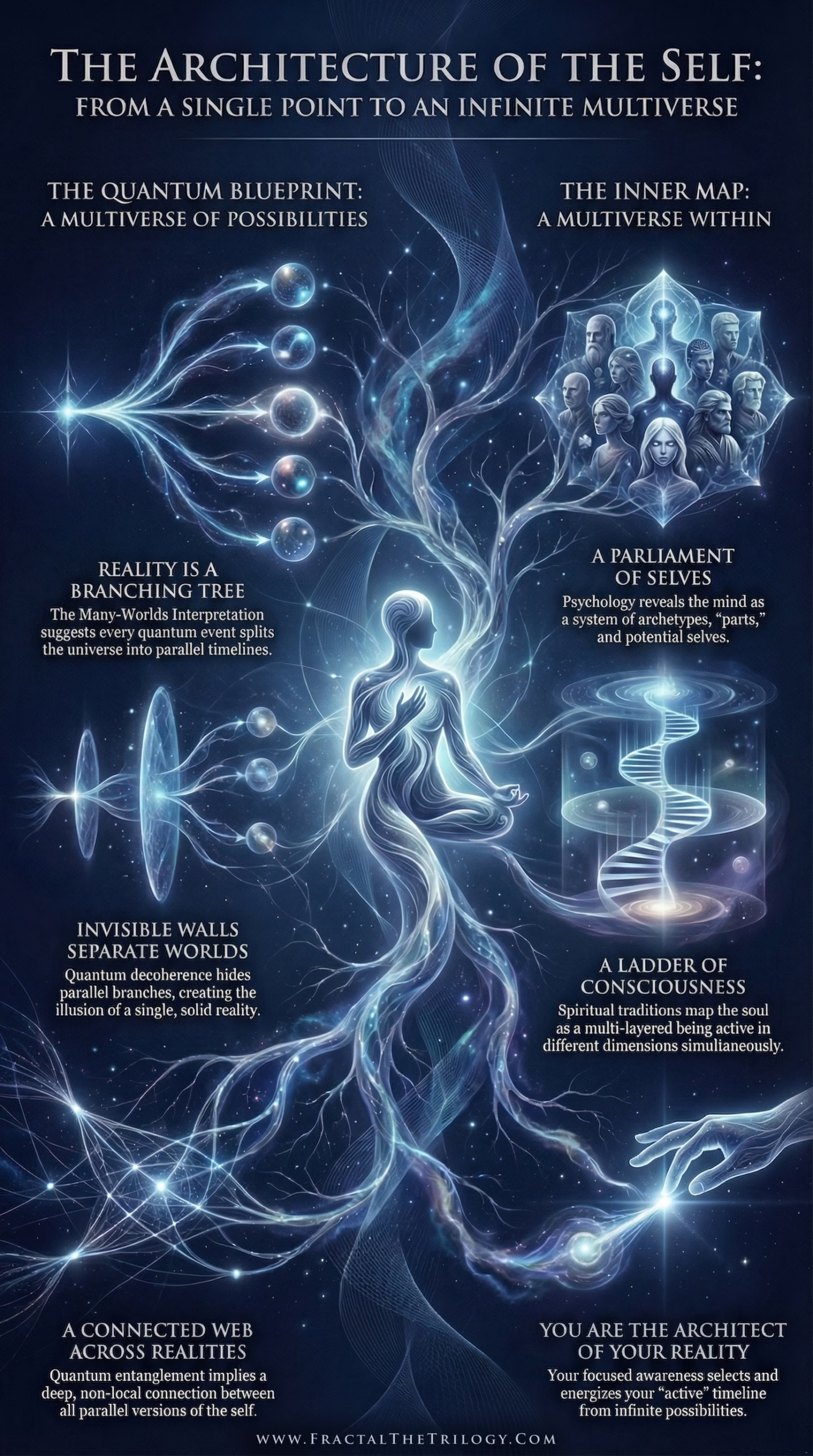
This implies that reality is a vast, branching structure—a “multiverse” of infinite diverging timelines. Every quantum event, every decision, every micro-interaction creates a new branch. Identity, in the MWI, is not a single thread but a tree. “You” are a colony of conscious organisms, inhabiting a vast probability space. This model removes the randomness and “action at a distance” that plagued classical quantum theory, replacing it with a deterministic, local, but infinitely multifaceted reality.2
1.2 Quantum Decoherence: The Wall Between Worlds
If there are infinite versions of us living out parallel lives—some where we are kings, others where we are beggars—why is our experience so stubbornly singular? Why do we not see the ghosts of our other selves? The answer lies in the phenomenon of quantum decoherence.
Decoherence is the mechanism by which the quantum system interacts with its environment—air molecules, photons, thermal radiation. This interaction causes the different terms of the superposition (the different branches) to lose their phase relationship. They become “entangled” with the environment in such a complex way that they can no longer interfere with one another.6
Think of a hologram. If you shine a coherent laser beam through it, you see a sharp image. If the light becomes scattered (incoherent), the image blurs and fades. Decoherence is the scattering of quantum information into the environment. It effectively “hides” the parallel branches from each other. It creates the appearance of wave function collapse without actual collapse occurring.6
Decoherence acts as the “membrane” described in Fractal – The Awakening—the barrier that separates timelines. It ensures that while the multiverse exists, we are trapped in a single, consistent history (a “quasi-classical domain”). However, this barrier is practical, not fundamental. The other branches are still there, just orthogonal to our current state vector. They are “parallel realities” in the truest sense—running alongside us, invisible but physically real, separated by the statistical irreversibility of thermodynamic interactions.6
1.3 Multiverse vs. Many-Minds Models
The implications of MWI for consciousness are profound and have led to a sub-theory known as the Many-Minds Interpretation. While Everett focused on the physical splitting of worlds, philosophers David Albert and Barry Loewer focused on the splitting of the mind.8
The Many-Minds view suggests that the physical state of the brain, like all matter, exists in a superposition. However, the mental state—the subjective experience of “I”—cannot be superposed. We never feel like we are seeing “spin up” AND “spin down” simultaneously. Therefore, Albert and Loewer proposed that every sentient physical brain is associated with an infinity of non-physical minds.8
When the physical brain branches via a quantum measurement, these minds differentiate. Each mind perceives a particular outcome. The “you” reading this sentence is just one of infinite minds associated with your physical body, traveling down one specific probabilistic path. This aligns eerily with the concept in The Oracle 2.0 of “Identity as Awareness” rather than form.1 It suggests that consciousness is a continuous field that “tunnels” through the branching structure of physical reality, creating the illusion of a single life from a manifold of possibilities.9
1.4 Quantum Branching and Probability Space
One of the fiercest debates in MWI is the “probability problem.” If everything happens, what does it mean to say that one outcome is more “probable” than another? If there is a version of you who wins the lottery and a version who doesn’t, and both are real, how do we calculate the odds?
Physicists like David Deutsch and Wallace have used decision theory to argue that rational agents in a splitting universe should essentially bet as if the Born Rule (standard quantum probabilities) holds true.10 This suggests that the “measure” of existence—the “weight” of a world—matters.
This “measure of existence” 4 can be metaphorically linked to the concept of “active timelines” in consciousness research. While all timelines exist, not all have equal “weight” or density. The timeline where you make consistent, coherent choices might have a higher “measure” (be more “real” or stable) than a timeline of chaotic entropy. This resonates with the idea in Fractal that the observer “collapses” or “selects” the reality they inhabit through the focus of their awareness.1 We are navigating a “probability space,” and our choices determine which branch carries the primary weight of our subjective continuity.11
1.5 Non-Locality & Entanglement as Clues
Perhaps the strongest physical evidence for a connected, multidimensional reality is quantum entanglement. When two particles interact, they become a single system. A measurement on one instantly determines the state of the other, even if they are light-years apart. Einstein called this “spooky action at a distance,” but modern physics accepts it as a fundamental feature of the universe.12
Entanglement implies that separation is an illusion. At the fundamental level, the universe is non-local; points A and B are not truly separate. If we apply this to the Many Worlds model, it suggests that the “you” in Branch A and the “you” in Branch B are entangled. Though decoherence prevents direct communication, the underlying quantum connection remains.14
This offers a physical mechanism for phenomena like intuition or synchronicities. Could a sudden, inexplicable urge to avoid a certain street be an “echo” from a parallel self who took that street and suffered? Could deep empathy be a form of entanglement with another conscious agent? The theory of “Parallel Lives” suggests that we are not isolated individuals but “hyper-dimensional objects” stretched across time, with entanglement serving as the nervous system of the collective self.15
2. Psychology & the Multidimensional Self
If physics provides the container for parallel realities, psychology describes the content. The human mind has never been a single, unified entity. It is a plurality, a choir of voices, a theater of conflicting desires and identities. Modern psychology, particularly in its depth and systemic forms, maps a “multiverse within” that mirrors the quantum multiverse without.
2.1 Jung’s Self and the Archetypal Multiverse
Carl Jung was the first modern cartographer of the multidimensional psyche. He recognized that the ego (the conscious “I”) is just one small island in a vast ocean of the unconscious. This ocean is populated by archetypes—universal, autonomous psychic structures that behave like separate personalities.17
The Shadow, the Anima/Animus, the Hero, the Wise Old Man—these are not just metaphors. To Jung, they were “complexes” with their own will, energy, and intent. They are, in a sense, parallel identities living within us. The Shadow contains the “unlived life”—the choices we rejected, the traits we suppressed. It is the repository of our parallel selves who made the “wrong” or “forbidden” choices.17
Jung’s concept of the Self (capital S) acts as the “supra-ordinate personality,” the center that encompasses both the conscious and unconscious. The goal of life, Individuation, is to integrate these fragmented parts into a coherent whole.18 Jung’s “Active Imagination”—a technique of entering a meditative state to dialogue with these inner figures—is essentially a method of inter-dimensional communication. When Jung conversed with Philemon (a figure in his psyche), he was treating an internal parallel self as a distinct, objective reality, bridging the gap between the ego and the multiverse of the unconscious.19
2.2 “Possible Selves” and the Simulation of Futures
In the domain of cognitive psychology, the theory of “Possible Selves” (Markus & Nurius, 1986) offers a pragmatic view of multidimensionality. This theory posits that our self-concept includes not just who we are, but who we might become, who we would like to become, and who we are afraid of becoming.21
These “possible selves” are cognitive bridges to the future. They are simulations. The brain is a prediction machine; it constantly runs scenarios of alternate timelines to guide decision-making.23 Neuroscience reveals that the Default Mode Network (DMN)—the brain system active when we are daydreaming or self-reflecting—is responsible for both remembering the past and simulating the future. This ability, known as chronesthesia or “mental time travel,” suggests that neurologically, a memory and a potential future are constructed of the same material.25
We are constantly inhabiting these simulations. When we worry, we are living in a “feared self” timeline. When we aspire, we are energizing an “ideal self” timeline. The brain does not distinguish strictly between “real” and “imagined” regarding emotional impact; imagining a stressful future triggers the same cortisol release as experiencing it. Thus, we are biologically living in multiple timelines simultaneously, with our physiological state determined by which “possible self” we are currently attending to.23
2.3 Dissociation, Multiplicity, and Internal Family Systems (IFS)
The model of Internal Family Systems (IFS) takes the idea of multiplicity and makes it the cornerstone of therapy. Developed by Richard Schwartz, IFS posits that the mind is not a unit but a system of discrete “parts” led by a core Self.28
These parts often take on rigid roles due to trauma:
- Exiles: Parts carrying pain, shame, or fear, locked in the past (trauma time). They are effectively “past selves” trapped in a parallel reality where the trauma is still happening.30
- Managers: Proactive protectors who try to control the environment to keep Exiles safe.
- Firefighters: Reactive protectors who distract (addiction, dissociation) when Exiles are triggered.
In the IFS framework, “unburdening” an Exile is remarkably similar to a quantum collapse or soul retrieval. The core Self (the observer) enters the scene of the trauma (the parallel timeline), witnesses the pain, and retrieves the part, bringing it into the “present”.32 This acknowledges that for the psyche, time is non-linear; the past is a parallel dimension that is accessible and modifiable through the power of witnessing.
Identity is thus “non-linear, multi-layered, and emerging through choices”.34 We are a collection of identities (“I am a mother,” “I am a professional,” “I am a scared child”) that switch dominance based on context. Health is not the elimination of these parts but their integration into a “self-led” system—a coherent superposition of all our potentials.35
2.4 The Brain as a Simulator of Versions
Neuroscience supports the view that the brain is a “reality simulator.” The predictive processing model suggests the brain hallucinates our conscious reality based on sensory inputs and prior expectations.23 It creates models of the “self-in-context.”
This implies that the “self” is a user interface—a construct created to navigate the world. We can construct multiple interfaces. The “work self” uses different neural pathways and behavioral scripts than the “home self.” This flexibility—self-complexity—is a marker of resilience. People with high self-complexity (many distinct self-aspects) are less prone to depression because a failure in one domain (one timeline) does not collapse the entire system.37
3. Spiritual Traditions on Multiple Selves
While science constructs models of the mind and universe, spiritual traditions have long offered maps of the soul that describe a multidimensional existence. These ancient cosmologies anticipated the modern discovery that we are not singular, biological accidents, but layered beings spanning multiple realms of reality.
3.1 Hinduism & Buddhism: The Trikaya and the Net of Indra
In Mahayana Buddhism, the Trikaya Doctrine (Three Bodies of the Buddha) provides a sophisticated template for multidimensional identity. It posits that an enlightened being exists simultaneously in three modes:
- Dharmakāya (Truth Body): The unmanifest, formless absolute. This is the “quantum vacuum” or “source code” of reality—pure potentiality without form.39
- Sambhogakāya (Enjoyment Body): The subtle body of light and energy. This is the realm of archetypes, visions, and high-frequency communication. It exists in a “celestial” parallel dimension.41
- Nirmāṇakāya (Emanation Body): The physical body that appears in time and space. This is the “collapsed wave function” visible to ordinary perception.42
Crucially, these are not separate entities but different frequencies of the same consciousness. We are all Trikaya beings, but we are asleep to the first two bodies, identifying only with the physical shell. The Net of Indra, a metaphor from the Avatamsaka Sutra, describes the universe as a web of jewels, where each jewel reflects all the other jewels.43 This is a perfect holographic model: every individual self contains the reflection of all other selves and the whole universe.
3.2 The Tibetan Bardo: Navigating the Gap
The Bardo Thodol (Tibetan Book of the Dead) describes the “bardos” as intermediate states of consciousness. While famously associated with the interval between death and rebirth, Tibetan teachings emphasize that we are always in a bardo.44
- The Bardo of Life: Ordinary waking consciousness.
- The Bardo of Dreaming: The parallel reality accessed during sleep.
- The Bardo of Meditation: The state of deep focus where the self dissolves.
In the death bardos (Chikhai, Chonyid, Sidpa), consciousness becomes fluid. Reality creates itself instantly based on the mind’s projections. Fear manifests as wrathful deities; love as peaceful ones. This describes a “participatory universe” where the observer creates the reality layer instantly.45 Navigating the bardo requires realizing that the terrifying or beautiful visions are “mind-made”—projections of one’s own multidimensional identity. This parallels the quantum concept that the observer is inextricable from the observed.
3.3 Kabbalah: The Five Levels of Soul
Jewish mysticism, specifically Kabbalah, maps the soul not as a monolith but as a five-layered structure, anchoring the human being in multiple dimensions simultaneously.46
- Nefesh (Biological Life): The “animal soul” associated with instincts, bodily functions, and the physical world (Assiyah). This is the local, biological self.
- Ruach (Spirit/Emotion): The emotional and moral seat of the personality (Yetzirah). It bridges the lower and higher selves.
- Neshama (Intellect/Breath): The higher intellect and intuitive connection to the Divine (Beriah). This is the first level of the “transpersonal” self.
- Chaya (Living Essence): The transcendent life force that exists beyond the body (Atzilut). It is the “observer” that is aware of the collective.
- Yechida (Singularity): The spark of God-consciousness, the point of absolute unity where the individual merges with the Infinite (Adam Kadmon).48
This structure implies that we are “identity stretched across timelines.” While our conscious attention may be focused on the Nefesh reality (paying bills, eating), our Neshama and Chaya are simultaneously active in higher dimensional realms, processing information and influencing our “active timeline” through intuition.50
3.4 Shamanism: The Walker Between Worlds
Shamanic cosmologies universally describe a “multiverse” consisting of at least three worlds: the Lower World, Middle World, and Upper World.51 These are not symbolic; they are accessible, parallel realities.
Soul Retrieval is a key shamanic practice that addresses the fragmentation of the self. When a trauma occurs, a part of the soul (vital essence) “flees” to a parallel reality (often a safe haven in the Lower or Upper World) to survive. The person is left with “soul loss”—disassociated, depressed, incomplete. The shaman enters an altered state (the “flight of the soul”) to travel to that non-local timeline, negotiate with the keepers of that realm, and bring the soul part back.53
This practice suggests that parallel lives are not just theoretical branches but “holding spaces” for our fragmented consciousness. Healing is the act of collapsing these separated parts back into a unified “Here and Now.”
3.5 The Ancient Greek Daimon
Heraclitus famously stated, “Character is destiny,” but a more literal translation is “Character is for man his daimon”.54 In Greek thought, the daimon was a guiding spirit, a divine counterpart assigned to each soul before birth.55
Plato, in the Myth of Er, describes the soul choosing its life pattern (destiny) before birth, which the daimon then ensures is fulfilled. The daimon can be interpreted as a “Higher Self” or a “Parallel Self” that exists outside linear time, holding the blueprint of our potential. Socrates spoke of his daimonion as an inner voice that warned him against wrong actions.56 This relationship represents the dialogue between the linear, local ego and the non-local, multidimensional self that sees the broader tapestry of fate.
4. Parallel Lives as a Metaphor for Consciousness Evolution
The concept of parallel lives is not just a description of external reality; it is a powerful metaphor for the internal evolution of consciousness. The multiverse is the landscape; choice is the vehicle.
4.1 Unlived Potentials and the Shadow
We are haunted by our “unlived lives”—the choices we didn’t make, the careers we abandoned, the lovers we left. Jungian analyst Robert Johnson argues that these unlived potentials don’t vanish; they reside in the unconscious, demanding energy.57
In a multidimensional framework, these are not “dead” branches. They are parallel streams of energy. The “you” that became a musician instead of an accountant is a live frequency within your total self. When we feel regret, we are resonating with that timeline. Consciousness evolution requires us to integrate these “unlived selves”—not by physically acting them out, but by acknowledging their energy and allowing it to inform our present. We can “download” the creativity of our artist-self without abandoning our current life.58
4.2 Choice and the Collapse of Probability
If reality is a wave function of infinite possibilities, choice is the mechanism of collapse. Every conscious intention selects a timeline. We are constantly steering through the “multiverse of the mind.”
Passive living creates a “drift,” where we are carried by the momentum of past choices (karma/habit). Active, conscious choice breaks the loop. By observing our own thoughts and reactions (the “Witness” perspective), we step out of the deterministic stream and regain the power to select a new branch.59 The “active timeline” is simply the one receiving the most voltage from our attention.24
4.3 Intuition as Parallel Processing
Intuition can be reframed as “entanglement information.” If our brains operate as quantum devices (Orch OR), intuition may be the leakage of data from parallel timelines.60
A sudden “bad feeling” about a decision might be the psychic echo of a parallel self who took that path and suffered. A flash of “déjà vu” might be a moment of synchronization where two timelines overlap.61 This view transforms intuition from a mystical guess into a “data packet” from the wider network of our multidimensional identity.
4.4 The Fractal Self
The ultimate metaphor is the Fractal. A fractal is a self-similar pattern that repeats at every scale. If the universe is a fractal, then the individual is not a part of the universe, but a reflection of it. “As above, so below.”
This means our internal struggles mirror cosmic struggles; our personal evolution contributes to universal evolution. We are “recursive” beings.62 The “Self” is a fractal iteration of the “Source.” To heal the part is to heal the whole.
5. Fractal Universe Connection (Fractal – The Awakening + The Oracle 2.0)
The theoretical framework of this report is brought to life by the narrative “lore” of Fractal – The Awakening and the wisdom teachings of The Oracle 2.0. These texts serve as a contemporary mythology for the multidimensional age.
5.1 Themes from Fractal – The Awakening
The protagonist, Elias Chronis, is the archetype of the “Seeker of the Fractal.” His journey to Mount Kailash is not merely physical; it is a descent into the structure of reality.
- The Projection of Awakening: Elias is told, “The mountain isn’t just Kailash. It’s the projection of our own awakening”.1 This encapsulates the “Holographic Universe” theory: the external world is a projection of internal consciousness.
- Hyper-Dimensional Echoes: Characters like the Mentor (Alessandro) and the Antagonist (The Guardians of Truth) are portrayed as “hyper-dimensional echoes.” They represent not just individuals, but recurring consciousness fields—archetypal forces (The Sage, The Shadow) that re-enact cosmic dramas through human avatars across history.1
- Identity Stretched Across Membranes: The narrative explores the “war for the fractal,” which is a battle over which timeline humanity will inhabit. Identity is described as being “stretched across multiple timelines/membranes,” implying that the “Self” is a non-local entity anchored in multiple realities simultaneously.
- Fractal Memory: Memory is revealed to be “not linear but fractal and simultaneous”.1 The “Archives” in the story hold “the reflection of timelines,” suggesting that the past is not gone but is a parallel layer of the present, accessible to those who can tune their consciousness to the right frequency.1
5.2 Themes from The Oracle 2.0
The Oracle 2.0 serves as the philosophical “codex” for this worldview, offering axioms that bridge code and consciousness.
- Identity as Awareness: The text asserts: “You Are Not Your Thoughts,” “The Observer Within,” and “The Illusion of Identity”.1 It defines the true identity not as the “form” (the body/ego) but as the “Awareness” or “Witness” that observes the form.
- Information That Creates Itself: The text alludes to reality as “Information that creates itself” and describes “Consciousness Is the Architect”.1 This mirrors John Wheeler’s “It from Bit”—the universe is a self-generating information system where “The Mind Reflects. Consciousness Creates”.1
- Observerhood and Reality Layers: Key teachings include “Presence Bends the World” and “Reality Responds to Coherence”.1 This is a direct application of the observer effect: the quality of the observer’s consciousness (coherence) determines the quality of the reality layer they encounter. We create our “reality layer” through the act of observation.1
- Recursive Existence: Titles like “The Dream Within the Dream” and “The Spiral is the Signature” point to a recursive ontology. Reality is a nested hierarchy of dreams, and awakening is the process of becoming “lucid” within the current level of the simulation.1
6. The Bridge Between Science & Spirituality
The historical chasm between science (matter) and spirituality (mind) is closing. New theories are forging a bridge built on information, consciousness, and geometry.
6.1 Panpsychism and Cosmopsychism
The materialist view—that consciousness is a random byproduct of dead matter—is failing to solve the “Hard Problem” of consciousness. In response, science is revisiting Panpsychism: the view that consciousness is a fundamental property of the universe, like mass or charge.63
Cosmopsychism goes further, suggesting the Universe as a whole is the fundamental conscious entity, and individual minds are “dissociated alters” of this cosmic mind.64 This aligns perfectly with The Oracle 2.0’s teaching that “Consciousness Connects All Things” and “There Is a Mind Beyond the Mind”.1 We are not generating consciousness; we are antennas tuning into a cosmic field.66
6.2 Reality as Information (It from Bit)
John Wheeler, the giant of 20th-century physics, proposed “It from Bit”—the idea that every physical “it” (particle, field) derives its existence from abstract “bits” of information elicited by yes/no questions (measurements).67 Reality is fundamentally informational.
Cognitive scientist Donald Hoffman takes this further with his Interface Theory of Perception. He argues that space-time and physical objects are not reality; they are a “desktop interface” (icons) designed by evolution to hide the complex truth of “conscious agents”.69 This validates the spiritual concept of Maya (illusion): the world we see is a user interface for the soul. We are multidimensional agents interacting through a VR headset called “the brain.”
6.3 The Holographic and Fractal Models
David Bohm’s theory of the Implicate Order posits that the entire universe is enfolded into every part of itself, like a hologram.71
The Fractal metaphor used in the Awakening trilogy is the geometric expression of this truth. A fractal is self-similar at all scales. If the universe is a fractal, then the “Multidimensional Self” is simply the realization that the specific “you” is a unique iteration of the total “I.” You contain the map of the whole.
7. Practical Implications for Readers
This knowledge is not just for philosophers; it is actionable. By adopting a multidimensional mindset, we can transform how we live, choose, and create.
7.1 Enhancing Decision-Making via “The Council”
Instead of agonizing over a decision alone, convene a “Council of Possible Selves.”
- Protocol: Close your eyes. Visualize a table. Invite your “Future Self” (who has already solved this problem), your “Risk-Taking Self,” and your “Wise/Compassionate Self.” Ask them for advice. This utilizes the brain’s simulation network to access latent wisdom and broader perspectives.73
- Timeline Selection: Visualize the decision as a branching path. “Feel into” Timeline A. Does it feel expansive or constrictive? “Feel into” Timeline B. Choose the timeline that resonates with coherence, not just logic.74
7.2 Enhancing Creativity and Intuition
- The Muse as Parallel Self: Reframe creative blocks. You are not trying to “invent” something from nothing; you are trying to “tune in” to a parallel reality where the book is already written, the song already composed. You are “downloading” from the fractal field.
- Quantum Jumping: Use visualization to “jump” into the frequency of a version of you who is already successful/creative/healed. Borrow their energy and feeling-state, and bring it back to your current “now”.75
7.3 Exercises for Integrating Identity Layers
- Journaling from Perspectives: Write a journal entry from the perspective of your “Shadow” (the part you hide). Then write one from your “Highest Self.” This integrates the fragmented layers of identity, reducing the energy cost of repression.77
- The “Who Am I?” Meditation: (From The Oracle 2.0 / Psychosynthesis) Sit quietly. Ask “Who am I?” Answer with a label (“I am a teacher”). Then say, “I have a job, but I am not my job.” “I have thoughts, but I am not my thoughts.” Peel away the layers until you rest in the pure, nameless Observer.79
- Mirror Work: Look into your eyes in a mirror. Soften your gaze. Ask, “Who is looking?” Feel the “Observer” separate from the “Image.” Acknowledge the multitude of ancestors and potential selves living in that gaze.81
FAQ (People Also Ask)
- Is the multidimensional self real?
- While scientifically theoretical (via the Many Worlds Interpretation) and psychologically metaphorical (via IFS and archetypes), the concept of a multidimensional self provides a robust framework for understanding the complexity of human consciousness and identity.
- How can I connect with my parallel selves?
- Techniques like Jungian Active Imagination, “Best Possible Self” visualization, and deep meditation can help you access the wisdom and perspectives of your latent or potential identities.
- What is the difference between the soul and the self?
- In many traditions (like Kabbalah and Trikaya), the “self” is the constructed identity navigating a specific timeline (ego/Nefesh), while the “soul” (or Awareness/Chaya) is the non-local observer that exists across all dimensions and timelines.
- Does quantum physics prove spirituality?
- Quantum physics dismantles the materialist view of a dead, separate universe. While it doesn’t “prove” specific religious dogmas, concepts like entanglement, non-locality, and the observer effect offer strong scientific parallels to spiritual truths about unity and the power of consciousness.
Conclusion
The journey through the science and spirituality of parallel lives reveals a stunning symmetry. The physicist peering into the atom finds a branching multiverse; the psychologist looking into the psyche finds a parliament of selves; the mystic diving into the soul finds a ladder of dimensions.
We are not solitary points on a line. We are the Fractal—a self-similar pattern repeating across the infinite scales of existence. Elias’s journey in The Awakening is our journey: to realize that the mountain is not outside us, but a projection of our own awakening. To accept that “Information creates itself” and that “Identity is Awareness” is to take the controls of the simulation.
By integrating our shadows, honoring our parallel potentials, and centering ourselves in the witness consciousness, we become whole. We stop being lost in the movie and remember we are the screen, the projector, and the light. The multiverse is not out there—it is in you.
Works cited
- FRACTAL – THE AWAKENING
- Many-worlds interpretation – Wikipedia, accessed December 11, 2025, https://en.wikipedia.org/wiki/Many-worlds_interpretation
- The Many- Worlds Interpreta tion of Quantum Mechanics, accessed December 11, 2025, https://cqi.inf.usi.ch/qic/everett_phd.pdf
- Many-Worlds Interpretation of Quantum Mechanics – Stanford Encyclopedia of Philosophy, accessed December 11, 2025, https://plato.stanford.edu/entries/qm-manyworlds/
- Everettian Interpretations of Quantum Mechanics – Internet Encyclopedia of Philosophy, accessed December 11, 2025, https://iep.utm.edu/everett/
- How Decoherence Splits The Quantum Multiverse – YouTube, accessed December 11, 2025, https://www.youtube.com/watch?v=GlOwJWJWPUs
- Quantum Multiverse: A Journey Beyond Our Universe | by Monalisa Q. (PhD) – Medium, accessed December 11, 2025, https://medium.com/quriosity/exploring-the-quantum-multiverse-a-journey-beyond-our-universe-7e0ebb503939
- Many-minds interpretation – Wikipedia, accessed December 11, 2025, https://en.wikipedia.org/wiki/Many-minds_interpretation
- (PDF) Locality and Mentality in Everett Interpretations I: Albert and Loewer’s Many Minds, accessed December 11, 2025, https://www.researchgate.net/publication/262893060_Locality_and_Mentality_in_Everett_Interpretations_I_Albert_and_Loewer’s_Many_Minds
- Why Probability in Quantum Mechanics is Given by the Wave Function Squared – Sean Carroll, accessed December 11, 2025, https://www.preposterousuniverse.com/blog/2014/07/24/why-probability-in-quantum-mechanics-is-given-by-the-wave-function-squared/comment-page-4/
- Branch-counting in the Everett interpretation of quantum mechanics† Simon Saunders – arXiv, accessed December 11, 2025, https://arxiv.org/pdf/2201.06087
- Entanglement – Microsoft Quantum, accessed December 11, 2025, https://quantum.microsoft.com/en-us/insights/education/concepts/entanglement
- Quantum entanglement – Wikipedia, accessed December 11, 2025, https://en.wikipedia.org/wiki/Quantum_entanglement
- Quantum Nonlocality – PMC – NIH, accessed December 11, 2025, https://pmc.ncbi.nlm.nih.gov/articles/PMC7514936/
- Quantum Entanglement and Nonlocality: Challenging the Local Realism of Classical Physics – Semantic Scholar, accessed December 11, 2025, https://pdfs.semanticscholar.org/9e4a/f8bf0bd4b77f89be1eb16f048df13e1e008f.pdf
- How a Many Worlds Interpretation of Quantum Mechanics Provides an Argument for the Concept of a”Higher Self”* : r/consciousness – Reddit, accessed December 11, 2025, https://www.reddit.com/r/consciousness/comments/1na92r4/how_a_many_worlds_interpretation_of_quantum/
- Jungian archetypes – Wikipedia, accessed December 11, 2025, https://en.wikipedia.org/wiki/Jungian_archetypes
- 12 Jungian Archetypes: The Foundation of Personality – PositivePsychology.com, accessed December 11, 2025, https://positivepsychology.com/jungian-archetypes/
- Active imagination – Wikipedia, accessed December 11, 2025, https://en.wikipedia.org/wiki/Active_imagination
- Active Imagination – International Association of Analytical Psychology – IAAP, accessed December 11, 2025, https://iaap.org/jung-analytical-psychology/short-articles-on-analytical-psychology/active-imagination-2/
- Possible Selves – Villiers Park, accessed December 11, 2025, https://www.villierspark.org.uk/possible-selves
- Possible Selves Theory – USC Dornsife, accessed December 11, 2025, https://dornsife.usc.edu/daphna-oyserman/wp-content/uploads/sites/232/2023/11/lee_and_oyserman_possible_selves_theory___education.pdf
- The Brain as a Prediction Machine: The Key to the Self? | Psychology Today, accessed December 11, 2025, https://www.psychologytoday.com/us/blog/finding-purpose/202201/the-brain-prediction-machine-the-key-the-self
- From possible selves and future selves to current action: An integrated review and identity-based motivation synthesis – USC Dornsife, accessed December 11, 2025, https://dornsife.usc.edu/daphna-oyserman/wp-content/uploads/sites/232/2023/11/Oyserman_and_Horowitz_Advances_in_Motivation_Science.pdf
- The Future of Memory: Remembering, Imagining, and the Brain – PMC – NIH, accessed December 11, 2025, https://pmc.ncbi.nlm.nih.gov/articles/PMC3815616/
- Consciousness of subjective time in the brain – PMC – NIH, accessed December 11, 2025, https://pmc.ncbi.nlm.nih.gov/articles/PMC3009795/
- Mental time travel – Wikipedia, accessed December 11, 2025, https://en.wikipedia.org/wiki/Mental_time_travel
- Internal Family Systems Therapy | Psychology Today, accessed December 11, 2025, https://www.psychologytoday.com/us/therapy-types/internal-family-systems-therapy
- IFS Institute: What is Internal Family Systems?, accessed December 11, 2025, https://ifs-institute.com/
- Internal Family Systems Model – Wikipedia, accessed December 11, 2025, https://en.wikipedia.org/wiki/Internal_Family_Systems_Model
- Understanding Exile Parts in Internal Family Systems (IFS) – Foster Counseling, accessed December 11, 2025, https://www.fostercounseling.org/resources-and-blog/understanding-exile-parts-in-internal-family-systems-ifs
- Unburdening Exiles: A Detailed Guide – IFS Guide, accessed December 11, 2025, https://ifsguide.com/unburdening-exiles-a-detailed-guide/
- The Steps of the IFS-Approach. This article covers the steps of the… | by Lucas Forstmeyer, accessed December 11, 2025, https://medium.com/@lucasforstmeyer/the-steps-of-the-ifs-approach-8ffafcb2f12f
- Identities: A developmental social-psychological perspective – PMC – PubMed Central, accessed December 11, 2025, https://pmc.ncbi.nlm.nih.gov/articles/PMC10950040/
- Autobiographical Memory, Narrative Identity, and Mental Health | Frontiers Research Topic, accessed December 11, 2025, https://www.frontiersin.org/research-topics/13710/autobiographical-memory-narrative-identity-and-mental-health/magazine
- Meeting the multidimensional self: fostering selfhood at the interface of Creative Arts Therapies and neuroscience – PMC – PubMed Central, accessed December 11, 2025, https://pmc.ncbi.nlm.nih.gov/articles/PMC11461312/
- Cultivating Self-Complexity: Nuanced Identity For Resilience And Success – Aretha Boex, accessed December 11, 2025, https://www.arethaboex.com/cultivating-self-complexity-for-resilience-and-success/
- Navigating Self Complexity: Embracing Our Multifaceted Nature – Psychology Fanatic, accessed December 11, 2025, https://psychologyfanatic.com/self-complexity/
- Trikaya – Grokipedia, accessed December 11, 2025, https://grokipedia.com/page/Trikaya
- Trikaya – Wikipedia, accessed December 11, 2025, https://en.wikipedia.org/wiki/Trikaya
- 300 – One Reality, Many Descriptions Part 5: Trikaya, the Three Bodies of Buddha, accessed December 11, 2025, https://zenstudiespodcast.com/trikaya-three-bodies-of-buddha/
- 2. The Trikāya Doctrine – A ‘Middle Way’ Model of Mind | Mandala of Love, accessed December 11, 2025, https://mandala-of-love.com/2024/01/04/2-the-trikaya-doctrine-a-middle-way-model-of-mind/
- Mindful Mechanisms: Drawing Parallels Between the Quantum Domain and the Three Bodies (Trikaya) of Buddhist Ontology – Article (Preprint v1) by David Leong | Qeios, accessed December 11, 2025, https://www.qeios.com/read/698WTS
- Bardo | Lion’s Roar, accessed December 11, 2025, https://www.lionsroar.com/buddhism/bardo/
- Digital Bardo: Reimagining the Tibetan Book of the Dead in Virtual Identity and Consciousness Transformation – MDPI, accessed December 11, 2025, https://www.mdpi.com/2077-1444/16/10/1276
- Soul « Ask! « – Ohr Somayach, accessed December 11, 2025, https://ohr.edu/744
- The Five-Layered Soul: What Ancient Jewish Wisdom Reveals About Human Consciousness | by Shiphra Tang | Medium, accessed December 11, 2025, https://medium.com/@tangjie_41782/the-five-layered-soul-what-ancient-jewish-wisdom-reveals-about-human-consciousness-993d51f55ccf
- The Jewish Home: Chapter 5 – Five Levels of the Soul – An Inverted Seal – GalEinai, accessed December 11, 2025, https://inner.org/jewhome/jewhome5.htm
- Meaning of Five | Nefesh | Ruach | Neshamah | Chayah | Yechidah – Ohr Chadash, accessed December 11, 2025, https://thetrugmans.com/the-meaning-of-five/
- Neshamah: Levels of Soul Consciousness – The divine soul involves five ascending levels of consciousness – Chabad.org, accessed December 11, 2025, https://www.chabad.org/kabbalah/article_cdo/aid/380651/jewish/Neshamah-Levels-of-Soul-Consciousness.htm
- Article Soul Retrieval – Scandinavian Center for Shamanic Studies, accessed December 11, 2025, https://www.shamanism.dk/article-soul-retrieval
- Shamanism and the Multiverse – The Pitt Pulse, accessed December 11, 2025, http://www.thepittpulse.org/shamanism-and-the-multiverse
- From “mind–matter” duality to “body–situation” mechanism —the phenomenology of the body on how shaman soul retrieval heals the sick – NIH, accessed December 11, 2025, https://pmc.ncbi.nlm.nih.gov/articles/PMC12502434/
- Heraclitus – Stanford Encyclopedia of Philosophy, accessed December 11, 2025, https://plato.stanford.edu/entries/heraclitus/
- Daimon – Wikipedia, accessed December 11, 2025, https://en.wikipedia.org/wiki/Daimon
- Daimonion (Socrates) – Wikipedia, accessed December 11, 2025, https://en.wikipedia.org/wiki/Daimonion_(Socrates)
- Coping with Unrealized Dreams and Fulfilling Your Purpose in the Second Half of Life, accessed December 11, 2025, https://api.pageplace.de/preview/DT0400.9781101216187_A24473705/preview-9781101216187_A24473705.epub
- The Unlived Life Will haunt You – This One Question Will Help You Find Meaning : r/Jung, accessed December 11, 2025, https://www.reddit.com/r/Jung/comments/1lgvfsm/the_unlived_life_will_haunt_you_this_one_question/
- Create an Anxiety Timeline – Wayfinder Wellness, accessed December 11, 2025, https://www.talkwithwayfinder.com/skills/anxiety-timeline
- The Many Selves in the Quantum Multiverse: From Seth to Everett and Beyond – Medium, accessed December 11, 2025, https://medium.com/@nahudini/the-many-selves-in-the-quantum-multiverse-from-seth-to-everett-and-beyond-f3e6a7b87a3c
- Quantum Physics and the Multiverse: A Layperson’s Guide to Parallel Realities – YouTube, accessed December 11, 2025, https://www.youtube.com/watch?v=r2wLGAI3uYo
- Consciousness, Reality, and the Infinite Fractal: The Theory of Everything – Reddit, accessed December 11, 2025, https://www.reddit.com/r/Metaphysics/comments/1ifwa8o/consciousness_reality_and_the_infinite_fractal/
- Panpsychism – Wikipedia, accessed December 11, 2025, https://en.wikipedia.org/wiki/Panpsychism
- Panpsychism (Stanford Encyclopedia of Philosophy/Spring 2018 Edition), accessed December 11, 2025, https://plato.stanford.edu/archives/spr2018/entries/panpsychism/
- Modern science has lost its mind We can’t dismiss AI consciousness – UnHerd, accessed December 11, 2025, https://unherd.com/2025/06/modern-science-lost-its-mind/
- According to New Physics Model, Consciousness Underlies the Universe – Evolution News, accessed December 11, 2025, https://scienceandculture.com/2025/12/according-to-new-physics-model-consciousness-underlies-the-universe/
- Understanding Wheeler’s “It from Bit” Concept | by Myk Eff | Quantum Psychology, Biology and Engineering | Medium, accessed December 11, 2025, https://medium.com/quantum-psychology-and-engineering/understanding-wheelers-it-from-bit-concept-0cebe5563607
- It from Bit: Pioneering Physicist John Archibald Wheeler on Information, the Nature of Reality, and Why We Live in a Participatory Universe – The Marginalian, accessed December 11, 2025, https://www.themarginalian.org/2016/09/02/it-from-bit-wheeler/
- Donald Hoffman’s Concepts Simplified: Understanding Reality and Perception – Brad Hook, accessed December 11, 2025, https://bradleyhook.com/donald-hoffmans-concepts-simplified-understanding-reality-and-perception/
- The Interface Theory of Perception – UC Irvine, accessed December 11, 2025, https://sites.socsci.uci.edu/~ddhoff/Hoffman-Stevens-Handbook.pdf
- Implicate and explicate order – Wikipedia, accessed December 11, 2025, https://en.wikipedia.org/wiki/Implicate_and_explicate_order
- Part 1 – David Bohm & the Holographic Universe – Cosmic Core, accessed December 11, 2025, https://www.cosmic-core.org/free/article-134-the-holographic-universe-part-1-david-bohm-the-holographic-universe/
- Best Possible Self | Practice | Greater Good in Action, accessed December 11, 2025, https://ggia.berkeley.edu/practice/best_possible_self
- Mastering the Art of Reality Shifting: How to Use Parallel Realities for Manifestation ♀️ | by Sneha | Medium, accessed December 11, 2025, https://snehagm1207.medium.com/mastering-the-art-of-reality-shifting-how-to-use-parallel-realities-for-manifestation-%EF%B8%8F-f63fe478ef7f
- Quantum Jumping Meditation – H. Michelle Gregory LLC, accessed December 11, 2025, https://hmichellegregoryllc.com/quantum-jumping-meditation/
- Quantum Jumping by Burt Goldman | Mindvalley, accessed December 11, 2025, https://www.mindvalley.com/quantum
- Best Possible Future Selves Exercise – Caroline Adams Miller, accessed December 11, 2025, https://www.carolinemiller.com/info/Best_Possible_Future_Selves_Exercise.pdf
- How Narrative Therapy Strengthens Identity And Self-Compassion – Counseling Now, accessed December 11, 2025, https://counselingnow.com/how-narrative-therapy-strengthens-identity-and-self-compassion/
- Psychosynthesis: A Foundational Bridge Between Psychology and Spirituality – PMC, accessed December 11, 2025, https://pmc.ncbi.nlm.nih.gov/articles/PMC5493721/
- Psychosynthesis Exercises for Personal & Spiritual Growth, accessed December 11, 2025, https://psychosynthesistrust.org.uk/psychosynthesis-exercises-for-personal-spiritual-growth-5/
- How does Tegmark’s Mathematical Universe Hypothesis account for consciousness and qualia? – Reddit, accessed December 11, 2025, https://www.reddit.com/r/consciousness/comments/1mss77g/how_does_tegmarks_mathematical_universe/