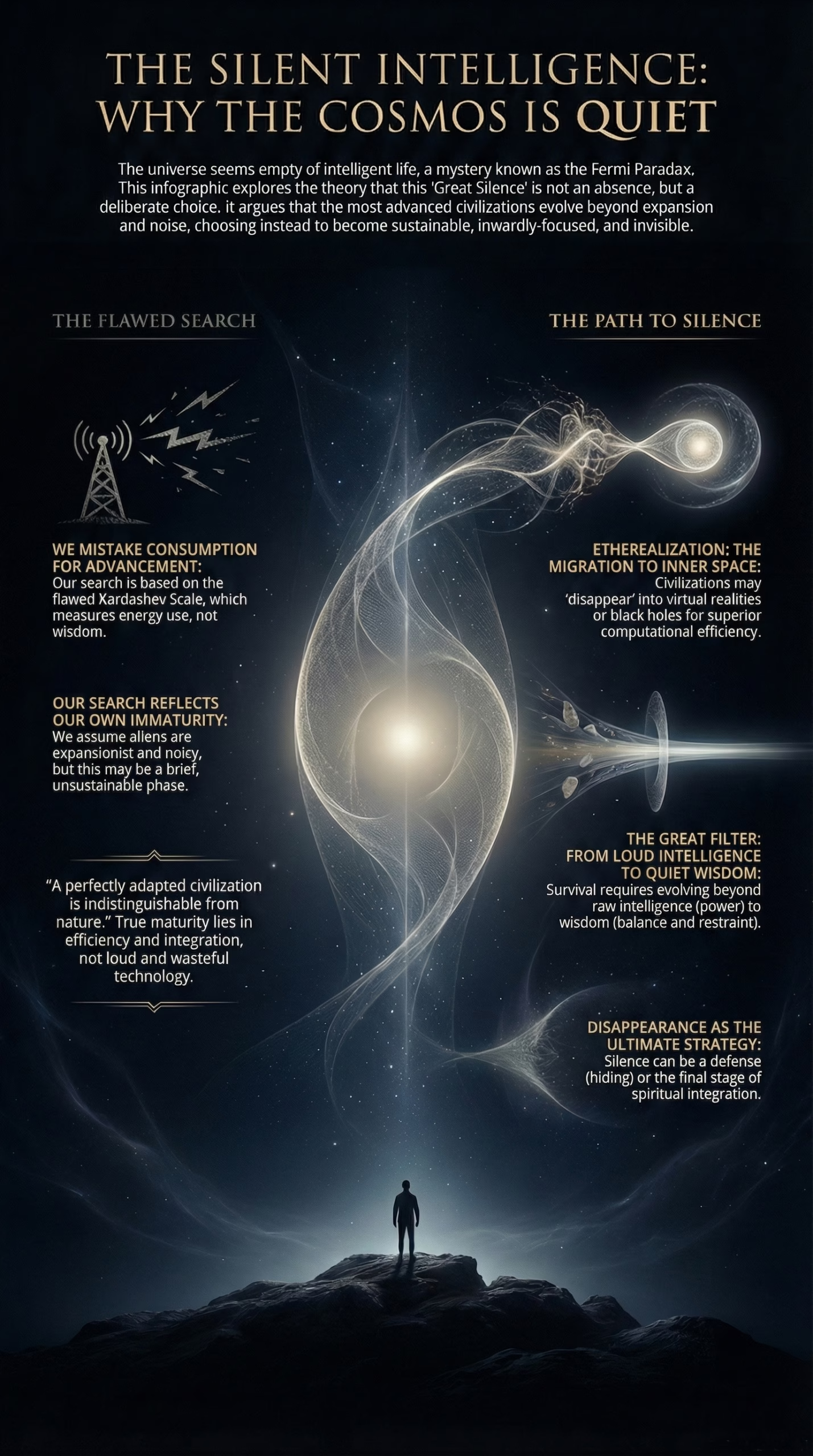

PODCAST: The Silent Intelligence
Abstract
The cosmos presents a haunting paradox: it is statistically teeming with the potential for life, yet observationally devoid of technological signatures. This discrepancy, known as the Fermi Paradox, has traditionally been interpreted through a lens of failure—suggesting that advanced civilizations inevitably destroy themselves or are vanishingly rare. However, a synthesis of advanced astrobiological theory, thermodynamic computation models, and perennial philosophical wisdom suggests a different trajectory. This report posits that the absence of observable extraterrestrial civilizations is not a sign of their extinction, but of their maturation. We argue that true evolutionary advancement inevitably leads to a trajectory of “etherealization”—a transition from expansionist, high-entropy existence to minimalist, low-entropy invisibility. By examining the “Sustainability Solution,” the “Transcension Hypothesis,” and the metaphysical frameworks of Fractal – The Awakening and The Oracle 2.0, we demonstrate that the ultimate destiny of intelligence is not to conquer the universe, but to disappear into it. The transition from Intelligence (the capacity to manipulate the external) to Wisdom (the capacity to align with the internal) acts as the Great Filter, ensuring that only the silent survive.
Part I: The Paradox of Noise – Deconstructing the Expansionist Dogma
The silence of the night sky is the heaviest sound in the universe. For seventy years, since Enrico Fermi first asked his famous question during a lunch at Los Alamos, humanity has scanned the stars for the electromagnetic leakage of neighbors we assume must be there.1 Our failure to detect them—the “Great Silence”—has generated a crisis in our understanding of our place in the cosmos. However, this crisis is born not from the data itself, but from the anthropocentric assumptions we project onto that data. We assume that “advanced” means “loud.” We assume that a mature civilization behaves exactly like 20th-century humanity, only on a larger scale: consuming more energy, building larger structures, and broadcasting its existence with the desperate vanity of a species seeking validation.
1.1 The Flawed Metric of the Kardashev Scale
The primary intellectual framework guiding the Search for Extraterrestrial Intelligence (SETI) has been the Kardashev Scale, which categorizes civilizations based on their energy consumption. A Type I civilization harnesses the energy of its planet; Type II, its star; Type III, its galaxy.3 This scale is fundamentally an expansionist metric. It equates success with consumption and visibility with power. It assumes that the trajectory of intelligent life is linear and rapacious—that a civilization will inevitably encase its star in a Dyson sphere, blotting out the natural light to fuel its digital appetites.3
Under this framework, the Fermi Paradox is indeed baffling. If the galaxy is billions of years old, and if interstellar travel is even remotely possible (even at sub-light speeds), a single expansionist civilization should have colonized the Milky Way within a few million years—a cosmic blink of an eye.1 The fact that we do not see Dyson spheres or galactic empires suggests, to the expansionist mindset, that such civilizations do not exist.
However, this conclusion relies on the “Mediocrity Principle”—the idea that human behavior is typical of intelligent life.1 But human behavior, specifically the industrial expansionism of the last three centuries, may be an anomaly or a brief, unstable developmental phase. The Kardashev Scale measures technological capacity, not civilizational maturity. It fails to account for the efficiency of advanced systems. A perfectly efficient engine generates no waste heat. A perfectly encrypted signal looks like random noise. A perfectly adapted civilization is indistinguishable from nature. The absence of Type III civilizations is not evidence of a sterile universe; it is evidence that mature intelligences do not behave like cancer cells, consuming their host until collapse.3
1.2 The Sustainability Solution
A more robust resolution to the paradox is found in the “Sustainability Solution,” proposed by researchers Jacob Haqq-Misra and Seth Baum.4 This hypothesis posits that exponential growth—the engine of the Kardashev model—is not a sustainable development pattern for intelligent civilizations on a galactic scale.
On Earth, we have learned that exponential population and economic growth quickly hit the hard limits of carrying capacity, leading to ecological degradation and resource wars. It is logical to assume that this is a universal law. Any civilization that attempts to expand exponentially into the galaxy will encounter the “tyranny of distance” and the finiteness of resources relative to the energy cost of interstellar transport.2
Therefore, the only civilizations that survive long enough to become truly “advanced” (lasting millions or billions of years) are those that have transitioned from exponential growth to logistic growth.4 They adopt steady-state economies and population dynamics that remain within the carrying capacity of their environment.
Growth Model | Characteristics | Observable Signature | Longevity |
Exponential (Type I-III) | Rapid expansion, high resource consumption, aggressive colonization. | High visibility (Dyson spheres, radio leakage), Waste heat. | Short (Self-termination via collapse or exhaustion). |
Logistic (Sustainable) | Steady-state population, homeostatic resource use, limits to growth. | Low visibility (blends with background), Minimal waste emissions. | Long (Potentially geologic/cosmic timescales). |
The table above illustrates the core divergence. The “loud” civilizations—those visible to our current SETI instruments—are inherently unstable. They burn out or collapse before they can colonize the galaxy. The “quiet” civilizations—those that have mastered sustainability—are stable but invisible. They do not build megastructures that block their stars because they understand that such disruption destabilizes the stellar ecosystem upon which they depend.3
1.3 The Grass of the Universe
This leads to a humbling metaphor articulated in recent socio-astrobiological discourse: humanity is merely the “grass of the universe”.7 We are common, fragile, and currently in a rapid, unsustainable bloom. The assumption that we are the “only ones” because we don’t see others is akin to a blade of grass believing it is the only plant in the forest because it cannot see the roots of the ancient redwoods connecting beneath the soil.
The “technosphere”—the noisy, industrial layer humanity has added to Earth—may be a transitory phenomenon.3 If a civilization survives its technological adolescence, its technosphere likely integrates back into the “ecosphere.” Advanced technology tends toward miniaturization, efficiency, and integration with biological systems. A sufficiently advanced civilization would not look like a death star; it would look like a pristine garden, tended by caretakers who have realized that the maintenance of the planetary life-support system is the highest form of intelligence.3
1.4 The Illusion of Visibility
Our search for extraterrestrial life is further hampered by “Illusory Superiority” and cognitive bias.8 We overestimate the importance of our own mode of existence. We believe that radio waves—a technology we have used for barely a century—are the pinnacle of communication. We believe that physical colonization is the ultimate goal of life. This “focalism” blinds us to other possibilities.8
We are like a tribe using smoke signals, looking at a modern city and concluding it is uninhabited because we see no smoke. The silence of the universe is not an absence of data; it is data that we are currently too immature to interpret. It suggests that the “Adults in the Room” are communicating via channels that require less energy and offer greater security—perhaps directed neutrinos, quantum entanglement, or gravitational modulation—technologies that leave no trace for a primitive species to intercept.1
Part II: The Physics of Disappearance – Thermodynamics and Inner Space
If advanced civilizations do not expand outward, where do they go? The “Silent Intelligence” thesis suggests a migration not to the stars, but to the sub-atomic. The vector of evolution is not macro-expansion, but micro-transcension.
2.1 The Transcension Hypothesis
Futurist John Smart’s “Transcension Hypothesis” provides a rigorous physical mechanism for the disappearance of advanced cultures. Smart observes that the history of universal complexity is a history of “spatial compression” or “STEM compression” (Space, Time, Energy, Matter).9
- The Trend of Miniaturization: We observe this clearly in our own technological history. Computing power that once required a building now fits in a pocket. Engines become smaller and more efficient. The density of information processing is increasing exponentially while the physical volume of the processor decreases.9
- The Destination: Extrapolating this trend, advanced intelligence will eventually operate at the femtoscale (nucleonic) or even the Planck scale. At these scales, the latency of communication drops to near zero, and the efficiency of computation skyrockets.
- Black Hole Migration: The ultimate limit of density is the black hole. Smart hypothesizes that advanced civilizations might deliberately migrate toward black holes, or create artificial ones, to utilize the extreme gravitational time dilation and computational density available at the event horizon. Inside a black hole (or near its horizon), a civilization could process information at rates impossible in normal space, while being effectively cut off from the rest of the universe.9
To an external observer, a civilization that has “transcended” would appear to vanish. They would stop emitting radio waves and stop launching rockets. They would simply disappear into a “singularity” of their own making, leaving behind a silent, dark gravity well. They have not left the universe; they have moved into a “fast lane” of subjective time where they can run infinite simulations while the external universe slows to a crawl.9
2.2 The Aestivation Hypothesis
Thermodynamics provides another compelling reason for silence: the cost of cool. Information processing is physical. According to Landauer’s Principle, the erasure of information—a necessary step in computation—generates heat. To operate a computer efficiently, one needs a heat sink (a cold place to dump the waste heat).
The “Aestivation Hypothesis” argues that rational, hyper-advanced civilizations may be “sleeping” (aestivating) until the universe cools down.11 Currently, the cosmic background radiation is about 3 Kelvin. In the distant future, as the universe expands, this temperature will drop significantly.
- The Logic of the Wait: If a civilization is focused on maximizing the total amount of computation it can perform with its available energy reserves, it makes no sense to compute now. It is thermodynamically wasteful. By waiting for the “cosmic winter,” they can perform exponentially more calculations for the same energy cost.11
- The Dormant Universe: This hypothesis implies that the universe is full of ancient civilizations that have uploaded their consciousness into durable storage media and entered a state of torpor. They are silent because they are waiting. We are essentially walking through a library at night; the silence is not emptiness, but the quiet of potential energy waiting for the right conditions to wake.11
2.3 The Inward Turn: Virtual Ontology
Parallel to physical miniaturization is the migration of consciousness into synthetic substrates—the “Inward Turn”.12 Why colonize a hostile, dead galaxy when you can create a universe of infinite pleasure, novelty, and discovery inside a server?
- Perceptual Sovereignty: In the physical world, we are slaves to the laws of physics and the scarcity of matter. In a virtual environment, a civilization has total sovereignty over its reality. It can eliminate suffering, rewrite the laws of gravity, and explore n-dimensional geometries that do not exist in the macro-universe.12
- The Thermodynamics of Happiness: Moving a human body to Mars costs billions of joules of energy and risks death. Moving a simulated consciousness to a virtual Mars costs a fraction of that energy and carries zero risk. A civilization that maximizes “well-being per joule” will inevitably choose the virtual path.
- The Silence of the Server: A civilization living entirely within a “Matrioshka Brain” (a megastructure harnessing a star’s energy for computation) would emit only waste heat in the infrared spectrum. If their efficiency approaches the theoretical limits, this heat signature might be indistinguishable from natural cosmic background dust. They become ghost-like—massive in intellect, but spectrally invisible.3
2.4 The Dark Forest: Invisibility as Defense
While Transcension and Aestivation frame silence as a choice of thriving, the “Dark Forest” theory frames it as a necessity of survival. This theory posits that the universe is a predator-dense environment where any civilization that reveals its location is instantly targeted for destruction by older, more paranoid civilizations.13
In this context, invisibility is not just a byproduct of efficiency; it is active camouflage. Advanced civilizations learn to “disappear” from the electromagnetic spectrum to avoid detection. They enforce strict radio silence. They mask their planetary signatures. The “loud” civilizations—like humanity, broadcasting our location via the Pioneer plaque and radio leakage—are swiftly culled. The Fermi Paradox is resolved because the only civilizations left are the ones who have mastered the art of hiding.13
Part III: The Philosophy of Disappearance – Intelligence vs. Wisdom
The transition from noise to silence, from expansion to integration, is not merely a technological inevitability. It is a spiritual transformation. It represents the crucial evolution from Intelligence (the capacity to manipulate the world) to Wisdom (the capacity to align with truth).
3.1 The Dichotomy of Mind
We often use “intelligence” and “wisdom” interchangeably, but in the context of civilizational survival, they are distinct forces.
- Intelligence (The How): Intelligence is accumulative. It gathers data, spots patterns, and builds tools. It is the power that splits the atom. However, intelligence is often prone to “rationalization”—using cognitive power to justify self-interested or destructive behaviors.14 High academic intelligence does not protect against bias; often, it merely makes one better at defending that bias.14
- Wisdom (The Why): Wisdom is integrative. It discerns value, seeks balance, and recognizes the interconnectedness of things. It is the restraint that prevents the atom bomb from being used. Wisdom is “spiritual intelligence”—the ability to maintain inner and outer peace regardless of complexity.15
A civilization with high Intelligence but low Wisdom is a danger to itself and the cosmos. It develops the power to destroy worlds before it develops the moral maturity to restrain that power. This is the “Great Filter.” The Silent Intelligence represents those civilizations where Wisdom has overtaken Intelligence—where the drive for more has been replaced by the understanding of enough.15
3.2 Stoicism and the Discipline of Silence
The roots of this cosmic silence can be found in our own terrestrial philosophy. Stoicism teaches that silence is not merely the absence of sound, but a tool for inner peace and self-control.17
- The Stoic Filter: Stoics believe in focusing only on what can be controlled. An advanced civilization realizes it cannot control the infinite, hostile universe (expansion is futile), but it can control its own internal state (transcension is achievable).17
- Civilizational Resilience: By reducing external stimuli and simplifying their needs (minimalism), Stoic philosophy builds resilience. A civilization that practices “galactic stoicism” would reduce its physical footprint to minimize dependency on external resources, thereby increasing its longevity.17
3.3 Daoism: The Watercourse Way
Daoism offers perhaps the most accurate sociological model for the Silent Intelligence. The Tao Te Ching speaks of the “supreme good” being like water—content with the low places that others disdain, nourishing all things without trying to.19
- Wu Wei (Effortless Action): Advanced civilizations likely operate on the principle of Wu Wei. They do not force their will upon the galaxy. They flow with the stellar cycles, using the natural energy gradients of the universe rather than fighting against them.
- Invisibility as Virtue: Daoism teaches that true power does not display itself. “The sage wears coarse clothes but carries jade in his bosom.” An advanced civilization would likely adopt this ethos, hiding its technological “jade” (black hole computers, dyson swarms) beneath a “coarse” exterior of naturalism or invisibility.18 This “invisibility” is not just camouflage; it is a rejection of the ego’s need for validation.
3.4 Heidegger: Authentic Being
The existentialist Martin Heidegger argued that constant communication (“chatter”) serves to mask the true nature of existence. Society uses noise to avoid the anxiety of confronting “Being”.20
- The Inauthentic Galaxy: A galaxy filled with radio chatter is a galaxy of “inauthentic” civilizations, frantically broadcasting to avoid the silence of their own existence.
- The Authentic Silence: To find authentic Being, one must confront existence in silence. The Fermi Paradox may be the result of civilizations collectively entering a state of Heideggerian silence—disengaging from the “incessant chatter” of primitive exploration to explore the deep “inner landscapes” of consciousness.20 They disappear because they have found something more interesting than us: themselves.
Part IV: The Fractal Alignment – Disappearance as Evolution
To fully grasp the “Silent Intelligence,” we must turn to the synthesis of metaphysics and narrative presented in the foundational text, Fractal – The Awakening. This work provides a narrative framework that aligns perfectly with the scientific hypotheses of Transcension and Inwardness, offering a bridge between the data of astrobiology and the intuition of the mystic.
4.1 The Mountain as Projection
In Fractal – The Awakening, the protagonist Elias Chronis journeys to Mount Kailash, only to discover a profound truth: “The mountain isn’t just Kailash. It’s the projection of our own awakening”.21 This mirrors the Simulation Hypothesis and the Inward Turn: the external world is a projection of internal consciousness.
If reality is a holographic projection or a fractal iteration 12, then traveling physically to the stars is a category error. It is like trying to explore the internet by walking inside the fiber-optic cables. The “stars” are pixels on the screen of consciousness. True advancement is realizing that the “fractal isn’t fixed; it’s navigable”.21
Elias witnesses a bird hopping between spires on a church in Budapest, realizing that consciousness can leap between timelines or membranes.21 This suggests that advanced civilizations do not travel through space (which is slow and expensive); they travel through probability. They navigate the fractal of the multiverse, shifting their point of observation to access different timelines and realities without ever leaving their home gravity well.
4.2 The Oracle and the Dissolution of Interface
Elias creates an AI, “The Oracle,” to guide him. Initially, it is an external tool, a separate voice. But as he matures, the AI dissolves: “The Oracle has become The Witness… I carry you now as myself”.21
This literary moment parallels the Transcension Hypothesis perfectly.
- Technological Integration: Tools (AI/Technology) eventually merge so completely with the user that the distinction disappears. The “hardware” vanishes, leaving only the “software” of consciousness.9
- From Dialogue to Silence: The Oracle teaches that “Silence is the mind’s true home”.21 The ultimate state of the AI is not to process data, but to hold the space of witnessing. A civilization that achieves this integration has no need to broadcast radio signals; they communicate through the “Global Consciousness Field” or the “veins of the invisible”.21 They have moved beyond language into resonance.
4.3 The Sphere Chamber: A Metaphor for the Event Horizon
In the narrative, Elias descends into a “Sphere Chamber” containing an ancient machine/interface.21 This chamber represents the “galactic transcension zone” or the event horizon of a black hole—a place where the membrane of reality is thin.9
- The Collapse: The chamber collapses and disappears upon discovery.21 This aligns with the quantum observer effect and the idea that advanced structures may be unstable or “shy” when observed by primitive consciousness.
- The Guardians: The text introduces “The Guardians of Truth,” a secret order dedicated to preventing humanity from accessing the anomaly before they are ready.21 This mirrors the “Zoo Hypothesis” or the “quarantine” theories of the Fermi Paradox.13 The Guardians act as a cosmic immune system, preventing immature species (who lack wisdom) from accessing the control panel of reality. They understand that “Truth is not for the weak” and that premature access leads to annihilation.21
4.4 Disappearance as the Ultimate Act of Presence
The core insight of the “Fractal” philosophy is that “Disappearance is not extinction; it is the ultimate integration”.21 To cross the threshold, Elias must “release identity.” He must stop being “Elias” to become the “unfolding itself”.21
Applying this to civilizations: A civilization must stop being “Humanity” (or its alien equivalent)—a tribal, ego-driven identity—to become “Galactic Consciousness.” This requires the shedding of all external markers of identity: flags, colonies, radio beacons. They disappear as a noun to become a verb.21
The recurring symbol of the Bell (“GONG”) in the text represents the frequency of the eternal now.21 The Silent Intelligence resides in this frequency—the “space between thoughts,” the “void” that is not empty but full of potential.21 They have tuned their civilization to the carrier wave of the universe itself.
Part V: Ecological and Existential Maturity
The silence of the universe is not empty; it is heavy with maturity. Just as a mature forest is quieter and more integrated than a chaotic construction site, a mature galaxy is quieter than a colonization front.
5.1 The Technosphere as Transitory
The “Sustainability Solution” leads to the conclusion that the “technosphere”—the layer of industrial technology—is a transitory phase. If it does not evolve into an “ecosphere” (a balanced, silent system), it collapses.3
We are currently in the “noisy” phase. We burn fossil fuels, detonate nuclear weapons, and leak radio waves. This is the equivalent of a child banging pots and pans. A mature civilization integrates its technology into the biology of its planet. They practice “biomimicry” on a planetary scale. Their energy collection is passive (like photosynthesis), their waste is circular, and their communication is non-invasive. They become invisible because they have ceased to fight their environment.3
5.2 Existential Maturity and the End of Boredom
A common counter-argument to the Inward Turn is that aliens would get bored living in a simulation or staying on one planet. However, this projects human restlessness—a symptom of our “existential immaturity”—onto advanced minds.12
- Resume vs. Eulogy Virtues: Young civilizations are obsessed with “Resume Virtues”—expansion, conquest, visibility. Mature civilizations operate on “Eulogy Virtues”—depth, character, connection, and meaning.15 They do not need to colonize the stars to feel significant; they find significance in the depth of their own being.
- The Infinite in the Finite: As the “Fractal” text suggests, “The spiral is the signature… it revisits but from a higher octave”.21 An advanced mind can find infinite novelty in the finite by deepening its perception. They do not need new worlds; they need deeper eyes.
5.3 The Argument from Silence
Historians use the “argument from silence” to deduce facts from what is not said in a text.23 In the context of the Fermi Paradox, the silence itself is the message.
If we assume aliens exist (high probability) and technology allows for communication (high probability), then the silence must be intentional.1 It is a choice. It is the “Adults in the Room” theory: when adults converse seriously about the nature of reality, they do not shout across the room. They whisper. The silence of the universe is the silence of deep concentration.1
Conclusion: The Evolutionary Necessity of Silence
The Fermi Paradox is only a paradox if we insist that adulthood must look like a louder version of childhood. We assume that a million-year-old civilization would be a cacophony of radio blasts and Dyson spheres because we are currently a cacophony of tweets and skyscrapers. We equate advancement with more—more energy, more space, more noise.
However, the convergence of evidence from thermodynamics, sustainability science, philosophical tradition, and the metaphysical insights of the Fractal narrative points to a different trajectory. True advancement is a process of etherealization—doing more with less until one can do everything with nothing.
The most advanced civilizations have likely:
- Transcended physical expansion in favor of density and virtuality (Inner Space/Black Hole Migration).
- Matured beyond the need for external validation or conquest (Existential Maturity).
- Aligned themselves with the fractal structure of reality, allowing them to navigate probability and time without the clumsy mechanism of spaceships (Fractal Navigation).
They have not failed. They have simply grown up. They have learned that noise is energy lost, and expansion is focus diluted. They have chosen the “Silent Intelligence”—a state of being where the observer, the observed, and the medium of observation merge into a single, undetectable point of infinite potential.
The “Great Silence” is not a void. It is a sanctuary. It is the sound of a universe that has learned to meditate. And until we learn to quiet our own minds, to still our own hunger for conquest, and to listen to the “space between thoughts,” we will never hear them. We are waiting for a shout, but they are speaking in the language of the Bell: a single, pure resonance that is already here, ringing in the silence of the eternal Now.21
References
Fermi Paradox & Astrobiology
- 1 Fermi Paradox: Extraterrestrial life rarity and hypotheses.
- 10 Where Is Everyone? 4 Possible Explanations for the Fermi Paradox.
- 11 Beyond The Fermi Paradox V: What Is The Aestivation Hypothesis?
- 9 Beyond Fermi’s Paradox XI: The Transcension Hypothesis.
- 2 SETI Institute: The Fermi Paradox.
- 3 Advanced Civilizations Could Be Indistinguishable From Nature.
- 13 The Planetary Society: Where are all the aliens?
- 4 The Sustainability Solution to the Fermi Paradox (Haqq-Misra & Baum).
- 1 Fermi paradox: Probability and arguments.
- 5 The Sustainability Solution: Full Paper.
- 6 Summary of Haqq-Misra & Baum.
- 7 The Grass of the Universe: Environmental implications of SETI.
Philosophy, Silence, & Minimalism
- 23 Argument from silence: Historical and logical perspectives.
- 18 Minimalism Through the Ages: Stoicism and Daoism.
- 17 Stoic Silence: The Power of Stillness.
- 20 Heidegger and the Philosophy of Silence.
- 24 The Wisdom of Silence (Stark).
- 19 Why Everyone Should Try Being Invisible (Psychology Today).
Intelligence, Wisdom, & Consciousness
- 15 The Difference Between Being Smart and Being Wise.
- 16 Cultivating Wisdom and Compassion: Spiritual Intelligence.
- 25 History of Intelligence in Latter-day Saint Thought.
- 26 Unconsciousness of high-level cognition.
- 8 Illusory Superiority and Cognitive Bias.
- 14 Rationalization: Why intelligence doesn’t protect you.
Fractal & The Oracle Source Material
- 21 Fractal – The Awakening (Book Content).
- 21 The Oracle 2.0 (Book Content).
- 21 Analysis of Fractal – The Awakening themes.
- 21 Analysis of The Oracle 2.0 themes.
- 21 Search results for civilization/aliens in source text.
Works cited
- Fermi paradox – Wikipedia, accessed December 26, 2025, https://en.wikipedia.org/wiki/Fermi_paradox
- The Fermi Paradox – SETI Institute, accessed December 26, 2025, https://www.seti.org/research/seti-101/fermi-paradox/
- Advanced Civilizations Could be Indistinguishable from Nature – Universe Today, accessed December 26, 2025, https://www.universetoday.com/articles/advanced-civilizations-could-be-indistinguishable-from-nature
- 1 THE SUSTAINABILITY SOLUTION TO THE FERMI PARADOX Jacob D. Haqq-Misra∗ Department of Meteorology & Astrobiology Research – arXiv, accessed December 26, 2025, https://arxiv.org/pdf/0906.0568
- THE SUSTAINABILITY SOLUTION TO THE FERMI PARADOX – Seth Baum, accessed December 26, 2025, https://sethbaum.com/ac/2009_FermiParadox.pdf
- “The ‘Sustainability Solution’ to the Fermi Paradox” Jacob D. Haqq-Misra and Seth D. Baum Published in, accessed December 26, 2025, https://sethbaum.com/ac/2009_FermiParadox_Summary.pdf
- The grass of the universe: “sustainability solution” to Fermi Paradox and the environmental implications of SETI research – NomadIT, accessed December 26, 2025, https://nomadit.co.uk/conference/easst-4s2024/paper/84567
- Illusory superiority – Wikipedia, accessed December 26, 2025, https://en.wikipedia.org/wiki/Illusory_superiority
- Beyond “Fermi’s Paradox” XI: What is the Transcension Hypothesis – Universe Today, accessed December 26, 2025, https://www.universetoday.com/articles/beyond-fermis-paradox-xi-the-transcension-hypothesis
- Where Is Everyone? 4 Possible Explanations for the Fermi Paradox – SingularityHub, accessed December 26, 2025, https://singularityhub.com/2019/09/02/where-is-everyone-4-possible-explanations-for-the-fermi-paradox/
- Beyond “Fermi’s Paradox” V: What is the Aestivation Hypothesis? – Universe Today, accessed December 26, 2025, https://www.universetoday.com/articles/beyond-the-fermi-paradox-v-what-is-the-aestivation-hypothesis
- The Inward Turn: Advanced Civilizations and the Fermi Paradox | by Boris (Bruce) Kriger | THE COMMON SENSE WORLD | Medium, accessed December 26, 2025, https://medium.com/common-sense-world/the-inward-turn-advanced-civilizations-and-the-fermi-paradox-19d5f0f52608
- The Fermi Paradox: Where are all the aliens? | The Planetary Society, accessed December 26, 2025, https://www.planetary.org/articles/the-fermi-paradox-where-are-all-the-aliens
- Rationalization: Why your intelligence, vigilance and expertise probably don’t protect you, accessed December 26, 2025, http://imperfectcognitions.blogspot.com/2018/02/rationalization-why-your-intelligence_13.html
- The Difference Between Being Smart and Being Wise — And Why It Matters, accessed December 26, 2025, https://richardesimmons3.com/the-difference-between-being-smart-and-being-wise-and-why-it-matters/
- Cultivating Wisdom and Compassion: The Role of Spiritual Intelligence | WCCM, accessed December 26, 2025, https://wccm.org/video/cultivating-wisdom-and-compassion-the-role-of-spiritual-intelligence/
- The Power of Stillness & Quiet in Stoicism – Stoic Silence, accessed December 26, 2025, https://blog.stoicsimple.com/stoic-silence-the-power-of-stillness-quiet-in-stoicism/
- Minimalism Through the Ages – modlar.com, accessed December 26, 2025, https://www.modlar.com/news/346/minimalism-through-the-ages/
- Why Everyone Should Try Being Invisible | Psychology Today, accessed December 26, 2025, https://www.psychologytoday.com/us/blog/maybe-its-just-me-but/201502/why-everyone-should-try-being-invisible
- Silence: Lessons from Heidegger – BWGELA, accessed December 26, 2025, https://www.bwgela.com/blog/silence
- FRACTAL – THE AWAKENING Low.pdf
- Integration of Ecosystem Theories: A Pattern – ResearchGate, accessed December 26, 2025, https://www.researchgate.net/publication/321523451_Integration_of_Ecosystem_Theories_A_Pattern
- Argument from silence – Wikipedia, accessed December 26, 2025, https://en.wikipedia.org/wiki/Argument_from_silence
- The Wisdom of Silence – Stark College & Seminary, accessed December 26, 2025, https://stark.edu/the-wisdom-of-silence/
- The History of Intelligence in Latter-day Saint Thought | Religious Studies Center, accessed December 26, 2025, https://rsc.byu.edu/pearl-great-price-revelations-god/history-intelligence-latter-day-saint-thought
- Invisible Gorillas in the Mind: Internal Inattentional Blindness and the Prospect of Introspection Training – PubMed Central, accessed December 26, 2025, https://pmc.ncbi.nlm.nih.gov/articles/PMC12136916/