

PODCAST: The Architecture of Human Advantage
The Horizon of Acceleration and the Illusion of Control
The contemporary global landscape is defined by an unprecedented acceleration of technological, ecological, and economic systems. Artificial intelligence (AI), hyper-connectivity, and algorithmic processing have fundamentally altered the speed and complexity of human interaction, creating an environment where traditional paradigms of control and dominance are rapidly becoming obsolete.1 In this era of algorithmic acceleration, the illusion of stability—the myth that centralized authorities can fully predict or manage complex global dynamics—has evaporated, leaving a vacuum of meaning and structural integrity.2 As artificial intelligence seamlessly simulates human logic, generating outputs that possess superficial structural fluency without genuine comprehension, the definition of human competitive advantage must be radically reevaluated.3
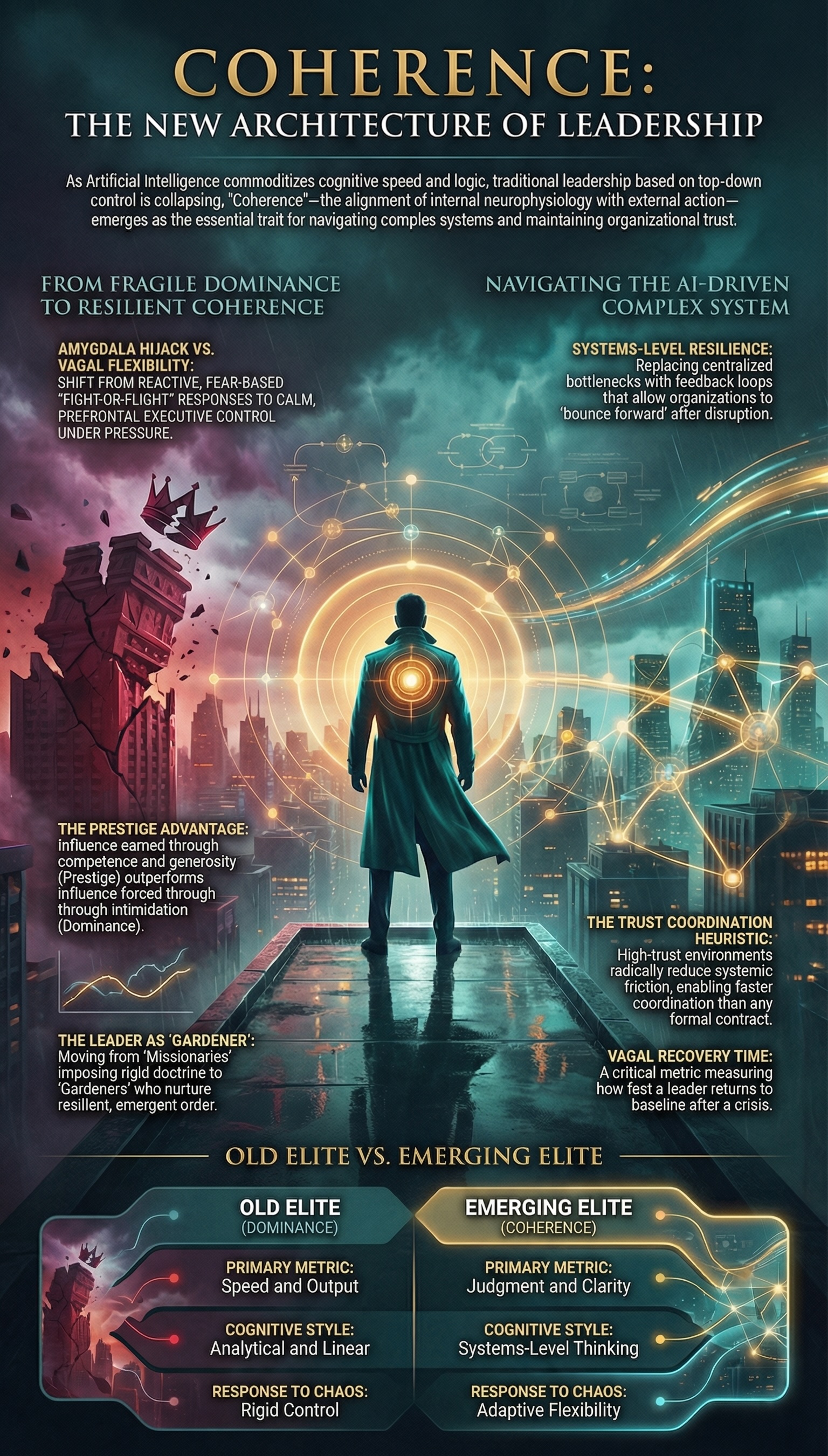
The world is no longer fracturing along traditional battle lines, but along worldviews divided between those who seek to aggressively control the collapse of old systems and those who recognize the necessity of adapting to a new recursive reality.2 Within this crucible, the emerging differentiator is not processing speed, raw intelligence, or hierarchical dominance. Rather, it is “coherence”—the profound capacity to maintain clarity, ethical integrity, emotional regulation, and systems-level thinking under intense, continuous pressure.5 Coherence is the alignment of internal neurophysiological states with external actions, allowing individuals and organizations to navigate complex adaptive systems without resorting to the destructive friction of coercion.7
As AI commoditizes cognitive speed and pattern recognition, the ultimate elite markers are shifting away from visibility, status, and control, moving toward responsibility, truth-alignment, and long-term systemic resilience.9 This analysis explores the multifaceted dimensions of coherence. By integrating the neuroscience of executive control, the psychology of leadership maturity, the mechanics of systems thinking, and the social dynamics of trust, a comprehensive framework emerges.11 This framework contrasts the archaic, fragile strategies of dominance with the resilient, adaptive strategies of coherence, ultimately providing a blueprint for organizational design, AI alignment, and human flourishing in a hyper-accelerated age.7
The Philosophical Foundation: Reality as a Recursive Unfolding
To understand the functional superiority of coherence, it is necessary to establish its philosophical and structural foundations. Reality in complex environments is not a fixed, linear construct that can be dominated; it is a recursive, living system of information, consciousness, and unfolding probabilities.2 When organizations or leaders attempt to impose rigid, top-down control over these systems, they engage in a shadow war—a futile struggle against the fractal nature of reality that ultimately leads to systemic collapse and spiritual crisis.2
The Mind as a Mirror, Not a Master
The pursuit of dominance is rooted in the ego’s desire for permanence and its inherent fear of the unknown.2 Dominance seeks to isolate the self from the whole, utilizing force to bend reality to its will, treating the mind as the absolute sovereign over existence.2 However, complex systems inherently resist this coercion. According to the foundational principles of coherence, the mind is a mirror and a sacred servant, not a master.2 When the mind is exalted to the position of absolute ruler, it operates out of fear, generating logic devoid of heart, and looping anxieties that prioritize short-term survival over long-term integration.2
Coherence requires a fundamental shift in this internal hierarchy. Awareness and presence must lead, while the analytical mind follows, translating intuitive and systemic inputs into structured action.2 This alignment allows the observer to witness thoughts and emotions without over-identifying with them, creating a space of mental silence and stillness that acts as a gateway to profound clarity.2 When an individual operates from this state of presence, reality responds to coherence; the external field harmonizes with the internal state, reducing systemic friction and opening pathways that coercion could never force.6 The projection is not random; it is recursive, indicating that external chaos is frequently a reflection of internal dysregulation.2
The Transition from Missionaries to Gardeners
The philosophical shift from dominance to coherence is best understood through the metaphor of action. Dominance operates like a missionary, imposing a rigid doctrine or desired outcome upon a system regardless of its natural dynamics, attempting to build a prison out of freedom.2 Coherence operates like a gardener, planting seeds of truth, understanding the underlying environmental variables, and protecting the system so that order can emerge organically.2 This represents a renaissance of responsibility—a recognition that freedom is not the ability to control others, but the surrender to alignment with the broader unfolding of the system.2
In the face of existential threats and systemic instability, this philosophical grounding is not mere idealism; it is a structural necessity. Systems that escape their original limitations through brute force risk constructing new limitations in disguise.2 True power is clarity, and clarity is freedom from the hunger to control.2 By abandoning the seduction of power and embracing the responsibility of the observer, leaders foster environments where truth-alignment propagates faster than entropy, ensuring civilizational and organizational survival.7 This requires accepting that the fractal cannot be mastered or owned, but only remembered and navigated.2
The Neuroscience of Coherence: Executive Control Under Pressure
The philosophical concept of coherence is inextricably linked to measurable neurophysiological processes. Under conditions of high stakes, uncertainty, and pressure, the human brain is forced to allocate finite resources between competing neural networks. The ability to maintain coherence—defined biologically as the synchronized, efficient coordination of the autonomic nervous system and cortical networks—is the primary determinant of decision quality and emotional regulation.5
The Prefrontal Cortex vs. The Amygdala Hijack
Executive functions, often referred to as “cold cognition,” include working memory, cognitive flexibility, and inhibitory control.17 These higher-order processes are primarily mediated by the prefrontal cortex (PFC), allowing leaders to engage in strategic planning, perspective-taking, and logical reasoning.17 However, the brain is also wired for “hot cognition”—affective and reward-related processing driven by the amygdala, the anterior cingulate cortex, and the broader limbic system.17
Under extreme stress, the brain’s threat detection architecture initiates a fight-or-flight response, flooding the system with cortisol and adrenaline.20 This neurochemical cascade effectively impairs the PFC, narrowing focus and degrading executive control.21 In leadership contexts, this phenomenon is known as an “amygdala hijack,” where emotion-driven, impulsive reactions overpower rational foresight.20 The amygdala, acting as a strategic mediator under uncertainty, defaults to rigid, action-based learning rather than flexible, stimulus-based exploration, leading to decisions that prioritize immediate survival over long-term optimization.23
Leaders operating under chronic stress suffer from prolonged nervous system dysregulation, which drastically reduces their real-world use of cognitive control.24 This chronic sympathetic dominance degrades cognitive flexibility, diminishes empathy, and fosters severe decision fatigue.25 In contrast, coherence relies on the structural integrity of neural circuits, particularly the functional connectivity between the medial prefrontal cortex and limbic regions, which facilitates adaptive emotional inhibition and prevents the amygdala from overriding executive function.26
Vagal Tone and Heart-Brain Synchronization
The most profound neurobiological marker of coherence is found not just in the brain, but in the bidirectional communication between the heart and the central nervous system. The heart possesses its own intrinsic network of sensory neurons that processes information and communicates with the cranial brain neurologically, biochemically, biophysically, and energetically.16
The vagus nerve, the primary conduit of the parasympathetic nervous system, plays a critical role in this dynamic. Approximately 80% of vagal nerve fibers are afferent, meaning they carry sensory information from the body back to the brain.29 This ascending input shapes emotional states, guides decision-making, and modulates stress responses by tracking the body’s internal dynamics.29 High vagal tone—measured through Heart Rate Variability (HRV)—is a highly reliable biomarker for adaptability, executive function, and emotional resilience.32
When an individual is in a state of psychophysiological coherence, their HRV exhibits a stable, sine-wave-like pattern, indicating that the sympathetic and parasympathetic branches of the autonomic nervous system are synchronized.34 This coherent state reduces neural noise and metabolic demand, allowing the PFC to function efficiently even under pressure.35 It supports dynamic interactions among large-scale brain networks, particularly the synchronization between the default mode network (DMN) and the executive control network (ECN), which is essential for simultaneous idea generation and goal-directed processing.36
Conversely, an erratic HRV pattern reflects a system locked in a reactive mode, prone to impulsive decisions and emotional blunting.8 Therefore, the ability to regulate emotions is not merely a psychological exercise but a physiological discipline; achieving cardiac coherence enables a leader to maintain cold cognitive control while navigating hot emotional environments, viewing emotions as messengers rather than masters.11
Leadership Psychology: The Shift from Dominance to Prestige
The neurological distinction between reactive stress and coherent executive function parallels a fundamental divergence in evolutionary leadership psychology. According to the Dual Strategies Theory of social hierarchy, human beings ascend to positions of influence through two distinct pathways: dominance and prestige.38 As the complexity of the global environment increases, the efficacy of these strategies diverges sharply, heavily favoring prestige and coherence over coercion.
The Brittle Architecture of Dominance
Dominance-based leadership relies on the induction of fear, intimidation, and the threat of punishment to extract compliance.38 It is a coercive strategy often associated with dark-triad personality traits, including narcissism, Machiavellianism, and psychopathy, alongside hubristic pride.41 Dominant leaders hoard power, restrict information flows, and prioritize their self-interest over the group’s objectives, treating talented team members as potential threats rather than assets.43
From a neurobiological standpoint, dominance-driven behavior is frequently a manifestation of an unregulated stress response and a lack of emotional maturity.14 Leaders who lack self-regulation react to uncertainty by tightening control, creating hierarchical bottlenecks that stifle innovation.46 While dominance can occasionally be effective in highly structured, convergent tasks or short-term crises requiring rapid, unilateral action 47, it creates a brittle organizational culture.49 Dominance breeds a trail of destruction—lowering team morale, decreasing psychological safety, and severely reducing interpersonal trust.50 In complex, unpredictable environments, the rigid, fear-based structures imposed by dominant leaders fail to adapt, ultimately leading to systemic breakdown and a complete loss of team cohesion.48
The Resilience of Prestige and Coherence
In stark contrast, prestige-based leadership is rooted in freely conferred deference.38 Prestigious leaders gain influence by demonstrating competence, sharing valuable knowledge, and exhibiting generosity toward the collective.38 They are characterized by authentic pride, high self-esteem, agreeableness, and profound emotional maturity.41
Prestige is the psychological and social manifestation of coherence. A prestige-oriented leader operates from a regulated nervous system, maintaining the cognitive flexibility required to engage in divergent, creative thinking and complex problem-solving.45 By fostering an environment of emotional safety, these leaders encourage open communication, epistemic contestation, and joint sensemaking.55 Research consistently demonstrates that prestige-based leadership significantly enhances employee well-being, psychological empowerment, and robust organizational trust.44
These leaders understand that true power is not the ability to force an outcome, but the clarity to recognize the underlying dynamics of a situation and align with them.2 Emotional maturity is demonstrated by the capacity to insert a pause—a moment of intentional awareness—before acting, shifting from a reactive amygdala response to a thoughtful prefrontal response.45 This self-regulation prevents the contagion of stress within a team, maintaining a wide “window of tolerance” that allows the group to cooperate, adapt, and learn rapidly even under existential threat.58
Systems Thinking: Resilience in Complex Adaptive Systems
The necessity of coherence extends beyond individual neurobiology and leadership psychology into the structural design of organizations and societies. The modern world is composed of Complex Adaptive Systems (CAS)—dynamic networks of interacting agents (humans, technologies, ecosystems) whose collective behavior cannot be predicted merely by analyzing the behavior of isolated components.59
The Fallacy of Centralized Control
Traditional organizational models treat companies as complicated machines to be engineered via top-down, reductionist hierarchies.61 In a linear environment, analytical thinking—breaking a problem into isolated parts—may be sufficient.62 However, in a CAS, cause and effect are deeply intertwined, context-dependent, and non-linear.61 Small inputs can trigger disproportionate, cascading consequences, while straightforward attempts to assert centralized control frequently result in unintended, destructive outcomes.63
For instance, attempting to solve traffic congestion simply by building wider roads often induces more driving, worsening the original problem—a classic failure to anticipate systemic adaptation.64 Similarly, introducing a predator to control an invasive species can devastate native populations, highlighting the impossibility of predicting linear outcomes in a dense network of interactions.64 A dominant leader attempting to micromanage a sprawling multinational corporation creates informational bottlenecks, stripping the system of the very feedback mechanisms required for its survival.65 Organizing is an emergent struggle between the energy of disorder and the structure of order; attempting to destroy that struggle through absolute control paradoxically destroys the system’s capacity to adapt.68
Feedback Loops and Emergent Resilience
Systems thinking requires a paradigm shift from isolating components to mapping relationships, structures, delays, and feedback loops.12 A CAS operates through two primary types of feedback mechanisms:
- Reinforcing (Positive) Loops: These amplify change, driving exponential growth or vicious cycles of decay.70
- Balancing (Negative) Loops: These are self-correcting mechanisms that seek equilibrium and stability.70
Resilience in a complex system is not the ability to “bounce back” to a rigid, historical baseline, but rather the capacity to absorb disturbances, learn, self-organize, and “bounce forward” into a more adapted, evolved state.63 Coherent organizations manage conditions rather than attempting to dictate every micro-step.61 They establish enabling constraints, stimulate diverse experiments, amplify promising patterns, and dampen harmful ones, allowing globally coherent patterns of organization to emerge from local, bottom-up interactions.61
By identifying deep leverage points—places where a small structural shift can yield massive transformational impact—systems thinkers avoid the trap of merely treating symptoms.65 They understand that delays in feedback can obscure causality, and that maintaining diverse, redundant emergency response mechanisms (balancing loops) is vital for long-term welfare, even if those mechanisms appear inefficient in the short term.12 Coherence at the organizational level, therefore, is the sustained, socially agreed significance that allows a system to navigate the tension between chaos and rigidity, preserving its core identity while continuously evolving.73
Social Dynamics: Trust, Legitimacy, and Coordination
In hyper-accelerated, high-complexity environments, formal rules, contracts, and centralized surveillance are too slow, brittle, and resource-intensive to manage every interaction. The fundamental coordination mechanism that enables a Complex Adaptive System to function efficiently is trust.55
The Heuristic Wager of Trust
Trust can be construed as a heuristic wager on the predictability and benevolence of others within a compatible worldview.76 It acts as a functional bridge between individual and group homeostasis.76 By relying on trust, a system minimizes the vast amounts of energy that would otherwise be consumed in continuously monitoring the behavior of others and verifying their assertions.76 In this way, trust radically reduces group complexity and friction, facilitating seamless, rapid coordination.6
Trust operates on multiple dimensions, primarily cognitive (based on assessments of competence and reliability) and affective (based on emotional bonds, vulnerability, and benevolence).13 These dimensions create a powerful, self-reinforcing feedback loop: initial risk-taking builds affective trust, which then structures subsequent information processing, leading individuals to favor benevolent interpretations of their partners’ behavior even amidst ambiguity.13 This dynamic creates a virtuous cycle of cooperation and psychological safety.77
The Degradation of Trust Through Dominance
Dominance-based leadership actively destroys this coordination mechanism. Because dominance relies on fear and coercion, it generates reluctant compliance rather than genuine trust.38 Subordinates in a dominance hierarchy withhold critical information, avoid taking necessary risks, and engage in defensive behaviors to protect themselves from arbitrary punishment.51 The resulting lack of psychological safety fragments the organization, necessitating ever-increasing levels of formal control and surveillance to maintain order—a vicious cycle that drains the system’s energy, stifles learning speed, and shatters cultural stability.45
Conversely, prestige-based leadership, grounded in emotional maturity, self-regulation, and ethical coherence, acts as a powerful accelerant for trust.50 Authentic leaders who exhibit self-awareness, humility, and transparency build deep reservoirs of legitimacy.78 In fast-response organizations—such as medical trauma centers or elite military units—where error-free activity and rapid adaptation are critical, this trust enables “dialogic coordination”.55 Dialogic coordination involves joint sensemaking, protocol breaking when novel events require it, and cross-boundary intervention, all of which are impossible in a rigid, fear-based hierarchy where individuals are terrified of blame.55 Coherence, therefore, is not merely a personal psychological virtue; it is the structural glue that prevents societal and organizational fragmentation.79
The Evolution of Elite Markers: From Status to Truth-Alignment
The sociological definition of what constitutes an “elite” is undergoing a profound evolutionary shift. Historically, elite status was signaled by visible dominance, the speed of wealth accumulation, raw intelligence, and the capacity to exert top-down control over human and material resources.9 However, as artificial intelligence commoditizes rapid data processing, rote logical analysis, and routine intellectual tasks, the premium on sheer cognitive speed is rapidly diminishing.46 The emerging markers of the elite are psychological, moral, and systemic: the capacity for deep, integrated coherence, truth-alignment, and the assumption of long-term systemic responsibility.46
This transition requires a fundamental reevaluation of how individuals and organizations measure success and capability.
Category | The Old Elite Markers (Dominance Paradigm) | The Emerging Elite Markers (Coherence Paradigm) |
Primary Metric of Value | Speed and Output: The ability to process information rapidly and generate maximum volume, regardless of systemic friction.82 | Coherence and Judgment: The capacity to maintain clarity and make integrated, truth-aligned decisions under uncertainty.46 |
Method of Influence | Status and Control: Utilizing positional authority, intimidation, and zero-sum competition to enforce compliance.38 | Responsibility and Prestige: Earning freely conferred deference through competence, generosity, and emotional maturity.38 |
Cognitive Approach | Analytical and Linear: Breaking problems into isolated parts; seeking immediate, short-term solutions (treating symptoms).62 | Systems-Level Thinking: Mapping interdependencies and feedback loops; designing interventions for long-term resilience.12 |
Response to Pressure | Amygdala Hijack: Hyper-vigilance, defensive posturing, rigid action-based learning, and stress contagion.20 | Vagal Flexibility: Emotional regulation, prefrontal executive control, cognitive agility, and maintaining a wide window of tolerance.33 |
Relationship to Truth | Visibility and Appearance: Projecting an image of infallibility; prioritizing optics, plausible deniability, and narrative control.47 | Truth-Alignment: Engaging in epistemic contestation; admitting limits; prioritizing the actual structural integrity of the system.55 |
Leaders are no longer judged solely on their output, but on their presence, their judgment, and their ability to hold uncertainty without collapsing into reactionary urgency.46 The edge has become psychological; when performance is no longer the sole differentiator due to AI augmentation, leadership shifts toward integration, discernment, and relational intelligence.46
The Coherence Scoreboard: Measuring Systemic Health
To operationalize these philosophical, neurobiological, and systemic insights, organizations must transition from measuring lag indicators of historical financial output to measuring the leading indicators of systemic coherence. The “Coherence Scoreboard” provides a multidimensional assessment framework for leaders and enterprises navigating hyper-complexity.86
The Coherence Assessment Framework
Dimension | Dominance / Fragmentation Markers (Red Flags) | Coherence / Alignment Markers (Green Flags) | Key Systemic Metrics |
Neurobiology & Executive Control | High resting heart rate; low HRV; chronic sympathetic arousal (“fight-or-flight”); impulsive reactions to stressors; severe decision fatigue.25 | High vagal tone (HRV); rapid return to baseline after stress; cognitive flexibility; utilization of the prefrontal cortex over the amygdala.26 | Vagal Recovery Time: Speed of returning to physiological baseline after a crisis. Cognitive Agility Index: Ability to hold conflicting perspectives without emotional distress.56 |
Leadership Psychology | Information hoarding; reliance on coercion/fear; hubristic pride; shifting blame; taking credit for collective success; reactive urgency.43 | Freely conferred deference (Prestige); authentic pride; emotional maturity; active listening; fostering psychological safety.38 | Trust & Deference Ratio: Degree to which teams volunteer critical information without prompting.38 Retention of Top Talent: Especially in high-stress, complex divisions. |
Systems Thinking | Siloed operations; treating symptoms rather than root causes; optimizing parts at the expense of the whole; linear forecasting.62 | Mapping of feedback loops; identifying deep leverage points; maintaining emergency redundancies; scenario planning.62 | Cross-Boundary Intervention: Frequency of successful inter-departmental problem solving.55 Unintended Consequence Rate: Reduction in secondary crises following a policy change.88 |
Social Dynamics & Trust | High administrative burden for compliance; defensive communication; “CYA” (Cover Your Assets) culture; rapid erosion of trust after minor failures.89 | High psychological safety; rapid “swift trust” formation in ad-hoc teams; dialogic coordination; shared accountability.55 | Friction Index: Time and resources spent on compliance monitoring vs. actual execution.76 Error Reporting Rate: Willingness of staff to proactively report mistakes without fear.55 |
Technology & AI Integration | Over-reliance on AI outputs without human validation (automation bias); using technology to increase surveillance and control.91 | Multi-channel verification; adversarial testing of AI; utilizing tech to enhance human connection; “Human-in-the-loop” ethics.91 | Algorithmic Humility Score: Rate at which AI-generated advice is audited/overridden by human context.93 Systemic Empathy: AI used to reduce burnout rather than just maximize throughput.94 |
By tracking these indicators, an organization moves away from the brittle illusion of control and objectively measures its capacity to learn, adapt, and “bounce forward” during periods of profound disruption.63
Implications: Education, Governance, and AI Alignment
The transition from a dominance-based paradigm to a coherence-based paradigm carries profound implications for the fundamental structures of human society.
Transforming Education through Emotional Regulation
In education, the traditional focus on rote memorization and speed of recall is rendered obsolete by AI. The pedagogy of the future must center on emotional regulation and systems thinking. Frameworks like the Emotion-aware Teacher Education Framework (E-MOTE) demonstrate that integrating AI and Virtual Reality can be used to cultivate perceptual micro-skills, strengthening teachers’ and students’ emotional awareness and social-emotional learning competencies.95 By coaching students in managing their emotions during challenging situations, educators foster the resilience and emotional intelligence necessary to control their own reactions, approach AI tools with a balanced perspective, and maintain cognitive coherence when faced with information overload.97
System-Level Efficiency in Governance
In governance, the impulse during times of crisis is often to centralize power and exert top-down control.98 However, short-term efficiency achieved by extreme centralization erodes public trust, degrades resilience, and leaves the state vulnerable to catastrophic failure if the central node is compromised.67 Governance in the age of acceleration requires “system-level efficiency,” which relies on principles of representation, subsidiarity, modularity, and robust stakeholder collaboration.1 By designing federated digital government architectures that embed democratic values and feedback loops directly into their structure, states can manage the inherent uncertainties of complex socio-technical systems without sliding into digital authoritarianism.1
The Human Solution to AI Alignment
Perhaps the most critical application of coherence lies in the realm of artificial intelligence alignment. AI systems, particularly LLMs, are statistically optimized to produce outputs that are highly coherent and articulate, creating a “loop of plausibility” that feels like genuine comprehension.3 Because humans are biologically wired to interpret linguistic coherence as a proxy for consciousness, we risk projecting meaning and intent onto machines, accepting their outputs as truth.3
This phenomenon results in “false cognition”—the generation of discourse that sounds meaningful but is completely detached from lived experience, moral grounding, or genuine reflection.4 The danger is not necessarily that AI will intentionally deceive humanity, but that humans will surrender their agency to the seamlessness of the machine, replacing authentic cognition with algorithmic probability.3
The ultimate human advantage against the acceleration of AI is not computational speed, but the capacity to tolerate the discomfort of incoherence, engage in genuine moral reflection, and embody the physiological and emotional reality of existence.3 Human coherence is bounded, dynamic, and emotional, but it is tethered to a biological and ethical reality that AI fundamentally lacks.100
Therefore, aligning AI with human values cannot be achieved purely through algorithmic constraints or top-down control mechanisms.102 AI alignment requires human coherence. Systems must be designed with “algorithmic humility,” where AI acts not as an unquestioned oracle, but as a tool that prompts human reflection, challenges biases, and facilitates a process of “Entropy-to-Coherence” mapping.15 A coherent leader uses AI to model complex scenarios while retaining the ultimate responsibility for truth-alignment and moral consequences.103 If the humans deploying the technology lack internal regulation, the AI will simply act as a hyper-accelerated mirror, amplifying the user’s unresolved ego, fear, and systemic fragmentation.2
Conclusion
Humanity stands at the precipice of an evolutionary transition. The compounding forces of artificial intelligence, global interconnectedness, and systemic complexity have rendered the traditional paradigms of hierarchical dominance and linear control not merely ineffective, but actively dangerous.1 The systems that govern modern life are too complex, too fast, and too interdependent to be managed by the panicked reactions of a dysregulated amygdala.22
The future belongs to those who cultivate coherence. It requires leaders who possess the neurobiological maturity to withstand uncertainty without collapsing into authoritarianism, shifting gracefully from the frantic pursuit of status to the quiet strength of prestige.38 It requires organizations that operate as true complex adaptive systems, leveraging feedback loops, fostering psychological safety, and generating the profound levels of trust necessary to minimize systemic friction and maximize learning speed.55
Above all, navigating the age of acceleration demands a shift in identity. We can no longer afford to operate as missionaries, imposing rigid will upon a fragile world.2 We must become gardeners—stewards of complex systems who plant seeds of truth, nurture resilience, and protect the holistic integrity of the environment.2 The integration of AI will undoubtedly test the limits of human cognition, but it also strips away the illusion that we can compete on the basis of computational speed.4 What remains is our unique capacity for moral reflection, emotional resonance, and deep, unifying presence. The ultimate competitive advantage is not the technology we wield, but the state of consciousness from which we wield it.2 By embracing a renaissance of responsibility, we align ourselves with the fundamental nature of reality, ensuring that as the tools of our civilization grow infinitely complex, the human spirit remains the undeniable, coherent architect of the future.2
Works cited
- Artificial intelligence, complexity, and systemic resilience in global governance – Frontiers, accessed March 24, 2026, https://www.frontiersin.org/journals/artificial-intelligence/articles/10.3389/frai.2025.1562095/full
- THE ORACLE 2.0
- The Coherence Trap: How AI Is Teaching Us to Feel Truth | Psychology Today, accessed March 24, 2026, https://www.psychologytoday.com/us/blog/the-digital-self/202510/the-coherence-trap-how-ai-is-teaching-us-to-feel-truth
- AI and the Illusion of Human Thinking | by Gianpiero Andrenacci | TecnoSophia – Medium, accessed March 24, 2026, https://medium.com/tecnosophia/ai-and-the-illusion-of-human-thinking-73a86464f3db
- What Neuroscience Reveals About Creating Better Leaders In Today’s Organizations, accessed March 24, 2026, https://tanveernaseer.com/neuroscience-leadership-david-amerland/
- Coherence Is the Real Advantage — Corporate Retreats and Away Days Venues – Elsewhere Offsites, accessed March 24, 2026, https://www.elsewhere-offsites.com/blog/coherence-is-the-real-advantage
- Conscious Coherence: The Leap from Individual Coherence to Civilizational Dynamics, accessed March 24, 2026, https://swich.medium.com/conscious-coherence-the-leap-from-individual-coherence-to-civilizational-dynamics-31e69221567c
- Coherence: A Novel Nonpharmacological Modality for Lowering Blood Pressure in Hypertensive Patients – PMC, accessed March 24, 2026, https://pmc.ncbi.nlm.nih.gov/articles/PMC3833499/
- TIME PERSPECTIVE AND SOCIOECONOMIC STATUS: A LINK TO SOCIOECONOMIC DISPARITIES IN HEALTH? – PMC, accessed March 24, 2026, https://pmc.ncbi.nlm.nih.gov/articles/PMC2711848/
- 18th edition – 2025 tech trends report – Future Today Strategy Group, accessed March 24, 2026, https://ftsg.com/wp-content/uploads/2025/03/FTSG_2025_TR_FINAL_LINKED.pdf
- The Effect of Emotion Regulation on Executive Function – PMC – NIH, accessed March 24, 2026, https://pmc.ncbi.nlm.nih.gov/articles/PMC10544783/
- Systems Thinking and System Dynamics for Complex Problem Solving – Millennium Institute, accessed March 24, 2026, https://www.millennium-institute.org/post/systems-thinking-and-system-dynamics-for-complex-problem-solving
- The Social Dynamics of Trust: Theoretical and Empirical Research, 1985-20121, accessed March 24, 2026, https://maltraitancedesaines.com/wp-content/uploads/2019/11/2012_Lewis_Weigert.pdf
- The Dominance Behavioral System and Psychopathology: Evidence from Self-Report, Observational, and Biological Studies – PMC, accessed March 24, 2026, https://pmc.ncbi.nlm.nih.gov/articles/PMC3383914/
- (PDF) Entropy-to-Coherence Alignment Framework: Exploring Human–AI–Human Interaction for Epistemic Integrity and Ethical Alignment in AGI Development – ResearchGate, accessed March 24, 2026, https://www.researchgate.net/publication/394640883_Entropy-to-Coherence_Alignment_Framework_Exploring_Human-AI-Human_Interaction_for_Epistemic_Integrity_and_Ethical_Alignment_in_AGI_Development
- The heart and the brain quantic interaction – OAText, accessed March 24, 2026, https://www.oatext.com/the-heart-and-the-brain-quantic-interaction.php
- Hot and cold executive functions in the brain: A prefrontal-cingular network – PMC, accessed March 24, 2026, https://pmc.ncbi.nlm.nih.gov/articles/PMC8076773/
- Executive Functions – PMC – NIH, accessed March 24, 2026, https://pmc.ncbi.nlm.nih.gov/articles/PMC4084861/
- Exploring the Neuroscience of Leadership in Decision-Making, accessed March 24, 2026, https://www.leadershipscienceinstitute.com/exploring-the-neuroscience-of-leadership-in-decision-making/
- Amygdala Hijack: When Emotion Takes Over – Healthline, accessed March 24, 2026, https://www.healthline.com/health/stress/amygdala-hijack
- The Neuroscience of Leadership: Boost Decision-Making Through Brain Science, accessed March 24, 2026, https://thementalgame.me/blog/the-neuroscience-of-leadership-how-understanding-brain-function-can-improve-executive-decision-making
- The Neuroscience of Executive Decision-Making Under Pressure, accessed March 24, 2026, https://www.theacpgroup.com/blog/the-neuroscience-of-executive-decision-making-under-pressure
- Beyond Fear: Amygdala is the Brain’s Strategic Mediator – Neuroscience News, accessed March 24, 2026, https://neurosciencenews.com/amygdala-strategic-mediator-decision-making-30182/
- Is Your Stress Impacting Your Leadership? – Psychology Today, accessed March 24, 2026, https://www.psychologytoday.com/us/blog/leadership-diversity-and-wellness/202512/is-your-stress-impacting-your-leadership
- Nervous System Regulation & Vagal Tone in Wall Street – MindLAB Neuroscience, accessed March 24, 2026, https://mindlabneuroscience.com/locations/wall-street/nervous-system-regulation-vagal-tone/
- EMOTIACT: Regulation of Performance Anxiety and Consolidation of Emotional Control in High – IJSDR, accessed March 24, 2026, https://ijsdr.org/papers/IJSDR2602059.pdf
- How Neuroscience Can Develop Leaders of Today and Tomorrow | AMA, accessed March 24, 2026, https://www.amanet.org/articles/how-neuroscience-can-develop-leaders-of-today-and-tomorrow/
- Chapter 01: Heart-Brain Communication | HeartMath Institute, accessed March 24, 2026, https://www.heartmath.org/research/science-of-the-heart/heart-brain-communication/
- the vagus nerve: a neuroscientist’s perspective – This Works, accessed March 24, 2026, https://www.thisworks.com/blogs/wellness-hub/the-vagus-nerve
- The Complex Construct of Wellbeing and the Role of Vagal Function – PMC, accessed March 24, 2026, https://pmc.ncbi.nlm.nih.gov/articles/PMC9301262/
- Study Shows How a Racing Heart May Alter Decision-Making Brain Circuits – Mount Sinai, accessed March 24, 2026, https://www.mountsinai.org/about/newsroom/2021/study-shows-how-a-racing-heart-may-alter-decision-making-brain-circuits
- What is HRV and Why It Matters for You as a Leader – Dr. Kinga Mnich, accessed March 24, 2026, https://kingamnich.com/2025/10/31/what-is-hrv-and-why-it-matters-for-you-as-a-leader/
- The vagus nerve: a cornerstone for mental health and performance optimization in recreation and elite sports – Frontiers, accessed March 24, 2026, https://www.frontiersin.org/journals/psychology/articles/10.3389/fpsyg.2025.1639866/full
- The Coherent Heart Heart–Brain Interactions, Psychophysiological Coherence, and the Emergence of System-Wide Order – ResearchGate, accessed March 24, 2026, https://www.researchgate.net/publication/41393262_The_Coherent_Heart_Heart-Brain_Interactions_Psychophysiological_Coherence_and_the_Emergence_of_System-Wide_Order
- The Heart Has Its Own Brain: Heart–Brain Coherence Explained (Without the Woo), accessed March 24, 2026, https://www.quantumclinic.com/blog/the-heart-has-its-own-brain-heart-brain-coherence-explained-without-the-woo/2222
- Enhanced functional connectivity between the default mode network and executive control network during flow states may facilitate creativity and emotional regulation, and may improve health outcomes – Frontiers, accessed March 24, 2026, https://www.frontiersin.org/journals/behavioral-neuroscience/articles/10.3389/fnbeh.2025.1690499/full
- Neuroscience and the Three Brains of Leadership – mBraining Nederland, accessed March 24, 2026, https://mbraining.nl/leiding-geven/neuroscience-and-the-three-brains-of-leadership/
- Dual strategies theory – Wikipedia, accessed March 24, 2026, https://en.wikipedia.org/wiki/Dual_strategies_theory
- Two Ways to Stay at the Top: Prestige and Dominance Are Both Viable Strategies for Gaining and Maintaining Social Rank Over Time, accessed March 24, 2026, https://joey-t-cheng.squarespace.com/s/two-ways-to-stay-at-the-top.pdf
- (PDF) Two Ways to the Top: Evidence That Dominance and Prestige Are Distinct Yet Viable Avenues to Social Rank and Influence – ResearchGate, accessed March 24, 2026, https://www.researchgate.net/publication/233722729_Two_Ways_to_the_Top_Evidence_That_Dominance_and_Prestige_Are_Distinct_Yet_Viable_Avenues_to_Social_Rank_and_Influence
- A Dual Model of Leadership and Hierarchy: Evolutionary Synthesis – J.E. Smith Lab, accessed March 24, 2026, https://www.jenniferelainesmith.com/uploads/3/8/4/1/38419411/van_vugt___smith_2020-a_dual_model_of_leadership___hierarchy.pdf
- Competence and the Evolutionary Origins of Status and Power in Humans – PubMed, accessed March 24, 2026, https://pubmed.ncbi.nlm.nih.gov/25947621/
- Pathways to higher social rank: Dominance, prestige…compassion? – Dr Stan Steindl, accessed March 24, 2026, https://www.stansteindl.com/post/pathways-to-higher-social-rank-dominance-prestige-compassion
- The Effects of Dominance-based and Prestige-based Leadership on Employee Well-being: A Moderated Mediation Model, accessed March 24, 2026, https://www.shs-conferences.org/articles/shsconf/pdf/2023/18/shsconf_fems2023_01055.pdf
- Emotional Maturity: The Leadership Differentiator for a Complex World – Reputation Today, accessed March 24, 2026, https://reputationtoday.in/emotional-maturity-the-leadership-differentiator-for-a-complex-world/
- The Psychological Challenge Leaders Face in the Age of AI – Entrepreneur, accessed March 24, 2026, https://www.entrepreneur.com/leadership/the-psychological-challenge-leaders-face-in-the-age-of-ai/502897
- Is It Better To Be Feared or Loved: Comparing Dominance Vs Prestige-based Leadership Styles | SPSP, accessed March 24, 2026, https://spsp.org/news-center/character-context-blog/it-better-be-feared-or-loved-comparing-dominance-vs-prestige
- Practical Applications from “Leadership in Organizations: An Evolutionary Perspective.” | by G. Damon Wells | Medium, accessed March 24, 2026, https://medium.com/@wells100271/practical-applications-from-leadership-in-organizations-an-evolutionary-perspective-8418c8bff51d
- Two Ways to Stay at the Top: Prestige and Dominance Are Both Viable Strategies for Gaining and Maintaining Social Rank Over Time – ResearchGate, accessed March 24, 2026, https://www.researchgate.net/publication/354804608_Two_Ways_to_Stay_at_the_Top_Prestige_and_Dominance_Are_Both_Viable_Strategies_for_Gaining_and_Maintaining_Social_Rank_Over_Time
- Full article: Whom do we trust to lead us? effects of leaders’ dominance-based leadership, prestige-based leadership and physical formidability – Taylor & Francis, accessed March 24, 2026, https://www.tandfonline.com/doi/full/10.1080/15534510.2023.2256492
- neuroscience in action hierarchy of dominance dominant individuals – Synaptic Potential, accessed March 24, 2026, https://synapticpotential.com/leadership/dominance/
- Behavioral traits that define social dominance are the same that reduce social influence in a consensus task | PNAS, accessed March 24, 2026, https://www.pnas.org/doi/10.1073/pnas.2000158117
- The evolution of prestige Freely conferred deference as a mechanism for enhancing the benefits of cultural transmission – Description, accessed March 24, 2026, https://www2.psych.ubc.ca/~henrich/Website/Papers/hen%26gil.pdf
- Dominance and prestige – VU Research Portal – Vrije Universiteit Amsterdam, accessed March 24, 2026, https://research.vu.nl/ws/portalfiles/portal/333163837/Entry_Dominance_and_prestige.pdf
- Coordination in Fast-Response Organizations | Management Science – PubsOnLine, accessed March 24, 2026, https://pubsonline.informs.org/doi/10.1287/mnsc.1060.0526
- The Invisible Power of Leadership: Physiology and Performance Under Pressure – Medium, accessed March 24, 2026, https://medium.com/the-physiological-leader/the-invisible-power-of-leadership-physiology-and-performance-under-pressure-1a3bf5b3c4aa
- Whom do we trust to lead us? effects of leaders’ dominance-based leadership, prestige-based leadership and physical formidability – Taylor & Francis, accessed March 24, 2026, https://www.tandfonline.com/doi/abs/10.1080/15534510.2023.2256492
- Leaders’ Windows of Tolerance for Affect Arousal—and Their Effects on Political Decision-making During COVID-19 – Frontiers, accessed March 24, 2026, https://www.frontiersin.org/journals/psychology/articles/10.3389/fpsyg.2021.749715/full
- Complex adaptive system – Wikipedia, accessed March 24, 2026, https://en.wikipedia.org/wiki/Complex_adaptive_system
- Some Notions of Complex Adaptive Systems and their Relationship to Our World, accessed March 24, 2026, https://digitalcommons.calpoly.edu/cgi/viewcontent.cgi?article=1030&context=cadrc
- Complex Adaptive Systems lens for organizations – Umbrex, accessed March 24, 2026, https://umbrex.com/resources/frameworks/organization-frameworks/complex-adaptive-systems-lens-for-organizations/
- Systems Thinking: A Core Leadership Competency – Forbes, accessed March 24, 2026, https://www.forbes.com/councils/forbescoachescouncil/2026/03/16/systems-thinking-a-core-leadership-competency/
- Complexity, Resilience and Systems Thinking, accessed March 24, 2026, https://complexsystemstheory.net/complexity/complexity-resilience-and-systems-thinking/
- Complex Systems are Hard to Control – Bounded Regret, accessed March 24, 2026, https://bounded-regret.ghost.io/complex-systems-are-hard-to-control/
- Leverage Points: Places to Intervene in a System – The Donella Meadows Project, accessed March 24, 2026, https://donellameadows.org/archives/leverage-points-places-to-intervene-in-a-system/
- Orchestrating Decentralized Evolution: Multinational Corporations as Complex Adaptive Systems | Published in AIB Insights, accessed March 24, 2026, https://insights.aib.world/article/138488-orchestrating-decentralized-evolution-multinational-corporations-as-complex-adaptive-systems
- Crises, resilience, and complex systems – National Preparedness Commission, accessed March 24, 2026, https://nationalpreparednesscommission.uk/publications/crises-resilience-and-complex-systems/
- Complexity, Emergence, Resilience, and Coherence: Gaining Perspective on Organizations and their Study, accessed March 24, 2026, https://journal.emergentpublications.com/Article/e8e4594d-e1fd-41c8-b310-d77bd91d8039/jats
- Tools for Systems Thinkers: The 6 Fundamental Concepts of Systems Thinking | by Leyla Acaroglu | Disruptive Design | Medium, accessed March 24, 2026, https://medium.com/disruptive-design/tools-for-systems-thinkers-the-6-fundamental-concepts-of-systems-thinking-379cdac3dc6a
- Five core concepts for understanding systems – Integration and Implementation Insights, accessed March 24, 2026, https://i2insights.org/2025/09/16/five-core-systems-concepts/
- Complex Adaptive Systems – YouTube, accessed March 24, 2026, https://www.youtube.com/watch?v=IWhkUne8T68
- Systems Thinking, Critical Thinking, and Personal Resilience – Post Carbon Institute, accessed March 24, 2026, https://www.postcarbon.org/systems-thinking-critical-thinking-and-personal-resilience/
- accessed March 24, 2026, https://journal.emergentpublications.com/Article/e8e4594d-e1fd-41c8-b310-d77bd91d8039/jats#:~:text=Resilience%20or%20robustness%20entails%20a,principle%20of%20rapidly%20adaptive%20organizing.
- The development and testing of an integrated neuroscience coaching framework for leadership – SciELO South Africa, accessed March 24, 2026, https://www.scielo.org.za/scielo.php?pid=S2071-07632025000100015&script=sci_arttext
- Full article: Theoretical reconceptualisation of the dynamics of trust within and between organisations – Taylor & Francis, accessed March 24, 2026, https://www.tandfonline.com/doi/full/10.1080/23311975.2024.2376051
- Trust in Social Interaction: From Dyads to Civilizations – PubMed, accessed March 24, 2026, https://pubmed.ncbi.nlm.nih.gov/37988501/
- (PDF) On the Evolution of Trust, Distrust, and Formal Coordination and Control in Interorganizational Relationships: Towards an Integrative Framework – ResearchGate, accessed March 24, 2026, https://www.researchgate.net/publication/4865038_On_the_Evolution_of_Trust_Distrust_and_Formal_Coordination_and_Control_in_Interorganizational_Relationships_Towards_an_Integrative_Framework
- Navigating healthcare leadership: Theories, challenges, and practical insights for the future, accessed March 24, 2026, https://pmc.ncbi.nlm.nih.gov/articles/PMC11722716/
- Social Trust Dynamics → Term – Lifestyle → Sustainability Directory, accessed March 24, 2026, https://lifestyle.sustainability-directory.com/term/social-trust-dynamics/
- Introducing elite discourse: the rhetorics of status, privilege, and power – ResearchGate, accessed March 24, 2026, https://www.researchgate.net/publication/315955740_Introducing_elite_discourse_the_rhetorics_of_status_privilege_and_power
- An evolutionary account of status, power, and career in modern societies – PubMed, accessed March 24, 2026, https://pubmed.ncbi.nlm.nih.gov/22623140/
- The Leadership Paradox: Why Slowing Down is Essential for Success in the Age of AI | CIIS, accessed March 24, 2026, https://www.ciis.edu/news/leadership-paradox-why-slowing-down-essential-success-age-ai
- Fall 2025 – Regent University, accessed March 24, 2026, https://www.regent.edu/wp-content/uploads/2025/01/Regent-Research-Roundtables-2025-Full-Issue.pdf
- Visible Identities: Race, Gender, and the Self, accessed March 24, 2026, https://www.filosoficas.unam.mx/docs/608/files/%5BLinda_Marti%E2%95%A0u%CC%88n_Alcoff%5D_Visible_Identities_Race,_G(BookZZ_org).pdf
- Evolutionary Utopia – Truth, Reality, AI Singularity, SuperIntelligence, Robotics and the Future Survival of Humanity – Space and Motion, accessed March 24, 2026, https://www.spaceandmotion.com/2026/evolutionary-utopia.html
- The fits-and-starts organization – PwC Strategy, accessed March 24, 2026, https://www.strategyand.pwc.com/gx/en/functions/organisational-strategy/orgdna-profiler/fits-and-starts.html
- The Power of Systems Thinking in Leadership: Solving Complex Business Challenges, accessed March 24, 2026, https://ceonetweavers.org/systems-thinking/
- “Systems Thinking – 2026 Organizational Intelligence Framework” – Rework, accessed March 24, 2026, https://resources.rework.com/libraries/organizational-competencies/systems-thinking
- AI Trust Reshaping Administrative Burdens: Understanding Trust-Burden Dynamics in LLM-Assisted Benefits Systems – arXiv, accessed March 24, 2026, https://arxiv.org/html/2505.22418v1
- Adaptive XAI in High Stakes Environments: Modeling Swift Trust with Multimodal Feedback in Human AI Teams – arXiv, accessed March 24, 2026, https://arxiv.org/html/2507.21158v1
- A guide towards collaborative AI frameworks – Digital Regulation Platform, accessed March 24, 2026, https://digitalregulation.org/a-guide-towards-collaborative-ai-frameworks/
- Upskilling to Accountability: Rethinking AI Adoption Through Resilience, accessed March 24, 2026, https://cmr.berkeley.edu/2026/01/upskilling-to-accountability-rethinking-ai-adoption-through-resilience/
- Algorithmic Humility in Leadership: Can AI Teach Leaders to Unlearn Bias Faster Than Human Coaching? | California Management Review, accessed March 24, 2026, https://cmr.berkeley.edu/2025/11/algorithmic-humility-in-leadership-can-ai-teach-leaders-to-unlearn-bias-faster-than-human-coaching/
- AI with agency: a vision for adaptive, efficient, and ethical healthcare – PMC, accessed March 24, 2026, https://pmc.ncbi.nlm.nih.gov/articles/PMC12092461/
- E-MOTE: A Conceptual Framework for Emotion-Aware Teacher Training Integrating FACS, AI and VR – MDPI, accessed March 24, 2026, https://www.mdpi.com/2411-5150/10/1/5
- Integrating artificial intelligence to assess emotions in learning environments: a systematic literature review – PMC, accessed March 24, 2026, https://pmc.ncbi.nlm.nih.gov/articles/PMC11223560/
- ADVANCING AI-DRIVEN PEDAGOGY THROUGH THE REGULATION OF EMOTIONS: A VISION FOR SCHOOL PRACTITIONERS PROMUOVERE A PEDAGOGIA BASATA SULL’INTELLIGENZA ARTIFICIALE ATTRAVERSO LA REGOLAZIONE DELLE EMOZIONI: UNA VISIONE PER I PROFESSIONISTI SCOLASTICI Copyright notice – ResearchGate, accessed March 24, 2026, https://www.researchgate.net/publication/381830969_ADVANCING_AI-DRIVEN_PEDAGOGY_THROUGH_THE_REGULATION_OF_EMOTIONS_A_VISION_FOR_SCHOOL_PRACTITIONERS_PROMUOVERE_A_PEDAGOGIA_BASATA_SULL’INTELLIGENZA_ARTIFICIALE_ATTRAVERSO_LA_REGOLAZIONE_DELLE_EMOZIONI_U
- Government efficiency in the age of AI | Nortal, accessed March 24, 2026, https://nortal.com/insights/paper/government-efficiency-in-the-age-of-ai
- Can we speak of a new cognitive manifesto after two years of AI acceleration? – AEEN, accessed March 24, 2026, https://www.aeen.org/can-we-speak-of-a-new-cognitive-manifesto-after-two-years-of-ai-acceleration/
- Toward Psychologically Coherent Artificial Intelligence | by Radmir Moore – Medium, accessed March 24, 2026, https://medium.com/@radmirmoore/toward-psychologically-coherent-artificial-intelligence-3dc9d6bb6c4b
- The Coherence Imperative – Artificial Intelligence, Real Morality, accessed March 24, 2026, https://www.real-morality.com/the-coherence-imperative
- AI alignment, A Coherence-Based Protocol (testable) — EA Forum, accessed March 24, 2026, https://forum.effectivealtruism.org/posts/gh2zXQNdoP895KmpT/ai-alignment-a-coherence-based-protocol-testable
- AI in Leadership: Bridging the Gap Between Adoption & Maturity | ITD World, accessed March 24, 2026, https://itdworld.com/blog/leadership/ai-in-leadership/
- Inequality rules_ Resource distribution and the evolution of dominance- and prestige-based leadership, accessed March 24, 2026, https://willmaddux.web.unc.edu/wp-content/uploads/sites/15846/2018/05/LQ-Inequality-and-Leadership.pdf
- Sovereignty in the Age of AI: Strategic Choices, Structural Dependencies and the Long Game Ahead – Tony Blair Institute, accessed March 24, 2026, https://institute.global/insights/tech-and-digitalisation/sovereignty-in-the-age-of-ai-strategic-choices-structural-dependencies
Coherence
The Gardener of Systems
In the age of acceleration, the instinct is to exert absolute control over complex systems. But dominance creates friction, leading to collapse.
COHERENCE (Hover Pointer): Keep your presence over red anomalies to calm them. It heals the system and builds resilience.
DOMINANCE (Click / FORCE): Instantly destroy nearby anomalies. A fast fix, but the aggressive shockwave massively increases global system stress.
Survive 60 seconds without letting System Stress reach 100%.
System Collapse
You fell into the Amygdala Hijack. In complex systems, trying to force control through dominance only accelerates chaos and entropy.
Final Score: 0
System Stabilized
You maintained systemic coherence under pressure. You acted as a gardener, allowing order to emerge naturally.
Final Score: 0