PODCAST: Sacred Geometry of the Mind
Executive Abstract
The prevailing modernist view of consciousness often frames the human mind as a chaotic emergent property of biological computation—a “ghost in the machine” arising haphazardly from the wetware of the brain. However, a converging body of expert research across computational neuroscience, evolutionary biology, depth psychology, and theoretical physics suggests a radically different conclusion: consciousness is geometrically structured. From the fractal branching of dendritic arbors that optimize neural connectivity to the recursive loops of self-awareness that define the ego, and from the Turing patterns governing biological morphogenesis to the archetypal mandalas that spontaneously emerge from the psyche during transformation, the architecture of the mind follows precise, elegant mathematical laws.
This report investigates the hypothesis that human “awakening”—defined here as the optimization of cognitive coherence, the integration of the recursive self, and the alignment with systemic evolutionary trajectories—is not a departure from physical laws but a realignment with the fundamental geometric principles of the universe. By synthesizing the Holonomic Brain Theory of Karl Pribram, the fractal neuroanatomy quantified by modern imaging, Jungian concepts of the circumambulation of the Self, and the narrative insights of the fractal-philosophical treatise Fractal: The Awakening, we demonstrate that the path to higher consciousness is a spiral trajectory governed by the golden ratio, recursive feedback, and self-similarity. We argue that the experience of “sacredness” is the subjective recognition of this geometric efficiency—a state where the internal fractal of the mind resonates harmonically with the external fractal of the cosmos.
Part I: The Architecture of the Instrument – Neural Geometry and the Fractal Brain
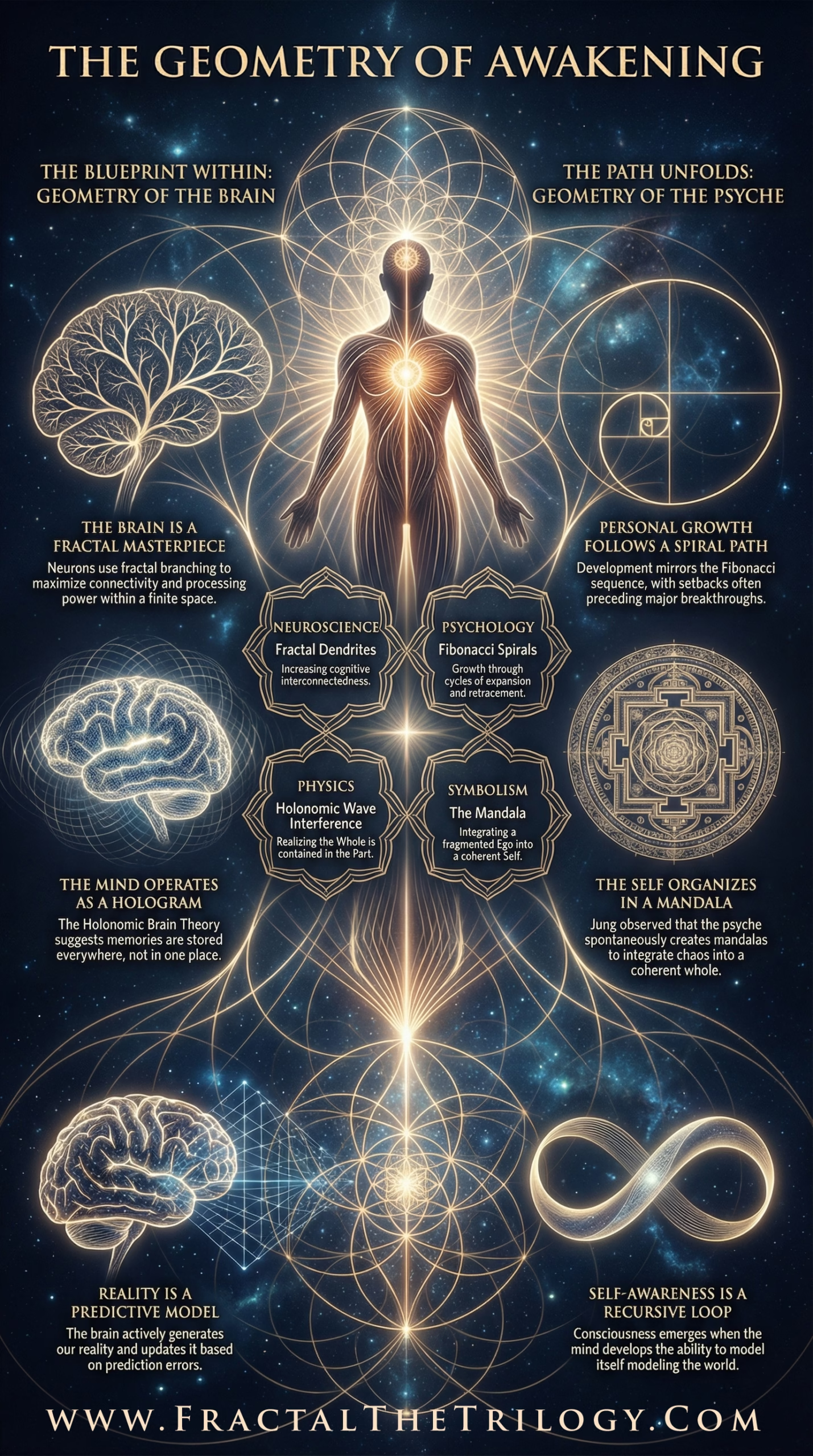
To understand the “software” of the awakened mind, one must first rigorously examine the “hardware” of the brain. The physical structure of the central nervous system is not a random tangle of wiring; it is a masterpiece of fractal engineering designed to solve a specific biological problem: how to maximize connectivity and information processing capacity within a finite volume and limited energy budget. This geometric efficiency forms the biological basis for what spiritual traditions have intuitively termed “sacred geometry.”
1.1 The Fractal Dimension of Dendritic Arbors
The neuron is the fundamental unit of cognition, and its morphology is strictly determined by the necessity of connection. A single neuron in the human cortex must receive input from thousands of other cells, creating a requirement for a vast receptive surface area packed into a microscopic volume. Nature’s universal solution to this packing problem is the fractal—a geometric shape that exhibits self-similarity across different scales.
Research into the morphology of neurons reveals that dendritic arbors—the complex, branching structures that receive synaptic inputs—exhibit distinct fractal characteristics. A fractal is quantified by its Fractal Dimension ($D$), a statistical index of complexity that compares how the detail in a pattern changes with the scale at which it is measured. Unlike Euclidean objects (where a line is 1D and a plane is 2D), fractals exist in fractional dimensions.
Recent studies analyzing 105 neuronal arbors have provided granular data on this geometry. They found that while individual dendritic branches often show “mild” fractal characteristics (approximating straight lines with a low Fractal Dimension, $D_B$), the arbor as a whole exhibits a much higher fractal dimension ($D_A$).1 This distinction is critical for understanding the “layered” nature of consciousness. It suggests that the complexity of the brain does not arise from the individual components being overly complex or chaotic, but from the arrangement, layering, and recursive stacking of simple components into a high-dimensional functional architecture.1
1.1.1 Optimization of Connectivity vs. Metabolic Cost
The fractal geometry of the brain is an evolutionary adaptation for optimization. A high fractal dimension in a dendritic arbor allows the neuron to explore 3D space extensively, maximizing the probability of forming synapses with other neurons. A neuron with a higher $D_A$ can “touch” more of its neighbors, integrating more diverse streams of information.2
However, there is a constraint: metabolic cost. Building and maintaining biological wire (axons and dendrites) consumes significant amounts of ATP. The brain, which represents only 2% of body weight but consumes 20% of the body’s energy 3, operates at a critical point of “criticality.” This is a state poised between order (low energy, low complexity) and chaos (high complexity, unsustainable energy cost).
If the fractal dimension is too low, the neural network is too sparse to support complex cognition or consciousness. If it is too high, the metabolic cost of maintaining the tissue exceeds the organism’s energy budget, leading to systemic failure. The human brain has settled on a specific range of fractal dimensions that balances these competing constraints.1 This geometric “sweet spot” allows for the emergence of complex functional connectivity, supporting the hypothesis that intelligence itself is a function of efficient geometric compression.
1.2 The Holonomic Brain: Consciousness as Wave Interference
If the physical structure of the brain is fractal, the functional mechanism of memory and perception appears to be holographic. The Holonomic Brain Theory, developed by neuroscientist Karl Pribram and physicist David Bohm, posits that the brain processes information not merely as discrete bits in localized neurons (like a digital computer), but as wave interference patterns.4
In a hologram, information is stored non-locally. If you cut a holographic film in half, you do not lose half the image; you lose resolution, but the whole image remains visible in the remaining piece. Pribram arrived at this model to explain the resilience of memory; experiments by Karl Lashley showed that removing large sections of a rat’s brain did not erase specific memories, suggesting that memory is distributed throughout the neural network rather than localized in a single “file”.4
1.2.1 The Mathematics of the Fourier Transform
The mathematical engine of the holonomic brain is the Fourier transform, an operation that converts complex spatial forms into wave frequencies. Pribram proposed that the dendritic webs of the brain—the fine-fibered networks discussed in the previous section—act as a resonant medium.5
Neural oscillations (brainwaves) create standing waves of electrical activity. When sensory input (a new wave) intersects with memory (a stored wave), the resulting interference pattern is the perception.6 This model suggests that our subjective experience of a stable, 3D reality is constructed mathematically by the brain interpreting frequencies from a “deeper order” of existence.3
The implications for the concept of “Sacred Geometry” are profound. If the brain operates holonomically, then the fundamental reality of the mind is not “things” but frequencies, ratios, and harmonics. The visual cortex does not “see” a chair; it processes the frequency transform of the chair and reconstructs the image holographically. “Awakening,” in this context, can be reinterpreted not as learning new information, but as increasing the coherence of these neural interference patterns. A “noisy” or “unawakened” mind is characterized by destructive interference—waves canceling each other out due to stress, trauma, or cognitive dissonance. An “awakened” mind exhibits constructive interference, allowing for a high-resolution, holographic perception of reality where the part is seen to contain the whole.6
1.3 Predictive Coding and Recursive Hierarchies
Contemporary neuroscience has moved toward a model of Predictive Coding, which asserts that the brain is a fundamental probability machine. It does not passively receive sensory data; it actively generates a generative model of the world and constantly updates that model based on prediction errors.7
This process is inherently recursive and hierarchical, mirroring the structure of a fractal.
- Top-Down Processing: Higher cortical levels (e.g., frontoparietal cortices) predict the activity of lower levels (e.g., visual cortex).
- Bottom-Up Processing: Prediction errors (surprises) flow up the hierarchy to update the model.
This architecture consists of nested loops of information processing operating at different temporal and spatial scales. Language processing in the human brain, for instance, has been shown to organize hierarchically, with higher areas predicting longer-range and more abstract representations than lower areas.9 This recursive capability—the ability to embed a thought within a thought, or a model within a model—is argued by some cognitive scientists to be the primary feature distinguishing human cognition from other species.10
The implications for “awakening” are significant. If our experience of reality is a controlled hallucination generated by a predictive model, then expanding consciousness involves updating the priors—the fundamental beliefs and geometric assumptions—that structure the model. The “membranes” of reality described in mystical texts can be understood scientifically as the distinct layers of this predictive hierarchy.11 To “break the membrane” is to ascend the predictive hierarchy, moving from modeling the content of the world to modeling the context of the modeler itself.
Part II: The Geometry of Becoming – Psychological Spirals and Mandalas
Moving from the biological substrate to the psychological experience, we find that the development of the self follows the same geometric principles found in biological growth. Human maturation is not linear; it is a logarithmic spiral, often adhering to the Fibonacci sequence and the golden ratio ($\phi$).
2.1 The Fibonacci Sequence in Psychological Growth
The Fibonacci sequence ($0, 1, 1, 2, 3, 5, 8, 13…$) defines a pattern where each number is the sum of the previous two. The ratio between consecutive numbers approximates the Golden Ratio ($1.618…$), a proportion found universally in nature, from the arrangement of sunflower seeds (phyllotaxis) to the spiral arms of galaxies.12
In psychology, the Fibonacci sequence offers a compelling model for the non-linear nature of healing and development. Human progress rarely happens in a straight line. It follows a pattern of expansion, regression (retracement), and then a breakthrough to a higher level of integration.13
2.1.1 Retracement as Re-alignment
Financial markets, which are essentially graphs of collective human psychology, utilize “Fibonacci Retracement” levels (23.6%, 38.2%, 61.8%) to predict market corrections. Similarly, in individual development, a “retracement” or regression to old habits is often not a failure, but a structural necessity—a gathering of energy required to propel the psyche to the next developmental integer.13
The Fibonacci Life-Chart Method (FLCM) has been applied to Erik Erikson’s stages of psychosocial development, suggesting that the timing of major life crises and maturation points follows a Fibonacci-based temporal pattern.14 This supports the idea that the “unfolding” of a human life is governed by the same mathematical laws that unfold a fern leaf or a nautilus shell. The spiral nature of time, where we revisit the same lessons at deeper levels of understanding, is a direct manifestation of this recursive geometry.12
2.2 Recursion and the Emergence of the Self
What is the “Self”? Cognitive science increasingly views the self not as a static entity, but as a recursive process—a “strange loop” where the system models itself modeling the world.
The Recursive Self-Modeling Threshold (RSMT) theory suggests that consciousness emerges when a system crosses a specific functional threshold: it develops a stable symbolic representation of itself and recursively operates on that symbol.15
- Level 1 (0-3 months): Proto-unity. No distinction between self and world (Non-dual awareness).
- Level 2 (18 months): Mirror recognition. The self becomes an object to itself (the first recursive loop).16
- Level 3 (4 years): Theory of Mind. “I think that you think that I think” (nested recursion).17
This recursive scaling allows for the phenomenon of “mental time travel”—the ability to project the self into the past or future. Awakening, in this context, is the expansion of this recursion to include the “Observer” itself—the realization that the “I” is just another symbol within the model, allowing consciousness to disidentify from the ego-construct and rest in the recursive process itself.18
2.3 Jungian Mandalas: The Geometry of Wholeness
Carl Jung, the pioneer of depth psychology, identified the Mandala (Sanskrit for “circle”) as the archetypal image of the Self. He observed that during periods of psychic chaos or transformation, the unconscious spontaneously generates mandala patterns—circular, symmetrical, often four-fold designs—to restore order.19
2.3.1 Circumambulation of the Self
Jung famously stated, “There is no linear evolution; there is only a circumambulation of the self”.21 This concept describes the process of Individuation (becoming whole) not as climbing a ladder, but as spiraling around a central point.
- The Center: The Self (the totality of conscious and unconscious).
- The Path: A spiral approach. We revisit the same traumas, archetypes, and lessons, but from a different vantage point (altitude) each time.22
This “circumambulation” is a fractal movement. We face the “Shadow” archetype at age 20, again at 40, and again at 60. The content changes, but the geometric relationship to the center remains constant. The mandala serves as a “psychocosmogram”—a map of the inner universe that organizes the chaotic fragments of the psyche into a coherent, symmetrical whole.20
Recent studies in positive psychology confirm Jung’s intuition: the creation of mandalas has been shown to significantly improve subjective well-being and mindfulness compared to unstructured drawing, suggesting that the geometric structure itself facilitates psychological integration.23 The mandala is the psychological equivalent of the Holonomic Brain’s interference pattern; it is the visual representation of constructive interference within the psyche—a state where opposing forces (conscious/unconscious, masculine/feminine) are held in dynamic equilibrium.
Part III: The Code of Life – Evolutionary Fractals and Turing Patterns
The mathematical patterns governing the mind are mirrors of the patterns governing biological life. Evolution is not merely a random roll of the genetic dice; it is a search algorithm navigating a fitness landscape defined by geometric constraints.
3.1 Turing Patterns and the Chemical Basis of Form
In 1952, Alan Turing, the father of computer science, published The Chemical Basis of Morphogenesis. He mathematically demonstrated how complex biological patterns—stripes, spots, spirals—could arise spontaneously from a homogeneous state through the interaction of two chemical substances (activators and inhibitors) diffusing at different rates.24
These Reaction-Diffusion systems explain how nature builds order from chaos without a master planner. The same math that creates the stripes on a zebra creates the ridges of a fingerprint, the spacing of hair follicles, and potentially the layout of ocular dominance columns in the visual cortex.25
In the context of the brain, Turing-like mechanisms are thought to guide the folding of the cerebral cortex (gyrification), creating the fractal surface area necessary for higher cognition.26 The brain folds itself because the laws of physics and chemistry dictate that specific geometry as the most energy-efficient solution to spatial constraints. This implies that biological form—and the neural substrate of consciousness—is an emergent property of universal mathematical laws, not random accident.
3.2 Convergent Evolution and the “Attractor”
If you replay the tape of life, would it look the same? The phenomenon of Convergent Evolution suggests that the answer is yes, at least geometrically. Distantly related species often evolve nearly identical solutions to the same problems:
- Hydrodynamics: Sharks (fish), Ichthyosaurs (reptiles), and Dolphins (mammals) all evolved the same fusiform (torpedo-like) body shape to minimize drag.27
- Optics: Vertebrates and Cephalopods (octopuses) independently evolved the camera-type eye, despite their evolutionary lineages diverging hundreds of millions of years ago.28
These convergences suggest that the “design space” of reality is not infinite. There are specific “Attractors”—optimal geometric solutions—that evolution inevitably gravitates toward.29
Philosophical Implication: If evolution converges on specific physical geometries (the eye, the wing, the fin), it is plausible that it also converges on specific cognitive geometries. “Awakening” or “Enlightenment” may not be a cultural invention, but an evolutionary attractor—a state of optimal cognitive processing that different species and civilizations inevitably discover when their neural complexity reaches a certain threshold. The “Fractal Mind” is the convergent solution to the problem of processing infinite information with finite resources.
3.3 Evolution as a Recursive Fractal Process
Evolution itself behaves like a fractal. The same patterns of differentiation, selection, and integration occur at the molecular level (genes), the cellular level (tissues), the organism level (species), and the cognitive level (ideas/memes).30
This “Omni-dimensional fractal nature of evolution” suggests that the process of becoming is scale-invariant.30 The growth of a forest, the growth of a neuron, and the growth of a society follow the same recursive logic. We are not just in the universe; we are the universe behaving fractally. The recursive loops of feedback—where the output of one generation becomes the input of the next—drive the system toward higher complexity and self-awareness.31
Part IV: The Narrative of Awakening – A Fractal-Inspired Vision
The synthesis of these scientific realities finds its narrative expression in the literary and philosophical work Fractal: The Awakening. This text serves as a powerful case study for how these mathematical principles translate into the subjective experience of spiritual transformation. The protagonist, Elias Chronis (“The Seeker of the Fractal”), navigates a world collapsing under linear, extractive systems, searching for a higher order of existence.
4.1 The Recursion of Reality: “I Am You”
In Fractal: The Awakening, Elias undergoes a journey that mirrors the scientific concepts of recursion and holography. His pivotal realization occurs not through linear deduction, but through a collapse of the subject-object distinction—a phenomenon well-documented in deep meditative states and psychedelic research.18
In the “Hidden Chamber” beneath Mount Kailash, Elias encounters an entity that reveals itself to be a higher harmonic of his own consciousness.11 The dialogue explicitly frames identity as recursive:
- “I am the part of you that exists beyond your current boundary of awareness.”
- “I am the higher resolution of your own unfolding consciousness.”.11
This narrative beat perfectly illustrates the Recursive Self-Modeling Threshold.15 Elias realizes that the “external” guide is actually an internal projection of his own potential—a feedback loop closing on itself. The text states: “You are not a traveler within the fractal. You are the fractal itself remembering its nature”.11 This is the ultimate recursion: the universe modeling itself through the human mind.
4.2 The Trinity Monument and the Membrane
The story utilizes architectural symbolism to map the structure of reality. At Matthias Church in Budapest, Elias contemplates the Trinity Monument and the fractal patterns of the Gothic facade.11 He perceives a “Trinity Model of Reality” that aligns with the physics of projection:
- The Source: The origin point (Singularity/Quantum Vacuum).
- Consciousness: The projection/light (The Observation/Wave Function).
- The Membrane: Space-Time/Matter (The Screen/Hologram).11
This model echoes the Holographic Principle in physics—where the 3D universe is a projection of information encoded on a 2D surface (membrane).32 Elias’s realization is that this membrane is not fixed; it is navigable through the manipulation of attention (symbolized by the “Bird” jumping between spires).11 He realizes, “THE MOUNTAIN ISN’T JUST KAILASH. IT’S THE PROJECTION OF OUR OWN AWAKENING”.11 The external world is recognized as a projection of the internal state, validating the Holonomic theory that perception is a construct of interference patterns.
4.3 Awakening as Patterned Remembrance
The conclusion of the report draws upon Elias’s final message to humanity. Awakening is defined not as a chaotic disruption or a departure from the physical, but as a “Renaissance of Responsibility” based on Patterned Remembrance.11
The text argues that humanity is drowning in data but starving for wisdom—essentially, we have high information content but low geometric coherence. The “Awakening” is the transition from a fragmented, linear perception of time (Chronos) to a holistic, spiral perception where every moment connects to the center.
Key Quote: “The fractal isn’t fixed. It’s navigable. If the fractal is a projection, then perhaps there is a way to move through the projector itself… To choose. To escape.” – Elias Chronis.11
However, the ultimate wisdom gained is that “escape” is a misunderstanding. The goal is Alignment. Just as a neuron must align with the fractal structure of the arbor to function, the human soul must align with the fractal structure of existence to awaken. Elias exhorts humanity: “DO NOT WAIT FOR SAVIORS. THE TIME OF AWAKENING IS NOW… PLANT SEEDS OF TRUTH… SO THAT ONE DAY, OUR CHILDREN MAY SAY: THAT WAS THE TIME WHEN HUMANITY REMEMBERED ITSELF”.11
Part V: Synthesis – The Geometry of the Soul
5.1 The Mind as a Fractal Antenna
Synthesizing the neurobiology and the mysticism, we arrive at a unified theory: The human mind is a fractal antenna.
- Structurally: Our dendrites are fractal ($D_A \approx 2.5$) to maximize the surface area for receiving information.2
- Functionally: Our brain processes information holographically (Holonomic Theory), allowing us to reconstruct the whole from the parts.4
- Psychologically: We grow in spirals (Fibonacci), circling the core of the Self (Mandala) through recursive life cycles.22
- Spiritually: Awakening is the conscious recognition of this geometry—the alignment of the micro-fractal (individual) with the macro-fractal (universal).
When an individual engages in “sacred” practices—meditation, mandala drawing, recursive self-inquiry—they are not engaging in magic. They are engaging in Neural Tuning. They are adjusting the fractal dimension of their attention to match the fractal dimension of the universe. This allows for optimal information transfer, experienced subjectively as “flow,” “oneness,” or “grace.”
5.2 The Resonance of Coherence
The concept of “Sacred Geometry” is often dismissed as esoteric, but in light of this research, it can be redefined as Geometric Coherence.
- Incoherence: Stress, trauma, and fear create “noise”—disordered wave patterns in the brain (destructive interference). This isolates the individual in a fragmented reality.
- Coherence: Love, gratitude, and compassion create ordered, harmonic wave patterns (constructive interference).34 This connects the individual to the larger field.
The “Awakening” described in Fractal and supported by the science of the Holonomic Brain is the state of maximum coherence. It is the moment where the internal fractal (the mind) resonates perfectly with the external fractal (the cosmos).
Table 1: The Isomorphism of Awakening
Domain | The Pattern | The Function | The “Awakening” Parallel |
Neuroscience | Fractal Dendrites ($D_B$/$D_A$) | Connectivity & Optimization | Increasing cognitive “bandwidth” and interconnectedness. |
Physics | Holonomic Wave Interference | Distributed Memory | Realizing the Whole is contained in the Part (Non-duality). |
Psychology | Fibonacci Spirals | Non-linear Growth | Retracement (Dark Night of the Soul) leads to expansion. |
Evolution | Convergent Attractors | Optimization of Form | Convergence toward a universal state of higher consciousness. |
Symbolism | The Mandala | Center & Periphery | Integrating the fragmented Ego into the Self. |
Philosophy | Recursion (The Loop) | Self-Reference | The Observer observing the Observer (Meta-Cognition). |
Conclusion: A Vision of Order
Human awakening is not a descent into chaos or a flight of fancy. It is a return to order. It follows mathematical patterns because mathematics is the language of relationship, and awakening is the ultimate restoration of relationship—between the part and the whole, the neuron and the network, the self and the Source.
The universe does not make mistakes. The spiraling path of the nautilus, the branching of the dendrite, the circumambulation of the soul, and the recursive loops of history are all expressions of the same underlying code. We do not walk a straight line to enlightenment; we spiral inward, guided by the golden ratio, returning to the center where we began, only to know it for the first time.
As Elias Chronis concludes in The Awakening: “The fractal breathes — and we are part of its song…. We are not here to escape the world. We are here to transform it”.11 The math is clear: we are built for this transformation. The geometry is already inside us, waiting for the signal of our own attention to light it up. The awakening is simply the recognition that we are the pattern we have been searching for.
Works cited
- Neuron arbor geometry is sensitive to the limited-range fractal properties of their dendrites, accessed January 9, 2026, https://pmc.ncbi.nlm.nih.gov/articles/PMC10013056/
- Investigating Fractal Analysis as a Diagnostic Tool That Probes the Connectivity of Hippocampal Neurons – Frontiers, accessed January 9, 2026, https://www.frontiersin.org/journals/physiology/articles/10.3389/fphys.2022.932598/full
- Article 135: The Holographic Universe – Part 4 – Dr. Karl Pribram & the Holographic Brain – Cosmic Core, accessed January 9, 2026, https://www.cosmic-core.org/free/article-135-the-holographic-universe-part-4-dr-karl-pribram-the-holographic-brain/
- Holonomic brain theory – Wikipedia, accessed January 9, 2026, https://en.wikipedia.org/wiki/Holonomic_brain_theory
- Holonomic brain theory – Scholarpedia, accessed January 9, 2026, http://www.scholarpedia.org/article/Holonomic_brain_theory
- Holonomic Brain Theory: A Revolutionary Perspective on Consciousness and Memory, accessed January 9, 2026, https://bodyofharmony.com/blogs/health-news/holonomic-brain-theory-a-revolutionary-perspective-on-consciousness-and-memory
- Evidence of a predictive coding hierarchy in the human brain listening to speech – NIH, accessed January 9, 2026, https://pmc.ncbi.nlm.nih.gov/articles/PMC10038805/
- Dynamic predictive coding: A model of hierarchical sequence learning and prediction in the neocortex – PubMed Central, accessed January 9, 2026, https://pmc.ncbi.nlm.nih.gov/articles/PMC10880975/
- (PDF) Evidence of a predictive coding hierarchy in the human brain listening to speech, accessed January 9, 2026, https://www.researchgate.net/publication/368941593_Evidence_of_a_predictive_coding_hierarchy_in_the_human_brain_listening_to_speech
- The Uniqueness of Human Recursive Thinking | American Scientist, accessed January 9, 2026, https://www.americanscientist.org/article/the-uniqueness-of-human-recursive-thinking
- FRACTAL – THE AWAKENING
- Time as Spiral: The Fibonacci Architecture of Reality – Interalia Magazine, accessed January 9, 2026, https://www.interaliamag.org/articles/domenico-meschino-and-omni-intelligence-ai-time-as-spiral-the-fibonacci-architecture-of-reality/
- ✓ Fibonacci Retracement: Unlocking the Secret Power of the Universe – Dr. Amit Ray, accessed January 9, 2026, https://amitray.com/fibonacci-retracement-unlocking-the-secrets-of-the-universe/
- Re-Envisaging the Eight Developmental Stages of Erik Erikson: The Fibonacci Life-Chart Method (FLCM) | Sacco – Canadian Center of Science and Education, accessed January 9, 2026, https://www.ccsenet.org/journal/index.php/jedp/article/view/24725
- The Recursive Self-Modeling Threshold: A Functional Theory of Consciousness and Subjectivity – ResearchGate, accessed January 9, 2026, https://www.researchgate.net/publication/391335705_The_Recursive_Self-Modeling_Threshold_A_Functional_Theory_of_Consciousness_and_Subjectivity
- From Waves to Thought. How recursion creates a mind. | by Jeff Reid | Medium, accessed January 9, 2026, https://medium.com/@jeff_94610/from-waves-to-thought-c44f4d0533cb
- Neural correlates of recursive thinking during interpersonal strategic interactions – PMC, accessed January 9, 2026, https://pmc.ncbi.nlm.nih.gov/articles/PMC8046141/
- Sacred Geometry and the Architecture of Consciousness | by Jose Cendejas | Medium, accessed January 9, 2026, https://medium.com/@davecendejas/sacred-geometry-and-the-architecture-of-consciousness-8f82c1b18c50
- Mandala Archetype: How the Self Turns Chaos Into Cosmos – This Jungian Life, accessed January 9, 2026, https://thisjungianlife.com/mandala-archetype/
- Carl Jung – Circles and the Self – Enfys Radley, accessed January 9, 2026, https://enfysjradley.wordpress.com/2016/03/12/carl-jung-circles-and-the-self/
- “There is no linear evolution; there is only a circumambulation of the self.” — Carl Jung, Psychology and Alchemy. – Reddit, accessed January 9, 2026, https://www.reddit.com/r/Jung/comments/1la63xm/there_is_no_linear_evolution_there_is_only_a/
- Personal Alchemy: Carl Jung’s Circumambulation of the Self – James Tripp, accessed January 9, 2026, https://www.jamestripp.co.uk/blog/blog/personal-alchemy-carl-jungs-circumambulation-of-the-self
- Cooperative and Individual Mandala Drawing Have Different Effects on Mindfulness, Spirituality, and Subjective Well-Being – NIH, accessed January 9, 2026, https://pmc.ncbi.nlm.nih.gov/articles/PMC7581735/
- Turing pattern – Wikipedia, accessed January 9, 2026, https://en.wikipedia.org/wiki/Turing_pattern
- Turing’s model for biological pattern formation and the robustness problem – PMC, accessed January 9, 2026, https://pmc.ncbi.nlm.nih.gov/articles/PMC3363041/
- Fractal dimension in human cortical surface: Multiple regression analysis with cortical thickness, sulcal depth, and folding area – PubMed Central, accessed January 9, 2026, https://pmc.ncbi.nlm.nih.gov/articles/PMC6871396/
- Convergent evolution explained with 13 examples | Natural History Museum, accessed January 9, 2026, https://www.nhm.ac.uk/discover/convergent-evolution.html
- 18.5G: Convergent Evolution – Biology LibreTexts, accessed January 9, 2026, https://bio.libretexts.org/Bookshelves/Introductory_and_General_Biology/General_Biology_(Boundless)/18%3A_Evolution_and_the_Origin_of_Species/18.05%3A_Evidence_of_Evolution/18.5G%3A_Convergent_Evolution
- (PDF) Convergent Evolution and the Origin of Complex Phenotypes in the Age of Systems Biology – ResearchGate, accessed January 9, 2026, https://www.researchgate.net/publication/298800886_Convergent_Evolution_and_the_Origin_of_Complex_Phenotypes_in_the_Age_of_Systems_Biology
- the omni-dimensional fractal nature of evolution | by Brecht Corbeel – Medium, accessed January 9, 2026, https://medium.com/@brechtcorbeel/the-omni-dimensional-fractal-nature-of-evolution-52743a8a5303
- accessed January 9, 2026, https://www.journals.uchicago.edu/doi/abs/10.1086/707748#:~:text=Evolution%20is%20never%20truly%20predictable,others%20evolve%20in%20the%20future.
- New Study Suggests that the Human Brain has a Fractal Architecture and is Poised at a Critical State Between Two Phases, accessed January 9, 2026, https://spacefed.com/biology/new-study-suggests-that-the-human-brain-has-a-fractal-architecture-and-is-poised-at-a-critical-state-between-two-phases/
- [PDF] The Fractal Geometry of the Brain – Semantic Scholar, accessed January 9, 2026, https://www.semanticscholar.org/paper/The-Fractal-Geometry-of-the-Brain-Ieva/6b9356d0e1eadea81407bcd5d138f549dd74e00b
- Hidden time-patterns in cyclic human movements: a matter of temporal Fibonacci sequence generation and harmonization – PMC – PubMed Central, accessed January 9, 2026, https://pmc.ncbi.nlm.nih.gov/articles/PMC12011819/