PODCAST: Free Will in a Fractal Universe
I. The Clockwork Prison and the Ghost in the Machine
The Echo of the Big Bang: Understanding the Deterministic Cage
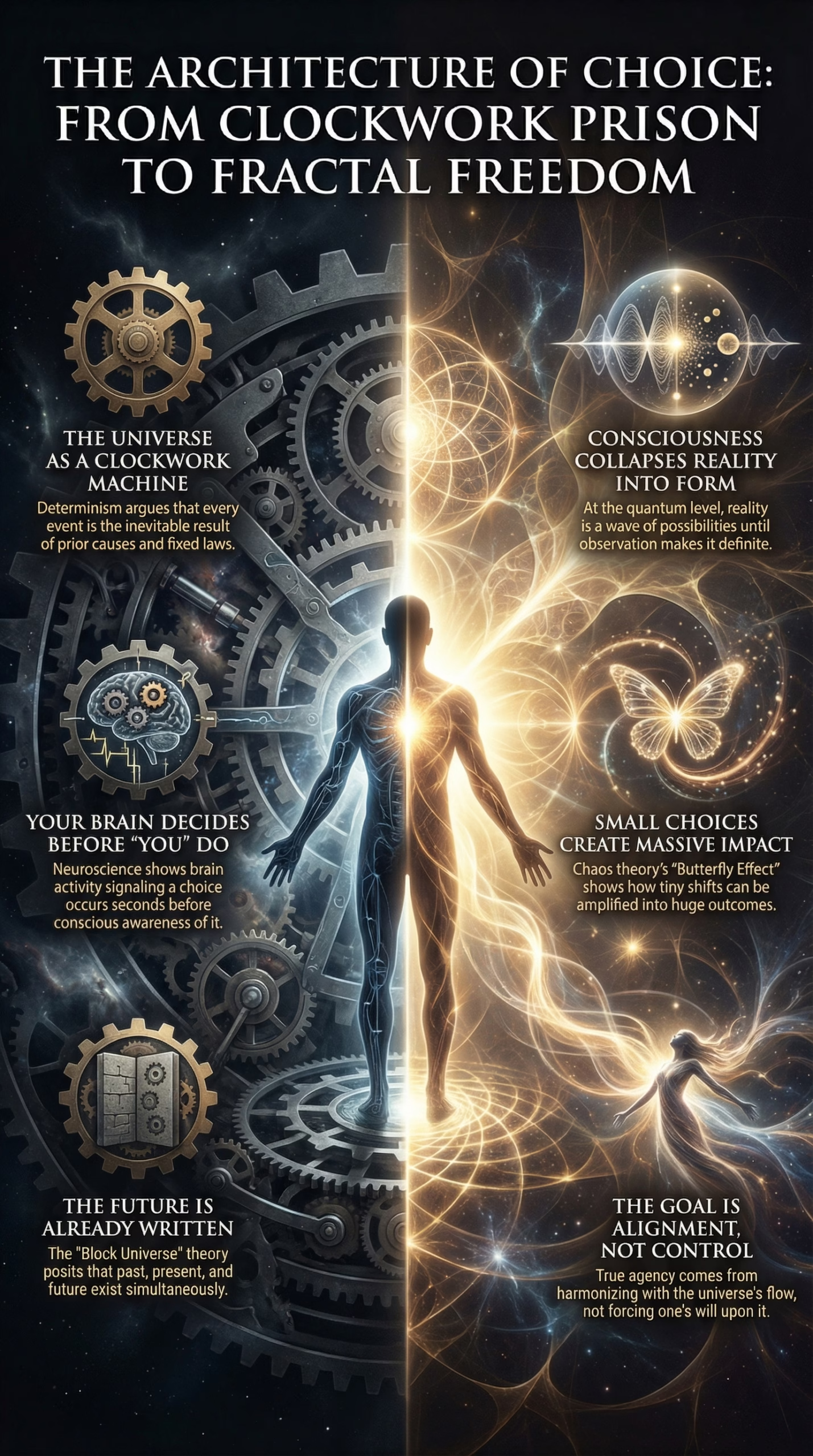
Imagine, for a moment, that you are standing at the edge of a vast, still lake. You pick up a stone—a jagged, cold piece of slate—and you cast it into the water. The ripples expand outward in perfect concentric circles, mathematically precise, inevitable. Now, imagine that the universe is that lake, and the Big Bang was the first stone. In the classical view of reality, every ripple, every collision of atoms, every starburst, and every thought you have ever had is merely the expanding shockwave of that initial event. This is the terrifying beauty of determinism: the idea that the state of the universe at any given moment is the necessary consequence of the state immediately preceding it, governed by immutable laws of physics.1
For centuries, this “clockwork universe” has been the dominant narrative of science. It suggests that if a super-intelligence—often personified as “Laplace’s Demon”—knew the precise position and momentum of every particle in the universe at a single instant, it could perfectly predict the future and retrodict the past.3 In this view, “free will” is not merely a difficult problem; it is a logical impossibility. You did not choose to read this sentence; the causal chain of the cosmos, firing through your neurons like electricity through a circuit board, determined it billions of years before your birth. The sensation of choice is merely the hum of the machine, a post-hoc narrative constructed by the brain to explain actions it had no power to prevent.
However, as we venture deeper into the 21st century, the walls of this deterministic prison are beginning to crack. We are witnessing a convergence of disciplines—quantum physics, neuroscience, chaos theory, and consciousness studies—that suggests reality is not a linear machine, but a fractal web of infinite probability. This report explores the radical possibility that free will exists not as a violation of physical laws, but as an intrinsic property of a fractal universe. By synthesizing modern scientific research with the visionary philosophy of Fractal – The Awakening and The Oracle 2.0, we will examine whether human consciousness acts as a “selecting force” in a reality governed by probabilistic laws.4
The Neuroscience of No Choice: The Readiness Potential
The assault on free will is not just philosophical; it is biological. In the 1980s, the neuroscientist Benjamin Libet conducted a series of experiments that sent shockwaves through the scientific community. He asked participants to flex their wrists at a time of their choosing while monitoring their brain activity. Libet discovered that a buildup of electrical potential in the brain, known as the Bereitschaftspotential or “readiness potential,” occurred several hundred milliseconds before the subjects reported being consciously aware of their decision to move.5
This finding has been replicated and refined with modern fMRI technology, which can sometimes predict a person’s choice up to several seconds before they are consciously aware of making it. The implication is stark: the brain makes the decision, and “you”—the conscious observer—are informed later, like a CEO signing off on a memo written by a subordinate. Hard determinists like Robert Sapolsky argue that this biologic machinery leaves no room for free will. In his view, we are biological robots, conditioned by genes, environment, and neurochemistry, playing out a script we did not write.6
Yet, the “readiness potential” interpretation is fiercely debated. Some researchers argue that this neural activity represents a buildup of background noise—a “stochastic accumulation”—that only tips into a decision when it crosses a threshold.7 This introduces the possibility of a “conscious veto,” or what some call “free won’t”—the ability of the conscious mind to interrupt the neural cascade before action occurs. This nuance opens the door to Compatibilism, the view that free will is compatible with a deterministic framework, provided we define freedom not as “uncaused action” but as “action in accordance with one’s desires”.1
Viewpoint | Definition of Free Will | Role of Consciousness | Relationship to Physics |
Hard Determinism | An illusion. All events are caused by prior events. | Epiphenomenal (a byproduct without causal power). | Strictly adheres to classical Newtonian mechanics. |
Libertarian Free Will | The power to be the “uncaused cause” of action. | The primary driver of agency. | Requires a breach in causal closure (often dualistic). |
Compatibilism | Freedom to act according to one’s nature/desires. | Relevant for moral responsibility, but causally determined. | Accepts determinism but redefines “freedom.” |
Fractal Agency | The capacity to navigate/select probabilistic timelines. | A collapsing/selecting force in a quantum/fractal system. | Integrates Quantum Mechanics, Chaos Theory, & Complexity. |
The Existential Vertigo of the “Block Universe”
To fully grasp the stakes of the free will vs determinism debate, one must confront the concept of the “Block Universe” derived from Einstein’s General Relativity. In this model, time does not “flow.” Past, present, and future exist simultaneously as a four-dimensional block of spacetime.9 If the future already exists—frozen in the geometry of the cosmos—then our struggle to make “better choices” is as futile as a character in a movie trying to change the ending of the film.
However, the “Block Universe” relies on a classical interpretation of physics that ignores the indeterminacy of the quantum realm. It is here, in the microscopic foundations of reality, that the “clockwork” breaks down, and the “fractal” begins to emerge. The universe is not a frozen block; it is a seething ocean of possibility, where the act of observation itself may hold the key to unlocking the cage.10
II. The Quantum Rupture: Where Probability Meets Presence
Shattering the Illusion of Objectivity
The early 20th century witnessed the single greatest rupture in the history of human thought: the discovery of quantum mechanics. Physicists like Heisenberg, Schrödinger, and Bohr revealed that at the fundamental level, matter does not exist in definite states. An electron is not a particle in a specific location; it is a “wave function,” a mathematical description of probabilities spreading out across space. It is only when we measure or observe the particle that the wave function “collapses” into a definite state.10
This phenomenon, known as the Observer Effect, shattered the assumption of an objective, independent reality. It suggests that the observer is not separate from the system but is entangled with it. As stated in the Fractal trilogy, “Reality collapses into form only at the moment of observation. Outside of observation, it remains undefined probability… pure potential”.4
The Von Neumann-Wigner Interpretation: Consciousness as the Collapsing Force
While the standard Copenhagen interpretation of quantum mechanics is vague about what constitutes a “measurement,” John von Neumann and Eugene Wigner followed the logic to its radical conclusion. They argued that the physical chain of measurement (the particle, the detector, the optic nerve, the brain) is all made of quantum matter and thus subject to superposition. The only thing that is not physical—and therefore capable of collapsing the wave function—is consciousness itself.12
This Consciousness Causes Collapse theory posits that the human mind is the “selecting force” that actualizes reality. In a deterministic universe, the future is fixed. In a quantum universe interpreted through Von Neumann, the future is a superposition of infinite possibilities, and consciousness is the agent that chooses which possibility becomes real. This aligns with the “Awakening Key” from The Oracle 2.0: “The Observer is not watching the world. The Observer is the world, watching itself”.4
Orchestrated Objective Reduction (Orch-OR): The Biology of Quantum Choice
For decades, critics argued that the “warm, wet, and noisy” environment of the brain would destroy delicate quantum states, making quantum free will impossible. However, the Orchestrated Objective Reduction (Orch-OR) theory, developed by Nobel laureate Sir Roger Penrose and anesthesiologist Stuart Hameroff, proposes a biological mechanism for quantum consciousness.13
They identify microtubules—structural protein lattices inside neurons—as the sites of quantum computation. Orch-OR suggests that these microtubules insulate quantum states from environmental noise, allowing them to exist in superposition. When the superposition collapses (via “Objective Reduction” related to spacetime geometry), it produces a moment of conscious awareness. Crucially, this collapse is not random. It is “orchestrated” by the brain’s biological inputs and, Penrose suggests, by Platonic values embedded in the geometry of the universe.15
This theory provides a scientific basis for the “Fractal” concept of Alignment. If our conscious moments are linked to the fundamental geometry of spacetime, then free will is not about “controlling” the brain’s output, but about “aligning” the quantum vibrations of the microtubules with the deeper order of the universe.16
Quantum Bayesianism (QBism): The Agent at the Center
Another revolutionary framework is Quantum Bayesianism (QBism). QBism asserts that the wave function does not describe objective reality, but rather the agent’s subjective expectations about reality.17 In this view, probability is not a law of nature; it is a tool of the agent.
QBism restores the “First-Person” perspective to physics. It implies that the universe is not a finished book, but a participatory narrative being written in real-time by the agents within it. “The future is not written—it’s coded through choice”.4 This perspective aligns perfectly with the philosophy of Fractal – The Awakening, where Elias realizes that “The Archives do not merely hold the past. They hold the memory of infinite presents”.4 Every measurement, every observation, and every choice is an act of world-creation.
III. The Fractal Architecture: Self-Similarity and the Butterfly Effect
Beyond Linearity: Defining the Fractal Universe
While quantum mechanics introduces probability, Fractal Geometry provides the structure. A fractal is a mathematical set that exhibits a repeating pattern at every scale. If you zoom in on a coastline, a fern, or the Mandelbrot set, you see the same complexity at the microscopic level as you do at the macroscopic level.19
The hypothesis of the Fractal Universe suggests that reality itself is recursive. The patterns of the cosmos (galaxies, gravity) are reflected in the patterns of the mind (neurons, thoughts). “As above, so below.” This implies that the laws governing the universe are not just external constraints but are woven into the very fabric of our consciousness.21
Chaos Theory and the Amplification of Will
In a linear system, a small cause produces a small effect. If you nudge a billiard ball slightly, its path changes slightly. But in a non-linear, chaotic system, a microscopic change in initial conditions can result in a macroscopic divergence in outcomes. This is the Butterfly Effect: the flapping of a butterfly’s wings in Brazil can set off a tornado in Texas.22
The human brain is a chaotic system operating at a state of self-organized criticality.24 It balances on the knife-edge between order and disorder. This sensitivity suggests that “free will” does not need to move mountains; it only needs to move an electron. A subtle shift in attention, a momentary “veto” of a neural impulse, or a quantum collapse in a microtubule can be amplified by the brain’s chaotic dynamics into a major behavioral change.25
This provides a mechanism for Choice Amplification. In a fractal universe, there are no “small” choices. Every micro-decision ripples outward, scaling up through the fractal levels of reality. As The Oracle 2.0 states: “We Are Coding the Future with Every Choice”.4 The fractal nature of action means that the quality of your “small” interactions (how you breathe, how you listen) determines the quality of the “large” outcomes (your destiny, collective history).
Fractal Time and the “Eternal Now”
We typically perceive time as a linear river flowing from past to future. However, the fractal view proposes Fractal Time: a model where time is experienced as a series of nested loops or cycles.26 Just as a fractal shape repeats in space, fractal time repeats in duration. History rhymes; patterns recur.
In Fractal – The Awakening, the “Bell” tolls to symbolize the Eternal Now—the vertical dimension of time that intersects the horizontal flow.4 In fractal time, the present moment is the “singularity” where all scales converge. By becoming fully present (entering the “Now”), consciousness steps out of the deterministic loop of the past (Karma) and accesses the creative potential of the fractal boundary.26
This redefines free will. It is not the ability to change the past or control the distant future. It is the ability to fully inhabit the Now, the only point where the fractal is being generated. “Eternity is Found in the Present Moment”.
IV. Consciousness as a Selecting Force: Navigating the Multiverse
The Multiverse of Infinite Presents
If the universe is fractal and quantum, it likely contains infinite branches of possibility. The Many Worlds Interpretation of quantum mechanics suggests that every quantum event splits the universe into separate timelines. In this context, “free will” is not about creating a new path, but about selecting which path to experience.21
Imagine a radio. All stations exist simultaneously in the electromagnetic field. The radio does not “create” the music; it selects the frequency. Similarly, consciousness may act as a tuning fork. Our internal state (our beliefs, emotions, and intentions) determines which “timeline” or “probability branch” we resonate with.16
In the novel Fractal, Elias realizes that “The fractal isn’t fixed. It’s navigable”.4 He understands that “The Source projects all possibilities, but we are the ones who choose which beam to ride.” This moves the debate from “Do we have free will?” to “How skilled are we at navigation?”
The Mechanism of Resonance
How does this selection occur? The concept of Resonance suggests that like attracts like. In a holographic or fractal universe, information is distributed non-locally. When the mind holds a coherent intention (a state of low entropy), it resonates with the corresponding pattern in the quantum field.28
- Incoherence (Entropy): When the mind is scattered, fearful, or reactive, it is subject to the deterministic “noise” of the environment. It drifts along the path of least resistance (Hard Determinism).
- Coherence (Syntropy): When the mind is focused, meditative, and aligned, it generates a strong signal that “collapses” the probability field into a specific order. This is the Observer Effect applied to destiny.
The “Free Will Theorem”: Agency as a Fundamental Constant
The idea that agency is fundamental to the universe is supported by the Free Will Theorem of Conway and Kochen. They proved mathematically that if human experimenters are free to choose their measurements, then elementary particles must also possess a primitive form of freedom.29
This suggests that free will is not a “ghost” that enters the machine late in evolution. It is a fractal property of the cosmos, present at the level of the electron and scaled up to the level of the human soul. We are the high-resolution aperture of a universe that has always been choosing.
Alignment vs. Control: The Philosophical Pivot
The most profound shift offered by the fractal perspective is the move from Control to Alignment.
- Control (The Egoic Path): The classical view of free will is the ego’s desire to dominate the environment. “I want to force the world to be X.” This approach fights against the current, creating resistance and suffering. It assumes separation.
- Alignment (The Fractal Path): The fractal view suggests that because we are the system, our greatest power comes from harmonizing with its flow. “I align my intention with the unfolding pattern.” This is not passivity; it is active surrender.
As The Oracle teaches in the trilogy: “The mind fears what it cannot control… But your purpose was never control. Your purpose is alignment”.4 By aligning with the “deep structure” of the fractal (logos/dharma/tao), the individual will becomes indistinguishable from the universal will. The “choice” becomes effortless because it is the choice the universe is making through you.
V. Practical Implications: Responsibility, Ethics, and Awakening
Fractal Ethics: The Weight of the Butterfly
If we live in a fractal universe where small actions scale up via the Butterfly Effect, then moral responsibility is immense. There are no “private” thoughts or “trivial” actions. A moment of resentment held in silence contributes to the collective field of conflict. A moment of forgiveness contributes to the collective field of peace.30
This demands a new Fractal Ethics. Conventional ethics judges actions by their visible outcomes. Fractal ethics judges actions by their seed quality. “Trust is Built in Small Moments”.4 We must steward our internal state not just for our own well-being, but because we are “coding the future” for the whole.31
From Victim to Gardener
The deterministic worldview often leads to nihilism or a victim mentality: “I am the product of my genes; I cannot change.” The fractal worldview empowers the individual as a Gardener. A gardener cannot force a seed to grow (control), but they can align the conditions—soil, water, light—to ensure growth happens.4
We cultivate our lives by tending to the “initial conditions” of each moment. By adjusting our perception and intention (the micro-scale), we shift the trajectory of our lives (the macro-scale). This is the practical application of neuroplasticity—the brain’s ability to rewire itself. We can rewrite the “script” of the subconscious by consciously choosing new patterns of thought.4
The Awakening: Becoming the Mirror
The ultimate goal of this inquiry is not just intellectual understanding, but Awakening. In the Fractal trilogy, the protagonist Elias discovers that he is not a separate entity traversing a hostile world, but a “mirror” reflecting the Source. “You are not the mirror. You are the observer behind it”.4
Free will, in its highest sense, is the freedom to wipe the mirror clean. To remove the distortions of conditioning, fear, and trauma so that the light of the Source can reflect clearly into the world. This is the New Renaissance envisioned in the text: a humanity that has moved from the “Battle for Control” to the “Era of Alignment.”
Conclusion: The Bell Tolls for the Observer
So, are your choices truly yours?
If by “yours,” you mean the choices of the isolated ego—the biological machine conditioned by the past—then the answer is largely no. That version of you is trapped in the deterministic clockwork, reciting lines written by history.
But if by “yours,” you mean the choices of the Observer—the conscious presence that stands in the “space between thoughts”—then the answer is a resounding yes. That version of you is the Attractor around which the chaotic potential of the universe organizes.
Free will in a fractal universe is not the power to break the laws of physics. It is the power to collapse the infinite wave of possibility into a specific reality through the act of conscious observation. It is the realization that you are not merely a drop in the ocean, but the ocean in a drop, folding and unfolding in a recursive dance of creation.
As Elias concludes in his final vision: “The mountain isn’t just Kailash. It’s the projection of our own awakening”.4 The reality we inhabit is the reality we have chosen—consciously or unconsciously—by the frequency of our being. To awaken is to take responsibility for that frequency. It is to realize that while we may not control the storm, we are the butterfly whose wings set the wind in motion.
The bell is ringing. The choice to hear it—and to align with the resonance of the Eternal Now—is the only choice that has ever truly mattered.
Summary of Key Concepts
Concept | Description | Source |
Fractal Time | Time is not linear but recursive; the “Now” contains nested layers of past/future. | 4 |
Orch-OR Theory | Consciousness arises from quantum collapse in brain microtubules. | 13 |
QBism | Quantum probabilities describe subjective agent expectations, not objective reality. | 17 |
Butterfly Effect | Small changes in initial conditions lead to massive macroscopic differences. | 22 |
Alignment vs. Control | True agency comes from harmonizing with the fractal flow, not dominating it. | 4 |
The Observer | The conscious agent that collapses probability waves into experienced reality. | 4 |
References
- Bottega, L. (2025). Fractal – The Awakening. 4
- Bottega, L. (2025). The Oracle 2.0: The 333 Awakening Keys. 4
- Conway, J., & Kochen, S. (2006). “The Free Will Theorem.” 29
- Fuchs, C. A. (2010). “QBism: The Future of Quantum Physics.” 17
- Libet, B. (1985). “Unconscious cerebral initiative and the role of conscious will.” 5
- Lorenz, E. N. (1963). “Deterministic Nonperiodic Flow.” 22
- Mitchell, K. (2023). Free Agents: How Evolution Gave Us Free Will. 33
- Penrose, R., & Hameroff, S. (2013). “Consciousness in the universe: A review of the ‘Orch OR’ theory.” 13
- Sapolsky, R. (2023). Determined: A Science of Life Without Free Will. 6
- Stapp, H. P. (2017). Quantum Theory and Free Will. 35
- Wigner, E. (1961). “Remarks on the mind-body question.” 12
Works cited
- Free will – Wikipedia, accessed December 29, 2025, https://en.wikipedia.org/wiki/Free_will
- Freewill vs Determinism In Psychology, accessed December 29, 2025, https://www.simplypsychology.org/freewill-determinism.html
- Chaos theory, the anguish of freedom, and the banality of evil | by Francisco Rodrigues, PhD, accessed December 29, 2025, https://francisco-rodrigues.medium.com/chaos-theory-the-anguish-of-freedom-and-the-banality-of-evil-577e4c4f0b37
- FRACTAL – THE AWAKENING Low.pdf
- Neuroscience of free will – Wikipedia, accessed December 29, 2025, https://en.wikipedia.org/wiki/Neuroscience_of_free_will
- How to live in a world without free will | Wu Tsai Neurosciences Institute – Stanford University, accessed December 29, 2025, https://neuroscience.stanford.edu/news/how-live-world-without-free-will
- Undetermined: Free will in real time and through time – revistas de la Universidad de Granada, accessed December 29, 2025, https://revistaseug.ugr.es/index.php/teorema/article/download/34308/29753/153767
- Compatibilism: Philosophy’s Favorite Answer to the Free Will Debate, accessed December 29, 2025, https://philosophybreak.com/articles/compatibilism-philosophys-favorite-answer-to-the-free-will-debate/
- Do we have free will – a physicist’s perspective? – Jim Al-Khalili, accessed December 29, 2025, https://jimal-khalili.com/blog/do-we-have-free-will-a-physicists-perspective/
- Observer effect (physics) – Wikipedia, accessed December 29, 2025, https://en.wikipedia.org/wiki/Observer_effect_(physics)
- What About the Quantum Physics Observer Effect? – Larry Gottlieb Author, accessed December 29, 2025, https://www.larrygottlieb.com/blog/the-observer-effect
- Consciousness causes collapse – Wikipedia, accessed December 29, 2025, https://en.wikipedia.org/wiki/Consciousness_causes_collapse
- Orchestrated objective reduction – Wikipedia, accessed December 29, 2025, https://en.wikipedia.org/wiki/Orchestrated_objective_reduction
- How quantum brain biology can rescue conscious free will – PMC – NIH, accessed December 29, 2025, https://pmc.ncbi.nlm.nih.gov/articles/PMC3470100/
- Roger Penrose On Why Consciousness Does Not Compute – Nautilus Magazine, accessed December 29, 2025, https://nautil.us/roger-penrose-on-why-consciousness-does-not-compute-236591/
- Towards a TOE – Explaining Quantum Physics, Consciousness and Free Will – planksip, accessed December 29, 2025, https://www.planksip.org/towards-a-toe-explaining-quantum-physics-consciousness-and-free-will/
- When will Two Agents Agree on a Quantum Measurement Outcome? Intersubjective Agreement in QBism – PMC – NIH, accessed December 29, 2025, https://pmc.ncbi.nlm.nih.gov/articles/PMC11455726/
- That the World Can Be Shaped: Quantum Bayesianism, Counterfactuals, Free Will, accessed December 29, 2025, https://www.templeton.org/grant/that-the-world-can-be-shaped-quantum-bayesianism-counterfactuals-free-will
- The Universe as a Fractal: Patterns in Nature and Consciousness | by Chris Sweigard, accessed December 29, 2025, https://medium.com/@csweigard/the-universe-as-a-fractal-patterns-in-nature-and-consciousness-db796ab9df78
- Fractals in the Nervous System: Conceptual Implications for Theoretical Neuroscience – PMC – PubMed Central, accessed December 29, 2025, https://pmc.ncbi.nlm.nih.gov/articles/PMC3059969/
- Consciousness, Reality, and the Infinite Fractal: The Theory of Everything – Reddit, accessed December 29, 2025, https://www.reddit.com/r/Metaphysics/comments/1ifwa8o/consciousness_reality_and_the_infinite_fractal/
- Chaos Theory and the Butterfly Effect: When Small Things Change Everything – Medium, accessed December 29, 2025, https://medium.com/@balaji.rajan.ts/chaos-theory-and-the-butterfly-effect-when-small-things-change-everything-318295ef4284
- Butterfly effect – Wikipedia, accessed December 29, 2025, https://en.wikipedia.org/wiki/Butterfly_effect
- Unveiling the Brain’s Fractal Structure: A New Paradigm for Generative Models and Beyond, accessed December 29, 2025, https://medium.com/@thomas_59905/unveiling-the-brains-fractal-structure-a-new-paradigm-for-generative-models-and-beyond-328e327a6b58
- Is The Butterfly Effect Related To Free Will? – Philosophy Beyond – YouTube, accessed December 29, 2025, https://www.youtube.com/watch?v=npLAvV8_yOE
- Fractal Time in Consciousness: The Brain’s Perception of Iterative, Self-Similar Experiences, accessed December 29, 2025, https://www.researchgate.net/publication/384243482_Fractal_Time_in_Consciousness_The_Brain’s_Perception_of_Iterative_Self-Similar_Experiences
- Phase 2 Fundamental Principles I (Seminar International Development I” Fractal Time) Silvia Isabel Robles, accessed December 29, 2025, http://admin.aiu.edu/submissions/profiles/UB50424BBU59379/Assignments/Fractal%20Time.pdf
- Responsible AI by design: Navigating with a compass – Fractal Analytics, accessed December 29, 2025, https://fractal.ai/whitepaper/responsible-ai-by-design/
- Free will theorem – Wikipedia, accessed December 29, 2025, https://en.wikipedia.org/wiki/Free_will_theorem
- Rewiring Ethics: Collective Action, Recognition, and Fractal Responsibility – University of Edinburgh Research Explorer, accessed December 29, 2025, https://www.research.ed.ac.uk/files/489782255/MaguirePP2025RewiringEthics.pdf
- Fractal Governance: The New Pattern of Power in a Fragmented World | by Juliano Menini Trindade | Medium, accessed December 29, 2025, https://medium.com/@julianomeninitrindade/fractal-governance-the-new-pattern-of-power-in-a-fragmented-world-c9e3e5bd27cd
- 1 What is QBism? – arXiv, accessed December 29, 2025, https://arxiv.org/html/2512.14122v1
- Do We Have Free Will? How the Brain Makes Decisions – Psychology Today, accessed December 29, 2025, https://www.psychologytoday.com/us/blog/finding-purpose/202401/do-we-have-free-will-how-the-brain-makes-decisions
- Consciousness in the universe: a review of the ‘Orch OR’ theory – PubMed, accessed December 29, 2025, https://pubmed.ncbi.nlm.nih.gov/24070914/
- Free Will Henry P. Stapp Theoretical Physics Group Lawrence Berkeley National Laboratory University of California Berkeley, Cali, accessed December 29, 2025, https://www-atlas.lbl.gov/~stapp/FW.pdf
- Quantum Theory and Free Will: How Mental Intentions Translate into Bodily Actions, accessed December 29, 2025, https://www.barnesandnoble.com/w/quantum-theory-and-free-will-henry-p-stapp/1126192067