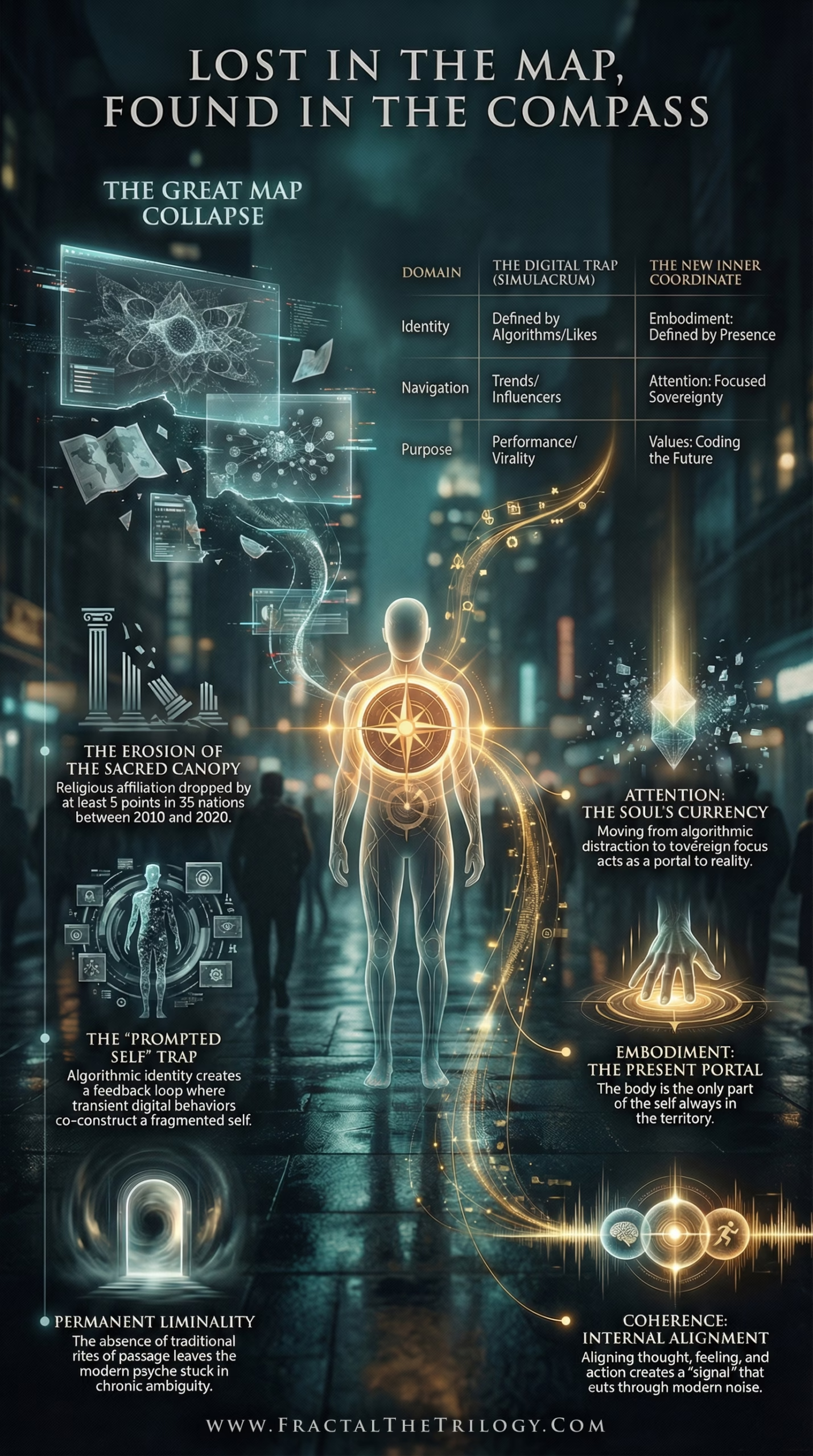

Introduction: The Paradox of High-Resolution Confusion
We reside in an era of unprecedented cartographic precision. Our satellites map every contour of the Earth’s surface to the centimeter; our genomic sequencers map the biological code of life; our algorithms map the behavioral predilections of billions of users in real-time. Yet, paradoxically, the modern human subject exists in a state of profound and pervasive disorientation. We are drowning in coordinates but starving for orientation. The external world has never been more rendered, yet the internal landscape has never been more blurred. This is the condition of “Fractal Disorientation”—a confusion that is not merely societal or psychological but structural, replicating self-similar patterns of collapse from the geopolitical macrocosm down to the synaptic firing of the anxious brain.
The central thesis of this investigation is that the modern sensation of being “lost” arises from a dual failure: the collapse of the “Old Meaning Maps” (religion, nation-state, linear career, nuclear family) and the structural inadequacy of their replacements (algorithmic identity, digital micro-tribes, performative selfhood). Without functioning “Inner Coordinates”—a stable, internalized system of navigation—the external maps provided by the information age fail to orient the subject. Instead, they produce a state of “Hyperchoice Paralysis” and “Narrative Instability,” where the self is no longer a coherent story but a fragmented series of data points drifting in a high-entropy ocean.
To navigate this crisis, we must look beyond the surface level of sociology into the deep architecture of human consciousness. We must integrate the anthropology of lost rites of passage, the Jungian analysis of the collective shadow, the neuroscience of predictive processing, and the philosophical distinction between the Map and the Territory. This report proposes that the way out of this labyrinth is not through the invention of new identities, but through a process of remembrance—a return to the “Witness” consciousness and the establishment of “New Inner Coordinates” based on Attention, Values, Embodiment, Coherence, and Service.
Part I: The Cartography of Collapse – The Erasure of Traditional Coordinates
For the vast majority of human history, identity was not a project to be curated but a location to be inhabited. The “Old Meaning Maps” were rigid, often oppressive, but they served a critical psychological function: they triangulated the individual’s position in the cosmos. One knew who they were because they knew where they were—geographically, spiritually, and socially. The collapse of these structures has liberated the individual from tradition but left them exposed to the vacuum of anomie.
The Dissolution of the Sacred Canopy
The most seismic shift in the landscape of meaning is the erosion of the religious framework, what sociologist Peter Berger termed the “Sacred Canopy.” Religion provided more than ethical guidelines; it provided a cosmology—a narrative structure with a beginning (Creation), a middle (the believer’s life), and an end (Salvation/Afterlife). This linear teleology gave time a direction and suffering a purpose.
Empirical data reveals a distinct “Secular Transition Model” occurring globally, which unfolds in a predictable three-step sequence.1
- Decline in Public Participation: The first coordinate to vanish is the communal ritual—attendance at worship services drops.
- Decline in Personal Importance: Subsequently, the subjective relevance of religious belief fades from the daily cognitive map.
- Loss of Affiliation: Finally, the individual sheds the label entirely, entering the category of the “nones.”
Between 2010 and 2020, religious affiliation declined by at least five percentage points in 35 nations, with precipitous drops in the United States (13 points), Chile (17 points), and Australia (17 points).3 This is not merely a statistical shift but an ontological one. The “participation-importance-belonging” sequence suggests a slow hollowing out of the cosmic map.
In the United States, the rise of the “nones”—those claiming no religious affiliation—has fundamentally altered the social fabric. While 75% of Americans still claim a faith, the intensity of belief and the regularity of practice have declined.4 This creates a “spiritual vacuum” where the existential questions (Who am I? Why am I here?) are no longer answered by a shared cultural script. The “Sacred Canopy” has torn, exposing the individual to the chill of a silent universe. Without this vertical coordinate (the connection to the Divine), the horizontal coordinates (connection to community) struggle to hold their shape.
The Fading of the Nation-State as Identity Container
Parallel to the decline of the sacred is the weakening of the secular substitute: the Nation-State. For the 19th and 20th centuries, nationalism functioned as a secular religion, offering a form of immortality through the survival of the collective and a sense of belonging to an “imagined community”.5 The map of the world was a puzzle of colored shapes, and one’s identity was securely fastened to a specific territory.
However, the forces of globalization and digital connectivity have eroded the solidity of national borders as containers of identity. We are witnessing the rise of “methodological nationalism” critiques, which suggest that the nation-state is no longer the primary unit of social reality.6 The “citizen” is being replaced by the “user” or the “consumer,” categories that transcend borders but lack the depth of civic obligation.
The weakening of the nation-state creates a crisis of political orientation. In a globalized world, power is diffuse and often invisible (multinational corporations, algorithms, international finance), making it difficult for the individual to locate the levers of agency. The “Nation” remains as a bureaucratic entity but fails as a source of deep meaning or “communitas.” The resurgence of nationalism in some quarters is best understood not as a sign of strength, but as a reactive symptom of this collapse—a desperate attempt to redraw a map that is fading.8
The Fragmentation of the Linear Biography
The private sphere has suffered a similar fracturing. The traditional biography—the “standard plot” of life involving a stable career and a nuclear family—has dissolved into “Liquid Modernity”.9 Zygmunt Bauman describes this as a shift from a solid era, where structures were meant to last, to a liquid era, where forms must remain fluid to survive.
The Career Map: The transition from industrial labor to the “gig economy” has destroyed the “career ladder” as a navigational tool. Work is no longer a source of stable identity or community but a series of precarious “gigs.” The worker is no longer a “company man” but a “brand of one,” responsible for their own marketing, training, and safety net.10 This “individualization without institutionalization” places an unbearable cognitive load on the individual, who must constantly reinvent themselves to remain marketable.12
The Family Map: The demographic transition has led to a diversification of family structures that, while liberating for many, removes the “default script” for adulthood.13 The delay in marriage, the rise of single-person households, and the complexity of modern kinship networks mean that there is no longer a standard timeline for “growing up.” The “conjugal family” is no longer the inevitable destination, leaving the individual to chart their own course through a sea of infinite relational possibilities.14
Table 1: The Collapse of Old Meaning Maps
Domain | The Old Map (Solid Modernity) | The Collapse Mechanism | The Resulting Void (Liquid Modernity) |
Cosmology | Religion: The Sacred Canopy. Provided vertical orientation (divine) and horizontal community. | Secular Transition: Decline in ritual participation, importance, and affiliation.1 | Existential Disorientation: Loss of teleology (purpose) and shared narrative. Rise of “DIY Spirituality.” |
Belonging | Nation-State: The Imagined Community. Provided civic identity and secular immortality. | Globalization: Porous borders, transnational flows of information and capital.7 | Civic Anomie: Weakening of social contract; identity shifts to sub-national tribes or transnational causes. |
Biography | Career/Family: The Linear Script. Education -> Job -> Marriage -> Retirement. | Gig Economy & Flexibilization: Erosion of long-term employment and traditional family structures.11 | Narrative Instability: The “Corrosion of Character” (Sennett); life as a series of disconnected episodes rather than a coherent story. |
Part II: The Digital Simulacrum – Replacements That Fail
Nature abhors a vacuum, and the human psyche abhors a lack of meaning. As the old maps have disintegrated, new mechanisms have rushed in to fill the void. These replacements are primarily digital, algorithmic, and performative. However, unlike the old maps which connected the individual to a physical territory and a historical lineage, these new maps connect the individual to a digital simulacrum—a map of a map—that fails to provide true orientation.
Algorithmic Identity and the “Prompted Self”
In the absence of traditional markers, we have turned to the Algorithm as the new High Priest of identity. We increasingly outsource our self-definition to digital systems, creating a feedback loop where the “self” is co-constructed by predictive models.15 This is the era of the “Prompted Self”.17
Just as a Large Language Model requires a prompt to generate text, the modern digital self requires external algorithmic stimuli to generate identity. We look to our feeds to tell us what to care about, what aesthetics to adopt (“Cottagecore,” “Dark Academia”), and what political tribes to align with. The algorithm creates an “Algorithmic Biography”—a compressed, instruction-based summary of traits used to target content.17
The danger lies in the “identity feedback loop”.18 The algorithm infers an identity based on transient behaviors (a click, a pause on a video), creates a label (e.g., “anxious consumer”), and feeds content that reinforces that label. The user, seeking coherence, subconsciously conforms to the algorithmic mirror. This is a form of “soft biopolitics,” where code structures the boundaries of who we think we are.19 The “Lens” of perception becomes the “Law” of identity.21
Micro-Tribes and the Sociology of Exclusion
As the broad “imagined community” of the Nation recedes, it is replaced by “Micro-Tribes” or “Neo-Tribes”.22 These are digital communities formed around niche interests, grievances, or linguistic codes.23 Unlike traditional communities, which were based on shared location and mutual obligation, micro-tribes are “elective,” fluid, and often ephemeral.
These tribes are defined by “Algorithmic Tribalism”.24 Algorithms cluster users with similar engagement patterns, creating echo chambers that reinforce shared biases and exclude dissent. Within these tribes, language becomes a gatekeeping mechanism—slang, memes, and acronyms (“delulu,” “rizz”) serve as “identity markers” that signal membership and exclude the “normies”.23
While these groups offer a potent hit of dopamine and a temporary sense of belonging (“collective effervescence”), they often lack the structural depth of true community. They are based on “Parasocial Belonging”—one-sided relationships with influencers or digital avatars where intimacy is simulated but not reciprocated.25 This leads to a fragile sense of social location; one can be “cancelled” or exiled from the tribe for a minor deviation in dogma, creating a state of chronic social anxiety.
Hyperchoice Paralysis and Post-Truth Fatigue
The removal of traditional scripts was promised as a liberation, but the psychological reality is “Hyperchoice Paralysis.” Psychologist Barry Schwartz’s “Paradox of Choice” explains that an abundance of options leads to increased cognitive load, decision fatigue, and decreased satisfaction.27
In a world without a pre-set menu, every aspect of life—diet, gender, career, location, morality—must be chosen. This leads to “Decision Fatigue” and “Analysis Paralysis”.29 The brain, exhausted by the constant demand to “maximize” utility, often shuts down or defaults to the path of least resistance (the algorithmic suggestion). The fear of “post-choice regret” haunts the modern subject, who is constantly aware of the infinite “unlived lives” they have sacrificed.28
Compounding this is “Post-Truth Fatigue”.31 The digital ecosystem is flooded with conflicting narratives, misinformation, and “alternative facts.” The cognitive effort required to discern truth from fabrication is unsustainable. This leads to “Narrative Instability” 33 and “Cynical Detachment”.34 The subject, unable to establish a coherent view of reality, retreats into apathy or adopts a rigid, fundamentalist worldview to reduce the stress of uncertainty.
Vignette 1: The Algorithmic Mirror (Identity Drift)
Theme: The prompted self and fluid identity.
Sarah, 26, is an influencer, but she feels less like a person and more like a channel for the zeitgeist. Last year, the algorithm favored “Cottagecore”—baking sourdough, floral dresses, slow living. Sarah became that. She felt it. She believed it. Her “self-model” aligned with the soft focus of the lens. Then, the metrics shifted. The algorithm began promoting “Cyber-Y2K”—sharp lines, neon, cynicism, fast pacing. Sarah felt a panic in her gut, a somatic signal of “identity drift”.35 She began to pivot. She changed her wardrobe, her lighting, her cadence of speech. But in the transition, she experienced a moment of depersonalization in front of her ring light. Who is looking back? Is she the baker or the raver? Or is she just the mirror reflecting the data stream? She feels “narrative instability”.33 Her life story doesn’t make sense anymore; the chapters don’t connect. She is a series of disconnected posts, held together by nothing but the platform’s interface. She feels the vertigo of the “liquid self”—flowing into whatever container the algorithm provides, never solidifying into a person. She is “Prompted,” but no longer “Authored.”
Vignette 2: The Infinite Scroll (Hyperchoice & Burnout)
Theme: The paralysis of the maximizer.
Elena sits on her beige sofa, the blue light of the TV flickering against her glasses. Her phone is in her hand. On the TV, Netflix creates a mosaic of five thousand possible worlds—dramas, comedies, documentaries. On her phone, a delivery app offers cuisine from forty distinct cultures. It is 8:00 PM. By 9:15 PM, Elena has watched nothing and eaten nothing. She feels a physical weight in her chest, a “decision fatigue” that feels like gravity increasing.28 She scrolls. The trailer for a sci-fi epic plays. Too long. A comedy special. Too loud. The Thai place. Too far. The pizza place. Too unhealthy. The sheer volume of “possible futures”—even trivial ones like dinner and a movie—overloads her predictive processing machinery. Her brain cannot calculate the “optimal” choice because the variables are infinite. The fear of “post-choice regret” keeps her frozen. At 9:45 PM, she eats cold cereal and watches a 15-second TikTok video on a loop. It is not what she wanted. But it required zero choice. She feels a hollow exhaustion, a “burnout” not from doing too much, but from processing the potential to do too much. She is lost in a library where she cannot read a single book because she is too busy reading the titles.
Vignette 3: The Echo Chamber (Tribalism & Shadow)
Theme: Pseudo-rites and projection.
Marcus, 24, feels the “Void.” He works a gig-economy job, coding for an AI trainer, a task that feels ephemeral and meaningless.11 He has no church, no union, no family nearby. He feels invisible. Then he finds “The Order,” a Discord server dedicated to a specific strain of political philosophy and crypto-trading. Here, there are ranks. There are enemies (the “normies,” the “system”). There is a language—a slang of acronyms and memes that serves as a barrier to entry.23 Marcus spends 12 hours a day in The Order. He participates in “raids” on rival Twitter threads. This feels like war. It feels like initiation. He feels the adrenaline of the “collective effervescence”.37 He projects all his internal feelings of inadequacy onto the “enemies” of the group.38 But when he turns off the computer, the silence of his apartment is deafening. The “pseudo-rite” has not transformed him. He is not a warrior; he is a typist. The disorientation returns, sharper than before, driving him back to the screen. He is not navigating reality; he is navigating a simulation of belonging.
Part III: The Neuro-Anthropology of Lost Initiation
Why do these digital replacements fail to orient us? Anthropology and neuroscience suggest that the human organism requires specific developmental structures—rites of passage—to transition from one stage of life to another. The modern world has largely excised these rituals, leaving us in a state of neurological and existential limbo.
The Loss of Rites of Passage
Arnold van Gennep defined the Rite of Passage as a tripartite process: Separation, Transition (Liminality), and Incorporation.39
- Separation: The initiate is removed from their previous status and social structure.
- Liminality: The “threshold” phase. The initiate is “betwixt and between,” stripped of identity, often subjected to ordeal and instruction by elders.40
- Incorporation: The initiate returns to the community with a new identity, rights, and responsibilities.
In traditional societies, these rites transformed the “child-self” into the “adult-self.” They provided a clear demarcation of growth. Modern secular society has largely abandoned these rites.39 We have birthdays and graduations, but these are celebrations, not initiations. They lack the element of “ordeal,” the containment of “liminality,” and the guidance of elders.
Without a formal rite to mark the transition, the psyche remains stuck in the liminal phase. This is the condition of “Permanent Liminality”—a state of chronic ambiguity where the individual feels they are waiting for life to begin, even into their 30s and 40s.43 They are ghosts in their own lives, unable to cross the threshold into adulthood because no one has opened the door.
The “Pseudo-Rite” of Consumerism and Digital Conflict
In the absence of true initiation, humans instinctively seek out “Pseudo-Rites”.44 We attempt to buy our way into adulthood through consumption (buying a house, a car, a luxury brand) or we seek initiation through risky behaviors (drugs, extreme sports) or intense digital experiences (gaming, “flame wars”).
These pseudo-rites mimic the intensity of initiation—the adrenaline, the risk, the tribal bonding—but they fail to provide the Incorporation. There is no return to the tribe with a new status. The gamer defeats the boss but remains in the basement. The consumer buys the car but remains insecure. The psyche creates “micro-initiations” that loop endlessly without ever crossing the threshold of transformation.45 The “Hero’s Journey” becomes a treadmill.
Neuroscience: The Narrative Brain and Predictive Processing
Neuroscience offers a mechanistic explanation for this disorientation. The human brain is a “Narrative Machine” designed to weave disparate events into a coherent story of the self.46 This narrative function is intimately tied to the Hippocampus, which creates “Cognitive Maps” of both physical space and social/narrative space.48
Thomas Metzinger’s “Self-Model Theory of Subjectivity” posits that the “self” is not a static thing, but a transparent simulation or model the brain runs to navigate the world.50 This self-model relies on “Predictive Processing” (Friston/Clark). The brain constantly generates predictions about the world and updates its model based on error signals.52
In a stable environment (traditional society), the prediction errors are manageable. The map fits the territory. In the “hyper-volatile” digital environment, the prediction errors are constant and overwhelming. The brain cannot predict the algorithmic feed; it cannot predict the shifting social norms; it cannot predict the economic future.
This chronic “prediction error” manifests as Anxiety and Stress.54 The self-model becomes unstable because it cannot successfully map its relation to the environment. To reduce this “free energy” (stress), the brain may narrow its focus (tribalism) or disengage entirely (dissociation/depression). This is the neurological correlate of “losing one’s coordinates.” The cognitive map collapses because the territory changes faster than the neurons can wire.56
Jungian Framing: The Shadow in the Machine
From a Jungian perspective, the loss of initiation means the failure to confront the Shadow—the repressed, darker aspects of the personality.57 Initiation rites often forced the initiate to face fear, mortality, and their own capacity for evil, integrating these elements into a whole personality.
Without this confrontation, the Shadow is Projected outward. In the digital realm, we see “Collective Shadow Projection” at scale.38 We project our repressed anger, greed, and fear onto the “Other”—the opposing political tribe, the cancelled celebrity, the faceless troll. The digital interface acts as a perfect screen for this projection, allowing us to fight our demons externally rather than integrating them internally.
The Hero’s Journey (Campbell) is stalled at the threshold. We refuse the “Call to Adventure” (internal growth) and instead engage in endless “Call of Duty” (external/virtual conflict).59 The digital world offers the image of the hero without the price of the journey. This results in a cultural stagnation, a loss of the archetypal energies (Warrior, Magician, Lover, King) needed to mature.61
Table 2: The Neuro-Anthropology of Disorientation
Concept | Origin/Discipline | Explanation | Modern Manifestation |
Liminality | Anthropology (Van Gennep/Turner) | The “threshold” state in a rite of passage; neither here nor there. | Chronic state of modern adulthood; “kidults”; gig economy precarity; feeling “stuck.” |
Predictive Processing | Neuroscience (Friston/Clark) | The brain’s attempt to minimize surprise by modeling the environment. | Failure of the brain to model the chaotic digital world -> High Anxiety/Stress (“Free Energy”). |
Cognitive Map | Neuroscience (Hippocampus) | The brain’s internal representation of space and context. | “Map Collapse” due to GPS reliance and narrative instability; loss of historical context. |
Shadow Projection | Psychology (Jung) | Casting repressed self-parts onto others to avoid internal conflict. | Online polarization; “cancel culture”; demonization of the out-group avatar. |
The Witness | Metaphysics/Consciousness | The meta-cognitive observer separate from thoughts/emotions. | The stabilizing agent; the “eye of the storm” in meditation and mindfulness. |
Part IV: Map vs. Territory – The Philosophical Core
The fundamental philosophical error of the modern age is the confusion of the Map for the Territory. Alfred Korzybski’s famous dictum, “The map is not the territory,” serves as a crucial razor for dissecting our disorientation.62
Information vs. Orientation
We are drowning in Information (data points, maps, symbols) but starving for Orientation (knowing where we stand and which way is North).
- Information is the accumulation of facts about the Territory. It is the raw data.
- Orientation is the embodied relationship between the Self and the Territory. It is the sense of direction.63
The digital world provides infinite maps. We can know the GPS coordinates of a coffee shop in Tokyo or the stock price of Apple in real-time. But these maps are abstractions. They are “reductions” of reality.65 When we live primarily through the screen, we inhabit the Map, not the Territory. We mistake the menu for the meal.
The Precession of Simulacra
Jean Baudrillard took this further with the concept of the Simulacrum. We have reached a stage where the Map precedes the Territory.62 We design our lives for the Instagram photo (the map) rather than the experience itself (the territory). We optimize our careers for the LinkedIn profile rather than the work.
This “Hyperreal” existence creates a profound sense of hollowness because the “self” engaging with the map is also a map—an algorithmic projection. The real human organism, the biological vessel, is left behind, disoriented and untouched in the physical world. The digital map is high-resolution, but it is flat. It lacks the “ontological weight” of the territory.
In the book Fractal: The Awakening, the protagonist Elias Chronis reflects on this: “The mountain isn’t just Kailash. It’s the projection of our own awakening”.21 This realization flips the script: the external world is a reflection of the internal state. If the internal state is chaotic, the external map will appear broken. The solution is not to fix the map, but to align the projector.
Part V: The New Inner Coordinates – The Oracle 2.0 Model
If the old maps are gone and the new maps are false, how do we navigate? We must move from external maps to internal compasses. We must establish “Inner Coordinates” that function regardless of the terrain.
Drawing from the insights of The Oracle 2.0 21, we can construct a navigational model based on five fixed points. These are not beliefs to hold, but faculties to cultivate. This model integrates the “Fractal” tone of seeing the self as a microcosm of the whole.
1. Attention: The Currency of the Soul
- The Anchor: “Attention Is the New Currency of the Soul.” 21
- The Shift: From distraction to sovereignty. In the attention economy, your focus is the product. To reclaim orientation, you must reclaim sovereignty over your attention. Focus is described as a “Portal”.21 Where you look is where you go.
- The Coordinate: Do not ask “What is happening?” (Information). Ask “Where am I placing my awareness?” (Orientation).
- Practical Reflection: “The World Is Made of Listening”.21 Consciously withdraw attention from the “noise” of the map to the “signal” of the immediate territory. Treat your attention as a sacred beam of light that creates reality.
2. Values: The Code of the Future
- The Anchor: “We Are Coding the Future with Every Choice.” 21
- The Shift: From reaction to creation.
Values are not abstract morals; they are decision-making algorithms for the soul. In a world of hyperchoice, values function as a “heuristic”—a mental shortcut that reduces decision fatigue. If you value “Sustainability,” 90% of consumer choices vanish, curing paralysis. - The Coordinate: “Build for the World You Want to Live In”.21
- Practical Reflection: “Innovation Without Soul Becomes Illusion”.21 Align choice with the “Architecture of Choice” rather than the impulse of the moment. View every decision as a line of code in the program of your life.
3. Embodiment: The Sacred Vessel
- The Anchor: “Your Body Is Not a Prison – It Is a Portal.” 21
- The Shift: From head to heart/gut. The digital world is disembodied. Disorientation happens in the head (the map). Re-orientation happens in the body (the territory). The body is the “Threshold of the Present Moment”.21 It is the only part of you that is always in the Territory and never in the Map.
- The Coordinate: “The Body Speaks in Sensation, Not Words”.21
- Practical Reflection: “Grounding Is a Return.” When the narrative fails, return to the breath. The nervous system tells the truth that the screen hides. Use the body as the anchor for the “Inner Navigation.”
4. Coherence: The Alignment of Reality
- The Anchor: “Reality Responds to Coherence.” 21
- The Shift: From fragmentation to integration.
Coherence is the state where thought, feeling, and action are aligned. When we are fragmented (thinking one thing, feeling another, doing a third), we create “interference patterns” in our reality. Coherence is the “signal” that cuts through the noise. - The Coordinate: “Integration Is the Goal of Inner Work”.21
- Practical Reflection: “Balance the Circuit with Silence”.21 Silence allows the scattered fragments of the self-model to coalesce back into a unified whole. Seek the “Stillness Beneath the Storm”.21
5. Service: The Stabilizing Force
- The Anchor: “Your Presence Is the Greatest Gift You Can Offer.” 21
- The Shift: From consumption to contribution. Navel-gazing leads to vertigo. Service grounds the individual in the “Other.” It breaks the solipsistic loop of the algorithmic self. “Relationships Are Assignments from the Soul”.21
- The Coordinate: “The Mind Is a Sacred Servant, Not a Sovereign”.21
- Practical Reflection: “Build Tools That Heal, Not Just Solve”.21 Moving from “What can I get?” to “What can I give?” re-establishes the web of interdependence that Durkheim identified as the cure for anomie. “Carry the song of life not as missionaries, but as gardeners”.21
Conclusion: Remembrance Rather Than Invention
The disorientation of the modern human is not a defect; it is a symptom of a profound transition. We are leaving the age of External Authority—where the map was provided by the King, the Priest, or the algorithm—and entering the age of Internal Authority, where the map must be drawn by the individual.
The danger lies in trying to invent a self to fit the chaos. Invention is a function of the ego, and it is fragile. It requires constant maintenance and validation. The Oracle suggests a different path: “Remembrance rather than invention.”.21
To “remember” is to re-member—to put the members back together. It is to recall the “Witness”—the observer that stands behind the thoughts, behind the digital avatars, behind the anxiety. This Witness is the “Fractal” seed of the universe within the individual. It is the “still point of the turning world.”
As Elias Chronis, the seeker in Fractal, reminds us: “Do not wait for saviors. The time of awakening is now”.21 The external chaos is a projection of our internal fragmentation. To find our way, we do not need a better GPS. We need to calibrate the inner compass.
We must stop looking at the Map (the screen, the news, the narrative) and start touching the Territory (the breath, the earth, the neighbor). We must navigate not by the stars of the old sky, which are fading, but by the “New Inner Coordinates” of our own awakened consciousness.
The map is dead. Long live the territory.
Table 3: The Shift from Old Coordinates to New Inner Coordinates
Domain | The Old Map (Collapsing) | The Digital Trap (Simulacrum) | The New Inner Coordinate (Oracle 2.0) |
Identity | Defined by Lineage/Nation | Defined by Algorithms/Likes | Embodiment: Defined by Presence |
Navigation | Dogma / Tradition | Trends / Influencers | Attention: Focused Sovereignty |
Belonging | Physical Community / Parish | Micro-Tribes / Echo Chambers | Service: Contribution to the Whole |
Truth | Authority / Scripture | Viral Content / Confirmation Bias | Coherence: Internal Alignment |
Purpose | Duty / Career Ladder | Performance / Virality | Values: Coding the Future |
Works cited
- The three stages of religious decline around the world – PMC – NIH, accessed February 7, 2026, https://pmc.ncbi.nlm.nih.gov/articles/PMC12365078/
- Global study uncovers common three-stage sequence in religious decline – Sociology, accessed February 7, 2026, https://www.sociology.ox.ac.uk/article/global-study-uncovers-common-three-stage-sequence-in-religious-decline
- Pew study maps global stages of religious decline, beginning with drop in worship service attendance – Christian Daily International, accessed February 7, 2026, https://www.christiandaily.com/news/pew-study-maps-global-stages-of-religious-decline-beginning-with-drop-in-worship-service-attendance
- U.S. Public Becoming Less Religious | Pew Research Center, accessed February 7, 2026, https://www.pewresearch.org/religion/2015/11/03/u-s-public-becoming-less-religious/
- (PDF) National Identity, Popular Culture and Everyday Life – ResearchGate, accessed February 7, 2026, https://www.researchgate.net/publication/205836856_National_Identity_Popular_Culture_and_Everyday_Life
- Religion, Migration, and Identity – Methodological and Theological Explorations – Brill, accessed February 7, 2026, https://brill.com/display/book/9789004326156/9789004326156_webready_content_text.pdf
- The Myth of the Nation-State: Theorizing Society and Polities in a Global Era – Lancaster University, accessed February 7, 2026, https://www.lancaster.ac.uk/fass/resources/sociology-online-papers/papers/walby-mythofthenationstate.pdf
- Full article: Updating cleavage theory for the twenty-first century – Taylor & Francis, accessed February 7, 2026, https://www.tandfonline.com/doi/full/10.1080/01402382.2025.2560781
- Zygmunt Bauman – Liquid Modernity (2000) – SozTheo, accessed February 7, 2026, https://soztheo.com/sociology/key-works-in-sociology/zygmunt-bauman-liquid-modernity-2000/
- Stress and the gig economy: it’s not all shifts and giggles – PMC, accessed February 7, 2026, https://pmc.ncbi.nlm.nih.gov/articles/PMC10079501/
- Exposure to psychosocial risk factors in the gig economy: a systematic review – European Trade Union Institute, accessed February 7, 2026, https://www.etui.org/sites/default/files/2021-02/Exposure%20to%20psychosocial%20risk%20factors%20in%20the%20gig%20economy-a%20systematic%20review-2021.pdf
- Zygmunt Bauman. Individual and society in the liquid modernity – PMC – NIH, accessed February 7, 2026, https://pmc.ncbi.nlm.nih.gov/articles/PMC3786078/
- Changing Patterns of Family Structures: A Sociological Perspective – IJFMR, accessed February 7, 2026, https://www.ijfmr.com/papers/2025/5/56757.pdf
- Family Change in Global Perspective: How and Why Family Systems Change – PMC, accessed February 7, 2026, https://pmc.ncbi.nlm.nih.gov/articles/PMC8298013/
- What Is Algorithmic Culture’s Impact on Identity? → Question, accessed February 7, 2026, https://lifestyle.sustainability-directory.com/question/what-is-algorithmic-cultures-impact-on-identity/
- From Social Recognition to Algorithmic Recognition: A Sociological Analysis of Identity in the Age of AI – Prezi, accessed February 7, 2026, https://prezi.com/p/bdr_r4heecso/from-social-recognition-to-algorithmic-recognition-a-sociological-analysis-of-identity-in-the-age-of-ai/
- Prompted Selves: The Emergence of Digital Identity in the Age of AI Simulation – Medium, accessed February 7, 2026, https://medium.com/common-sense-world/prompted-selves-the-emergence-of-digital-identity-in-the-age-of-ai-simulation-4cd258e31ac8
- The algorithmic self: how AI is reshaping human identity, introspection, and agency – PMC, accessed February 7, 2026, https://pmc.ncbi.nlm.nih.gov/articles/PMC12289686/
- A New Algorithmic Identity: Soft Biopolitics and the Modulation of Control – Morgan Klaus Scheuerman, accessed February 7, 2026, https://www.morgan-klaus.com/readings/algorithmic-identity.html
- [PDF] A New Algorithmic Identity | Semantic Scholar, accessed February 7, 2026, https://www.semanticscholar.org/paper/A-New-Algorithmic-Identity-Cheney-Lippold/b303d8aaef2c5ef078655a02279e6d2c51e9a1ac
- THE ORACLE 2.0 – TEXT VERSION.pdf
- MyTribe: Manifestations of belonging in online social interactions Brady Robards and Andy Bennett (Griffith University), accessed February 7, 2026, https://research-repository.griffith.edu.au/server/api/core/bitstreams/5e1d18f4-0578-5b07-b0e0-cfa25d643b44/content
- (PDF) THE SOCIOLINGUISTICS OF “ONLINE LINGUISTIC MICRO-TRIBES”: HOW DIGITAL COMMUNICATION SHAPES NICHE IDENTITY AND EXCLUSION – ResearchGate, accessed February 7, 2026, https://www.researchgate.net/publication/394231896_THE_SOCIOLINGUISTICS_OF_ONLINE_LINGUISTIC_MICRO-TRIBES_HOW_DIGITAL_COMMUNICATION_SHAPES_NICHE_IDENTITY_AND_EXCLUSION
- Algorithmic Tribalism → Term – Lifestyle → Sustainability Directory, accessed February 7, 2026, https://lifestyle.sustainability-directory.com/term/algorithmic-tribalism/
- Why people form parasocial relationships – Cambridge Dictionary Word of the Year 2025, accessed February 7, 2026, https://www.youtube.com/watch?v=EVfOQqB9hzI
- Parasocial Relationships and Tribal Behavior: Delineating their Link – ResearchGate, accessed February 7, 2026, https://www.researchgate.net/publication/271766996_Parasocial_Relationships_and_Tribal_Behavior_Delineating_their_Link
- The Paradox of Choice – The Decision Lab, accessed February 7, 2026, https://thedecisionlab.com/reference-guide/economics/the-paradox-of-choice
- Choice Overload – The Decision Lab, accessed February 7, 2026, https://thedecisionlab.com/biases/choice-overload-bias
- Analysis Paralysis: The Paradox of Choice – Neurosity, accessed February 7, 2026, https://neurosity.co/blog/analysis-paralysis-the-paradox-of-choice
- Analysis Paralysis: The Burden of Choice – Spiegeloog, accessed February 7, 2026, https://www.spiegeloog.amsterdam/analysis-paralysis-the-burden-of-choice/
- Bearing Witness: The Psychological Strain Inside Modern Newsrooms – Anthology/Matt, accessed February 7, 2026, https://www.anthologymatt.com/article/bearing-witness-the-psychological-strain-inside-modern-newsrooms
- Post-truth: A guide for the perplexed – ResearchGate, accessed February 7, 2026, https://www.researchgate.net/publication/311094467_Post-truth_A_guide_for_the_perplexed
- From self-narration to a worldview: a phenomenological, narratological, and linguistic case study of a patient with a complex clinical picture of bipolar disorder – PMC, accessed February 7, 2026, https://pmc.ncbi.nlm.nih.gov/articles/PMC12865984/
- Cynicism Can Be Toxic and Sometimes Fatal | Psychology Today, accessed February 7, 2026, https://www.psychologytoday.com/us/blog/emotions-dont-think/202302/cynicism-is-lethal-toxic-and-sometimes-fatal
- When the self “logs in” – a critical narrative review of digital identity in health professions education – Frontiers, accessed February 7, 2026, https://www.frontiersin.org/journals/medicine/articles/10.3389/fmed.2025.1715752/full
- The Flowing Self: Identity in Drift and the Dynamics of Being – Medium, accessed February 7, 2026, https://medium.com/@krigerbruce/the-flowing-self-identity-in-drift-and-the-dynamics-of-being-b6e619c22196
- What Happens When We Lose Our Social Rituals? – Greater Good Science Center, accessed February 7, 2026, https://greatergood.berkeley.edu/article/item/what_happens_when_we_lose_our_social_rituals
- Understanding Carl Jung’s Concept of ‘The Shadow’ – and its Impact on Individuals and Society – The British Association of Anger Management, accessed February 7, 2026, https://www.angermanage.co.uk/understanding-carl-jungs-concept-of-the-shadow/
- The Systems Thinker – Rites of Passage in a World That Is Not Flat, accessed February 7, 2026, https://thesystemsthinker.com/%EF%BB%BFrites-of-passage-in-a-world-that-is-not-flat/
- Liminality – Wikipedia, accessed February 7, 2026, https://en.wikipedia.org/wiki/Liminality
- Liminality | Psychology | Research Starters – EBSCO, accessed February 7, 2026, https://www.ebsco.com/research-starters/psychology/liminality
- The Earth Wisdom of Male Initiation – Digital Commons @ Cortland, accessed February 7, 2026, https://digitalcommons.cortland.edu/cgi/viewcontent.cgi?article=1152&context=taproot
- Arnold van Gennep and the Rites of Passage: Illuminating the Structure of Human Transitions – – Taproot Therapy Collective, accessed February 7, 2026, https://gettherapybirmingham.com/arnold-van-gennep-and-the-rites-of-passage-illuminating-the-structure-of-human-transitions/
- Games and Ethics: Theoretical and Empirical Approaches to Ethical Questions in Digital Game Cultures [1st ed.] 9783658281748, 9783658281755 – DOKUMEN.PUB, accessed February 7, 2026, https://dokumen.pub/games-and-ethics-theoretical-and-empirical-approaches-to-ethical-questions-in-digital-game-cultures-1st-ed-9783658281748-9783658281755.html
- V·M·I – ScholarSpace, accessed February 7, 2026, https://scholarspace.manoa.hawaii.edu/bitstreams/4e272fba-0089-414a-a108-b03843607310/download
- Narrative and Pain: Towards an Integrative Model | Anesthesia Key, accessed February 7, 2026, https://aneskey.com/narrative-and-pain-towards-an-integrative-model/
- In new book “The Narrative Brain”, IU professor explores the power of storytelling in the human mind, accessed February 7, 2026, https://news.iu.edu/college/live/news/44023-in-new-book-the-narrative-brain-iu-professor
- The Human Hippocampus: Cognitive Maps or Relational Memory?, accessed February 7, 2026, https://www.jneurosci.org/content/25/31/7254
- Cognitive Maps: Some People Make Them, Some People Struggle – PMC, accessed February 7, 2026, https://pmc.ncbi.nlm.nih.gov/articles/PMC6095672/
- Self models – Scholarpedia, accessed February 7, 2026, http://www.scholarpedia.org/article/Self_models
- Thomas Metzinger on the Self-Model: Why the “Self” isn’t a Substance – YouTube, accessed February 7, 2026, https://www.youtube.com/watch?v=alzv5smLI4s
- The brain, self and society: a social-neuroscience model of predictive processing – PMC, accessed February 7, 2026, https://pmc.ncbi.nlm.nih.gov/articles/PMC6467179/
- Full article: Provoking thought: A predictive processing account of critical thinking and the effects of education – Taylor & Francis, accessed February 7, 2026, https://www.tandfonline.com/doi/full/10.1080/00131857.2021.2006056
- Interoceptive active inference and self-representation in social anxiety disorder (SAD): exploring the neurocognitive traits of the SAD self | Neuroscience of Consciousness | Oxford Academic, accessed February 7, 2026, https://academic.oup.com/nc/article/2020/1/niaa026/6055433
- Uncertainty and Anticipation in Anxiety: An integrated neurobiological and psychological perspective – PMC, accessed February 7, 2026, https://pmc.ncbi.nlm.nih.gov/articles/PMC4276319/
- The cognitive map in humans: Spatial navigation and beyond – PMC, accessed February 7, 2026, https://pmc.ncbi.nlm.nih.gov/articles/PMC6028313/
- Shadow Self and Carl Jung: The Ultimate Guide to the Human Dark Side | HighExistence, accessed February 7, 2026, https://www.highexistence.com/carl-jung-shadow-guide-unconscious/
- A Definitive Guide to Jungian Shadow Work + 5 Exercises – Scott Jeffrey, accessed February 7, 2026, https://scottjeffrey.com/shadow-work/
- Episode 123 — Every Hero’s Journey – This Jungian Life, accessed February 7, 2026, https://thisjungianlife.com/episode-123-every-heros-journey/
- 86. A Jungian Hero’s Journey as Individuation Process in J.K. Rowling’s Harry Potter and the Sorcerer’s Stone – DergiPark, accessed February 7, 2026, https://dergipark.org.tr/en/download/article-file/3459712
- The Hero’s Journey: Joseph Campbell’s Path to Inner Growth – Scott Jeffrey, accessed February 7, 2026, https://scottjeffrey.com/heros-journey-steps/
- Map–territory relation – Wikipedia, accessed February 7, 2026, https://en.wikipedia.org/wiki/Map%E2%80%93territory_relation
- Disorientation and self-consciousness: a phenomenological inquiry, accessed February 7, 2026, https://d-nb.info/1209130416/34
- Difference Between Orientation, Disorientation And Re-Orientation | Cram, accessed February 7, 2026, https://www.cram.com/essay/Difference-Between-Orientation-Disorientation-And-Re-Orientation/P3XDBFH9CX5W
- The Map Is Not the Territory – Farnam Street, accessed February 7, 2026, https://fs.blog/map-and-territory/