

PODCAST: The Architecture of the Void
The contemporary high-performance landscape is characterized by a profound and paradoxically silent anomaly: the hollow echo of achieved ambitions. Across elite organizational tiers, an epidemic of profound disillusionment has emerged, uncoupled from failure and intimately tied to success itself. In an era defined by a “Great Acceleration”—a period where technological, economic, and systemic velocities have outpaced human neurobiological and spiritual adaptation—the structures of achievement have begun to unravel the very meaning they were designed to generate.1 This phenomenon is not merely an emotional crisis; it is a systemic failure of the human operating system within modern corporate environments. The “meaning vacuum” is a structural void created when the kinetic energy of ambition is entirely severed from existential purpose.2 It is the space where the architecture of the mind, driven by ancient neurochemical reward loops and modern sociological pressures, collides with the philosophical reality that external metrics cannot satisfy the evolutionary requirements of the human soul.1
To decode why success feels empty requires a multidisciplinary lens. The modern professional exists at the intersection of conflicting forces. Biologically, the organism is wired to chase ever-receding horizons. Psychologically, the individual merges their sense of self with their economic output. Sociologically, the corporate citizen is forced to perform upon an exhausting, perpetual stage. Philosophically, the human being is starved of the deep, resonant purpose that once anchored communities and civilizations. By analyzing the intersection of neurobiology, behavioral psychology, sociological dramatism, and existential philosophy, a clear pattern emerges. The modern incentive structures that organizations rely upon to drive performance are fundamentally incompatible with the human requirement for coherence and truth.5 Addressing this crisis demands a transition from traditional, metric-obsessed management to coherent leadership—a framework that restores purpose without falling into the trap of prescriptive moralism.7
The Neurobiology of the Chase: Reward Loops and the Arrival Fallacy
The architecture of human motivation is governed heavily by the dopaminergic system, an ancient neural pathway that evolved to ensure the survival of the species in environments defined by scarcity and danger.4 However, the popular and frequent characterization of dopamine as a “pleasure molecule” is a fundamental neuroscientific misunderstanding.4 Dopamine is an anticipatory neuromodulator; it is the chemical of “wanting,” not the chemical of “liking”.4 It functions primarily as a prediction signal, providing the biological urge that mobilizes physical and cognitive resources toward a perceived future reward.4
In high-performance cultures, this neurobiological mechanism is continuously weaponized and subsequently exhausted. Environments that constantly dangle the next promotion, the next funding round, or the next performance bonus hijack the brain’s reward prediction error systems.11 When an individual anticipates a reward and exerts effort toward it, dopamine levels spike during the pursuit phase, maintaining the organism in a state of high arousal, narrowed focus, and forward momentum.4 Phasic dopamine reward signals take on a prominent role in how the brain models associative regularities, learning to continually chase the cues that promise acquisition.13 Yet, upon the actual achievement of the goal, the dopaminergic surge dissipates rapidly. If the reward matches the prediction, the dopamine response drops to baseline; if the neurochemical system has been overstimulated, the drop often falls below baseline, creating a physiological deficit.10 The nervous system, having utilized the chemical solely for the hunt, leaves the achiever at the summit with a sudden, profound emptiness.15
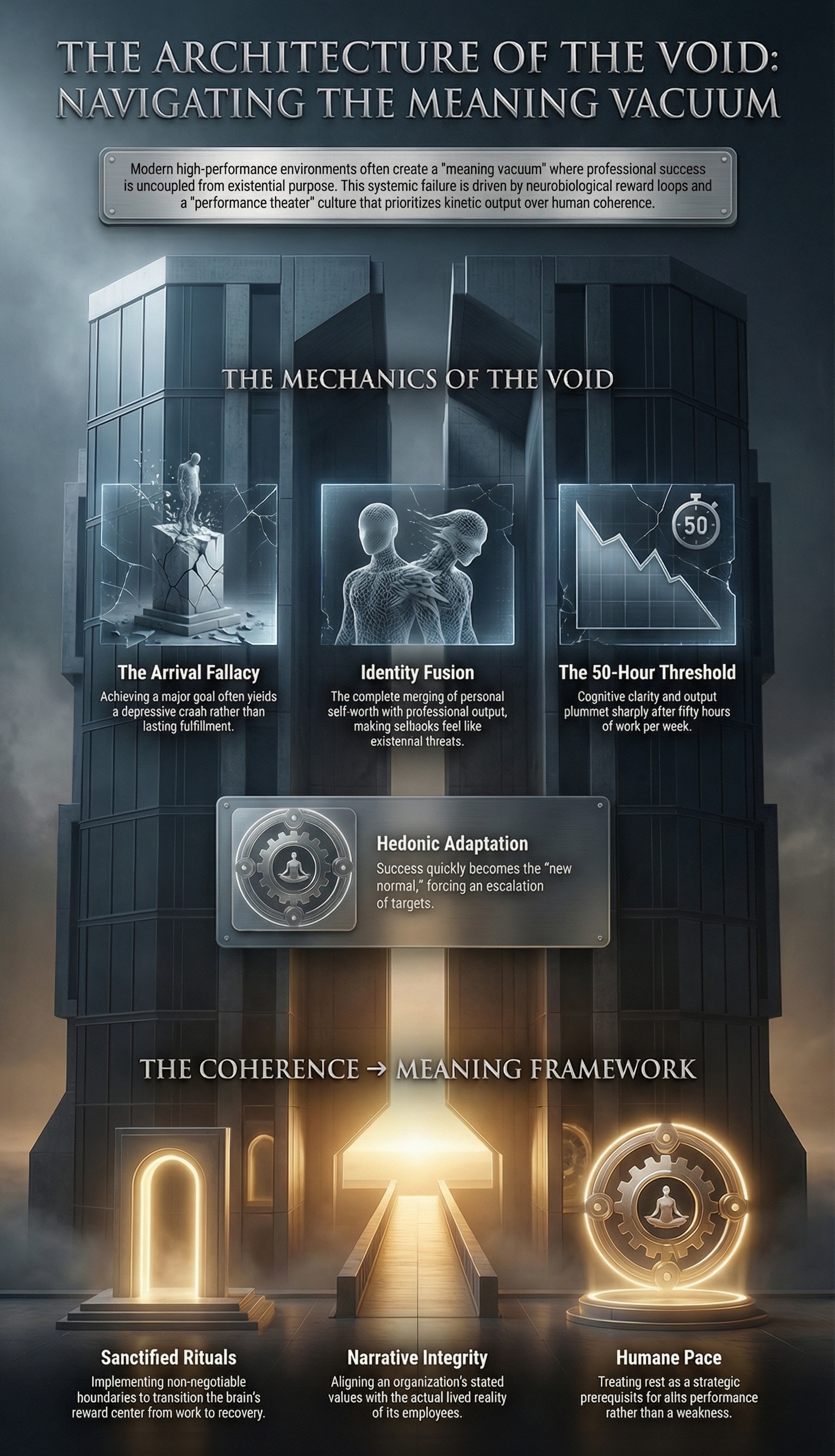
This biological reality gives rise to the “Arrival Fallacy,” a psychological term coined by behavioral scientist Tal Ben-Shahar to describe the pervasive cognitive illusion that reaching a specific destination or attaining a major goal will yield lasting happiness and existential fulfillment.9 Because the human brain is wired to want more as a survival mechanism, it struggles to remain content with the reward for any significant duration.9 The illusion is so powerful that when individuals finally cross the threshold of their ultimate ambitions—whether securing a massive corporate acquisition, launching a successful initial public offering, or even winning an Olympic gold medal—they frequently experience a depressive crash rather than sustained joy.16 The moment after a monumental success is strangely quiet, stripped of the friction, deadlines, and anticipatory dopamine that had previously structured the individual’s days.15
High achievers trapped in this loop rarely interpret the post-success emptiness as a biological reset. Instead, they interpret the void as a failure of magnitude.15 The subconscious assumption is that the accomplished goal simply was not large enough or prestigious enough to deliver the promised salvation. This misinterpretation triggers the next cycle of the loop. The individual opens a new spreadsheet, drafts a new strategic plan, and establishes an even more extreme target.15 This perpetual striving creates a “hedonic hamster wheel,” where the nervous system is subjected to chronic stress and overstimulation, completely divorcing the individual from the present moment and ensuring that true fulfillment remains an ever-receding horizon.4 The tragedy of the Arrival Fallacy is not that goals are inherently meaningless, but that the human brain is physiologically incapable of resting in the state of arrival.9
The Psychology of the Void: Hedonic Adaptation and Identity Fusion
The neurobiological trap of the dopaminergic chase is compounded and solidified by two immensely powerful psychological forces: hedonic adaptation and the phenomenon of identity fusion with work. Together, these mechanisms ensure that the structural void of the modern high-performance environment cannot be filled by external accumulation.
Hedonic Adaptation and the Shifting Baseline
Hedonic adaptation, frequently referred to as the hedonic treadmill, is the psychological conjecture that human beings possess an innate tendency to quickly return to a relatively stable baseline of emotional valence despite major positive or negative life events.21 Originally conceptualized by researchers Brickman and Campbell, this theory suggests that as an individual achieves higher status, accumulates greater wealth, or secures more power, their expectations and material desires rise in exact tandem.21 The extraordinary becomes the ordinary; the new luxury quickly metabolizes into the new normal.
In hyper-competitive corporate cultures, the hedonic treadmill guarantees that external achievements cannot fill the meaning vacuum. The pursuit of success mutates into a defense mechanism against the void, an exhausting attempt to outrun the inevitable return to baseline.22 This process involves complex cognitive changes, including the shifting of values, the recalibration of attention, and the reconstruction of how one interprets their situation.21 Paradoxically, the process of adaptation often involves the tendency of highly successful individuals to construct elaborate rationales for considering themselves deprived, a phenomenon social theorists refer to as “abundance denial”.21 When progress is measured purely by velocity and endless accumulation, the profound philosophical warning that “Speed Is Not Always Progress” is tragically ignored.1 The individual runs ever faster, yet remains emotionally stationary.24
The Annihilation of the Self: Identity Fusion
The psychological damage accelerates exponentially when the high achiever undergoes “identity fusion” with their professional role. Identity fusion is a psychological construct rooted in social psychology and cognitive anthropology that describes a phenomenon far more extreme than standard group identification.25 While traditional social identity theory describes an individual’s behavior as existing on a continuum—where the personal self waxes as the social self wanes, and vice versa—identity fusion involves the complete union of the personal and social selves.25
When fusion occurs, the boundaries that separate the unique characteristics of the individual from the characteristics of their occupational role become highly permeable and virtually indistinguishable.25 The professional no longer merely performs a job; their fundamental sense of self-worth, their existential value, and their core identity become entirely entangled with their productivity and output.28 The mantra of the fused professional is no longer “I do this work,” but rather, “I am this work”.29
The consequences of this profound psychological entanglement in high-pressure environments are catastrophic, transforming everyday corporate challenges into matters of existential survival.
- Existential Threat via Metric: Because the individual has merged their identity with their accomplishments, any professional challenge, missed deadline, or critical feedback session is no longer processed as a standard workplace hurdle.29 It is processed by the amygdala as a direct, moral failure and a lethal threat to the core self.29
- Erosion of Boundaries and Recovery: Research consistently demonstrates that psychological detachment from work during non-work hours is one of the strongest predictors of recovery from occupational stress.28 The fused individual, however, cannot psychologically detach. Their mind continues to rehearse work problems, answer late-night emails, and monitor digital channels, destroying the recovery periods necessary for nervous system regulation.28
- The Architecture of Burnout: Burnout in the context of identity fusion is not merely physical exhaustion or decision fatigue. It is a slow erosion of the self beneath the weight of constant output, representing a complete crisis of identity.29 When the individual can no longer sustain the relentless energy required by the high-performance culture, the fused identity structure shatters. This collapse frequently co-occurs with severe anxiety, depressive disorders, and a total loss of meaning, as the individual is forced to confront the terrifying reality that the source of their identity was simultaneously the source of their suffering.28
Psychological Mechanism | Functional Description | Impact on High-Performance Individuals |
Hedonic Adaptation | The rapid return to a baseline state of emotion following significant achievements or life changes. | Invalidates the emotional reward of long-term goals; forces a perpetual escalation of targets to achieve brief satisfaction. |
Arrival Fallacy | The cognitive bias assuming that reaching a specific milestone will yield permanent fulfillment. | Creates a post-achievement deficit (“the void”) when the expected emotional salvation fails to materialize. |
Identity Fusion | The complete merging of the personal self with the professional role, erasing psychological boundaries. | Converts professional setbacks into existential crises; eliminates the capacity for psychological recovery, guaranteeing burnout. |
The Sociology of the Stage: Performance Theater and Status Competition
The internal psychological void experienced by the high achiever is mirrored, sustained, and magnified by the external sociological structures of modern corporate environments. To understand the pervasive emptiness of elite organizational cultures, one must examine the dynamics of social interaction through the lens of dramaturgical sociology.
Drawing upon Erving Goffman’s seminal work, The Presentation of Self in Everyday Life, social interaction in professional spheres can be understood as an elaborate theatrical performance.33 Individuals act as “performers” managing impressions on a “front stage” to control how their “audience”—comprising peers, managers, shareholders, and the broader market—perceives them.34 This dramaturgical analysis posits that the self is not a static entity, but rather a dramatic effect emerging from the immediate scene being presented, governed by cultural values, norms, and the desire for social acceptance.33
In high-performance cultures, this performance theater becomes the absolute and dominant mode of existence. Leaders and employees continuously curate their behavior, adopting standardized, generalizable “masks” to project invulnerability, hyper-competence, and perpetual enthusiasm.33 The modern corporate worker engages in “dramatic realization,” selectively portraying only the aspects of themselves that align with the organization’s idealized archetype of success.33 However, sustaining this front-stage persona requires immense, ongoing cognitive and emotional labor. The “back stage”—the private sanctuary where the individual can relax, experience doubt, drop the performance, and recuperate—is increasingly erased by digital connectivity, remote work technologies, and an “always-on” culture that demands continuous visibility.34
The Pathology of Status Competition
This exhausting dramaturgical existence is aggressively fueled by intense and unyielding status competition. A long-standing tradition in sociology recognizes that the desire for high social rank is a fundamental driver of human behavior, rooted deeply in emotional tastes and internal reward mechanisms.36 In group dynamics, status is not simply a byproduct of financial compensation; it determines access to resources, influence, and organizational survival.36
While pure merit-based status competition can theoretically drive individuals to work hard and contribute to group output, modern corporate environments frequently diverge from pure meritocracy.36 In many high-performance arenas, status is increasingly determined by “politics”—non-productive social activities, alliance building, and optics designed solely for status enhancement and impression management.36 When status can be achieved or maintained through political maneuvering and performance theater rather than genuine value creation, the overarching culture becomes highly cynical and overall organizational performance degrades.36
The workplace transforms into a zero-sum gladiator arena where individuals compete fiercely for the optic of success rather than the substance of it. This sociological environment actively repels authenticity. To admit to emotional exhaustion, to express vulnerability, or to question the fundamental purpose of the corporate mission is to break character on the front stage. Doing so risks immediate and severe social and professional penalties, including marginalization and loss of rank.35 Consequently, the meaning vacuum is hermetically sealed. The individual is trapped neurochemically by the dopamine loop, psychologically by identity fusion, and sociologically by the strict requirement to endlessly perform a script of relentless, frictionless success.
The Philosophy of the Void: Evolutionary Necessity and the Search for Meaning
To truly comprehend the crisis of the meaning vacuum, the analysis must move beyond corporate management theory and delve into the realms of evolutionary biology and existential philosophy. The human organism is not merely a biological machine designed for resource accumulation; it is fundamentally a meaning-making entity.
From an evolutionary perspective, the human capacity for purpose, existential reflection, and deep altruism was selected for because it binds fragile tribal structures together, ensuring collective survival and cooperation in hostile, ancestral environments.38 A sense of meaning is not a modern luxury or a philosophical indulgence; it is an evolutionary necessity and a biological imperative wired into the human genome.39 Humans become their most resilient and capable selves when prioritizing strong personal relationships and shared, transcendent goals.39
When modern individuals are placed in highly optimized, hyper-individualistic corporate environments devoid of deeper purpose—where fixed social roles have dissolved and the narrative of endless progress is increasingly doubted—their evolutionary hardware begins to malfunction.3 The symptoms of this malfunction—the rising tide of anxiety, depressive disorders, burnout, and the desperate seeking of validation through status and tribal political identities—are the distress signals of an organism severed from its natural state of interconnectedness.3 The modern meaning crisis is structural, built into the very way contemporary economic and social systems operate, leaving individuals waiting for a reward that never comes because it is always just over the horizon.3
The philosophy encapsulated in the concept that “Everything Is Made of Meaning” posits that meaning is not merely a subjective, secondary overlay invented by the human mind, but a constitutive fabric of reality itself.1 Existence operates as a complex, fractal system where the observer and the observed are intimately entangled, and where “Reality Responds to Coherence”.1 When an individual or an organization is fundamentally misaligned—when their stated values contradict their daily actions, or when their operational speed vastly outpaces their capacity for reflection—the system falls into dissonance.
High-performance cultures fail the human spirit because they prioritize kinetic output and the illusion of control over systemic coherence. They treat the mind as a master to be optimized and flogged, rather than recognizing the deeper philosophical truth that “The Mind Follows. Awareness Leads”.1 True effectiveness and existential peace arise not from dominating the environment or endlessly manipulating reality for personal gain, but from aligning with the natural flow and rhythm of existence.1 When the architecture of corporate life denies this reality, it builds vast, capable systems that inevitably feel cold, empty, and meaningless to the people trapped inside them.3
The Destruction of Meaning via Misaligned Incentive Systems
Organizations attempt to govern these complex neurobiological, sociological, and philosophical forces using notoriously blunt instruments: financial incentive systems. While intended to align employee behavior with organizational goals, empirical research clearly indicates that complex, poorly designed incentive structures are primary destroyers of meaning, ethics, and intrinsic purpose.5
When corporate architecture over-indexes on complex, performance-based monetary incentives, it inadvertently engineers a culture of evasion, manipulation, and moral hazard.5 The dark side of performance bonuses reveals a landscape where well-intentioned systems routinely lead to disastrous outcomes.43
- The Ratchet Effect and Opacity: Incentive systems frequently become overly complex, featuring dynamic pay rates and shifting targets. When incentives are opaque, workers fail to understand the full picture and do not change their behavior optimally.5 Furthermore, when incentives compare current performance to benchmarks established by past outcomes, they trigger the “ratchet effect.” If workers realize that exerting maximum effort today will simply result in higher, more punitive expectations tomorrow, they intentionally throttle their effort and slow down to avoid tougher future targets.5 The system, designed to maximize output, instead breeds strategic mediocrity and mutual distrust.
- Goal Fixation and Ethical Fading: Tying heavy financial bonuses to specific, narrow metrics creates severe goal fixation. This fixation depletes self-control, encourages excessive risk-taking, and leads to unethical behavior, such as falsifying financial reporting or manipulating billable hours.6 The incentive alters the employee’s perception of reality itself. Leading up to the 2008 financial crisis, loan officers incentivized to approve sketchy applications did not merely knowingly approve bad loans; the incentive structures literally changed how they perceived the viability of those loans.43 This environment normalizes compromises until “ethical fading” occurs—a process where small breaches of integrity are repeated so often they cease to register as moral decisions at all.37
- The Erasure of the “Why”: The philosophy of the fractal universe warns that “Innovation Without Soul Becomes Illusion”.1 When an organization reduces its entire operational philosophy to a quarterly numerical target, it strips the work of its existential weight. The human brain, while highly responsive to monetary reward, requires a narrative of contribution and relatedness to sustain long-term, healthy engagement.41 A system that implicitly dictates “Make it happen” regardless of the method destroys the narrative integrity of the organization, disconnecting effort from impact and leaving employees wealthy but existentially adrift.8
Incentive Mechanism | Intended Organizational Goal | Actual Psychological & Behavioral Outcome |
Dynamic/Complex Targets | Continuous motivation through shifting performance benchmarks. | The Ratchet Effect: Intentional throttling of effort to avoid punitive future expectations; confusion and opacity. |
High-Stakes Financial Bonuses | Maximizing output and rewarding top-tier execution. | Ethical Fading & Goal Fixation: Altered perception of risk; normalization of corner-cutting; falsification of data. |
Metric-Only Evaluation | Objective, data-driven assessment of employee value. | Erasure of Meaning: Disconnection of effort from existential impact; promotion of zero-sum status competition. |
Coherent Leadership: Restoring the Fractal Without Moralism
The traditional response to ethical fading, burnout, and meaning vacuums in the corporate sector has been a reactive pivot toward “moral leadership”.45 While substantial research demonstrates that leaders who prioritize ethics generally outperform their peers in driving engagement, reducing turnover, and increasing trust, relying on “moralism” presents a distinct and dangerous organizational vulnerability.47
Morality is highly subjective and culturally contingent. An extensive review of moral leadership literature reveals that different ethical frameworks clash fundamentally.48 A servant leader (grounded in consequentialism), an ethical leader (grounded in deontology and compliance), and an authentic leader (grounded in virtue ethics) may all act morally according to their own internal frameworks while simultaneously viewing the decisions of the others as profoundly unethical.45 Imposing a subjective, rigid moralism upon a diverse workforce breeds resentment, encourages performative compliance on the front stage, and deepens organizational fragmentation.
The solution to the meaning vacuum is not prescriptive moralism, but Coherent Leadership.
Coherence is the structural ability to stay grounded and oriented amidst intense pressure, ensuring that awareness, decisions, and actions remain perfectly aligned even when the surrounding system is deeply unsettled and far from equilibrium.8 As physicist Ilya Prigogine noted, when a complex system is far from equilibrium, small islands of coherence have the capacity to shift the entire system to a higher order.8 A coherent leader acts as this lighthouse—a stabilizing architecture amidst chaos.
Coherence does not require intense emotional moralizing to demand order. It dictates a structural reality: if a belief does not align with the whole, it must be revised; if an action undermines the system’s true, long-term aims, it must be rejected.50 Coherence is a condition of existence for any system that thinks or chooses; no mind or organization survives prolonged incoherence.50
A coherent leader does not preach; they architect environments where truth and purpose can naturally emerge from the noise. They understand that the organization is a fractal reflection of the individuals within it. By embodying narrative integrity and actively rejecting the performance theater that drives the status-treadmill, the coherent leader signals to the organization that the “front stage” mask is no longer required for survival. This radical shift creates psychological safety, allowing employees to decouple their identity from their output, breathe, and re-engage with their work not as a survival mechanism, but as a conscious choice.51
The “Coherence → Meaning” Framework
To operationalize this philosophy and rescue their cultures from the void, organizations must adopt the “Coherence → Meaning” Framework. This framework dismantles the neurobiological and sociological traps of the high-performance culture by restructuring the organizational environment around five fundamental pillars: Rituals, Narrative Integrity, Values-to-Decision Alignment, Humane Pace, and Truth Systems.
1. Rituals: The Sanctification of Attention
The modern workspace, particularly with the advent of omnipresent digital communication, has aggressively eradicated the boundaries between work and recovery. This ensures that the nervous system remains in a chronic state of threat and anticipation.28 Rituals serve as the necessary, structured architecture to ground the human organism and transition consciousness between states of being.
- Digital and Physical Sanctification: As the philosophical framework notes, “Even the Digital Can Hold Ritual”.1 Organizations must establish clear, non-negotiable rituals for entering and exiting deep work. This includes strict communication blackouts after hours, ceremonial transitions from strategy to execution, and the normalization of “mindful pauses” to reset the brain’s reward center.19
- Breaking Identity Fusion: Rituals must be specifically designed to sever the toxic fusion between identity and work. By creating end-of-day practices that explicitly transition the individual out of their professional avatar and back into their personal self, the organization protects the employee from the existential threat of continuous performance.28 “Sacredness lives in the ordinary,” meaning that even the simple, protected act of disconnecting and silencing notifications becomes a vital ritual of mental preservation.1
2. Narrative Integrity: Aligning the Myth and the Matrix
An organization cannot claim to value innovation, health, and collaboration if its actual incentive structures reward ruthless conformity, zero-sum status competition, and exhaustion.37 As the text warns, “Innovation Without Soul Becomes Illusion”.1 Narrative integrity requires the absolute, unflinching alignment of the stories an organization tells internally and externally with the lived reality of its employees.
- Eradicating the Perception Gap: When executive reality and employee perception disconnect, profound cynicism thrives. Research highlights a persistent gap where executives believe they foster collaboration, while employees experience the opposite.54 Coherent leaders do not tell stories to manipulate; they ensure the organizational myth (recognizing that “The Stories You Live Are the Stories You Inherit” 1) is structurally supported by daily operations. Storytelling, when authentic, triggers oxytocin and builds deep emotional resonance and loyalty.54
- Rewarding the “How”: To restore narrative integrity, performance must be evaluated not just on the raw metrics achieved, but on the method of achievement. If a leader hits a quarterly revenue target but burns out their team and relies on ethical shortcuts to do so, the narrative integrity of the organization demands that this be categorized and treated as a failure.37
3. Values-to-Decision Alignment: Coding the Future
Values cannot exist merely as corporate abstractions printed on lobby walls; they must act as the immediate, algorithmic filters for all decision-making. The philosophy dictates that “The Future Is Not Written—It’s Coded Through Choice”.1
- The Power of Three and Evidence over Opinion: Decisions and leadership narratives must be evaluated through a clear lens that connects a foundational past, an active present, and a strategic future.55 Every strategic choice regarding talent or direction must pass through a strict coherence filter grounded in evidence, not political opinion: Does this decision clarify ownership? Does it strengthen accountability? Does it make the truth visible?.56
- Designing for the Desired World: Leaders must “Build for the World You Want to Live In” and “Build Tools That Heal, Not Just Solve”.1 If a new incentive program or technological integration is proposed, leadership must ruthlessly analyze its second-order effects. Will it trigger the ratchet effect? Will it encourage ethical fading? If an action violates the organization’s core values or relies on deceiving the workforce, the decision must be rejected, regardless of the short-term financial upside.5
4. Humane Pace: Rest as Resistance
The “Great Acceleration” operates on the flawed assumption that human capital scales linearly with hours worked—a fallacy decisively disproven by economic and neurological data.57 Employee output and cognitive clarity plummet sharply after a natural threshold (typically around 50 hours), and the “extra” hours spent in a state of exhaustion yield almost no additional results, instead degrading decision-making capacity.57
- The Philosophy of Rhythm: The universe operates in cycles, teaching that “Speed Is Not Always Progress,” and “The Earth Does Not Hurry—And Yet Everything Blooms”.1 Organizations must shift their operational paradigms from a state of relentless, linear velocity to one of sustainable, cyclical rhythm.
- Rest as a Strategic Imperative: “Rest Is Resistance in a World That Worships Speed”.1 Coherent leadership institutionalizes rest not as a weak concession to burnout, but as a hard prerequisite for sustained elite performance. By enforcing a humane pace, the organization allows the dopaminergic system to reset, preventing the Arrival Fallacy from generating perpetual dissatisfaction and allowing the human mind to access the “space between thoughts” where true insight resides.1
5. Truth Systems: The Infrastructure of Reality
Truth in a complex organization is rarely a singular, static fact; rather, “Truth Reveals Itself in Layers”.1 However, when organizations intentionally obscure reality through opaque compensation matrices, hidden agendas, or performative corporate politics, the “meaning vacuum” expands exponentially.5
- Epistemic Awareness and Psychological Clarity: Leaders must build environments where team members can examine information, voice dissent, and challenge assumptions without fear of retaliation or loss of status.52 This requires immense psychological clarity and the deliberate dismantling of the “front stage” performance culture.52
- Systemic Transparency: A true “Truth System” hard-wires honesty and accountability into the corporate infrastructure.58 It shifts the culture from managing perceptions and optics to managing reality based on verified data and ethical cognition.52 When employees know that the system is transparent, fair, and unwilling to tolerate deception, the heavy cognitive load of defensive posturing evaporates. The immense energy previously spent on status competition and theatrical performance can then be redirected toward meaningful, purposeful, and highly coherent work.60
Conclusion
The modern meaning vacuum is the inevitable, catastrophic consequence of systems that attempt to extract infinite kinetic energy from finite human architecture. When the ancient neurobiology of reward is hijacked by ever-moving goalposts, when personal identity becomes dangerously and inextricably fused with corporate output, and when the sociology of the workplace demands relentless, exhausting theatrical performance, success itself transforms into a mechanism of profound spiritual and psychological exhaustion.
The resolution to this existential crisis does not lie in designing more sophisticated, complex financial incentive schemes, nor does it reside in relying upon subjective, platitudinal moralizing that divides rather than unites. It lies in recognizing the profound philosophical truth that “Everything Is Made of Meaning,” and that humans are evolutionary organisms requiring deep, resonant purpose and interconnectedness to function at their highest capacity.
By adopting the “Coherence → Meaning” framework, organizations cease to be arenas of attrition and abundance denial. Through the intentional, courageous implementation of sanctified rituals, unyielding narrative integrity, strict values-to-decision alignment, a biologically humane pace, and robust truth systems, leaders can architect environments where reality naturally responds to coherence. In doing so, they dismantle the void, quiet the noise of the Great Acceleration, and allow true, sustainable, and meaningful progress to finally bloom.
Works cited
- FRACTAL – THE AWAKENING Low.pdf
- Creating Postmodern Hybrid Organizational Systems: Exploring the Philosophical Foundations of Administrative Theory Through A Re – DigitalCommons@URI, accessed March 30, 2026, https://digitalcommons.uri.edu/cgi/viewcontent.cgi?article=1403&context=theses
- THE MEANING CRISIS. Why Progress Leaves Us Empty — And What… | by Boris (Bruce) Kriger | Jan, 2026 | Medium, accessed March 30, 2026, https://medium.com/@krigerbruce/the-meaning-crisis-f99ca0ea2f10
- The Dopamine Deficit: Why Success May Feel Empty | Psychology Today, accessed March 30, 2026, https://www.psychologytoday.com/us/blog/motivate/202504/the-dopamine-deficit-why-success-may-feel-empty
- Complex incentives shape worker effort, for better or worse – Cornell Chronicle, accessed March 30, 2026, https://news.cornell.edu/stories/2025/12/complex-incentives-shape-worker-effort-better-or-worse
- New study finds employee incentives can lead to unethical behavior in the workplace, accessed March 30, 2026, https://news.vt.edu/articles/2018/12/ncr-pamplin.html
- Leadership With a Moral Purpose: Why Ethical Leaders Outperform – Quarterdeck, accessed March 30, 2026, https://quarterdeck.co.uk/articles/leadership-with-a-moral-purpose/
- The Leadership Skill No One Is Training:3 Reasons Coherence Is Critical in Unsettled Times – Carolyn B. Ellis – Facilitator, Adaptability Assessment, Coach, accessed March 30, 2026, https://carolynbellis.com/the-leadership-skill-no-one-is-training3-reasons-coherence-is-critical-in-unsettled-times/
- How to Overcome the Arrival Fallacy – The Growth Equation, accessed March 30, 2026, https://thegrowtheq.com/how-to-overcome-the-arrival-fallacy/
- The Dopamine Paradox: Why Pleasure Often Undermines Motivation – GlobalRPH, accessed March 30, 2026, https://globalrph.com/2026/02/the-dopamine-paradox-why-pleasure-often-undermines-motivation/
- The Greed Machine: Why It’s Never Enough | by Boris (Bruce) Kriger – Medium, accessed March 30, 2026, https://medium.com/@krigerbruce/the-greed-machine-why-its-never-enough-41028db60be4
- Dopamine: Beyond the Rush of a Reward – Simons Foundation, accessed March 30, 2026, https://www.simonsfoundation.org/2019/01/24/dopamine-beyond-the-rush-of-a-reward/
- Dopamine in motivational control: rewarding, aversive, and alerting – PMC – NIH, accessed March 30, 2026, https://pmc.ncbi.nlm.nih.gov/articles/PMC3032992/
- Dopamine, Prediction Error and Beyond – PMC – NIH, accessed March 30, 2026, https://pmc.ncbi.nlm.nih.gov/articles/PMC7804370/
- Achievement Addiction: The Hidden Cost of Wanting More – Michael Serwa, accessed March 30, 2026, https://michaelserwa.com/articles/the-addiction-to-achievement/
- The Arrival Fallacy: Why Reaching the Top Feels Empty – YouTube, accessed March 30, 2026, https://www.youtube.com/watch?v=ZtJjazidwAE
- The Arrival Fallacy #psychology #neuroscience – YouTube, accessed March 30, 2026, https://www.youtube.com/shorts/TBH6xwTm9R8
- 652: Arthur Brooks – The Power of Teaching, The Arrival Fallacy, The Mad Scientist Profile, Lifting Heavy Weights, & The Two Best Practices To Be Happy — The Learning Leader Show With Ryan Hawk Transcript, accessed March 30, 2026, https://podcasts.happyscribe.com/the-learning-leader-show-with-ryan-hawk/652-arthur-brooks-the-power-of-teaching-the-arrival-fallacy-the-mad-scientist-profile-lifting-heavy-weights-the-two-best-practices-to-be-happy
- When Success Stops Feeling Like Success – MentorMyBoard, accessed March 30, 2026, https://www.mentormyboard.com/resources/blog-detail-page/BL0MHLTV70M
- The Arrival Fallacy: When Emptiness Follows Accomplishment – Exceptional Futures, accessed March 30, 2026, https://www.exceptionalfutures.com/the-arrival-fallacy/
- Hedonic treadmill – Wikipedia, accessed March 30, 2026, https://en.wikipedia.org/wiki/Hedonic_treadmill
- Why Success Stops Feeling Good: The Psychology of the Hedonic Treadmill – Hailey Magee, accessed March 30, 2026, https://www.haileymagee.com/blog/why-success-stops-feeling-good-the-psychology-of-the-hedonic-treadmill
- Hedonic Adaptation Psychology → Term – Lifestyle → Sustainability Directory, accessed March 30, 2026, https://lifestyle.sustainability-directory.com/term/hedonic-adaptation-psychology/
- Stepping Off the Achievement Treadmill | Psychology Today, accessed March 30, 2026, https://www.psychologytoday.com/us/blog/the-regret-free-life/202502/stepping-off-the-achievement-treadmill
- Identity fusion – Wikipedia, accessed March 30, 2026, https://en.wikipedia.org/wiki/Identity_fusion
- Identity Fusion | Psychology | Research Starters – EBSCO, accessed March 30, 2026, https://www.ebsco.com/research-starters/psychology/identity-fusion
- Strongly fused individuals feel viscerally responsible to self‐sacrifice – PMC – NIH, accessed March 30, 2026, https://pmc.ncbi.nlm.nih.gov/articles/PMC9790423/
- Work Burnout: Signs, Causes and How to Recover – Therapsy, accessed March 30, 2026, https://therapsy.it/work-burnout-signs-causes-recovery/
- The Role of Identity in Burnout: Reconnecting with Purpose Beyond Productivity, accessed March 30, 2026, https://joshua-shuman-psychologist.com/the-role-of-identity-in-burnout-reconnecting-with-purpose-beyond-productivity/
- The High Achiever’s Paradox: When Success Feels Empty – Achieve Counseling & Wellness, accessed March 30, 2026, https://achievecounseling.org/the-wellness-journal/f/the-high-achievers-paradox-when-success-feels-empty
- Stress Management for Busy Professionals | CEREVITY, accessed March 30, 2026, https://cerevity.com/how-to-manage-stress-in-a-fast-paced-world-a-guide-for-busy-professionals/
- How to Tell If You Have High-Functioning Burnout or Stress (2026) – The Pursuit Counseling, accessed March 30, 2026, https://thepursuitcounseling.com/how-do-i-know-if-i-have-high-functioning-burnout-or-just-stress/
- Dramaturgy (sociology) – Wikipedia, accessed March 30, 2026, https://en.wikipedia.org/wiki/Dramaturgy_(sociology)
- Dramaturgical Analysis | Drama and Theater Arts | Research Starters – EBSCO, accessed March 30, 2026, https://www.ebsco.com/research-starters/drama-and-theater-arts/dramaturgical-analysis
- Erving Goffman’s The Presentation of Self in Everyday Life, accessed March 30, 2026, https://web.pdx.edu/~tothm/theory/Presentation%20of%20Self.htm
- Status Competition and Performance in Work Groups – INSEAD, accessed March 30, 2026, https://sites.insead.edu/facultyresearch/research/doc.cfm?did=2176
- Good People, Bad Systems: When Performance Incentives Undermine Ethics | Walton College | University of Arkansas, accessed March 30, 2026, https://walton.uark.edu/insights/posts/good-people-bad-systems-when-performance-incentives-undermine-ethics.php
- How evolutionary principles improve the understanding of human health and disease – PMC, accessed March 30, 2026, https://pmc.ncbi.nlm.nih.gov/articles/PMC3352556/
- An Evolutionary Understanding of Our Meaning and Purpose on This Planet, accessed March 30, 2026, https://nextbigideaclub.com/magazine/evolutionary-understanding-meaning-purpose-planet-bookbite/48458/
- Evolution and the Purposes of Life – The New Atlantis, accessed March 30, 2026, https://www.thenewatlantis.com/publications/evolution-and-the-purposes-of-life
- From Burnout to Belonging | Psychology Today, accessed March 30, 2026, https://www.psychologytoday.com/us/blog/leadership-diversity-and-wellness/202512/from-burnout-to-belonging
- The Risks and Rewards of Employee Incentive Programs – SHRM, accessed March 30, 2026, https://www.shrm.org/topics-tools/news/all-things-work/employee-incentives-go-wrong
- The Dark Side of Performance Bonuses | Working Knowledge – Baker Library, accessed March 30, 2026, https://www.library.hbs.edu/working-knowledge/the-dark-side-of-performance-bonuses
- The Impact of Incentives on Job Performance, Business Cycle, and Population Health in Emerging Economies – PMC, accessed March 30, 2026, https://pmc.ncbi.nlm.nih.gov/articles/PMC8866177/
- Does morality in leadership matter? It depends on your definition of right and wrong., accessed March 30, 2026, https://www.rsm.nl/discovery/2019/morality-in-leadership/
- Moral leadership matters now more than ever: New Study | World Economic Forum, accessed March 30, 2026, https://www.weforum.org/stories/2021/02/why-moral-leadership-matters-now-more-than-ever/
- Moral leaders perform better — but what’s ‘moral’ is up for debate – UBNow, accessed March 30, 2026, https://www.buffalo.edu/ubnow/stories/2018/10/lemoine-moral-leadership.html
- Moral Recovery and Ethical Leadership – PMC – NIH, accessed March 30, 2026, https://pmc.ncbi.nlm.nih.gov/articles/PMC7580815/
- Taking Stock of Moral Approaches to Leadership: An Integrative Review of Ethical, Authentic, and Servant Leadership | Academy of Management Annals, accessed March 30, 2026, https://journals.aom.org/doi/10.5465/annals.2016.0121
- The Coherence Imperative – Artificial Intelligence, Real Morality, accessed March 30, 2026, https://www.real-morality.com/the-coherence-imperative
- Unveiling the Mechanisms through Which Leader Integrity Shapes Ethical Leadership Behavior: Theory of Planned Behavior Perspective – PMC, accessed March 30, 2026, https://pmc.ncbi.nlm.nih.gov/articles/PMC10669232/
- The Leadership Integrity Framework for Trust in the Age of Misinformation – UniversePG, accessed March 30, 2026, https://www.universepg.com/cjbis/the-leadership-integrity-framework-for-trust-in-the-age-of-misinformation
- Influence of destructive leadership behaviors on the meaning of work and work productivity, accessed March 30, 2026, https://pmc.ncbi.nlm.nih.gov/articles/PMC10751304/
- Culture Shift? Don’t Underestimate Perception and Storytelling – Rachel Medanic, accessed March 30, 2026, https://rachelmedanic.com/2025/10/07/culture-shift-dont-underestimate-perception-and-storytelling/
- The Power Of Three: A Practical Framework To Tell A More Strategic Leadership Story, accessed March 30, 2026, https://www.forbes.com/councils/forbescoachescouncil/2025/12/12/the-power-of-three-a-practical-framework-to-tell-a-more-strategic-leadership-story/
- The Three Lenses of Leadership: Structure, Ownership, and Truth | by Kumar Shailove | Hiver Engineering | Medium, accessed March 30, 2026, https://medium.com/hiver-engineering/the-three-lenses-of-leadership-structure-ownership-and-truth-09baffa4d51c
- The Strategic No: A Case Study On High-Achiever Burnout And The Science Of Doing Less, accessed March 30, 2026, https://www.forbes.com/councils/forbeshumanresourcescouncil/2026/02/18/the-strategic-no-a-case-study-on-high-achiever-burnout-and-the-science-of-doing-less/
- Durai’s Ethical Leadership Model | PDF | Artificial Intelligence – Scribd, accessed March 30, 2026, https://www.scribd.com/document/933785485/S-Vijay-Kumar-Durai-Crisis-Global-Leadership
- Ricardo Semler – The NEW future of work in the age of AI. Corporate transfiguration built on total transparency, trust and autonomy. me% – Oration Speakers, accessed March 30, 2026, https://orationspeakers.com/speakers/ricardo-semler/
- The Trust Economy Is Collapsing And Startups Are Turning It Into A Business Opportunity, accessed March 30, 2026, https://techround.co.uk/startups/the-trust-economy-is-collapsing-and-startups-are-turning-it-into-a-business-opportunity/
The Architecture of the Void
Use UP/DOWN arrows (or tap top/bottom of screen) to switch lanes.
Collect Success Goals (Gold) to spike your Dopamine.
Avoid Burnout Triggers (Red) which drain your Meaning.
Every promotion shrinks your capacity for Meaning.
The Void
Through Hedonic Adaptation, your internal world slowly collapsed under the weight of your own ambition.


