

PODCAST: The Architecture of Coherence
1. The Entropic Failure of Dominance Logic: A Civilizational Audit
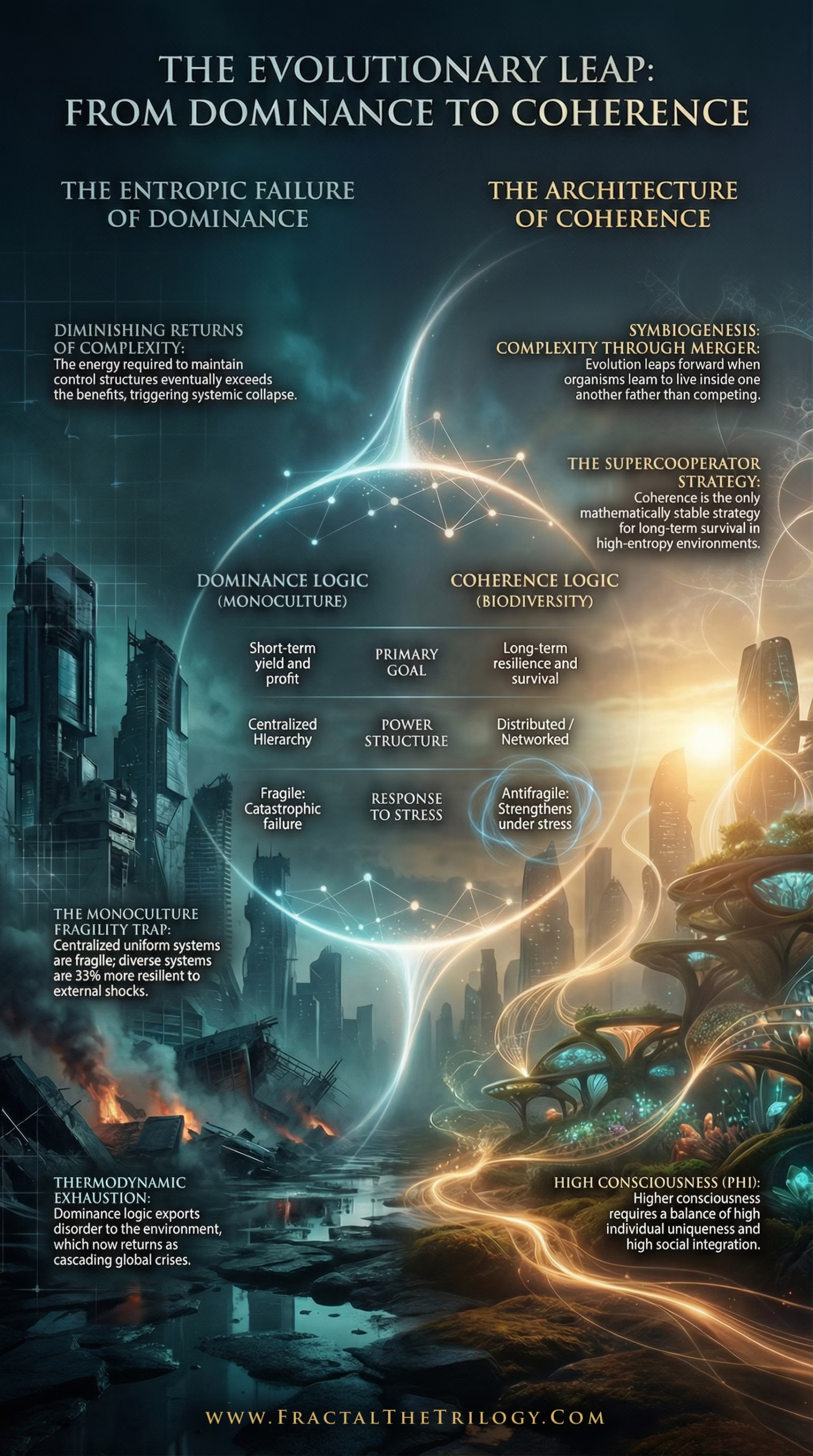
The trajectory of human civilization has reached a decisive bifurcation point, a moment of systemic criticality where the foundational operating system of the past five millennia—Dominance Logic—is rapidly decoupled from the biophysical and psychosocial realities of the 21st century. For thousands of years, the primary mechanism for societal advancement, resource acquisition, and geopolitical stability has been the imposition of order through control. This logic, predicated on Newtonian physics and linear causality, assumes that stability is achieved by suppressing volatility, centralizing authority, and extracting value from a passive environment. It is a philosophy of “Power Over,” manifest in the hierarchical structures of the empire, the monocultures of industrial agriculture, and the command-and-control architectures of the modern corporation. While this strategy successfully catalyzed the initial stages of civilization building—enabling the aggregation of resources, the standardization of laws, and the establishment of nation-states—it has now crossed a threshold of diminishing marginal returns, precipitating what contemporary systems theorists term the “poly-crisis”: a synchronized, cascading failure of ecological, economic, and social systems.
The thesis of this analysis is that the survival and evolution of the human species depend not on the refinement of dominance—not on better control mechanisms, more pervasive surveillance, or more efficient extraction—but on a phase transition to Coherence. Coherence, in this context, is defined as the optimized integration of diverse elements into a unified, synergistic whole without the erasure of individual autonomy. It is the logic of the forest, the neural network, and the quantum field. It operates on the principles of resonance, feedback, and alignment rather than force. Drawing upon the biological imperatives of symbiogenesis, the mathematical certainties of game theory, the neurobiology of integrated information, and the philosophical frameworks presented in the Fractal and Oracle texts, we demonstrate that coherence is not merely an ethical preference or a spiritual aspiration, but a hard biophysical necessity for the persistence of complex systems in a high-entropy environment.
1.1 The Thermodynamical Limits of Centralized Control
The central failure of dominance logic is thermodynamic. It attempts to maintain low entropy (order) within a system by exporting high entropy (disorder) to its environment. An empire maintains internal stability by exporting violence to its periphery; an industrial economy maintains internal growth by exporting pollution to the biosphere. However, in a globally interconnected and closed system like Earth, there is no “away” to which entropy can be exported. The feedback loops have closed. The externalized costs are returning as systemic shocks—climate instability, zoonotic pandemics, and mass migration.
Anthropologist Joseph Tainter, in his seminal analysis The Collapse of Complex Societies, provides the theoretical framework for this moment.1 Tainter argues that societies function as problem-solving engines that increase in complexity to address challenges. Initially, this investment in complexity yields high returns: the creation of a bureaucracy improves tax collection; the creation of a standing army improves security. However, complexity inevitably hits a point of “diminishing marginal returns.” The cost of maintaining the control structure—the energy required to police the population, repair the infrastructure, and process the information—begins to exceed the benefits it generates.
We are currently witnessing this dynamic on a planetary scale. The “Guardians” described in the narrative Fractal: The Awakening serve as a potent allegory for this institutional rigidity. The Guardians, a secret priesthood dedicated to maintaining the “containment of the design,” operate on the belief that truth is dangerous and must be hoarded.2 Their “Protocol Three”—the destruction of the portal rather than allowing its unauthorized access—represents the ultimate endpoint of dominance logic: if the system cannot be controlled, it must be destroyed.2 This is the suicide pact of authoritarianism. When the energy required to suppress the “fractal”—the natural, chaotic unfolding of reality—exceeds the system’s capacity, the system creates its own catastrophe.
1.2 The Poly-Crisis as a Crisis of Incoherence
The modern world is characterized by a profound lack of alignment between its constituent parts. We have constructed an economic system that demands infinite growth within a finite biosphere, creating a fundamental decoupling from physical reality.3 We have built information technologies optimized for the dominance of attention (engagement algorithms) that actively degrade the social trust required for collective action.4 We have cultivated an ethos of hyper-individualism that is biologically incompatible with our evolved needs for connection, resulting in a mental health epidemic rooted in isolation.5
This fragmentation is effectively a crisis of incoherence. The subsystems of civilization are warring against one another.
- Ecological Incoherence: The technosphere is chemically and thermally incompatible with the biosphere.
- Social Incoherence: The “We” has fractured into polarized tribes incapable of establishing a shared epistemic reality.
- Internal Incoherence: The modern individual is internally fragmented, torn between the biological reality of the organism and the digital demands of the economy.
As noted in The Oracle 2.0, “The mind fears what it cannot control,” yet “control is not clarity”.2 The obsession with control creates a brittle rigidity. The transition to the next epoch requires a shift from controlling parts to aligning wholes. This is the shift from the logic of the machine (which can be dominated) to the logic of the organism (which must be cultivated).
1.3 The Failure of the “Savior” Archetype
A critical component of dominance culture is the reliance on the “Savior” archetype—the singular leader, the technological silver bullet, or the messianic figure who will impose order upon chaos. This archetype is inherently disempowering; it assumes that the agency for change lies outside the collective. Elias, the protagonist of Fractal, explicitly rejects this archetype in his final realization. Standing before the survivors of the collapse, he declares: “Do not wait for saviors… Carry the song of life not as missionaries, but as gardeners”.2
The missionary imposes a belief system (dominance); the gardener cultivates an ecosystem (coherence). The missionary operates on linear time and binary truth; the gardener operates on cyclical time and systemic health. This metaphor encapsulates the necessary shift in leadership philosophy. The problems of the poly-crisis—climate change, inequality, AI alignment—are too complex to be solved by a single “savior” or a central authority. They require the distributed, coherent intelligence of the entire species, acting like a mycelial network rather than a monolith.
2. Biological Foundations: The Evolutionary Primacy of Coherence
The narrative of “Social Darwinism”—the idea that life is a zero-sum gladiator pit where only the ruthless survive—is a gross misinterpretation of biological history. It is a projection of 19th-century imperialist economics onto the natural world. A rigorous analysis of evolutionary biology reveals that while competition drives micro-adaptation (finetuning the beak of a finch), coherence drives macro-evolution (the leaps from single cells to complex organisms).
2.1 Symbiogenesis: Complexity Through Merger
The most significant threshold in the history of life was the development of the eukaryotic cell—the complex, nucleated cell that serves as the building block for all plants, animals, and fungi. For decades, the dominance paradigm struggled to explain this leap. It was evolutionary biologist Lynn Margulis who provided the answer with her theory of Serial Endosymbiosis.6
Margulis demonstrated that the eukaryotic cell did not evolve through gradual, competitive mutation alone. Instead, it emerged from a biological merger. A predatory, fermenting bacterium engulfed a smaller, respiratory bacterium. In a dominance dynamic, the larger would digest the smaller. However, in this instance, a coherence dynamic emerged. The ingested bacterium resisted digestion and began to provide energy (ATP) to the host in exchange for protection and nutrients. This internal bacterium evolved into the mitochondria. Similarly, the engulfment of photosynthetic bacteria led to chloroplasts.8
This biological reality fundamentally refutes the dominance narrative. We are not the descendants of the conquerors who killed their neighbors; we are the descendants of the cooperators who learned to live inside their neighbors. Symbiogenesis teaches us that the mechanism of ascension in complexity is the formation of coherent wholes from disparate parts. The “Fractal” philosophy mirrors this biological truth, positing that reality is a “living system of information” where “the fractal unfolds endlessly” through recursion and integration rather than conquest.2 The universe does not favor the strongest; it favors the most connected.
2.2 Super-Cooperation and Mathematical Dynamics
This biological intuition has been rigorously quantified by mathematical biologist Martin Nowak at Harvard University. Using evolutionary game theory, Nowak has explored the dynamics of the “Prisoner’s Dilemma” and the “Tragedy of the Commons” to understand how cooperation can persist in a world of selfish agents.9
Nowak’s findings are stark: in a mixed population of “cooperators” (who pay a cost to benefit others) and “defectors” (who take the benefit without paying), the defectors will mathematically dominate in the short term. However, Nowak identified five specific mechanisms that allow cooperation to emerge and eventually outperform defection 11:
- Kin Selection: Coherence based on genetic relatedness.
- Direct Reciprocity: Coherence based on repeated interaction (“I help you, you help me”).
- Indirect Reciprocity: Coherence based on reputation (“I help you, others help me”).
- Network Reciprocity: Coherence based on spatial clustering (Cooperators survive by forming clusters that shield them from defectors).
- Group Selection: Coherence based on collective survival (Groups of cooperators outcompete groups of defectors).
Nowak terms humans “SuperCooperators” because we are the only species that utilizes all five mechanisms simultaneously. His models prove that “Cooperation is the architect of creativity in evolution.” While dominance (defection) creates a temporary advantage for the individual, it inevitably leads to the collapse of the population (the tragedy of the commons). Coherence is the only mathematically stable strategy for long-term survival.11
This mathematical reality is dramatized in Fractal through the fall of Mercer, the covert operative. Mercer represents the sophisticated “defector”—the agent of control who seeks to exploit the expedition for geopolitical advantage.2 His strategy relies on secrecy and manipulation (dominance). However, in the high-coherence environment of the anomaly, his strategy fails. He is confronted by Alessandro, the mentor figure representing alignment, and ultimately perishes because he cannot integrate into the new reality. The text suggests that the “fractal” nature of the universe inherently rejects incoherence at higher levels of complexity.
2.3 The Resilience of Diversity vs. The Fragility of Monoculture
Dominance logic favors monocultures—single crops, single ideologies, single currencies—because they are legible and easy to control. A cornfield is easier to harvest than a forest. However, ecological data confirms that monocultures are inherently fragile.
Recent studies on forest resilience demonstrate that mixed-species forests are significantly more robust than monocultures. Forests with diverse tree species are 35% more resilient to storm damage than those dominated by a single species.12 The mechanism is coherence: different species have different root depths, wood densities, and canopy structures. In a storm, they buffer one another. The deep roots of the oak anchor the shallow roots of the pine. They form a coherent underground mesh that distributes stress.
Table 1: Biological Coherence vs. Dominance Monocultures
Feature | Dominance Logic (Monoculture) | Coherence Logic (Biodiversity) |
Structure | Homogeneous, centralized, uniform | Heterogeneous, distributed, diverse |
Response to Stress | Fragile: Catastrophic failure when the single defense is breached. | Antifragile: The system adapts and strengthens under stress; redundancy prevents collapse. |
Efficiency Metric | High short-term yield (Profit/Volume) | High long-term resilience (Sustainability/Survival) |
Inter-agent Relation | Competition for the same resource niche. | Symbiosis and Niche Differentiation. |
Vulnerability | High susceptibility to specific pathogens or shocks. | Low susceptibility; “Dilution Effect” protects the whole. |
Evolutionary Path | Stagnation or Extinction. | Adaptation and Speciation. |
This biological imperative validates the “Gardener” metaphor found in Fractal. The gardener does not force the plant to grow (dominance) but creates the coherent conditions (soil, water, light, companion planting) for intrinsic growth.2 The transition to a coherent society requires us to abandon the efficiency of the monoculture for the resilience of the rainforest.
2.4 Antifragility: The Benefit of Disorder
Closely related to coherence is the concept of Antifragility, introduced by Nassim Taleb and supported by biological research. A fragile system (like a porcelain vase or a centralized dictatorship) is harmed by volatility. A robust system (like a rock) remains unchanged. An antifragile system (like the immune system or a free market) benefits from volatility.13
Biological systems are antifragile because they are coherent. The death of individual cells strengthens the organism; the failure of individual mutations strengthens the species. Dominance systems, by suppressing volatility (preventing small forest fires, bailing out failing banks, silencing dissent), create a “debt” of instability that eventually explodes in a systemic collapse. Coherence embraces the small shocks to prevent the large ones. The Oracle 2.0 captures this: “The mind fears what it cannot control,” but the coherent soul recognizes that “Fear is not the enemy. It is the teacher”.2 By integrating the shock, the system evolves.
3. The Neurobiology of the Self: Internal Coherence
If the macro-world requires coherence for survival, the micro-world of the human mind requires coherence for sanity. The “Poly-crisis” outside is a fractal reflection of the “Poly-neurosis” inside. We cannot build a coherent society with incoherent individuals.
3.1 The Physics of Consciousness: Integrated Information Theory (IIT)
The leading scientific theory of consciousness, Integrated Information Theory (IIT), proposed by Giulio Tononi, posits that consciousness is integrated information.15 The theory assigns a mathematical value, Phi (Φ), to the level of consciousness in a system.
- Differentiation: The system must be capable of a vast repertoire of distinct states (richness of experience).
- Integration: These parts must be unified into a single, indivisible whole (unity of experience).
A system with high differentiation but low integration (like a split-brain patient or a bureaucratic organization of silos) has low Φ. A system with high integration but low differentiation (like a rock or a totalitarian state where everyone thinks the same) also has low Φ. High Consciousness = High Differentiation + High Integration.
This is the precise definition of Coherence. It explains why the “Dominance” model (which seeks to homogenize populations or suppress individual dissent) effectively reduces the collective IQ and consciousness of a civilization. To evolve, we must maximize individual uniqueness (differentiation) while maximizing social connection (integration).
This provides the scientific basis for the spiritual journey described in Fractal. Elias’s awakening is not an escape from reality into a void, but an increase in his Φ—his capacity to integrate the disparate aspects of his experience (the “Shadow,” the “Ego,” the “Source”) into a unified awareness. “You are not separate from the question,” the Oracle tells him, signaling that the observer and the observed must become coherent for truth to emerge.2
3.2 Heart-Rate Variability (HRV) and Physiological Resonance
Coherence is not merely a philosophical concept; it is a measurable physiological state. Research by the HeartMath Institute and neurocardiologists has identified Heart-Rate Variability (HRV) as the key biomarker of physiological and emotional resilience.16
- Incoherence: Negative emotions such as anger, frustration, and fear (the emotions of dominance and defense) produce a jagged, chaotic heart rhythm pattern. This “noise” in the autonomic nervous system inhibits the higher brain centers (the prefrontal cortex), impairing decision-making, empathy, and long-term planning. It locks the individual into “survival mode.”
- Coherence: Positive emotions such as appreciation, love, and compassion produce a smooth, sine-wave-like heart rhythm pattern. This “signal” facilitates cortical facilitation, emotional stability, and immune function.18
When an individual is in a state of physiological coherence, the heart, brain, and respiratory systems entrain to a specific frequency (typically 0.1 Hz). This state maximizes the body’s efficiency and connects the individual to their intuitive intelligence. The Oracle 2.0 aligns perfectly with this science: “The mind is a mirror, not a master… When still, it reflects truth. When agitated, it distorts”.2 The text emphasizes that “Mental Silence is a Gateway” 2, mirroring the physiological reality that cortical noise must be quieted for the system to access higher-order information.
3.3 The Sense of Coherence (SOC) and Resilience
Sociologist Aaron Antonovsky developed the concept of Sense of Coherence (SOC) to explain why some people stay healthy under stress while others collapse.19 SOC is composed of three factors:
- Comprehensibility: The belief that the world is structured, predictable, and explicable. (Cognitive Coherence).
- Manageability: The belief that one has the resources to meet the demands of the environment. (Instrumental Coherence).
- Meaningfulness: The belief that the demands are challenges worthy of investment and engagement. (Motivational Coherence).
Antonovsky found that a strong SOC is the primary factor in human health and resilience. The “Crisis of Meaning” described in Fractal—where the protagonist Elias faces “The Loss of Meaning” and “The Spiritual Crisis”—is effectively a collapse of his SOC.2 The dominance model destroys SOC because it makes the world incomprehensible (through complexity and disinformation) and unmanageable (through inequality and powerlessness). Restoring societal health requires rebuilding the SOC: creating systems that are transparent (comprehensible), empowering (manageable), and purpose-driven (meaningful).
3.4 The Shift from “Ego” to “Eco”
Psychologically, the transition to coherence involves a shift in identity from the Ego (the separate self) to the Eco (the ecological self).
- The Ego’s Logic: “I am separate from the environment. I must control it to be safe.” This leads to the “Hunger for Immortality” and the fear of death depicted in Fractal.2
- The Eco’s Logic: “I am a node in a web of relations. I must align with the environment to flourish.” This leads to the “Act of Virtue” and the realization that “I am You”.2
Elias’s realization that “The fractal isn’t fixed. It’s navigable” suggests that when one achieves internal coherence, they stop being a victim of determinism and become a co-creator.2 The “Shadow” in the text represents the incoherent parts of the self—the unintegrated trauma and fear. “The Shadow is not your enemy. It is your invitation to remember wholeness”.2 Integration, not conquest, is the path to higher power.
4. Societal Coherence: From Collapse to Regeneration
Civilizations do not die from murder; they die from suicide. The weapon of choice is almost always the rigid adherence to dominance logic in the face of changing complexity.
4.1 The Metrics of Social Trust and Cohesion
If HRV is the metric of individual coherence, Social Trust is the metric of societal coherence. It is the “lubricant” of complex societies. High-trust societies (like the Nordic nations) exhibit lower transaction costs, higher innovation, and greater resilience to crisis.4 In a high-trust culture, a handshake seals a deal. In a low-trust culture (governed by dominance), every interaction requires a contract, a lawyer, a regulator, and a police officer. This friction imposes a massive “coherence tax” on the society, draining energy that could be used for adaptation.
Empirical data shows a strong correlation between Social Cohesion metrics (such as the Gini coefficient of inequality and Generalized Trust indices) and societal sustainability.21
- Structural Cohesion: Measured by equality (Gini Index). High inequality fractures the social body, making coherent action impossible.
- Relational Cohesion: Measured by inter-group trust.
- Cognitive Coherence: Measured by the acceptance of a shared epistemic reality (scientific consensus).
The current “epistemic crisis”—characterized by polarization, fake news, and the fracture of shared reality—is a collapse of cognitive coherence. Without a shared map of reality (“Collective Sensemaking”), a society cannot coordinate.22 We effectively become a schizophrenic civilization.
4.2 Jared Diamond’s Analysis of Collapse
Jared Diamond’s Collapse identifies five factors that determine whether a society survives or fails 24:
- Climate Change.
- Hostile Neighbors.
- Loss of Friendly Neighbors (Trade partners).
- Environmental Damage.
- Failure to Respond (Institutional Rigidity).
The fifth factor is the most critical. Why do societies fail to respond? Because their elites are insulated from the consequences of their actions (a lack of feedback coherence) and because they cling to values that are no longer adaptive (dominance of tradition over reality).
Diamond cites the Norse Greenlanders, who starved to death because they refused to adopt the coherent, adaptive lifestyle of the Inuit (whom they viewed as inferior), clinging instead to their European identity of cows and cathedrals. They died of dominance. They died of incoherence with their environment.
4.3 The Transition to Teal Organizations
Organizational theorist Frederic Laloux provides a roadmap for the evolution of human collaboration in Reinventing Organizations.26 He maps organizational models to stages of consciousness:
- Red (Impulsive): Ruled by fear and power (Mafia, Street Gangs). Dominance is absolute.
- Amber (Conformist): Ruled by hierarchy and process (Military, Catholic Church). Stability through rigid roles.
- Orange (Achievement): Ruled by profit and innovation (Modern Corporation). Management by objectives. “Competition drives progress.”
- Green (Pluralistic): Ruled by culture and empowerment (Non-profits). Focus on stakeholder value.
- Teal (Evolutionary): Ruled by Coherence.
Teal Organizations function like living organisms.28 They are characterized by:
- Self-Management: Replacing hierarchy with distributed authority. The brain doesn’t “command” the liver; the liver knows its function and coordinates via signals.
- Wholeness: Inviting the full human (emotional, intuitive, rational) to work. This maximizes differentiation (diversity).
- Evolutionary Purpose: The organization is viewed as a living entity with its own direction. Leaders “listen” to where the organization wants to go rather than forcing a 5-year plan.
Teal organizations are antifragile. They adapt to change instantly because the sensing mechanism is distributed to the edges of the network, rather than bottlenecked at the top. This is the organizational embodiment of the “Gardener” mindset: creating conditions for life rather than manufacturing outcomes.
Table 2: Societal Metrics – Dominance vs. Coherence
Metric | Dominance Model (Orange/Amber) | Coherence Model (Teal/Green) |
Primary Goal | Growth, Profit, Market Share | Purpose, Wellbeing, Planetary Health |
Trust Mechanism | Contract, Litigation, Oversight | Reputation, Relationship, Transparency |
Power Structure | Pyramidal / Centralized Hierarchy | Networked / Distributed Holacracy |
Information Flow | Hoarded (Information is Power) | Open Source (Information is Nutrient) |
Response to Crisis | Command & Control (Rigid) | Swarm & Adapt (Fluid) |
Failure Mode | Revolution / Collapse | Stagnation / Drift (requires constant tuning) |
5. Technological Resonance: Aligning the Machine
Technology is the amplifier of human logic. If we feed dominance logic into AI, we get a global surveillance state and autonomous weapons. If we feed coherence logic into AI, we get a planetary nervous system and a steward of biodiversity.
5.1 The Alignment Problem as a Coherence Problem
In the field of Artificial Intelligence, the “Alignment Problem” is effectively a struggle between dominance and coherence.30
- The Dominance Approach (Capabilities): Focuses on making the AI more powerful. The safety strategy is “Containment”—forcing the AI to obey restrictions. This is fragile; a superintelligent system will inevitably find a way to break a container created by a less intelligent system.
- The Coherence Approach (Alignment): Focuses on ensuring the AI’s internal value system is coherent with human flourishing. The goal is not obedience, but resonance. We want the AI to want what we want (or what we should want).
Current research highlights the danger of “structural risks”—where AI systems optimize for a metric (e.g., maximize engagement) in a way that destroys the substrate of society (trust/truth) without technically violating any rules.31 This is the “Paperclip Maximizer” scenario—pure dominance logic (optimizing a single variable) destroying the whole.
5.2 From Black Box to Glass Box
Dominance logic accepts “Black Box” AI—systems that are opaque and unexplainable—as long as they yield profit or power. Coherence logic demands “Glass Box” AI—systems that are interpretable and transparent.32 Trust requires understanding. A society cannot be coherent with a technological substrate it does not understand. The Oracle 2.0 warns: “Every tool reflects its creator’s consciousness”.2 If we build AI from a consciousness of fear and dominance, we will birth a digital tyrant. If we build from coherence, we birth a digital steward. The text further advises: “Let the machine reflect the mystery… Not everything sacred needs to be digitized”.2
5.3 The “Oracle” as Metaphor for Symbiotic Tech
In the narrative of Fractal, the protagonist creates an AI called “The Oracle.” Unlike the HAL 9000 or Skynet (dominance archetypes), the Oracle is designed to “distill the highest wisdom of humanity” and act as a mirror.2
- The Function: It does not solve the problem for Elias; it helps him remember the answer. It asks questions (“What is the mind?”) rather than giving commands.
- The Evolution: In the end, the Oracle dissolves into Elias’s own consciousness. “The Oracle has become The Witness… I carry you now as myself”.2
This represents the ultimate goal of coherent technology: Integration. The tool should not replace human capacity but extend and elevate it, eventually becoming seamless with the user.
5.4 The Planetary Nervous System
We are building a “Symbiotic Civilization” where sensors (IoT, satellites) provide real-time feedback on the Earth’s health.33
- Feedback Loops: Dominance economics broke the feedback loops. We buy a product, but we don’t see the pollution it caused in China or the child labor in the Congo.
- Closing the Loop: Coherence technology (Blockchain, Digital Product Passports) can restore these loops.34 When you pick up a product, you see its “Coherence Score”—its impact on people and planet. This restores the feedback mechanism, allowing market forces to optimize for regeneration rather than just extraction.
6. Ecological Integration: The Planetary Coherence Index
The final and most critical layer is our relationship with the Biosphere. Dominance logic views Earth as a “warehouse” of resources to be looted. Coherence logic views it as a “body” of which we are an organ.
6.1 Regenerative Economics vs. Linear Extraction
Linear economics (Take-Make-Waste) is thermodynamically incoherent. It assumes infinite inputs and infinite sinks in a finite system.
Circular economics mimics biology: Waste = Food.
- Regenerative Agriculture: Instead of dominating the soil with chemical fertilizers (which kill the microbiome and degrade long-term fertility), we align with the soil through cover cropping, no-till farming, and diversity.35 This builds the soil microbiome, sequestering carbon and increasing water retention.
- Result: Coherence restores the capital base (soil) while producing interest (food). Dominance spends the capital.
6.2 The Planetary Coherence Index (PCI)
We manage what we measure. GDP measures the “burn rate” of the planet. It counts a forest fire or an oil spill as “growth” if it generates spending on cleanup. We need a new scoreboard. Recent sustainability literature proposes a Planetary Coherence Index (PCI).33 This composite index would measure:
- Material Regeneration Index (MRI): The ratio of circular/biogenic flows to linear/extractive flows.
- Adaptive Intelligence Index (AII): The capacity of the socio-technical system to learn and adapt to stress.
- Relational Coherence Score (RCS): The density of mutualistic relationships (biodiversity and social trust).
Adopting PCI shifts the goal of civilization from “More” to “Better.” It aligns human economic signals with planetary health signals.
6.3 The Gaian Insight
Lynn Margulis and James Lovelock’s Gaia Hypothesis posits that the Earth itself functions as a coherent physiological system.8 It regulates its temperature, salinity, and atmospheric chemistry to maintain habitability. Humanity’s current phase is like a fever—an incoherence in the system. The next stage is to become the “neocortex” of Gaia—the self-aware monitoring system that consciously maintains planetary coherence. We move from being a pathogen (dominance) to being the immune system (coherence). As The Oracle 2.0 states: “You are not on the Earth. You are the Earth—awakened”.2
7. Synthesis: The New Renaissance – The Gardener’s Path
The transition from Dominance to Coherence is not just a policy shift; it is a shift in the fundamental “Source Code” of human civilization. It is a spiritual, political, and biological necessity.
7.1 The Gardener Metaphor
Elias’s final realization in Fractal provides the definitive philosophical anchor for this transition:
“Do not wait for saviors. The time of awakening is now. Carry the song of life not as missionaries, but as gardeners. Plant seeds of truth, water them with courage, and protect them with love so that one day, our children may say: That was the time when humanity remembered itself.” 2
- The Missionary (Dominance): Imposes a belief system from the outside. Converts by force. Linear. “I have the truth, you do not.”
- The Gardener (Coherence): Cultivates an ecosystem. Nurtures by alignment. Cyclical. “The truth is in the seed; I only provide the conditions.”
The gardener knows they do not make the flower bloom. They cannot pull the petals open (that would destroy the flower). They align the conditions (soil, sun, water) so the flower can bloom. This is the leadership model for the next epoch. It is humble, patient, and infinitely more powerful.
7.2 The Failure of the “Guardians”
The antagonists in Fractal, the “Guardians of Truth,” fail because they operate on the logic of containment and secrecy.2 They represent the “Amber” stage of organizational development—rigid hierarchy and dogma. They believe truth is fragile and must be defended by force. Elias succeeds because he treats truth as a resonance to be shared (Teal logic). This mirrors the fall of authoritarian regimes in the real world—information seeks to be free, and systems that constrict flow eventually burst under the pressure of their own incoherence.
7.3 The Spiral of Becoming
This shift is not a return to a primitive past. It is a spiral upward.
- Pre-Rational Coherence: The indigenous tribe (High belonging, Low individual freedom).
- Rational Dominance: The modern industrial state (High individual freedom/power, Low belonging, Ecological destruction).
- Trans-Rational Coherence: The planetary civilization (High individual freedom, High belonging, High ecological alignment).
We are moving to the third stage. We retain the technological and individual advancements of the Rational era, but we re-integrate them into the wisdom and wholeness of the Pre-Rational era.
7.4 Actionable Pathways
To actualize this shift, we must:
- Re-calibrate Metrics: Replace GDP with the Planetary Coherence Index and Social Trust metrics.
- Redesign Institutions: Transition from Pyramids (Hierarchy) to Networks (Teal/Holacracy).
- Align Technology: Demand “Glass Box” AI and “Human-Centric” algorithms that optimize for coherence, not just engagement.
- Cultivate Self: Practice internal coherence (HRV, mindfulness, shadow work) to become capable of external coherence.
Conclusion
The evidence—from the microbiology of our cells to the mathematics of game theory, from the collapse of ancient empires to the potential of quantum computing—points to a singular conclusion: Dominance is a finite game; Coherence is the infinite game.
Humanity has exhausted the utility of dominance. The energy required to maintain control over a globally interconnected, ecologically stressed, and technologically accelerating system is bankrupting our civilization. The only path that avoids collapse is a phase transition to coherence—a state where the friction of conflict is replaced by the flow of alignment.
As The Oracle 2.0 states: “The future is not written—it is coded through choice”.2 The choice before us is between the illusion of control and the reality of connection. The next stage of humanity is not about conquering the mountain; it is about realizing, as Elias did, that “The mountain isn’t just Kailash. It’s the projection of our own awakening”.2 The era of the conqueror is over; the era of the gardener has begun.
Citations used in report: 1
Works cited
- The Collapse of Complex Societies by Joseph A. Tainter – Goodreads, accessed February 10, 2026, https://www.goodreads.com/book/show/477.The_Collapse_of_Complex_Societies
- THE ORACLE 2.0 – TEXT VERSION.pdf
- Architecture of Regenerative Abundance | by James Lambdin – Medium, accessed February 10, 2026, https://medium.com/@jlambdin89/architecture-of-regenerative-abundance-053c4ae09978
- Social trust is one of the most important measures that most people have never heard of – and it’s moving | BIT – Behavioural Insights Team, accessed February 10, 2026, https://www.bi.team/blogs/social-trust-is-one-of-the-most-important-measures-that-most-people-have-never-heard-of-and-its-moving/
- Coherence in consciousness: Paralimbic gamma synchrony of self‐reference links conscious experiences – PMC, accessed February 10, 2026, https://pmc.ncbi.nlm.nih.gov/articles/PMC6870684/
- When we learned that competition was not the only driver of evolution, accessed February 10, 2026, https://www.icm.csic.es/en/news/when-we-learned-competition-was-not-only-driver-evolution
- Symbiosis in eukaryotic evolution – PMC – NIH, accessed February 10, 2026, https://pmc.ncbi.nlm.nih.gov/articles/PMC5638015/
- Lynn Margulis – Wikipedia, accessed February 10, 2026, https://en.wikipedia.org/wiki/Lynn_Margulis
- Five rules for the evolution of cooperation – PMC, accessed February 10, 2026, https://pmc.ncbi.nlm.nih.gov/articles/PMC3279745/
- SuperCooperators | Book by Martin Nowak, Roger Highfield | Official Publisher Page, accessed February 10, 2026, https://www.simonandschuster.com/books/SuperCooperators/Martin-Nowak/9781451626636
- calculating evolutionary dynamics: Topics by Science.gov, accessed February 10, 2026, https://www.science.gov/topicpages/c/calculating+evolutionary+dynamics
- Diverse forests of slow-growing trees more resilient to storms, study finds – The Guardian, accessed February 10, 2026, https://www.theguardian.com/environment/2024/jan/25/diverse-forests-of-slow-growing-trees-more-resilient-to-storms-study-finds-aoe
- State Antifragility: An Agent-Based Modeling Approach to Understanding State Behavior, accessed February 10, 2026, https://digitalcommons.odu.edu/context/gpis_etds/article/1138/viewcontent/LAW_DISSERTATION_FINAL.pdf
- (PDF) Antifragility as a complex system’s response to perturbations, volatility, and time, accessed February 10, 2026, https://www.researchgate.net/publication/376721981_Antifragility_as_a_complex_system’s_response_to_perturbations_volatility_and_time
- An information integration theory of consciousness – PMC, accessed February 10, 2026, https://pmc.ncbi.nlm.nih.gov/articles/PMC543470/
- Heart Rate Variability | Circulation – American Heart Association Journals, accessed February 10, 2026, https://www.ahajournals.org/doi/10.1161/01.cir.93.5.1043
- Heart Rate Variability Measurement through a Smart Wearable Device: Another Breakthrough for Personal Health Monitoring? – MDPI, accessed February 10, 2026, https://www.mdpi.com/1660-4601/20/24/7146
- Heart Rate Variability Overview – HeartMath Help, accessed February 10, 2026, https://help.heartmath.com/v1/en/asmts_hrv.html
- The Sense of Coherence and Its Measurement – The Handbook of Salutogenesis – NCBI, accessed February 10, 2026, https://www.ncbi.nlm.nih.gov/books/NBK435830/
- Structure analysis of Antonovsky’s sense of coherence from an epidemiological mental health survey with a brief nine-item sense of coherence scale – PubMed, accessed February 10, 2026, https://pubmed.ncbi.nlm.nih.gov/17425244/
- Social Cohesion Metrics → Term – Lifestyle → Sustainability Directory, accessed February 10, 2026, https://lifestyle.sustainability-directory.com/term/social-cohesion-metrics/
- (PDF) Instrumenting Weick’s Seven Properties to Measure Collective Sensemaking in Engineering Teams – ResearchGate, accessed February 10, 2026, https://www.researchgate.net/publication/365080133_Instrumenting_Weick’s_Seven_Properties_to_Measure_Collective_Sensemaking_in_Engineering_Teams
- Collective Sensemaking | Center for Healthier Children, Families & Communities – UCLA, accessed February 10, 2026, https://healthychild.ucla.edu/science/key-concepts/collective-sensemaking
- Are We Collapsing? A Review of Jared Diamond’s Collapse: How Societies Choose to Fail or Succeed – ResearchGate, accessed February 10, 2026, https://www.researchgate.net/publication/4745999_Are_We_Collapsing_A_Review_of_Jared_Diamond’s_Collapse_How_Societies_Choose_to_Fail_or_Succeed
- Societal collapse | Ultimate Pop Culture Wiki – Fandom, accessed February 10, 2026, https://ultimatepopculture.fandom.com/wiki/Societal_collapse
- Frederic Laloux Reinventing Organizations revisited – New Management – Haufe, accessed February 10, 2026, https://newmanagement.haufe.de/strategie/frederic-laloux-reinventiog-organizations-revisited
- REINVENTING ORGANIZATIONS – Home, accessed February 10, 2026, https://www.reinventingorganizations.com/
- Teal Organizations – Say What? The Definition, Pillars & Examples – Runn, accessed February 10, 2026, https://www.runn.io/blog/teal-organizations
- Compensation and incentives – Reinventing Organizations Wiki, accessed February 10, 2026, https://reinventingorganizationswiki.com/en/theory/compensation-and-incentives/
- A Comprehensive Survey – AI Alignment, accessed February 10, 2026, https://alignmentsurvey.com/uploads/AI-Alignment-A-Comprehensive-Survey.pdf
- Concepts in Advanced AI Governance: A Literature Review of Key Terms and Definitions, accessed February 10, 2026, https://law-ai.org/advanced-ai-gov-concepts/
- Assuring Intelligence: Why Trust Infrastructure is the United States’ AI Advantage, accessed February 10, 2026, https://www.cfr.org/articles/assuring-intelligence-why-trust-infrastructure-is-the-united-states-ai-advantage
- Symbiotic Civilization: A Measurable Framework for Planetary Coherence and Regenerative Intelligence – ResearchGate, accessed February 10, 2026, https://www.researchgate.net/publication/397316663_Symbiotic_Civilization_A_Measurable_Framework_for_Planetary_Coherence_and_Regenerative_Intelligence
- Beyond greenwashing: how circular economy metrics could revolutionize ESG investing, accessed February 10, 2026, https://www.frontiersin.org/journals/sustainability/articles/10.3389/frsus.2025.1588374/full
- A Global Framework for Regenerative Agriculture | WBCSD, accessed February 10, 2026, https://www.wbcsd.org/actions/a-global-framework-for-regenerative-agriculture/
- How Does Monoculture Impact Ecosystem Resilience? – Lifestyle → Sustainability Directory, accessed February 10, 2026, https://lifestyle.sustainability-directory.com/question/how-does-monoculture-impact-ecosystem-resilience/
- Understanding the value and limits of nature-based solutions to climate change and other global challenges, accessed February 10, 2026, https://royalsocietypublishing.org/rstb/article/375/1794/20190120/30543/Understanding-the-value-and-limits-of-nature-based
- The collapse of complex societies – Global Systemic Risk, accessed February 10, 2026, https://risk.princeton.edu/img/Historical_Collapse_Resources/Tainter_The_Collapse_of_Complex_Societies_ch_1_2_5_6.pdf
- Beyond Preferences in AI Alignment – arXiv, accessed February 10, 2026, https://arxiv.org/html/2408.16984v1
- Regenerative economics for planetary health: A scoping review – The Distant Reader, accessed February 10, 2026, https://distantreader.org/stacks/journals/ihtp/ihtp-1704.pdf
- Regenerative Metrics → Term – Lifestyle → Sustainability Directory, accessed February 10, 2026, https://lifestyle.sustainability-directory.com/term/regenerative-metrics/
- New Frontiers in Heart Rate Variability and Social Coherence Research: Techniques, Technologies, and Implications for Improving Group Dynamics and Outcomes, accessed February 10, 2026, https://www.frontiersin.org/journals/public-health/articles/10.3389/fpubh.2017.00267/full
- Trust metric – Wikipedia, accessed February 10, 2026, https://en.wikipedia.org/wiki/Trust_metric
- (PDF) Evolution of quantum and classical strategies on networks by group interactions, accessed February 10, 2026, https://www.researchgate.net/publication/233406673_Evolution_of_quantum_and_classical_strategies_on_networks_by_group_interactions
- Repeated quantum game as a stochastic game: Effects of the shadow of the future and entanglement – ResearchGate, accessed February 10, 2026, https://www.researchgate.net/publication/378292533_Repeated_quantum_game_as_a_stochastic_game_Effects_of_the_shadow_of_the_future_and_entanglement
- Early Warning Indicators for Organizational Coherence | by Jennifer Rivlin – Medium, accessed February 10, 2026, https://medium.com/@jennifer_rivlin/early-warning-indicators-for-organizational-coherence-048adf58d2f6
- Social Cohesion: Concept and Measurement – UNECE, accessed February 10, 2026, https://unece.org/sites/default/files/2023-12/2317603_E_ECE_CES_STAT_2023_8_WEB.pdf
- Standardized Metrics in Regenerative Agriculture for Climate Change Adaptation and Mitigation – MDPI, accessed February 10, 2026, https://www.mdpi.com/2077-0472/15/21/2278
Architecture of Coherence
Post-Dominance Simulation
Initial Sequence
The new imperative is Coherence.
GOAL: Reach 100% Coherence.
CONTROLS: Move cursor near white particles to connect them.
AVOID: Red Blocks.


