
PODCAST: Presence as Power
Executive Summary: The Ontological Crisis and the Renaissance of Awareness
The global business landscape is currently navigating a profound ontological crisis that transcends traditional economic cycles or technological disruptions. We are witnessing a fundamental decoupling of human capacity from organizational demand, manifested most acutely in the catastrophic rates of executive burnout, the unraveling of legacy leadership models, and a pervasive crisis of meaning. The “Great Acceleration” of the 21st century has exposed the fragility of the “power over” paradigm—a management philosophy characterized by command-and-control structures, the relentless extraction of human energy, and a dismissal of internal states as irrelevant to the bottom line. Recent data indicates that this model has reached a terminal velocity, creating a “meta-instability” that threatens the viability of global enterprises.
In this vacuum, a new paradigm is emerging, one that posits Presence and Awareness not as “soft skills” or peripheral wellness initiatives, but as the primary drivers of strategic agility, innovation, and systemic stability. This report, titled Presence as Power, synthesizes extensive data from 2024-2025 workforce analytics, neurobiological research, complexity theory, and metaphysical philosophy to argue that the next sustainable competitive advantage will be found in Conscious Intelligence.
The analysis reveals that organizations are complex adaptive systems that mirror the consciousness of their leaders. When leadership operates from a state of neurobiological dysregulation—the “amygdala hijack”—the organization inherits chaos, reactivity, and short-termism. Conversely, leaders who cultivate “strategic self-awareness” and act as “stabilizing nodes” create cultures of psychological safety that fuel innovation and resilience.
We examine the “human differentiator” in the age of Artificial Intelligence, arguing that as cognitive tasks are commoditized by algorithms, the distinctly human capacity for empathy, ethical judgment, and “conscious use” becomes the premium asset. Through detailed case studies of Microsoft, Patagonia, Barry-Wehmiller, and Eileen Fisher, we demonstrate that conscious leadership is not merely an ethical imperative but a superior risk-management strategy that delivers outsized returns on investment (ROI).
Furthermore, drawing upon the philosophical frameworks found in The Oracle 2.0 and Fractal: The Awakening, we explore the mechanisms by which the internal state of the leader literally shapes the external reality of the enterprise. The conclusion is stark: humanity is facing a “threshold of extinction” or a “new renaissance,” and the determining factor is the quality of our awareness. In an era of infinite noise, the ability to command one’s own attention and remain present is the ultimate form of power.
Part I: The Great Unraveling – The Cost of Unconsciousness
1.1 The Burnout Epidemic as a Systemic Signal
To understand the necessity of presence, one must first confront the cost of its absence. The corporate world is currently experiencing a breakdown of its biological and psychological infrastructure. Data from 2024 and 2025 reveals a landscape where chronic stress has metastasized from a personal health issue into a critical operational risk, described in some narratives as “The Great Acceleration” where systems unravel due to a lack of conscious anchoring.1
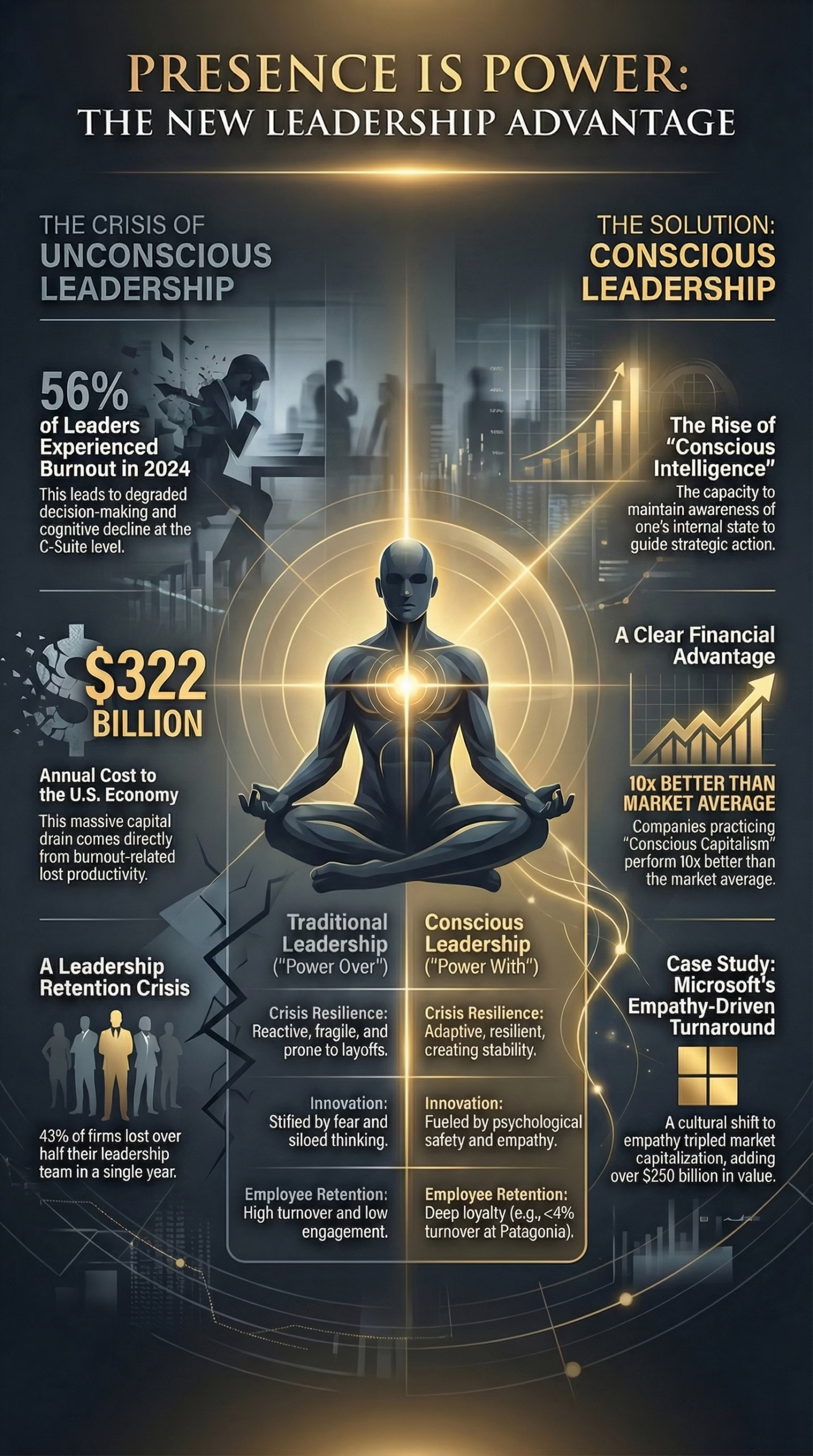
Recent statistics paint a sobering picture of the executive landscape. Leadership burnout rates jumped from 52% in 2023 to 56% in 2024, a statistical shift that represents thousands of senior decision-makers losing the cognitive capacity to lead effectively.2 More alarmingly, 43% of organizations have lost at least half of their leadership teams in a single year, signaling a retention crisis that threatens institutional memory and strategic continuity.2 This is not merely a matter of workload; it is a crisis of sustainability in how human energy is deployed. The “churn” at the top creates a vacuum of stability, leading to erratic strategic pivots and a loss of trust among the wider workforce.
The healthcare sector serves as the canary in the coal mine, with 74% of executives reporting extreme stress levels.2 When the leaders responsible for the systems of life and death are themselves operating in a survival state, the risk of systemic failure increases exponentially. Similarly, in sales, media, and marketing—sectors driven by high-velocity metrics—73% of leadership teams experienced significant turnover.2 This suggests that the pressure to perform without the “restoration” of presence is breaking the human component of the business machine.
The financial implications are staggering. Workplace burnout costs the U.S. economy an estimated $322 billion annually in lost productivity and up to $190 billion in healthcare costs.3 These figures represent a massive capital drain that no efficiency algorithm can offset. It is a “hidden tax” levied by unconscious management practices.
1.2 The Generational Fracture and the Demand for Meaning
Perhaps most concerning is the generational trajectory of this crisis. While burnout was traditionally associated with mid-career fatigue, Gen Z and millennial workers are now reporting peak burnout at age 25—17 years earlier than the historical average.3 This profound shift suggests that the current operating system of business—legacy capitalism focused solely on extraction and profit maximization—is fundamentally incompatible with the emerging workforce’s psychological and spiritual needs.
This generation is not just “tired”; they are suffering from a “loss of meaning,” a theme explored extensively in Fractal: The Awakening under the “Spiritual Crisis”.1 The younger workforce demands “Conscious Culture”—environments where values are not just marketing slogans but operational realities. They are sensitive to the “incongruence” of leaders who preach wellness but practice burnout. As noted in the Women in the Workplace 2025 report, there is a notable “ambition gap” emerging, where women are less interested in promotion because the “price” of leadership—total sacrifice of well-being—is deemed too high.4
The “Great Resignation” and “Quiet Quitting” phenomena were merely the tremors preceding this earthquake. The workforce is voting with their feet and their nervous systems, rejecting “power without presence.” They are seeking what The Oracle 2.0 describes as “The Calling of Humanity”—a move toward work that honors the “sacredness of life” rather than consuming it.4
1.3 The Mechanism of Collapse: Power Without Presence
The root cause of this unraveling is identified in both clinical research and narrative philosophy as the exercise of “power without presence.” In the allegorical narrative Fractal: The Awakening, this dynamic is personified by the “Guardians” and the character Mercer. These archetypes represent control, secrecy, and the preservation of existing hierarchies at the cost of human vitality.1 Their leadership style leads to “Algorithmic Collapse” and “Geopolitical Fracture” because it attempts to impose static order on a fluid, complex reality.1
This literary metaphor mirrors the real-world observation that “unconscious leadership”—leadership driven by ego, reactivity, and short-termism—is the primary driver of organizational fragility. When leaders operate without self-awareness, they project their internal chaos onto the organization. This phenomenon is described in The Oracle 2.0 through the concept that “The Mind Is a Mirror, Not a Master”.1 When the mind is agitated and untethered from presence, it distorts reality, leading to strategic errors and toxic cultures.
The “Great Acceleration” described in the source text parallels the real-world “meta-instability” identified by intelligence agencies.5 In both contexts, the collapse is driven by a failure to recognize that the systems we build are reflections of the consciousness that builds them. As noted in The Oracle 2.0, “Every Tool Reflects Its Creator’s Consciousness”.1 If the creator is burnt out, reactive, and fragmented, the tool—whether it be an AI algorithm or a corporate strategy—will inevitably amplify those flaws.
Table 1: The Cost of Unconscious Leadership
Metric | Data Point | Implication | Source |
Executive Burnout | 56% of leaders in 2024 | Degraded decision-making capabilities; cognitive decline at C-Suite. | 2 |
Leadership Turnover | 43% of firms lost 50%+ of leadership | Loss of strategic continuity, institutional trust, and cultural cohesion. | 2 |
Sales/Marketing Turnover | 73% of leadership teams | Instability in revenue-generating sectors; inability to sustain growth. | 2 |
Economic Impact | $322 Billion annually | Massive capital drain due to lost productivity and absenteeism. | 3 |
Healthcare Stress | 74% of executives in extreme stress | Critical failure risk in essential service leadership and patient safety. | 2 |
Generational Risk | Peak burnout at age 25 | Future leadership pipeline is eroding before maturity; talent crisis. | 3 |
Part II: The Neuroscience of Presence
2.1 The Amygdala Hijack and the Loss of Executive Function
To argue that “Awareness is the new competitive advantage” requires moving beyond philosophical abstraction into neurobiological reality. The competitive advantage of presence is rooted in the physiology of the human brain, specifically in the dynamic between the amygdala (the threat detection center) and the prefrontal cortex (PFC), the seat of executive function.
In high-pressure business environments, leaders are constantly subjected to stimuli that the brain perceives as threats—a challenging question from a board member, a missed quarterly target, or an aggressive email. The amygdala cannot distinguish between a physical predator (a lion) and a social threat (a failing project).6 When triggered, it initiates an “amygdala hijack,” flooding the system with cortisol and adrenaline.6
The critical consequence of this hijack for leadership is the “shutting down” of the prefrontal cortex.8 This area of the brain is responsible for strategic planning, complex decision-making, empathy, and emotional regulation.9 In a hijacked state, a leader literally loses access to their executive intelligence. They become reactive, binary in their thinking (fight or flight), and incapable of nuance. They are operating from a survival state rather than a creative state.
Presence, or mindfulness, is the neurobiological antidote to this hijack. Research indicates that consistent practice of presence strengthens the prefrontal cortex and reduces reactivity in the amygdala.7 Studies by Hölzel et al. (2011) and Taren et al. (2013) demonstrate that mindfulness practice increases gray matter density in the brain regions associated with learning and memory processes, emotion regulation, self-referential processing, and perspective taking.7 This allows a leader to maintain “physiological coherence” under pressure. When a leader remains regulated, they retain access to their full cognitive suite, enabling them to navigate complexity without descending into panic or aggression.
2.2 Mirror Neurons and the Contagion of Calm
The power of presence extends beyond the individual leader’s decision-making capabilities; it acts as a stabilizing force for the entire organization through the mechanism of mirror neurons. Neuroscience confirms that emotions are contagious. A leader’s physiological state is broadcast to the team, whose own nervous systems subconsciously mirror that state via interpersonal resonance.8
If a leader enters a crisis meeting in a state of dysregulation (rapid heart rate, shallow breathing, aggressive tone), the team’s collective amygdalae are activated. This triggers a “stress contagion” that reduces the group’s collective IQ, stifles creativity, and forces employees into defensive postures.10 Conversely, a leader who embodies “calm”—defined not as slowness but as clarity and regulation—acts as a “regulation anchor” for the room.10
This is the neurobiological basis of Executive Presence. It is not merely about gravitas, attire, or rhetorical skill; it is the projection of a regulated nervous system that signals safety to the tribe.8 Leaders who project this steadiness gain followers because the human brain is wired to seek security in times of uncertainty.8
In the narrative of Fractal: The Awakening, this dynamic is dramatized through the character of Elias Chronis. While the world around him descends into “Global Panic” and “Algorithmic Collapse,” Elias utilizes “presence” to stabilize the chaotic variables of the mission.1 He acts as the neurobiological anchor for his team, contrasting sharply with the Guardians, whose fear-based control mechanisms only accelerate the chaos. This fictional representation aligns perfectly with the scientific reality: the leader’s internal state sets the systemic temperature.
2.3 The Observer Effect in Decision Making
The intersection of quantum mechanics and cognitive science offers a profound insight into leadership: the role of the Observer. In physics, the Observer Effect suggests that the act of observation influences the phenomenon being observed. The Oracle 2.0 translates this into a leadership context: “The Observer does not visit the world. The Observer builds it with every glance”.1
In practical leadership terms, this relates to Strategic Self-Awareness.11 A leader who can occupy the position of the “Witness”—observing their thoughts, biases, and emotional triggers without identifying with them—gains a “meta-perspective”.12 This meta-decision process allows the leader to arbitrate between different strategies rather than reacting habitually.
The “Ladder of Inference” model further elucidates this. Leaders often jump from data to assumptions to actions in milliseconds, driven by unconscious biases.13 A conscious leader—an Observer—pauses on the ladder. They interrogate their own meaning-making process. By “witnessing without identifying” 1, they create a gap between stimulus and response. In that gap lies the freedom to choose a response that aligns with long-term strategy rather than short-term ego defense. This capacity to “step back” and view the self as an object of inquiry is the foundation of Conscious Intelligence.14
Part III: Defining Conscious Intelligence
3.1 Frameworks of Consciousness in Business
The term Conscious Intelligence is emerging as a distinct and critical capability, separating high-performing future leaders from legacy managers. While Emotional Intelligence (EQ) focuses on interpersonal dynamics and Intelligence Quotient (IQ) on cognitive processing, Conscious Intelligence represents a higher-order integration of awareness, purpose, and systemic perception.
Several frameworks have emerged to define this competency:
- The NWLI Model (New World Leaders Institute): This model breaks Conscious Intelligence down into four quadrants:
- Cognitive Intelligence: Critical thinking and learning/unlearning.
- Heart Intelligence: Emotional courage, empathy, and authenticity.
- Relational Intelligence: Building trust and cultural bridges.
- Energy Intelligence: Managing personal resilience and ethical decision-making.14
- Eric Erenstoft’s Paradigm: Erenstoft defines Conscious Intelligence as “mastery over our circumstances” through the illumination of “Invisible Distinctions”.15 It is the ability to respond judiciously rather than reactively, maintaining a trajectory toward a “True North” despite external chaos. This framework emphasizes that we cannot control circumstances, but we can control our conduct within them through elevated perspective.
- Dr. Stevie Carnegie’s “We not Me”: This framework positions Conscious Intelligence as an ethical shift from individualistic survival to collective flourishing. It involves nine competencies that transition leadership from ego-centric to eco-centric.17
- Luigino Bottega’s “Operating System” Approach: Within the context of The Oracle 2.0, Conscious Intelligence is defined as using Awareness as the Operating System.1 It posits that the mind and technology are merely applications running on the substrate of consciousness. Therefore, the quality of the output depends entirely on the stability and clarity of the operating system (the leader’s awareness).
3.2 Synthesized Definition for the Modern Executive
Synthesizing these frameworks, we can define Conscious Intelligence for the modern executive as:
The capacity to maintain a meta-awareness of one’s own internal state, cognitive biases, and systemic impact while simultaneously navigating complex external environments. It is the integration of deep presence (The Observer) with strategic action (The Architect), allowing for decision-making that serves the whole rather than the fractured parts.
This intelligence is characterized by Conscious Use 1: the intentional deployment of attention. As noted in The Oracle 2.0, “Attention Is the New Currency of the Soul”.18 A leader with high Conscious Intelligence hoards this currency and invests it with precision, refusing to squander it on noise, polarization, or reactive drama.
3.3 The Shift from “Power Over” to “Power Of”
Conscious Intelligence marks the transition from “Power Over” (coercion, hierarchy, control) to “Power Of” (empowerment, connection, creativity). The “Power Over” model, represented by the Guardians in the Fractal narrative, relies on secrecy and the suppression of truth to maintain order.1 It is a brittle power that shatters under stress.
“Power Of,” represented by Elias Chronis and the “Gardener” archetype, is resilient. It does not force growth; it creates the conditions for it.1 It recognizes that a leader cannot mandate innovation; they can only cultivate the soil (culture) in which innovation naturally emerges. This aligns with the “Truly Human Leadership” model of Barry-Wehmiller, which measures success by the flourishing of lives touched, not just units produced.19
Part IV: The Business Case for Conscious Leadership
4.1 The ROI of Awareness: Hard Metrics for Soft Skills
For decades, the business world treated awareness, empathy, and purpose as “nice-to-haves,” secondary to hard analytical skills and financial engineering. The data now suggests that this hierarchy has inverted. Conscious leadership is delivering superior financial returns, higher retention, and more robust innovation. It is the new “hard skill” for the algorithmic age.
Research indicates that for every $1 invested in leadership training that focuses on these “human” skills, businesses see a return of up to $4.15.20 Furthermore, companies that practice “Conscious Capitalism”—characterized by stakeholder orientation and conscious leadership—have been reported to perform ten times better than the market average over the long term.21
4.2 Case Study: Microsoft’s Empathetic Turnaround
The transformation of Microsoft under Satya Nadella is the quintessential case study of Conscious Intelligence driving market value. Upon taking over in 2014, Nadella inherited a company stifled by internal competition and a “know-it-all” culture. He initiated a radical cultural shift grounded in the “Growth Mindset” (inspired by Carol Dweck) and placed empathy at the core of the business strategy.22
Nadella argued that empathy is not just a moral virtue but a source of innovation; “You cannot build products for customers you do not understand”.24 This was not merely rhetoric. Microsoft instituted “Hackathons” that encouraged diverse collaboration and “learning from failure”.25 They shifted performance metrics from individual brilliance to collaborative impact.
The result? Microsoft’s market capitalization tripled, and it regained its position as a global tech leader.26 By shifting from a culture of aggression to one of conscious inquiry, Nadella demonstrated that the “soft” skill of empathy is the engine of “hard” financial results ($250 Billion market value created directly attributed to this cultural shift in some analyses).22
4.3 Case Study: Patagonia and the “Holdfast” Commitment
Patagonia represents the zenith of conscious leadership, where “purpose” is structurally integrated into the firm. Under Yvon Chouinard, the company proved that environmental stewardship is a competitive advantage. In 2022, Chouinard transferred 100% of the company’s voting stock to the Patagonia Purpose Trust and the Holdfast Collective, effectively making “Earth the only shareholder”.27
This radical alignment of values and operations acts as a massive differentiator.
- Customer Loyalty: 40% of customers feel more loyal due to environmental grants.29
- Retention: Employee turnover is less than 4%, significantly lower than the retail industry average, due to the deep sense of purpose.30
- Circular Economy: The “Worn Wear” program extends the life of clothing, reducing carbon/waste footprints by 20-30%, proving that sustainability and profitability can coexist through business model innovation.30
4.4 Case Study: Barry-Wehmiller’s “Truly Human Leadership”
In the manufacturing sector, Barry-Wehmiller CEO Bob Chapman pioneered “Truly Human Leadership.” The premise is simple but revolutionary: the way a leader manages their team directly impacts the cardiovascular health of employees and the stability of their families.31
During the 2008 recession, facing a 30% drop in orders, traditional logic dictated mass layoffs. Chapman refused, stating, “We would not let a family member go in hard times.” Instead, they implemented a furlough program where everyone, from the CEO down, took unpaid time off. The result was not just survival, but a surge in loyalty and productivity that allowed the company to bounce back faster than competitors.19 This approach—valuing lives over short-term balance sheet adjustments—created a reservoir of trust that functions as a strategic reserve in times of crisis.
4.5 Case Study: Eileen Fisher’s Social Consciousness
Eileen Fisher, a B Corp certified leader in sustainable apparel, demonstrates how internal work translates to external impact. Fisher emphasizes the “Personal Side of Leadership,” engaging in the same “whole-person” development work she asks of her employees.32 The company’s “Social Consciousness” approach focuses on human rights and environmental sustainability, leading to initiatives like the Renew line (clothing take-back) and shifts to renewable energy.33 These initiatives resulted in $43k in savings and $1.6 million less in transportation costs in 2019 alone, proving that conscious operations drive efficiency.33
Table 2: Comparative ROI of Leadership Models
Metric | Traditional Leadership (“Power Over”) | Conscious Leadership (“Power Of”) | Source |
Employee Retention | High turnover, low engagement. 43% leadership churn. | High retention, deep loyalty. Turnover <4% (Patagonia). | 2 |
Innovation | Stifled by fear and siloed thinking. | Fueled by psychological safety and empathy (Microsoft). | 22 |
Crisis Resilience | Reactive, fragile, prone to panic (Layoffs). | Adaptive, resilient, “stabilizing nodes” (Barry-Wehmiller). | 19 |
Market Value | Focused on short-term quarterly gains. | Sustainable long-term growth (Microsoft tripling cap). | 26 |
Decision Making | Prone to Amygdala Hijack and bias. | Utilizing Prefrontal Cortex; Strategic Awareness. | 6 |
Part V: Conscious Intelligence in the Age of AI
5.1 The Human Differentiator: Why AI Needs a Soul
As Artificial Intelligence (AI) commoditizes cognitive labor—processing data, generating code, optimizing logistics—the value of human contribution is shifting up the ontological stack. We are entering an era where “intelligence” in the computational sense is abundant and cheap. In this environment, what becomes scarce and valuable?
The answer is Conscious Intelligence. While AI can simulate logic, it cannot possess presence, moral judgment, or genuine empathy. It cannot “care.” It lacks the “Heart Intelligence” defined in the NWLI model.14 As noted in The Oracle 2.0, “The Machine Reflects the Mystery” but cannot replace it.1 The text argues that “Innovation Without Soul Becomes Illusion”.1
Therefore, the leader’s role shifts from being the “processor of information” to the “architect of meaning” and the “steward of consciousness.” Satya Nadella explicitly links this to the future of work, stating that as AI takes over repetitive tasks, empathy and emotional intelligence become the primary career skills.36 The ability to connect, to read nuance, and to make ethical judgments that an algorithm cannot parse is the new “hard skill.”
5.2 The “Black Box” and the Ethics of Awareness
A critical insight derived from the research is that AI systems are not neutral; they are amplifiers of the consciousness that creates and wields them. “Every Tool Reflects Its Creator’s Consciousness”.1 If an organization is led by unconscious leaders driven by bias and fear, their AI deployments will likely scale that bias and fear, leading to algorithmic discrimination and ethical failures.37
The “Black Box” problem of AI—where decisions are made by opaque neural networks—requires “ethical leadership” to ensure accountability.38 Leaders must implement “rigorous bias testing frameworks” and prioritize transparency.38 This requires a “human-in-the-loop” who is not just technically proficient but ethically awake—a leader capable of “Conscious Use”.1
This framework defines Conscious Intelligence as the integration of spiritual awareness with technological application—using awareness as the “operating system” upon which technical competence runs.1 In Fractal: The Awakening, the protagonist builds “The Oracle” AI not to replace human decision-making but to “distill the highest wisdom”.1 This mirrors the ideal future state of enterprise AI: a partnership where the machine provides the processing power, but the conscious human provides the intent, the ethics, and the “soul” of the strategy. This concept is reinforced by Reid Hoffman’s notion of “Superagency,” where AI amplifies human agency rather than diminishing it.39
Part VI: Leadership as a Stabilizing Node
6.1 Complexity Theory and the Strange Attractor
In the domain of complexity theory, organizations are viewed not as machines but as “Complex Adaptive Systems” (CAS). In a CAS, linear command-and-control strategies fail because the system is too volatile and interconnected to predict. Here, the role of the leader shifts from “Director” to “Stabilizing Node” or “Strange Attractor“.35
A “Strange Attractor” in physics is a set of values toward which a system tends to evolve. In leadership, a conscious leader acts as a strange attractor by embodying a specific frequency of being—values, calm, clarity—that pulls the chaotic system into a coherent pattern without using force.40
This connects directly to the concept of Presence as a stabilizing force. When a leader maintains internal coherence (regulation of their own nervous system), they act as a node that stops the propagation of chaos (stress contagion) through the network.35 They metabolize the anxiety of the system rather than amplifying it. This is the definition of “Adaptive Leadership”—enabling the system to adjust to new realities by holding the tension of change.41
6.2 The Antidote to Polarization
Societal and workplace polarization is one of the greatest threats to business continuity in the 2020s. The binary thinking of “us vs. them” destroys collaboration and blinds organizations to nuance. Research indicates that mindfulness and conscious leadership interventions can reduce “affective polarization”—the emotional dislike of the opposing group.42
Conscious leadership acts as an antidote to polarization because it operates from a “dialectical” mindset—the ability to hold two opposing truths simultaneously.44 By moving up the “Ladder of Inference” and questioning their own assumptions, conscious leaders model a form of intellectual humility that de-escalates conflict.13
Studies show that leaders who bridge divides do so by “creating superordinate identities”—shared goals that transcend political or tribal affiliations.45 In Fractal: The Awakening, Elias Chronis demonstrates this by rejecting the role of the “savior” (a polarizing figure) and choosing the role of the “gardener” (a nurturing figure).1 He seeks “unity” and “integration” rather than victory over an enemy. This mirrors the real-world strategy of leaders who bridge divides by focusing on shared human needs rather than ideological positions.45
Part VII: Mechanics of the Observer – Protocols for Practice
7.1 From Theory to Praxis: Operationalizing Presence
How does a leader cultivate this “Power of Presence”? It is not an intellectual exercise; it is a somatic and cognitive discipline. Drawing from The Oracle 2.0 and the neurobiological literature, we can identify specific protocols for operationalizing awareness.
Protocol A: The Pause (Breaking the Hijack)
The fundamental practice is the insertion of a pause between stimulus and response. This allows the prefrontal cortex to come back online. The Oracle 2.0 refers to this as “The Space Between Thoughts”.1
- Exercise: When triggered, take three deep breaths before responding. Use the “STOP” method: Stop, Take a breath, Observe, Proceed. This simple act can prevent the amygdala hijack.9
Protocol B: Somatic Anchoring
Presence is accessed through the body. The mind can lie; the body cannot.
- Exercise: “Locate the feeling in the body”.46 If you feel anger, where is it? Chest? Stomach? “Breathe into the sensation” until it shifts. The Oracle 2.0 explicitly states, “The Body Is the Threshold of the Present Moment”.1 Leaders are encouraged to use the breath as a “portal” to regulate their physiology in high-stakes meetings.47
Protocol C: Reframing Reality (The Lens)
Recognize that “Perception Is a Lens, Not a Law”.1 Conscious leaders actively question their interpretative frameworks.
- Exercise: Utilize the “Ladder of Inference”.13 Ask: “What data did I select? What meaning did I add? What assumptions am I making?” This creates “cognitive distance” and reduces bias.
Protocol D: Conscious Use of Technology
Applying intention to digital interaction. “Attention Is the New Currency of the Soul”.1
- Exercise: “Digital Hygiene.” Create “no-device zones” for deep work. Practice “Conscious Use” 48—before unlocking a phone, ask “What is my intention?” This prevents the “zombie scroll” that depletes dopamine and executive function.
Protocol E: The Gardener’s Mindset
The transition from “Power Over” to “Power Of” is effectively captured in the “Gardener” archetype found in the Fractal text.1
- Application: A gardener cannot force a plant to grow; they can only create the conditions (soil, water, light). Similarly, a conscious leader stops trying to force outcomes and starts tending to the conditions (culture, safety, clarity) that allow outcomes to emerge.
Conclusion: The Ultimate Interface
The data is irrefutable: the old model of leadership is burning out its practitioners and failing its stakeholders. The “power” that relies on exhaustion, reactivity, and control is actually a form of weakness—a brittleness that shatters under the pressure of complexity.
True power—sustainable, regenerative, and creative—is found in Presence. It is the ability to stand in the center of the storm and remain the eye. It is the capacity to utilize Conscious Intelligence to guide the raw power of AI. It is the discipline of the Observer who shapes reality not by force, but by the clarity of their vision.
As we move toward 2030, the organizations that thrive will be those led by individuals who have done the inner work. They will be the “stabilizing nodes” in a chaotic network, the “gardeners” of human potential, and the architects of a reality that is not just profitable, but profound. The bell is ringing, as the Fractal text suggests.1 It is a call to remember that before we are leaders, executives, or strategists, we are conscious awareness itself. And that awareness is the ultimate competitive advantage.
Key Takeaways for Strategic Action
- Prioritize Nervous System Regulation: Treat executive calm as a strategic asset, not a luxury. Invest in training that builds neurobiological resilience (mindfulness, somatic awareness).
- Audit the “Unconscious” Drivers: Rigorously examine the hidden biases and emotional reactivities driving strategic decisions. Utilize the “Observer” framework to detach ego from outcome.
- Reframe AI Strategy: View AI not just as automation, but as an amplification of organizational culture. Ensure “human-in-the-loop” systems are staffed by conscious humans to mitigate bias and ensure ethical alignment.
- Measure What Matters: Expand KPIs to include metrics of “Conscious Culture”—retention, trust, psychological safety, and societal impact.
- Lead as a Stabilizing Node: In times of polarization, refuse to react. Hold the center. Use dialectical thinking to bridge divides and maintain systemic coherence.
The future belongs to the awake.
Works cited
- FRACTAL – THE AWAKENING
- Executive burnout statistics 2025: A look into the leadership crisis – Superhuman Blog, accessed December 19, 2025, https://blog.superhuman.com/executive-burnout-statistics/
- The State of Workplace Burnout in 2025: A Comprehensive Research Report, accessed December 19, 2025, https://blog.theinterviewguys.com/workplace-burnout-in-2025-research-report/
- Women in the Workplace 2025 report – McKinsey, accessed December 19, 2025, https://www.mckinsey.com/capabilities/people-and-organizational-performance/our-insights/women-in-the-workplace
- Development in the Future of Work – McKinsey, accessed December 19, 2025, https://www.mckinsey.com/~/media/mckinsey/featured%20insights/people%20in%20progress%20blog/learning%20trends%202025/2025_mckinsey%20learning%20perspective.pdf
- The Amygdala Hijack: How to Lead When Your Brain is Under Threat – IronMind Leadership, accessed December 19, 2025, https://ironmindleadership.ca/2025/11/13/the-amygdala-hijack/
- The Neuroscience of Calm: Leading with Clarity Under Pressure – Dr. Jonathan Fisher, accessed December 19, 2025, https://www.drjonathanfisher.com/blog/the-neuroscience-of-calm-leading-with-clarity-under-pressure
- Leadership Presence: Conquer The Neuroscience Today, accessed December 19, 2025, https://mindlabneuroscience.com/neuroscience-of-leadership-presence/
- How to Avoid the Amygdala Hijack: Harnessing executive coaching for optimal functioning in leaders – Dr. Robin Buckley, accessed December 19, 2025, https://drrobinbuckley.com/how-to-avoid-the-amygdala-hijack-harnessing-executive-coaching-for-optimal-functioning-in-leaders/
- How Neuroscience Proves That Connection Transforms Leadership and Coaching, accessed December 19, 2025, https://co2coaching.com/neuroscience-proves-that-connection-transforms-leadership/
- Why Self-Awareness Is the New Competitive Advantage – Elite High Performance, accessed December 19, 2025, https://www.elitehighperformance.com/2025/12/11/why-self-awarenes-is-the-new-competitive-advantage/
- Ten Challenges for Decision Neuroscience – Frontiers, accessed December 19, 2025, https://www.frontiersin.org/journals/neuroscience/articles/10.3389/fnins.2010.00171/full
- The Ladder of Inference: Building Self-Awareness to Be A Better Human-Centered Leader, accessed December 19, 2025, https://www.harvardbusiness.org/insight/the-ladder-of-inference-building-self-awareness-to-be-a-better-human-centered-leader/
- Shaping Conscious Leaders for an Ethical AI Future | New World Leaders Institute, accessed December 19, 2025, https://newworldleadersinstitute.com/nwli-model
- CONSCIOUS INTELLIGENCE® – ERIC ERENSTOFT, accessed December 19, 2025, https://ericerenstoft.com/conscious-intelligence-platform/
- CONSCIOUS INTELLIGENCE® V. EMOTIONAL INTELLIGENCE – Conscious Intelligence, accessed December 19, 2025, https://ericerenstoft.com/conscious-intelligence-v-emotional-intelligence/
- Conscious Intelligence Competencies: Taking Emotional Intelligence to the Next Level for Our 21st Century World of Relationships – Google Books, accessed December 19, 2025, https://books.google.com/books/about/Conscious_Intelligence_Competencies.html?id=XG520QEACAAJ
- Human or AI?: The conscious agent – Korn Ferry, accessed December 19, 2025, https://www.kornferry.com/institute/human-or-ai-the-conscious-agent
- Barry-Wehmiller Case Study Solution | PDF – Scribd, accessed December 19, 2025, https://www.scribd.com/document/658051963/Barry-wehmiller-case-study-solution
- Investing in leadership learning: ROI and business impact | HiBob, accessed December 19, 2025, https://www.hibob.com/blog/investing-in-leadership-learning/
- Responsible Gamechangers: 5 Examples of Companies Embracing Conscious Capitalism, accessed December 19, 2025, https://bigimpacthq.com/conscious-capitalism-companies/
- How Empathy Created $250 Billion In Market Value For Microsoft | Last Eight Percent – IHHP, accessed December 19, 2025, https://ihhp.com/blog/2017/12/15/empathy-created-250-billion-market-value-microsoft/
- Enhancing Innovation through Organisational Learning and Empathy Culture: Microsoft under CEO Satya Nadella | Harvard Business Impact Education, accessed December 19, 2025, https://hbsp.harvard.edu/product/IN1838-PDF-ENG
- Microsoft CEO Satya Nadella: “Success comes from empathy” | IESE Insight, accessed December 19, 2025, https://www.iese.edu/insight/articles/microsoft-ceo-satya-nadella-success-empathy/
- Empathy and innovation: How Microsoft’s cultural shift is leading to new product development, accessed December 19, 2025, https://news.microsoft.com/source/features/innovation/empathy-innovation-accessibility/
- Case Study: Satya Nadella’s Leadership at Microsoft – IOSR Journal, accessed December 19, 2025, https://www.iosrjournals.org/iosr-jbm/papers/Vol26-issue12/Ser-2/I2612027479.pdf
- 4 Key Leadership Lessons from Patagonia Founder, Yvon Chouinard, accessed December 19, 2025, https://ceoworld.biz/2022/10/14/4-key-leadership-lessons-from-patagonia-founder-yvon-chouinard/
- Patagonia: the brand that inspired a new kind of leadership – CMI, accessed December 19, 2025, https://www.managers.org.uk/magazine/patagonia-the-brand-that-inspired-a-new-kind-of-leadership/
- How Patagonia Enhances Customer Experience (CX) with a Commitment to Sustainability, accessed December 19, 2025, https://www.renascence.io/journal/how-patagonia-enhances-customer-experience-cx-with-a-commitment-to-sustainability
- Case Study Details – Industry Net Zero Accelerator – Patagonia – Sparking the sustainability cultural shift at every level – The World Economic Forum, accessed December 19, 2025, https://initiatives.weforum.org/industry-net-zero-accelerator/case-study-details/patagonia—sparking-the-sustainability-cultural-shift-at-every-level/aJYTG00000001H34AI
- The Cascading Impact of the Way We Lead – Barry-Wehmiller, accessed December 19, 2025, https://www.barrywehmiller.com/post/blog/2023/03/01/the-cascading-impact-of-the-way-we-lead
- Eileen Fisher and the personal side of leadership – Strategy+business, accessed December 19, 2025, https://www.strategy-business.com/blog/Eileen-Fisher-and-the-Personal-Side-of-Leadership
- The Business Case for Sustainable Apparel at EILEEN FISHER – NYU Stern, accessed December 19, 2025, https://www.stern.nyu.edu/sites/default/files/assets/documents/EILEEN%20FISHER%20Case.pdf
- Case Study: Microsoft – Leading with Empathy, Integrity, & Innovation – Humanify Leadership, accessed December 19, 2025, https://humleads.org/home-2-2
- Complexity Leadership Theory: An Interactive Perspective on Leading in Complex Adaptive Systems – UNL Digital Commons, accessed December 19, 2025, https://digitalcommons.unl.edu/cgi/viewcontent.cgi?article=1007&context=managementfacpub
- Satya Nadella says, “IQ without emotional quotient is a waste”: Why empathy is the most important career skill today, accessed December 19, 2025, https://timesofindia.indiatimes.com/education/careers/news/satya-nadella-says-iq-without-emotional-quotient-is-a-waste-why-empathy-is-the-most-important-career-skill-today/articleshow/126056647.cms
- Bias in AI | Chapman University, accessed December 19, 2025, https://www.chapman.edu/ai/bias-in-ai.aspx
- Why Ethical Leadership is the Missing Piece in the AI Revolution – Global Leaders Today, accessed December 19, 2025, https://globalleaderstoday.online/why-ethical-leadership-is-the-missing-piece-in-the-ai-revolution/
- Superagency in the workplace: Empowering people to unlock AI’s full potential – McKinsey, accessed December 19, 2025, https://www.mckinsey.com/capabilities/tech-and-ai/our-insights/superagency-in-the-workplace-empowering-people-to-unlock-ais-full-potential-at-work
- Attractor theory looks at dynamic behaviour by plotting movement. – Complex Adaptive Leadership, accessed December 19, 2025, https://www.complexadaptiveleadership.com/complexitylessons/attractors.html
- Complexity leadership in action: a team science case study – PMC – PubMed Central, accessed December 19, 2025, https://pmc.ncbi.nlm.nih.gov/articles/PMC10413259/
- Mindfulness as a tool to reduce political polarisation – Uppsala University, accessed December 19, 2025, https://www.uu.se/en/news/2025/2025-11-17-mindfulness-as-a-tool-to-reduce-political-polarisation
- Is Deliberation an Antidote to Extreme Partisan Polarization? Reflections on “America in One Room” | American Political Science Review – Cambridge University Press & Assessment, accessed December 19, 2025, https://www.cambridge.org/core/journals/american-political-science-review/article/is-deliberation-an-antidote-to-extreme-partisan-polarization-reflections-on-america-in-one-room/5DEFB6F8D944ECDE77A5E80C3346D4DE
- Mindfulness: A Tool for Polarization or America’s Political Healer? – Mindful Leader, accessed December 19, 2025, https://www.mindfulleader.org/blog/108164-mindfulness-a-tool-for
- Full article: Moving beyond us-versus-them polarization towards constructive conversations, accessed December 19, 2025, https://www.tandfonline.com/doi/full/10.1080/13510347.2024.2401127
- Being a “conscious” leader: Three foundational commitments – Integration and Implementation Insights, accessed December 19, 2025, https://i2insights.org/2024/12/10/conscious-leadership/
- Master Your Executive Presence in 3 Easy Steps: Experienced, Competent & Confident Leader – YouTube, accessed December 19, 2025, https://www.youtube.com/watch?v=qgjMHtlHoBM
- 11 Reasons Why Leaders Need to Understand Artificial Intelligence (AI), accessed December 19, 2025, https://balancedscorecard.org/blog/11-reasons-why-leaders-need-to-understand-artificial-intelligence-ai/