PODCAST: Ancient Codes
1. Introduction: The Bell Tolls for the Anthropocene
In the twilight of the industrial age, humanity finds itself confronting a paradox of progress. We possess the technological capacity to map the event horizons of black holes and edit the genetic source code of life, yet we are simultaneously witnessing the unraveling of the ecological and social fabrics that sustain our existence. The “great acceleration” of the 20th and 21st centuries has delivered material abundance to many, but it has arguably done so by severing the cognitive and spiritual tethers that bind the human species to the rhythmic cycles of the biosphere. We are suffering from a profound dislocation—a temporal, spatial, and ontological homelessness.
It is within this context of “meta-crisis”—the convergence of ecological collapse, mental health epidemics, and the dissolution of meaning—that a different signal is beginning to cut through the noise. It is a signal encoded not in silicon or fiber optics, but in the oral histories, ritual technologies, and cosmological maps of Indigenous peoples. For centuries, Western rationalism dismissed these traditions as pre-scientific mythology, superstition, or folklore. However, the frontiers of modern science—quantum physics, complexity theory, epigenetics, biosemiotics, and cognitive neuroscience—are now arriving at a startling convergence with these ancient ways of knowing.
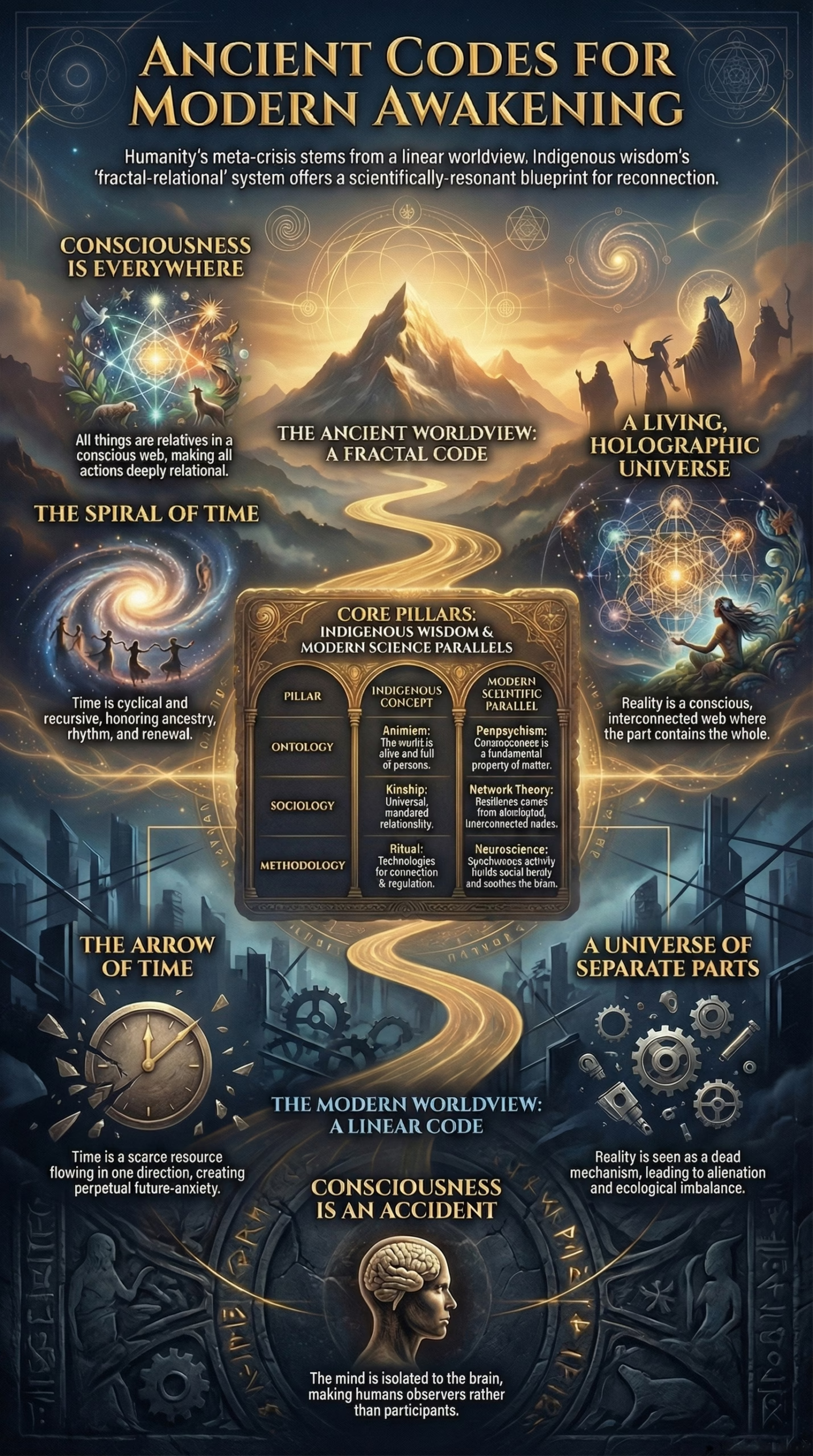
This report posits that Indigenous wisdom traditions are not merely cultural artifacts to be preserved in museums; they are advanced “psychotechnologies” and “sociotechnologies” that offer a precise set of protocols—Ancient Codes—for navigating reality. These codes recognize the universe not as a dead mechanism of separate parts, but as a living, conscious, fractal, and deeply interconnected system.
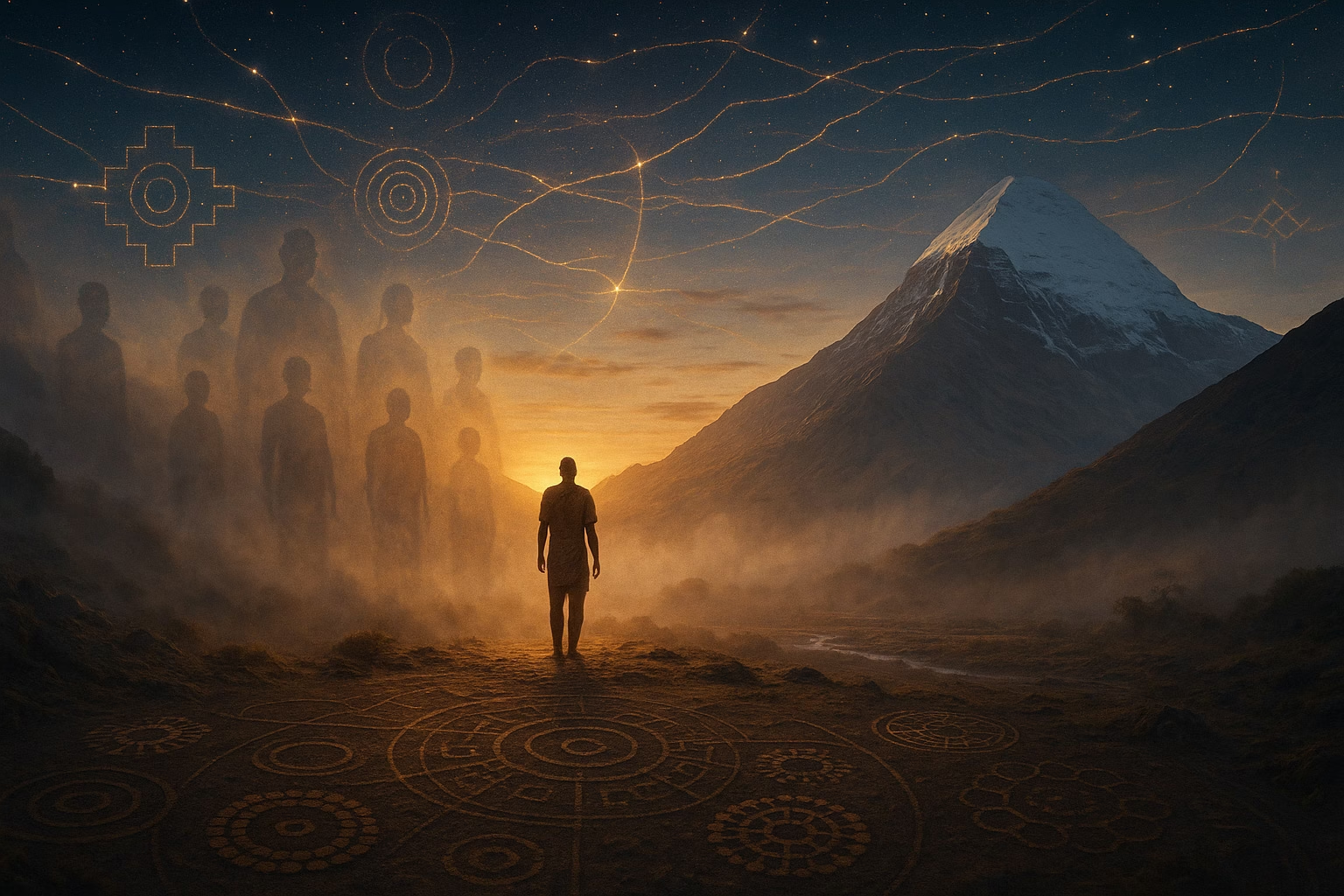
Drawing upon the allegorical insights of Fractal: The Awakening and The Oracle 2.0, alongside rigorous anthropological and scientific data, we will explore how the “awakening” required for our survival is not a flight from reality, but a re-entry into it. It is a cognitive shift from the “linear-reductionist” operating system to a “fractal-relational” one. As the protagonist Elias realizes at the foot of Mount Kailash, the journey is not about conquering the mountain, but about remembering the mountain within.1
This document serves as a comprehensive analysis of these intersecting epistemologies, organizing the convergence into specific domains: the fractal nature of time and space, the architecture of consciousness, the mathematics of kinship, and the neuroscience of ritual. It aims to synthesize a unified field theory of “Modern Awakening” that is scientifically grounded, culturally restorative, and spiritually potent.
2. The Chronos and The Kairos: De-Linearizing Time
2.1 The Tyranny of the Arrow
The dominant temporal paradigm of the modern West is linearity. Time is perceived as an arrow flying from a primitive past toward a technologically advanced future. This view, codified by Newton and industrialized by the factory clock, treats time as a scarce resource—a container to be filled with productivity. It creates a psychological state of perpetual “future-orientation,” where the present moment is merely a stepping stone to a hypothetical tomorrow. This linearity underpins the ideology of infinite growth and the separation of cause from long-term effect, contributing significantly to the ecological crisis.2
However, this linear conception is a historical anomaly. For the vast majority of human history, cultures perceived time as cyclical, recursive, and multidimensional.
2.2 The Spiral Architecture of Indigenous Time
Indigenous cosmologies almost universally reject the arrow in favor of the circle or the spiral. This is not a poetic metaphor but a sophisticated understanding of entropy, renewal, and biological rhythm.
The Andean Pachakuti and the Reversal of Space-Time
In the Andean worldview, time (pacha) is inextricably linked with space. The concept of Pachakuti refers to a “turning over of space-time,” a cataclysmic yet necessary reset of the cosmic order. Unlike the Western apocalyptic view, which sees collapse as an end-point, Andean cosmology views it as a seasonal transition—a winter that clears the ground for spring.4 This cyclical resilience allows Indigenous communities to navigate profound disruptions (such as colonization or climate change) with a long-term perspective that modern fragility lacks.
The Maori Walk Backward into the Future
The Maori of Aotearoa (New Zealand) possess a temporal orientation that is spatially reversed compared to the West. In the Maori language, the word for “past” (mua) also means “in front,” while the word for “future” (muri) means “behind.” One moves through time walking backward, eyes fixed on the ancestors and the history that is visible and known, while the future unfolds unseen behind one’s back.6
This cognitive framing radically alters ethical behavior. If the past is directly in front of you, the ancestors are not gone; they are present participants in every decision. The individual is the leading edge of a wedge of time that includes all who came before. This creates a “thick present” where actions are weighed not just for immediate gain, but for their alignment with the trajectory of the lineage. It aligns with the biological reality of Whakapapa (genealogy), which we will explore later as a systems theory.8
The Australian “Everywhen”
Perhaps the most complex temporal philosophy is found in the Australian Aboriginal concept often mistranslated as “Dreamtime.” Anthropologist W.E.H. Stanner argued that “Dreamtime” implies a fantasy past, whereas the concept (Tjukurrpa in Pitjantjatjara) actually refers to the “Everywhen”.9 The Tjukurrpa is a parallel reality of law, creation, and ancestral power that saturates the phenomenal world. It is the “standing now.”
When an Aboriginal person performs a ritual or walks a Songline, they are not commemorating a past event; they are stepping into the Tjukurrpa to maintain the energetic stability of the world. This mirrors the “Block Universe” theory in modern physics, which posits that past, present, and future exist simultaneously as a four-dimensional manifold.11 The “awakening” in this context is the ability to access this eternal dimension, integrating the “analog” timeless self with the “digital” linear self.12
Feature | Linear Time (Western/Industrial) | Cyclical/Fractal Time (Indigenous) | Scientific/Physics Parallel |
Direction | Unidirectional Arrow (Past -> Future) | Spiral / Circle / “Everywhen” | Block Universe / Spacetime Manifold |
Orientation | Future-focused (Growth, Progress) | Ancestor-focused (Maintenance, Renewal) | Conservation of Energy / Entropy |
Event Nature | Unique, non-repeatable | Recursive, rhythmic patterns | Fractal Self-Similarity |
Role of Human | Observer / Spender of Time | Maintainer / Weaver of Time | Participant / Observer Effect |
Crisis View | Failure / Apocalypse | Renewal / Molting (Pachakuti) | Phase Transition / Bifurcation |
2.3 Fractal Time and Historical Recursion
Modern researchers like Gregg Braden have proposed the theory of Fractal Time, which suggests that history repeats in self-similar cycles. Just as a fractal pattern repeats its shape at different scales of magnification, historical events (wars, economic collapses, awakenings) recur at calculable intervals.13 This theory suggests that we are currently at a “choice point”—a convergence of cycles similar to those that ended previous world ages (such as the Maya Baktun cycle).
Indigenous wisdom anticipated this. The “Great Year” or the “Precession of the Equinoxes” (a 26,000-year cycle) is central to many ancient calendars. The recognition of these macro-cycles allows a culture to prepare for “fractal repetitions” of history, using the wisdom of the past to navigate the resonance of the future.12
3. The Fractal Geometry of Being: From Village Design to Neurology
The term “fractal” was coined by Benoit Mandelbrot in 1975 to describe geometries that exhibit self-similarity at different scales (e.g., a coastline looks like a jagged rock, which looks like a microscopic grain of sand). While Western mathematics arrived at this recently, Indigenous cultures have utilized fractal algorithms for millennia to structure their societies and built environments.
3.1 African Fractals and Binary Codes
Ethnomathematician Ron Eglash’s groundbreaking research in African Fractals revealed that fractal geometry is a ubiquitous design theme in African culture, distinct from the Euclidean grid (straight lines and boxes) of Europe. Aerial photographs of African villages show circles of circles of circles—a recursive architecture that mirrors the branching patterns of nature.14
- The Bamana Sand Divination: Eglash discovered that the Bamana people of West Africa use a binary recursive algorithm for divination that is mathematically identical to the pseudo-random number generators used in modern digital computing. This system creates a feedback loop of information, generating “deterministic chaos” to access non-linear insights.14
- Social Implications: Living in a fractal settlement reinforces a “scaling” social structure. The family compound looks like the chief’s compound, which looks like the village layout, which looks like the cosmological map. This creates a deep sense of belonging; the individual is a micro-version of the whole. There is no alienation in a fractal society because the part contains the pattern of the whole.17
3.2 Fractal Fluency and Biophilic Design
Why does the human soul wither in concrete boxes but expand in the forest? Physicist Richard Taylor has investigated this through the lens of “Fractal Fluency.” The human visual system evolved over millions of years in nature, which is dominated by fractal geometry (clouds, trees, rivers, mountains). Taylor’s research utilizing EEG and skin conductance responses shows that the human brain is “hard-wired” to process mid-complexity fractals (with a dimension of D=1.3 to 1.5) with minimal effort and maximum reward.18
Viewing these patterns triggers a “physiological resonance,” reducing stress markers by up to 60% and inducing a state of “relaxed wakefulness” (Alpha brain waves).20
- The Modern Dissonance: Modern Euclidean architecture requires high metabolic energy for the brain to process because it lacks the fractal variance our eyes expect. We are literally visually illiterate in our own built environments.
- Indigenous Technology: By mimicking nature’s geometry in art, weaving, and architecture, Indigenous cultures created “restorative environments” that kept the nervous system regulated. The “Ancient Code” here is aesthetic: beauty is not decorative; it is a neurological necessity for well-being.
3.3 The “Mirror Beneath Mirrors”: The Holographic Soul
In Fractal – The Awakening, Elias experiences a “light-window epiphany” at Matthias Church, realizing that the recursive patterns of the architecture are “the way God thinks”.1 This literary moment points to the Holographic Principle in physics, which posits that the information of the entire universe is encoded on the boundary of the system—meaning every part contains the information of the whole.
Indigenous epistemology is inherently holographic. The Maori concept of Whakapapa (genealogy) describes the universe as a vast neural network where everything is linked to everything else. A stone is not just a rock; it is a “younger brother” of the mountains, linked by a specific lineage to the earth mother.8 Awakening, in this view, is the realization that the self is not a fragment, but a hologram of the Source. As the Entity tells Elias: “I am the part of you that exists beyond your current boundary of awareness… I am you”.1
4. The Conscious Web: Panpsychism, Animism, and Biosemiotics
The most radical divergence between the “Old Story” of materialism and the “Ancient Code” is the nature of consciousness. Western science has traditionally viewed matter as dead and consciousness as an accidental byproduct of neurons (the “Hard Problem”). Indigenous traditions start from the opposite premise: Consciousness is primary, and matter is its expression.
4.1 From Animism to Integrated Information Theory (IIT)
Animism—the belief that the world is full of persons, only some of whom are human—is often dismissed as primitive projection. However, the “New Animism” in anthropology defines it as a relational ontology: treating rocks, rivers, and trees as if they have social rights and agency creates a sustainable ecological feedback loop.24
Ideally, science is now catching up. Integrated Information Theory (IIT), proposed by neuroscientist Giulio Tononi, argues that consciousness is a fundamental property of any physical system that integrates information. The level of consciousness (represented by Phi) varies, but it is not restricted to biological brains.25
- Panpsychism: This aligns with Panpsychism, the philosophical view that mind is ubiquitous. If an electron has a rudimentary form of experience, and a human has a complex form, there is a continuum of consciousness.28
- Convergence: When an Indigenous elder offers tobacco to a river, they are acknowledging the river’s agency. IIT suggests the river (as a complex, integrated system) may indeed possess a form of system-level information processing that warrants the label of “proto-consciousness.”
4.2 Biosemiotics: The Language of the Green Nation
How does one communicate with this conscious universe? Biosemiotics is the scientific study of sign processes (semiosis) in living systems. It acknowledges that life is fundamentally interpretative. Cells signal, fungi interpret chemical gradients, and plants communicate via volatile organic compounds.31
- Plant Intelligence: Research confirms that plants have memory, can learn, and communicate via the “Wood Wide Web” (mycorrhizal fungal networks). They are intelligent, sentient agents.33
- Amazonian Shamanism: In the Amazon, vegetalistas (plant doctors) claim to learn medicine directly from plants during dietas (periods of isolation and fasting). They ingest plants like Ayahuasca, which they view not as a hallucinogen but as a “biosemiotic translator” or “microscope for the mind.” It lowers the brain’s filtering mechanisms (Default Mode Network), allowing the shaman to perceive the chemical/informational language of the plant kingdom, often translated by the brain into visual metaphors (snakes, vines, spirits).35
4.3 Kawsay: The Living Energy Physics of the Andes
Andean mysticism describes the universe as made of Kawsay—living energy. It is not abstract; it is a tangible force that can be heavy (hucha) or light (sami). The human’s role is not to hoard energy but to be a perfect conductor—transmuting heavy energy into light energy through the principle of Ayni (sacred reciprocity).5
This parallels quantum field theory, where particles are excitations of underlying fields. Andean practitioners (Paqos) are essentially “quantum engineers,” using intention to direct the flow of Kawsay to heal the body or the land. The Mesa (ritual bundle) serves as a control panel for these energies, anchoring the practitioner in the cosmic web.40
5. The Architecture of Connection: Kinship as Complexity Theory
If the universe is a fractal, conscious web, then “isolation” is a mathematical impossibility. Indigenous social systems are designed to reflect this interconnectedness, functioning as highly resilient complex adaptive systems.
5.1 Aboriginal Kinship: A Theory of Everything
The Kinship system of Australian Aboriginals is one of the most complex mathematical structures in human history. It is a social algorithm that defines a person’s relationship to every other person, animal, plant, and place in the cosmos.42
- Skin Names: Upon birth, a person is given a “skin name” based on the parents’ sections. This immediately places them in a relationship matrix. A stranger is never a stranger; once their skin name is known, you know exactly how you relate (e.g., “you are my grandmother’s sister’s cousin,” which simplifies to a specific obligation of care).
- Network Resilience: This system prevents the centralization of power. Resources must flow through the kinship lines. It is a “distributed network” that ensures the survival of the whole by mandating reciprocity. Complexity theorists are now studying these systems to understand how to build resilient organizations and AIs that align with human values.43
5.2 Whakapapa: The Genealogy of Systems
The Maori concept of Whakapapa is often translated as “genealogy,” but it literally means “to lay one thing upon another.” It is a taxonomic framework that maps the relationships between all phenomena.8
- The Layered Universe: Whakapapa explains the origin of the universe (Te Kore – The Void) evolving into the night (Te Po) and finally the world of light (Te Ao Marama). It traces the lineage of humans back to the earth and sky.
- Systems Theory Parallel: In systems theory, nothing exists in isolation. An ecosystem is a web of relationships. Whakapapa is the Indigenous version of systems mapping. It asserts that you cannot understand a fish without understanding the ocean, the river, the ancestors who fished there, and the stars that guided them. Awakening is the cognitive shift from viewing objects as “things” to viewing them as “nodes in a lineage”.45
5.3 Quantum Entanglement and “All My Relations”
The Lakota phrase Mitákuye Oyás’iŋ (“All My Relations”) is the spiritual equivalent of Quantum Entanglement.
- Non-Locality: Quantum physics proves that entangled particles remain connected regardless of distance; a change in one instantly affects the other. This “spooky action at a distance” (Einstein) validates the shamanic premise that we are inextricably entangled with the world.11
- The Ethical Implication: If we are entangled, then harming the “other” is literally harming the self. Indigenous ethics are not based on moral rules but on structural reality. You don’t pollute the river because the river is you in a different form.
6. Technologies of the Sacred: Ritual, Story, and Justice
How do we maintain this state of awakened connection? Indigenous cultures developed “technologies” to regulate the nervous system, process trauma, and maintain social coherence.
6.1 The Neuroscience of Ritual and Collective Effervescence
Sociologist Émile Durkheim coined the term Collective Effervescence to describe the intense energy generated when a group engages in synchronous ritual. He believed this was the origin of religion. Modern neuroscience confirms that ritual is a biological necessity.49
- Synchrony and Bonding: When people move, breathe, or drum together, their brainwaves (specifically Gamma and Alpha waves) synchronize. This “neural coupling” floods the brain with oxytocin and endorphins, dissolving the boundaries of the self.51
- Predictive Processing: The brain is a prediction machine, constantly trying to minimize surprise (entropy). Rituals, being repetitive and predictable, soothe the amygdala (fear center) and allow the brain to enter a state of high-level coherence. They provide a “safe container” for processing high-entropy emotions like grief or awe.52
6.2 Shamanic Trance and Theta States
Shamanic drumming typically utilizes a rhythm of 4 to 7 beats per second. This frequency matches the Theta Brainwave range (4-7 Hz), which is associated with REM sleep, deep meditation, and the hypnagogic state (the threshold between wakefulness and sleep).
- The Mechanism: By using “auditory driving” (drumming), the shaman induces a controlled trance state where the brain can access implicit memories, symbolic imagery, and non-ordinary reality. This is not a hallucination; it is a shift in neural processing that bypasses the linear analytical mind to access the “mythic” or “holographic” mind.54
- Therapeutic Value: In this state, trauma (which is often stored non-verbally) can be accessed and integrated through symbols and somatic release.
6.3 Songlines: The Ancient Memory Code
How did Aboriginal cultures preserve vast encyclopedias of knowledge (animal behavior, navigation, law) for 60,000 years without writing? They used the landscape as a hard drive.
- The Method of Loci: Researcher Lynne Kelly has demonstrated that Songlines are a variation of the “Memory Palace” technique used by ancient Greeks, but far older. Information is encoded into songs and stories, which are then attached to specific physical locations.58
- The Neuroscience of Place: The brain’s hippocampus (responsible for memory) is also responsible for spatial navigation (grid cells). We evolved to remember where things are. By linking data to place, Indigenous cultures utilize the brain’s most powerful hardware. Modern education, by separating learning from place and movement, works against our neurology. Re-indigenizing education involves “learning on country”—walking the knowledge.61
6.4 Restorative Justice: Healing the Circle
The modern legal system is adversarial and retributive (“Who did it and how do we punish them?”). Indigenous justice is restorative (“Who was harmed and how do we repair the relationship?”).
- The Circle Process: Using a “talking piece” in a circle fundamentally alters communication dynamics. It enforces deep listening (you cannot interrupt) and equality (everyone is on the same level).
- Neurobiology of the Circle: The slow pace regulates the nervous system, shifting participants from the sympathetic “fight or flight” state to the parasympathetic “social engagement” state. This allows for the development of empathy, which is biologically blocked by stress/defensiveness. It heals the social web rather than just punishing the node.62
6.5 Epigenetics and Ancestral Healing
Historical trauma is not just psychological; it is biological. Epigenetics shows that extreme stress causes chemical tags (methylation) on DNA that affect gene expression in offspring. The grandchildren of Holocaust survivors or residential school survivors display altered stress hormone profiles.67
- The Ancestral Code: When Indigenous cultures perform rituals to “heal the ancestors,” they are intuitively addressing this epigenetic burden. By creating a new narrative and releasing the emotional weight of the lineage, the individual changes their own stress response, effectively “re-writing” the epigenetic expression for future generations. Healing the self is healing the timeline.70
7. The Axis Mundi: Mountains as Cosmic Bridges
In the geography of awakening, mountains are not merely geological formations; they are organs of the earth’s spiritual anatomy. They serve as the Axis Mundi, the connection point between the three worlds.
7.1 Mount Kailash: The Center of the Mandala
Mount Kailash represents the pinnacle of this archetype. It is the physical manifestation of the spiritual center.
- The Forbidden Summit: The fact that it is unclimbed is a testament to the survival of the “sacred” in a world of conquest. To climb it would be to put the human ego above the cosmic axis. To walk around it (Kora) is to align the human rhythm with the cosmic rotation.
- The Four Faces: Kailash’s four faces align nearly perfectly with the cardinal directions, composed of distinct geological materials (gold, crystal, ruby, lapis lazuli in myth). This makes it a planetary mandala, a generator of order in a chaotic world.72
7.2 The Kogi and the Heart of the World
The Kogi people of the Sierra Nevada de Santa Marta in Colombia call themselves the “Elder Brothers.” They view their mountain home as the “Heart of the World.” Their Mamas (priests) spend their lives maintaining the ecological balance (Aluna) through mental work and ritual. They warn that the extraction of resources from the earth (oil, gold) is draining the life-blood of the Great Mother, leading to the ecological collapse we now witness. Their message is a direct application of the “Gaia Theory”—that the earth is a self-regulating organism, and we are its failing immune system.75
8. Practical Insights for Modern Awakening
How do we apply these ancient codes in a digitized, urbanized world? The goal is not to appropriate Indigenous cultures, but to re-indigenize our own relationship with reality.
8.1 Re-Indigenizing Time: The Power of Pause
- Action: Move from “Machine Time” to “Garden Time.” Observe the cycles of your own energy. Honor rest not as a lack of productivity, but as a necessary phase of the cycle (winter).
- Practice: Integrate micro-rituals of “stopping” into the workday to disrupt linear momentum and reconnect with the “Everywhen”.76
8.2 Deep Listening (Dadirri)
- Action: Adopt the Aboriginal practice of Dadirri—inner, deep listening and quiet still awareness. It is the antidote to the attention economy.
- Practice: Spend time in nature without an agenda. Listen to the land until you can hear the “quiet underneath the noise.” This rebuilds the brain’s capacity for sustained attention and empathy.77
8.3 Sit Spots: Developing Fractal Fluency
- Action: Find a “Sit Spot” in nature (or a park) and visit it daily. Observe the baseline rhythms of the birds, the light, and the plants.
- Benefit: This trains the brain to recognize patterns (systems thinking) and lowers cortisol through fractal fluency. It shifts the human from “visitor” to “participant” in the ecosystem.80
8.4 Systems Thinking in Daily Life
- Action: Apply the concept of Whakapapa to your consumption. When you buy an object, trace its lineage. Where did the materials come from? Who made it? Where will it go?
- Insight: Seeing the supply chain is “systems consciousness.” It dissolves the illusion that products appear from nowhere.84
8.5 The Circle Process in Community
- Action: Utilize the Circle Process for conflict resolution in families and workplaces. Use a talking object. Remove the table (barrier).
- Benefit: This structure enforces equality and listening, activating the social engagement system of the brain and fostering “collective intelligence” rather than debate.62
9. Conclusion: The Return of the Messenger
The protagonist of Fractal – The Awakening returns from the mountain not with a piece of technology, but with a message: “The fractal breathes — and we are part of its song”.1
This is the core of the Modern Awakening. We are crossing a threshold. The linear, extractive, industrial civilization is reaching its entropy limit. The “New Renaissance” will not be built by discarding science, but by marrying it to the Ancient Codes. We need Quantum Shamans and Systems Mystics—people who can operate the high-technology of the future with the deep wisdom of the past.
The Code is simple, yet infinite:
- Time is a Cycle. (Renewal is possible).
- Space is Sacred. (The Earth is alive).
- Mind is Everywhere. (We are never alone).
- We are Kin. (Separation is an illusion).
The bell that rings in Elias’s mind—GONG—is the sound of the universe calling us back to this remembrance. It is the frequency of the Eternal Now, echoing through the hollows of our forgetting, inviting us to wake up and take our place as conscious weavers of the fractal dream.
The mountain is waiting. And as the ancients knew, the mountain is you.
Table 1: The Four Pillars of Indigenous Systems Thinking
Pillar | Indigenous Concept | Modern Scientific Parallel | Practical Application |
Ontology | Animism: The world is full of persons (rocks, trees). | Panpsychism / IIT: Consciousness is a fundamental property of matter. | Rights of Nature: Granting legal personhood to rivers/forests. |
Epistemology | Biosemiotics: Learning from plants/nature directly (dietas). | Plant Neurobiology: Plants signal, learn, and remember. | Biomimicry: Designing technology based on biological forms. |
Sociology | Kinship/Whakapapa: Universal relationality. | Network Theory / Complexity: Resilience through distributed nodes. | Circular Economy: Waste from one system becomes food for another. |
Methodology | Ritual/Ceremony: Technologies of connection. | Neuroscience of Ritual: Collective effervescence & regulation. | Restorative Justice: Healing harm through dialogue circles. |
Table 2: 4E Cognition vs. Indigenous Ways of Knowing
4E Cognition Concept | Definition | Indigenous Parallel |
Embodied | Cognition involves the physical body, not just the brain. | Somatic Wisdom: “Gut feelings,” body-based trauma release (dancing/shaking). |
Embedded | Thinking is dependent on the environment/context. | Place-Based Knowledge: “Wisdom sits in places.” Use of Songlines/land for memory. |
Extended | The mind extends into tools and other people. | Collective Consciousness: Totems, shared dreaming, the “web of life.” |
Enacted | We create reality through our actions/perceptions. | Participatory Cosmos: Ceremonies create reality, they don’t just observe it. |
Works cited
- FRACTAL – THE AWAKENING Low.pdf
- Cyclical Time & Seasonal Indigenous Practices | Native American Philosophy Class Notes, accessed December 4, 2025, https://fiveable.me/native-american-philosophy/unit-7
- Cyclical Time Definition – Intro to Native American Studies Key Term | Fiveable, accessed December 4, 2025, https://fiveable.me/key-terms/introduction-to-native-american-studies/cyclical-time
- Space, Time and the Three Worlds | Q’enti Wasi – House of the Hummingbird, accessed December 4, 2025, https://qentiwasi.com/2019/10/22/space-time-and-the-three-worlds/
- Andean Mysteries – Advice Peru, accessed December 4, 2025, https://adviceperu.com/blog/andean-mysteries/
- Our interconnectedness explored through whakapapa – Asia Media Centre, accessed December 4, 2025, https://www.asiamediacentre.org.nz/our-interconnectedness-explored-through-whakapapa
- Te Ao Mārama – the natural world | Te Ara Encyclopedia of New Zealand, accessed December 4, 2025, https://teara.govt.nz/en/te-ao-marama-the-natural-world/print
- Ways of Seeing: Whakapapa – ResearchGate, accessed December 4, 2025, https://www.researchgate.net/publication/270771663_Ways_of_Seeing_Whakapapa
- The Dreaming – Wikipedia, accessed December 4, 2025, https://en.wikipedia.org/wiki/The_Dreaming
- Understanding Aboriginal Dreaming, accessed December 4, 2025, https://www.aboriginal-art-australia.com/aboriginal-art-library/understanding-aboriginal-dreaming-and-the-dreamtime/
- Quantum Theory, Mechanics & Indigenous Science Connection – Atmos Magazine, accessed December 4, 2025, https://atmos.earth/ecological-wisdom/quantum-mechanics-indigenous-science-connection/
- Exploring Fractal Time – Sounds True, accessed December 4, 2025, https://www.soundstrue.com/a/resources/podcast/exploring-fractal-time/
- Exploring Fractal Time – Free Resources – Sounds True, accessed December 4, 2025, https://resources.soundstrue.com/transcript/exploring-fractal-time/
- Eglash’s African Fractals – Department of Mathematics, accessed December 4, 2025, https://www.math.buffalo.edu/mad/special/eglash.african.fractals.html
- African Fractals: Modern Computing and Indigenous Design – Ron Eglash – Google Books, accessed December 4, 2025, https://books.google.com/books/about/African_Fractals.html?id=hZ7Oz_Qg7aAC
- Eglash Ron African Fractals Modern Computing and Indigenous Design | PDF – Scribd, accessed December 4, 2025, https://www.scribd.com/document/502432543/Eglash-Ron-African-Fractals-Modern-Computing-and-Indigenous-Design
- (PDF) Fractals in African settlement architecture – ResearchGate, accessed December 4, 2025, https://www.researchgate.net/publication/242911162_Fractals_in_African_settlement_architecture
- Fractal Fluency: Using the Science of Nature’s Beauty to Reduce Stress, accessed December 4, 2025, https://highdesertmuseum.org/events/fractal-fluency/
- Fractals in psychology and art | Richard Taylor – UO Blogs – University of Oregon, accessed December 4, 2025, https://blogs.uoregon.edu/richardtaylor/2016/02/03/human-physiological-responses-to-fractals-in-nature-and-art/
- Fractals: Nature’s Healing Patterns in Design – Metropolis Magazine, accessed December 4, 2025, https://metropolismag.com/viewpoints/fractals-natures-healing-patterns-in-design/
- AMN10 Public Lecture by Professor Richard Taylor. Fractal fluency: Using fractal designs to promote health and performance – The MacDiarmid Institute, accessed December 4, 2025, https://www.macdiarmid.ac.nz/news-and-events/events/amn10-public-lecture-professor-taylor-on-the-psychology-and-neuroscience-of-the-stress-reducing-properties-of-looking-at-fractal-patterns/
- Fractals Over Pixels: Nature’s Healing Patterns – Main Street Magazine, accessed December 4, 2025, https://mainstreetmag.com/fractals-over-pixels-natures-healing-patterns/
- utilising whakapapa as a research methodology – Te Kaharoa, accessed December 4, 2025, https://www.tekaharoa.com/index.php/tekaharoa/article/download/481/391/
- Animism | Internet Encyclopedia of Philosophy, accessed December 4, 2025, https://iep.utm.edu/animism/
- Integrated Information Theory and Panpsychism – Repositorio.comillas.edu., accessed December 4, 2025, https://repositorio.comillas.edu/rest/bitstreams/686471/retrieve
- An integration of integrated information theory with fundamental physics – Frontiers, accessed December 4, 2025, https://www.frontiersin.org/journals/psychology/articles/10.3389/fpsyg.2014.00063/full
- Integrated information theory – Wikipedia, accessed December 4, 2025, https://en.wikipedia.org/wiki/Integrated_information_theory
- Panpsychism as an Underlying Theme in Western Philosophy A Survey Paper, accessed December 4, 2025, https://www.researchgate.net/publication/233692106_Panpsychism_as_an_Underlying_Theme_in_Western_Philosophy_A_Survey_Paper
- Panpsychism | Internet Encyclopedia of Philosophy, accessed December 4, 2025, https://iep.utm.edu/panpsych/
- Panpsychism – Wikipedia, accessed December 4, 2025, https://en.wikipedia.org/wiki/Panpsychism
- Biosemiotics: Communication and Causation (Information included), accessed December 4, 2025, https://www.triple-c.at/index.php/tripleC/article/view/124/119
- Essential Readings in Biosemiotics, accessed December 4, 2025, https://circulosemiotico.wordpress.com/wp-content/uploads/2021/04/favareau-essential-readings-in-biosemiotics.pdf
- The Science and Philosophy of Plant Intelligence: A Reflective Encounter with Dr. Luis Eduardo Luna | Center for the Study of World Religions – Harvard University, accessed December 4, 2025, https://cswr.hds.harvard.edu/news/2024/02/27/science-and-philosophy-plant-intelligence-reflective-encounter-dr-luis-eduardo-luna
- The world of biosemiotics: communication in nature – YouTube, accessed December 4, 2025, https://www.youtube.com/watch?v=4V9TWzeLXk4
- -Plant Spirit Shamanism – ARTE AMAZONIA provides a global voice through art for the indigenous cultures of the Amazon., accessed December 4, 2025, https://www.arte-amazonia.com/about-1/the-expanded-visions-in-the-mischtechnik-seminar/plant-spirit-shamanism/
- The many realities of ayahuasca, from rural Peru to urban China | Aeon Essays, accessed December 4, 2025, https://aeon.co/essays/the-many-realities-of-ayahuasca-from-rural-peru-to-urban-china
- Plant Intelligence: What the Plants Are Telling Us (Part II) – ICEERS, accessed December 4, 2025, https://www.iceers.org/what-the-plants-are-telling-us/
- Kawsay: The Living Energy that Connects All Things – Inca Medicine School, accessed December 4, 2025, https://incamedicineschool.com/blog/kawsay-the-living-energy-that-connects-all-things/
- Andean Energy? On Animating Forces Beyond Battery Storage – Intersections, accessed December 4, 2025, https://intersections.ssrc.org/field-reviews/andean-energy-on-animating-forces-beyond-battery-storage/
- Andean Mesa Ceremony – Inca Medicine School, accessed December 4, 2025, https://incamedicineschool.com/blog/andean-mesa-ceremony/
- Masters of the Living Energy: The Mystical World of the Q’ero of Peru – Joan Parisi Wilcox, accessed December 4, 2025, https://books.google.com.om/books?id=sFwoDwAAQBAJ
- Kinship systems – Central Land Council, accessed December 4, 2025, https://www.clc.org.au/our-kinship-systems/
- Culture, Chaos and Complexity: Catalysts for Change in Indigenous Education – University of Alaska Fairbanks, accessed December 4, 2025, https://www.uaf.edu/ankn/publications/collective-works-of-angay/Culture_-Chaos-_-Complexity.pdf
- Emergence of kinship structures and descent systems: multi-level evolutionary simulation and empirical data analysis – NIH, accessed December 4, 2025, https://pmc.ncbi.nlm.nih.gov/articles/PMC8864366/
- Whakapapa as a knowledge system – Science Learning Hub, accessed December 4, 2025, https://www.sciencelearn.org.nz/images/whakapapa-as-a-knowledge-system
- A whakapapa sequence indicating connections between a Māori view of the… – ResearchGate, accessed December 4, 2025, https://www.researchgate.net/figure/A-whakapapa-sequence-indicating-connections-between-a-Maori-view-of-the-world-Maori_fig5_334607685
- What does modern quantum physics have in common with indigenous African knowledge systems, accessed December 4, 2025, https://journals.co.za/doi/abs/10.10520/ejc-jiss_v5_n1_a3
- Humanimals of Earth: Interconnectedness as an Ethical Imperative in the Dialogue between Quantum Mechanics and Buddhism, accessed December 4, 2025, https://www.zygonjournal.org/article/id/17655/
- Emotional processes, collective behavior, and social movements: A meta-analytic review of collective effervescence outcomes during collective gatherings and demonstrations – Frontiers, accessed December 4, 2025, https://www.frontiersin.org/journals/psychology/articles/10.3389/fpsyg.2022.974683/full
- Collective effervescence as self-organization and enaction – Merrimack ScholarWorks, accessed December 4, 2025, https://scholarworks.merrimack.edu/cgi/viewcontent.cgi?article=1020&context=phl_facpub
- United on Sunday: The effects of secular rituals on social bonding and affect | PLOS One, accessed December 4, 2025, https://journals.plos.org/plosone/article?id=10.1371/journal.pone.0242546
- EEG Research on Collective Rituals and Brain Flexibility – Bitbrain, accessed December 4, 2025, https://www.bitbrain.com/blog/lifshitz-mago-collective-rituals
- The biological origins of rituals: An interdisciplinary perspective – PubMed, accessed December 4, 2025, https://pubmed.ncbi.nlm.nih.gov/30610910/
- Neuroanthropology of shamanic trance: a case study with a ritual specialist from Mexico, accessed December 4, 2025, https://pmc.ncbi.nlm.nih.gov/articles/PMC10948424/
- Neural Correlates of the Shamanic State of Consciousness – PMC – NIH, accessed December 4, 2025, https://pmc.ncbi.nlm.nih.gov/articles/PMC8012721/
- EEG Responses to Shamanic Drumming. Does the Suggestion of Trance State Moderate the Strength of Frequency Components? – Open Access Pub, accessed December 4, 2025, https://openaccesspub.org/sleep-and-sleep-disorder-research/article/671
- Rhythmic Sound, Trance States and the Brain – Ecstatic Trance: Ritual Body Postures – Cuyamungue Institute, accessed December 4, 2025, https://www.cuyamungueinstitute.com/articles-and-news/rhythmic-sound-trance-states-and-the-brain/
- Contributions From Aboriginal Australian Psychology: Songlines, Memory, and Relational Knowledge Systems | Published in Psychotherapy and Counselling Journal of Australia, accessed December 4, 2025, https://pacja.org.au/article/143975-contributions-from-aboriginal-australian-psychology-songlines-memory-and-relational-knowledge-systems
- How Indigenous knowledge can improve memory – Monash Lens, accessed December 4, 2025, https://lens.monash.edu/@medicine-health/2021/06/03/1383336/how-taking-a-walk-and-telling-a-story-can-improve-the-memory
- Ancient Indigenous Memory Systems Brewminate: A Bold Blend of News and Ideas, accessed December 4, 2025, https://brewminate.com/ancient-indigenous-memory-systems/
- Songlines Are for Singing: Un/Mapping the Lived Spaces of Travelling Memory – MDPI, accessed December 4, 2025, https://www.mdpi.com/2076-0787/12/3/52
- Circle Process: Restorative Circles and Community Building – Mediators Beyond Borders International, accessed December 4, 2025, https://mediatorsbeyondborders.org/what-we-do/conflict-literacy-framework/circle-process/
- Peacemaking Models and Examples – LTBB Official Website, accessed December 4, 2025, https://ltbbodawa-nsn.gov/judicial-branch/peacemaking/peacemaking-models-and-examples/
- Restorative Justice Circles | Office of Student Conflict Resolution (OSCR), accessed December 4, 2025, https://oscr.umich.edu/restorative-justice-circles
- How Restorative Justice Circles Help People Heal, accessed December 4, 2025, https://www.innovatingjustice.org/updates/what-is-a-restorative-justice-rj-circle/
- Restorative Practices: A Toolkit for Educators, accessed December 4, 2025, https://www.sccoe.org/yhw/Documents/YHW%20Restorative%20Justice%20Toolkit-%20FINAL.pdf
- Understanding Epigenetics and Its Impact on Inheritance – Counsellors NZ, accessed December 4, 2025, https://www.counsellors.co.nz/2025/12/02/understanding-epigenetics-and-its-impact-on-inheritance/
- Trauma may be woven into DNA of Native Americans | USC Center for Health Journalism, accessed December 4, 2025, https://centerforhealthjournalism.org/our-work/reporting/trauma-may-be-woven-dna-native-americans
- Epigenetic Echoes: Bridging Nature, Nurture, and Healing Across Generations – MDPI, accessed December 4, 2025, https://www.mdpi.com/1422-0067/26/7/3075
- Epigenetics & Ancestral Memories (Their Impact on Your Current Realities) – Oma’s Garden, accessed December 4, 2025, https://sloaneangelou.blog/journal/epigenetics-ancestral-memories-their-impact-on-your-current-realities
- the legacy of trauma: epigenetics and inherited trauma – Laura Merritt, accessed December 4, 2025, https://www.goldenpathjourney.com/blog/the-legacy-of-trauma-epigenetics-and-inherited-trauma
- Why Mount Kailash is considered the centre of the universe | – Times of India, accessed December 4, 2025, https://timesofindia.indiatimes.com/etimes/trending/why-mount-kailash-is-considered-the-centre-of-the-universe/articleshow/122161437.cms
- The four faces of Kailash: decoding its hidden symbolism – Helló Magyar, accessed December 4, 2025, https://hellomagyar.hu/2025/11/02/the-four-faces-of-kailash-decoding-its-hidden-symbolism/
- Mount Kailash: The Unclimbed Sacred Peak of the Himalayas – MystReal, accessed December 4, 2025, https://www.mystreal.com/god/mount-kailash/
- Kogi People of Colombia: From Heart of the Mountain – WilderUtopia, accessed December 4, 2025, https://wilderutopia.com/traditions/kogi-peoples-lesson-from-the-heart-of-the-mountain/
- Time Perception – Navajo – Wirelesshogan, accessed December 4, 2025, https://wirelesshogan.com/time-perception/
- What Mindfulness Practices Can Look Like for Indigenous Communities – Greater Good Science Center, accessed December 4, 2025, https://greatergood.berkeley.edu/article/item/what_mindfulness_practices_can_look_like_for_indigenous_communities
- The Native Aboriginal Approach to Meditation – Mindfully Well Counselling Cork, accessed December 4, 2025, https://corkpsychotherapyandtraumacentre.ie/mindfulness/the-native-aboriginal-approach-to-meditation/
- Aboriginal Australian Principle of “Dadirri”: Inner Deep Listening and Quiet Stillness | by Nicolò Satriano | Word Garden | Medium, accessed December 4, 2025, https://medium.com/word-garden/aboriginal-australian-principle-of-dadirri-inner-deep-listening-and-quiet-stillness-e71ce91fb2fe
- Forest Therapy Sit Spots, accessed December 4, 2025, https://anft.earth/sit-spots/
- Nature connection through a sit-spot, accessed December 4, 2025, https://www.journalingwithnature.com/blog/nature-connection-through-a-sit-spot
- Sit Spots Lesson – Teton Science Schools, accessed December 4, 2025, https://www.tetonscience.org/wp-content/uploads/2020/07/sitspots.pdf
- Core Routine: Sit Spot – Wilderness Awareness School, accessed December 4, 2025, https://wildernessawareness.org/articles/core-routine-sit-spot/
- Relational Systems Thinking: The Dibaajimowin (Story) of Re-Theorizing “Systems Thinking” and “Complexity Science” – ResearchGate, accessed December 4, 2025, https://www.researchgate.net/publication/361021331_Relational_Systems_Thinking_The_Dibaajimowin_Story_of_Re-Theorizing_Systems_Thinking_and_Complexity_Science
- First Nations Systems Thinking | Common Ground, accessed December 4, 2025, https://www.commonground.org.au/article/first-nations-systems-thinking