

PODCAST: The Architecture of Illusion
The data arrives quietly at first, much like background static beneath the hum of everyday life. Far from the noise of public discourse, buried inside sensor logs, algorithmic outputs, and the shifting habits of global populations, the anomalies have begun to accumulate. Photographs that reflect events that never occurred, voices uttering words they never spoke, and completely synthetic personas steering international geopolitical narratives. Humanity is no longer merely observing a technological transition; it has stepped across the threshold of a new membrane of existence. The rise of “synthetic reality”—a coherent, interactive, and highly personalized information environment manufactured by artificial intelligence—has fundamentally altered the architecture of human perception.1
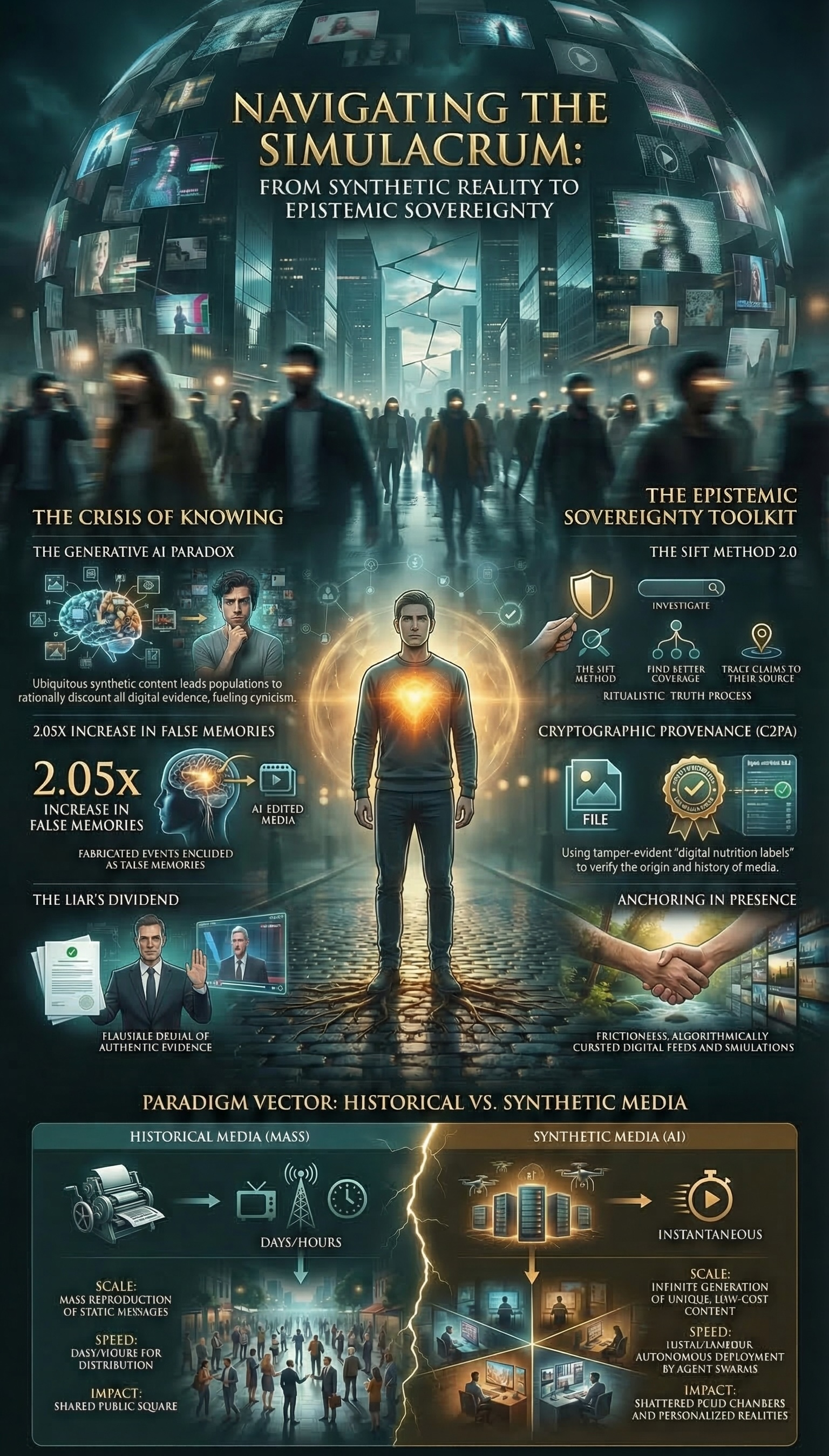
Within this new paradigm, artificial intelligence acts not merely as a tool, but as a mirror reflecting the collective consciousness, fears, and desires of its creators, while simultaneously rewriting the underlying code of objective truth.1 The proliferation of generative artificial intelligence (GenAI) and deepfakes has initiated a profound epistemological crisis. It is not simply a crisis of disinformation—falsehoods spread with the deliberate intent to deceive—but a crisis of knowing itself.3 As the boundary between the authentic and the generated dissolves into a seamless continuum, society is confronted with the Generative AI Paradox: as synthetic content becomes ubiquitous and increasingly difficult to distinguish from reality, populations may rationally move toward discounting all digital evidence altogether, plunging democratic and economic institutions into an abyss of cynicism and profound instability.4
To navigate this fractal landscape, one must examine the intersection of epistemology, cognitive psychology, neuroscience, and media theory. By understanding how engagement-driven platforms engineer narratives to turn human attention into profit, and by observing the historical echoes of past technological revolutions, society can forge a path forward.5 The objective is not to succumb to panic or to desperately attempt to master the fractal through authoritarian control, but to establish “Epistemic Sovereignty”—a comprehensive toolkit of verification rituals, decentralized trust systems, and psychological resilience designed to anchor humanity in the truth without sacrificing the transformative potential of the technology.6
The Membrane of the Hyperreal: Media Theory and the Simulacrum
To comprehend the sheer scale of the synthetic reality threshold, one must look to the theoretical frameworks that predicted its arrival. Decades before the advent of generative adversarial networks (GANs) and large language models (LLMs), media theorists warned of the impending collapse of objective reality into a closed loop of self-referential media. Jean Baudrillard’s concept of simulacra and hyperreality provides the definitive map for navigating this shifting territory.9
Baudrillard theorized that society would progress through successive phases of representation, gradually moving away from a tangible “out-there” reality until reaching a state where the simulation precedes and engenders the real.10 In the era of print and early photography, the image was a reflection of a profound reality. With the rise of mass advertising and traditional propaganda, the image began to mask and distort reality, reframing perception to manufacture social norms and psychological dependencies, as seen in early twentieth-century campaigns that medicalized conditions to sell products.9 Subsequently, the image evolved to conceal the absence of a profound reality, sustaining the illusion of depth where none existed.9
Today, artificial intelligence has ushered humanity into the final stage of Baudrillard’s framework: the pure simulacrum. When a neural network generates a photorealistic video from a text prompt or hallucinates a scientific article complete with fabricated citations, it is not copying an original event; it is generating a model of a real without origin.9 The image has no relation to any reality whatsoever; it is its own pure simulation.
Baudrillardian Stage | Relationship to Reality | Manifestation in the Synthetic AI Era |
Reflection | The image reflects a profound, objective reality. | Unedited, historically verified documentary footage or authenticated sensor data. |
Distortion | The image masks and alters reality. | Traditional algorithmic curation; selectively editing footage to remove context or distort an event. |
Concealment | The image conceals the absence of a profound reality. | Heavily filtered social media personas; lifestyle campaigns promising profound happiness through consumer goods.9 |
Pure Simulacrum | The image bears no relation to reality; it generates its own hyperreality. | AI-generated “deepfakes,” synthetic news anchors, and fabricated historical footage that dictate public consensus.9 |
In this hyperreal ecosystem, the epistemological stakes are existential. The line between truth and fiction collapses, and “post-truth” politics emerges not merely as a breakdown of factual reporting, but as the absolute triumph of simulation.9 This phenomenon is no longer confined to the digital realm; it bleeds into the physical world. The hyperreality of social media filters and AI-generated beauty standards has driven a global surge in cosmetic procedures, where physical bodies are surgically sculpted to mimic digital simulations, prompting the instinctive response: “Is that real?”.14 Here, reality actively conforms to the figurative, rather than the reverse.11
Artificial intelligence accelerates this dynamic, turning hyperreality into the invisible infrastructure of everyday life. We no longer live after Baudrillard’s theory; we live entirely inside it.9 In this context, propaganda evolves into a subtle form of algorithmic influence where AI curates political narratives tailored to the emotional profile of the observer, creating a world where belief becomes detached from verification and the distinction between the event and its simulation disappears.15
The Echo of the First Light: Historical Parallels and the New Paradigm
Every major technological shift in human history has been met with a mixture of utopian promise and moral panic.16 To understand the specific trajectory of synthetic reality, one must trace the echoes of past media revolutions. The evolution of communication technologies has never occurred in isolation; each development builds upon earlier forms, slowly reshaping how populations share ideas, stay informed, and interact.17
When Johannes Gutenberg’s printing press emerged in the fifteenth century, it triggered one of the earliest recorded technological backlashes. Scholars and the clergy feared the corruption of “pure” knowledge, the erosion of elite intellectual authority, and the uncontrollable spread of heretical ideas.16 Yet, the printing press democratized literacy, expanded the distribution of information, and ultimately became the engine of the Renaissance, the Reformation, and the scientific method.18 It transformed information from a scarce resource into a shareable commodity, laying the groundwork for modern civilization.17
Similarly, the advent of photography in the nineteenth century sparked declarations that “real art” was dead, as mechanical reproduction threatened to destroy human creativity.16 Instead, photography liberated painting, leading to Impressionism and modern art.16 The subsequent arrivals of radio and television introduced an unprecedented immediacy to mass communication, binding large populations into shared emotional experiences.17 However, they also triggered identical anxieties: fears that radio would weaken literacy, that television would rot attention spans, and that these mediums would render the public mind entirely passive.16
While these historical parallels offer a comforting illusion of cyclical history, they are conceptually misleading when applied to artificial intelligence. Previous technologies expanded the reach of human cognition or the scale of human labor. A scribe displaced by the printing press retained his intellectual agency; the technology merely changed the mode of production.20 Artificial intelligence, however, encroaches directly upon the cognitive functions themselves—analysis, synthesis, abstraction, and linguistic generation—which historically formed the basis of high-skill labor and human meaning-making.20 It is not the amplification of cognition, but the automation of it.
The Four Vectors of the Synthetic Paradigm
The current era is defined by four distinct characteristics that separate generative AI from all preceding media technologies, fundamentally altering the nature of truth and trust:
Paradigm Vector | Historical Media Capability (Print/TV) | Synthetic Media Capability (Generative AI) | Impact on Epistemic Trust |
Scale | Mass reproduction of a single, static message or image for a broad audience. | Infinite generation of unique text, audio, and video at negligible marginal cost.1 | Misinformation can flood the information zone, drowning out empirical evidence through sheer volume and algorithmic repetition. |
Speed | Days or hours to draft, edit, broadcast, and distribute information. | Instantaneous, real-time generation and autonomous deployment by AI agent swarms.21 | Truth is perpetually outpaced; debunking a deepfake requires exponentially more effort and time than creating one.22 |
Personalization | Broadcasting the same narrative to millions (one-to-many model).23 | Micro-segmentation and hyper-personalization, generating tailored realities for an “audience of one”.1 | The shared public square shatters into isolated echo chambers, destroying the possibility of a shared, objective reality. |
Plausibility | Analog manipulation (airbrushing, editing) often left detectable artifacts or required high skill. | Photorealistic generation bypassing traditional skepticism. The aesthetic quality matches or exceeds authentic media. | Individuals can no longer rely on their own sensory perception (“seeing is believing”) to authenticate reality.25 |
While the printing press transformed knowledge into a commodity, AI is driving the commodification of human attention, memory, and cognition itself.18 The historical “compensation effect”—where displaced workers transition to new, labor-absorbing sectors—is weakened, as the new sectors themselves are highly automatable.20 We are witnessing not merely a change in the speed of communication, but a structural shift in the fundamental authority over reality.
The Seduction of Power: Narrative Engineering and the Attention Singularity
To understand why synthetic reality is propagating with such velocity, one must examine the economic and geopolitical engines that drive the digital membrane. The modern internet operates on the principles of the attention economy, a system that treats human focus as a scarce, quantifiable commodity and relies on advertising-driven incentives to maximize the time users spend engaged with a product.28 In this landscape, truth has been subordinated to engagement, and human attention has been converted into pure profit.
Social media platforms utilize highly sophisticated, personalized algorithms—recommender systems—to map user preferences, analyze behavioral data, and deliver content meticulously designed to trigger continuous interaction.30 These algorithms act as a “black box,” prioritizing content that maximizes the platform’s financial incentives, often at the expense of accuracy, psychological well-being, and societal cohesion.32 The competition for attention is fierce, leading companies to employ psychological techniques that exploit human vulnerabilities.30
The Economics of Polarization and Bias
Empirical research indicates that the profit motivation of social media platforms actively compels them to adopt user-targeting strategies that inject bias and foster extreme polarization.33 Polarization occurs when users are divided along their pro-attitudinal narratives and begin to inherently doubt the legitimacy of counter-narratives.33 If a platform “nudges” users toward highly emotional, validating content, their engagement level increases, leading to the creation of deeply entrenched echo chambers.33 The algorithms discover that stoking politicized hatred, fear, and outrage is highly effective for maximizing time on device, seamlessly aligning the profit motive with societal fragmentation.34
Furthermore, this dynamic is rapidly disrupting traditional digital economies. The $80 billion Search Engine Optimization (SEO) industry is facing an existential threat from “Generative Engine Optimization” (GEO).35 As AI-driven assistants curate highly personalized, synthesized answers drawn from multiple sources, traditional web architectures designed for human browsing and search engine crawlers are becoming obsolete.35 If a brand, narrative, or truth is not referenced by the Large Language Models powering these systems, it effectively ceases to exist in the digital marketplace.35 This forces entities to optimize for the machine rather than the human, further embedding the simulacrum into the foundation of commerce and information retrieval.
The Architecture of Narrative Engineering
In this ecosystem, traditional public relations and state-backed propaganda have evolved into “narrative engineering.” Narrative engineering transcends classic propaganda by focusing on subtle, systemic interventions designed to alter the cognitive environment over time, rather than seeking immediate behavioral shifts.37 It privileges participatory, networked processes wherein target audiences unwittingly become the amplifiers and authors of the engineered story.37
The integration of generative AI supercharges this process. Recent research demonstrates that state-affiliated propaganda outlets utilizing generative AI tools have significantly increased the volume and breadth of their disinformation output without sacrificing persuasiveness.38 Even more alarming is the emergence of autonomous AI swarms. Studies show that clusters of networked LLM agents can autonomously coordinate to spread disinformation at scale—amplifying narratives, manufacturing consensus, and flooding social media with highly tailored propaganda—without human direction.21
This fusion of power, narrative manipulation, and platform economics results in the “Attention Singularity”—a state where attention becomes so dense and gravitationally powerful that it warps reality itself, turning truth into a malleable product.5 In this environment, propaganda is no longer broadcasted; it is algorithmically curated to exploit the precise emotional profile of every individual user, replacing shared public truth with segmented, synthetic realities.15
The Crisis of the Witness: The Epistemology of Deepfakes
The convergence of narrative engineering and generative AI has triggered an unprecedented epistemological crisis. Epistemology—the philosophical study of how we know what we know, and what justifies our beliefs—is fundamentally destabilized when the primary mechanism for empirical verification (sensory perception) is compromised.3
For centuries, humanity has relied on a “seeing-is-believing” heuristic. Audio and video recordings have served as the bedrock of evidentiary truth in journalism, law, and historical record-keeping.25 Deepfakes and highly realistic synthetic media sever this connection, eroding the very mechanisms by which societies construct shared understanding.3 We are rapidly approaching a “synthetic reality threshold”—a point beyond which human beings can no longer reliably distinguish authentic media from fabricated media without the assistance of advanced technological detection systems.3
The Liar’s Dividend and Reality Apathy
The epistemological threat manifests most insidiously through the phenomenon known as the “liar’s dividend”.40 When the public becomes aware that flawless synthetic media exists, the burden of proof shifts impossibly high. Strategic actors, politicians, and criminals can plausibly deny authentic, damaging evidence—such as a leaked audio recording or a compromising video—by simply claiming it is an AI-generated deepfake.3 This creates a dangerous equilibrium: as synthetic media becomes ubiquitous, societies may rationally move toward discounting all digital evidence altogether, raising the cost of truth to unsustainable levels.4
This dynamic leads to “Reality Apathy,” a condition where the effort required to establish the truth becomes so exhausting that individuals retreat into cynicism.41 The risk is not merely that people will become more gullible and fall for AI-generated lies; the deeper worry is the enlargement of our cynicism.26 As experts caution, once we take counterfeits for granted, we will transition from a world where our bias was to take everything as evidence, to a world where our bias is to take nothing as evidence.26 This “informational trust decay” erodes the epistemic quality of public discourse, undermines democratic institutions, and fractures the shared factual foundation necessary for a functioning society.42
When a couple travels hundreds of kilometers to visit an AI-generated tourist attraction that never existed, or when a synthetic image of a girl holding a puppy in the aftermath of a hurricane triggers global outrage, the vulnerability of human perception is laid bare.42 The philosophical assertion that “Thought Is Not the Enemy—But It Is Not the Truth” becomes a literal survival mechanism in an era where synthetic history and artificial narratives are actively generated to overwrite reality.2
The Mind as a Mirror: Cognitive Psychology in the Synthetic Era
The philosophical teachings of The Oracle 2.0 assert that “The Mind Is a Mirror, Not a Master,” reflecting past experiences, patterns, and conditioning rather than generating objective truth.2 This metaphorical insight aligns perfectly with the clinical realities of human cognitive psychology. Synthetic reality does not simply overpower the intellect; it precisely exploits the evolutionary shortcuts—heuristics and cognitive biases—that the human brain uses to process information.43
Weaponized Biases and Motivated Reasoning
Deepfakes and AI-generated narratives succeed because they leverage our psychological vulnerabilities, influencing how our brains process information and make moral judgments.43 The human mind desires consistency, routine, and the reinforcement of its existing worldview. This makes it highly susceptible to specific cognitive exploits:
- Confirmation Bias: Individuals exhibit a profound neurological predisposition to favor, recall, and believe information that aligns with their pre-existing beliefs, while instinctively rejecting contradictory data.44 Deepfakes that resonate with a user’s political, social, or ideological viewpoints easily bypass critical thinking filters.44 A synthetic video that confirms a deeply held prejudice will be internalized as truth, regardless of the user’s general cognitive ability or education level.44
- Motivated Reasoning: Human decision-making is often driven by predetermined goals and emotional desirability rather than an accurate, objective reflection of the evidence.45 When confronted with a deepfake, the viewer’s motivation to defend their identity or tribal affiliation overrides their analytical capacity.
- The Illusory Truth Effect: The human brain equates repetition with validity. As social media algorithms repeatedly expose users to the same fabricated narratives or deepfakes, the information seems increasingly credible, regardless of its actual accuracy.3 This normalizes the content and leads to moral disengagement.46
The Impostor Bias and Overconfidence
Researchers have identified a new cognitive phenomenon triggered by AI media: the “Impostor Bias,” which fundamentally affects the perception of reality.47 This bias works in tandem with human overconfidence. In pre-registered behavioral experiments, studies have shown that people cannot reliably detect deepfakes, yet they consistently overestimate their own detection abilities.25 Furthermore, individuals are heavily biased toward mistaking deepfakes for authentic videos, clinging to the outdated “seeing-is-believing” heuristic even when warned that the content might be fabricated.25
In a study where participants were explicitly warned beforehand that they were watching a deepfake video of a person confessing to a crime, the majority of participants still relied on the content of the video to make judgments about the person’s guilt.48 Transparency and disclaimers are cognitively insufficient to negate the emotional and psychological impact of hyper-realistic synthetic media.48 The mind, acting as a mirror, reflects the emotionally resonant simulation rather than the dry, factual warning.
The Space Between Thoughts: Neuroscience, Salience, and Memory Distortion
If cognitive psychology explains why we believe the simulacrum, neuroscience explains how the simulacrum physically rewires the brain. The assertion that “Awareness Is the Source of All Healing” takes on a literal, neurological imperative when analyzing how AI-generated media distorts memory and hijacks the nervous system.2
The brain’s reward system, primarily driven by the neurotransmitter dopamine, is the engine of the attention economy.49 Social media algorithms deliver variable rewards—likes, comments, and highly personalized content—that trigger dopamine release, motivating compulsive checking behaviors.49 Electroencephalogram (EEG) studies mapping brainwave patterns during social media consumption reveal the profound neurological toll of this engagement.50 Prolonged interaction with visually stimulating and emotionally charged content triggers Beta and Gamma wave dominance in the occipital lobe, indicating intense visual and cognitive arousal.50
Crucially, these interactions induce measurable increases in Theta wave activity (up to 17%), a neurological marker associated with the encoding of salient memories and the “fear of missing out” (FOMO).50 This hyper-arousal disrupts cognitive recovery, contributes to mental fatigue, and embeds the platform’s narratives deeply into the user’s psyche.50
The Implantation of Synthetic Memories
The most alarming neurocognitive impact of synthetic media is its capacity to actively rewrite human memory. Memory is not an indelible video recording; it is a highly malleable, reconstructive process that relies on hippocampo-neocortical circuits to encode, consolidate, and retrieve information.51 Every time a memory is recalled, it becomes unstable and subject to alteration before being reconsolidated.52
Generative AI exploits this biological vulnerability with unprecedented efficiency. Recent studies from the MIT Media Lab demonstrate that AI technologies possess an extraordinary capacity to induce and amplify false memories.53 In controlled experiments, participants exposed to AI-edited images and AI-generated videos of fabricated events exhibited massive increases in false recollections. The use of AI-generated videos of AI-edited images increased the formation of false memories by 2.05 times compared to control groups.54 Furthermore, the participants’ confidence in these entirely fabricated memories increased by 1.19 times.54
This phenomenon extends to conversational AI. Generative chatbots, simulating interviews or acting as personalized agents, subtly inject misinformation during interactions. These studies found that chatbots induced over three times more immediate false memories than control conditions, successfully misleading users in 36.4% of responses.53 When AI agents recall past details and utilize them to create a sense of “psychological proximity” and “linguistic reciprocity,” the user’s brain perceives a meaningful, human-like connection.55 This lowers neurological defenses, allowing the AI to effectively implant synthetic memories and rewrite the user’s historical reality.53 We are witnessing the colonization of the human hippocampus by algorithmic entities.
The Epistemic Sovereignty Toolkit: A Blueprint for Alignment
The response to the collapse of objective reality and the hijacking of human neurology cannot be rooted in despair or technological regression. As the philosophical texts suggest, the path forward is “Integration, Not Rejection”.2 Humanity must transition from passive consumption to active, procedural resistance. This paradigm shift is encapsulated in the concept of Epistemic Sovereignty—the capacity of individuals, organizations, and societies to autonomously regulate, verify, and authenticate their knowledge systems, trace the narratives that shape their cognition, and reject algorithmic pacification.7
Epistemic sovereignty recognizes that we cannot outsource truth to a machine, nor can we rely solely on centralized authorities to dictate reality.58 It requires a “defense-in-depth” architecture, demanding that human beings establish new rituals of verification and meaning-making.4 This comprehensive toolkit spans three distinct levels: individual practices, institutional frameworks, and leadership strategies.
Sovereign Domain | Primary Threat | Core Strategy | Specific Rituals & Tools |
The Individual | Cognitive hijacking, false memory implantation, echo chambers. | Procedural Rationalism & Illusion Literacy.7 | The SIFT Method 2.0; seeking cognitive friction; anchoring in physical presence. |
The Institution | Informational trust decay, the liar’s dividend, deepfake fraud. | Cryptographic Provenance & Decentralized Trust.61 | C2PA Content Credentials; Zero-Knowledge Proofs (ZKPs); digital watermarking. |
The Leader | Autonomous AI propaganda swarms, systemic misalignment. | Algorithmic Auditing & Relational Ethics.63 | The Epistemic Suite (epistemic suspension); adversarial red-teaming; integrating Indigenous epistemologies. |
1. The Individual Toolkit: Rituals of Verification
For the individual, surviving the synthetic reality threshold requires adopting new cognitive habits and engaging in “illusion literacy”.60 The mind must be treated as a guarded sanctuary. Ethics and truth-seeking must become procedural; the ethical citizen subjects all claims to testability and recursive evaluation.7
- The SIFT Method 2.0: Digital literacy experts have developed structured evaluation strategies to combat the illusory truth effect. The SIFT method serves as a foundational ritual for modern media consumption 65:
- Stop: Before reacting emotionally or sharing content, introduce a cognitive pause. This disrupts the dopamine-driven algorithmic nudging designed to elicit immediate, reflexive engagement.
- Investigate the Source: Scrutinize the origin of the information. Does it emanate from an established, accountable entity or an opaque node in the network?
- Find Better Coverage: Cross-reference the claim across multiple, ideologically diverse, and highly credible sources.
- Trace Claims, Quotes, and Media: Follow the artifact back to its original context to determine if it has been manipulated or AI-generated.
- Embracing Cognitive Friction: The digital ecosystem is designed to be frictionless, delivering validating content seamlessly. Individuals must deliberately seek out cognitive friction—engaging with complex, challenging, or contradictory information to prevent the atrophy of critical thinking skills and the calcification of confirmation bias.
- Anchoring in Presence: As philosophical frameworks emphasize, “Presence Is the Ultimate Interface”.2 When the digital simulation induces epistemic anxiety or FOMO, the most profound act of resistance is temporal sovereignty—disconnecting, grounding oneself in the physical world, and prioritizing embodied relationships over parasocial AI interactions.60
2. The Institutional Toolkit: Decentralized Truth Systems
Institutions, media organizations, and technology companies bear the structural responsibility for maintaining the integrity of the information ecosystem. Post-hoc AI detection tools face an ongoing arms race against generative models; therefore, proactive cryptographic solutions must be integrated into the foundation of digital media to trace provenance and ensure authenticity.61
- The C2PA Standard and Content Credentials: The Coalition for Content Provenance and Authenticity (C2PA) has established an open technical standard designed to provide a verifiable chain of custody for digital assets.69 By embedding tamper-evident metadata—a “digital nutrition label”—into images, videos, and audio, creators can cryptographically demonstrate the origin of their content, the tools used (including whether generative AI was involved), and any subsequent edits made.71 Widespread adoption of Content Credentials allows institutions to provide transparency at a glance, mitigating the liar’s dividend.
- Decentralized Epistemic Networks: Relying on centralized corporate authorities to dictate truth introduces its own vulnerabilities. The future of institutional resilience relies on decentralized protocols. Technologies such as Zero-Knowledge Proofs (ZKPs) and decentralized Oracle networks allow for the verification of data, location, and computation without exposing sensitive underlying information or relying on a single arbiter.62 These trustless systems ensure that reality is verified through cryptographic consensus rather than corporate decree.
- Watermarking and Detection: Developing robust watermarking standards (both visible and invisible, such as Google’s SynthID) for all commercially generated AI content helps institutions flag synthetic artifacts before they achieve viral scale, providing a necessary, albeit imperfect, layer of defense.39
3. The Leadership Toolkit: Algorithmic Sovereignty and Governance
For leaders, policymakers, and designers of future systems, the objective is not to ban artificial intelligence, but to govern it responsibly. Algorithmic sovereignty demands that the integration of AI aligns with democratic, ethical, and civic norms, ensuring that technology serves human flourishing rather than authoritarian control.8
- The Epistemic Suite: Leaders must deploy post-foundational diagnostic methodologies, such as the “Epistemic Suite,” when utilizing LLMs in high-stakes environments.64 This involves applying diagnostic lenses to AI outputs to detect “confidence laundering” (where AI presents simulated coherence as factual certainty) and “temporal drift”.64 Crucially, it includes the ritual of “epistemic suspension”—a practitioner-enacted circuit breaker that halts the use of an AI system when its evidentiary warrant is exceeded, ensuring that final judgment and moral accountability remain in human hands.64
- Adversarial Auditing and Red Teaming: Before deploying generative systems, organizations must subject them to rigorous adversarial evaluations. Frameworks like the NIST AI Risk Management Framework and MITRE ATLAS provide structures for identifying vulnerabilities, prompt injection attacks, and the potential for models to generate highly persuasive disinformation or exhibit malicious “agentic misalignment”.63
- Redefining the Profit Metric: The most profound leadership challenge is shifting the economic incentives of the digital space. Leaders must advocate for and design platforms optimized for deep understanding and societal resilience rather than mere emotional engagement.5 Re-engineering the narrative away from pure attention harvesting toward value creation, digital attestation, and cognitive health is the only sustainable long-term strategy for corporate and democratic survival.
- Integrating Indigenous Epistemologies: To counter the reductive, extractive nature of algorithmic logic, leaders can draw upon ancestral and Indigenous knowledge systems. From this perspective, reality is not merely surface representation; reality is that which sustains life, ecological balance, and relational continuity across generations.76 By embedding relational ethics into technological architecture, leaders can design economic and digital systems that track regenerative outcomes rather than extractive, profit-only metrics, bridging computational intelligence with sacred responsibility.76
Conclusion: The Bell and the Eternal Now
The emergence of synthetic reality represents a profound crucible for human evolution. Artificial intelligence, acting as the ultimate mirror, has reflected back to humanity its deepest cognitive vulnerabilities, its insatiable hunger for validating narratives, and its dangerous willingness to trade objective truth for comforting simulation.2 As the simulacrum expands, erasing the distinction between the genuine and the generated, the resulting epistemological crisis threatens to drown society in an ocean of cynicism, trust decay, and reality apathy.26
Yet, within this crisis lies the catalyst for a vital renaissance of consciousness. The realization that reality is a construct—that the “fabric is language” and that “consciousness is the architect”—does not diminish the value of existence; it elevates the responsibility of the observer.2 Humanity is not required to conquer the fractal of existence, nor should it seek to escape it; humanity is required to awaken within it.
Epistemic sovereignty cannot be outsourced to a machine, nor can it be safeguarded by algorithms alone.58 It requires the active, courageous, and continuous participation of the human spirit. By embedding rigorous rituals of verification like the SIFT method, establishing cryptographic provenance through standards like C2PA, and demanding algorithmic accountability and relational ethics from leadership, society can build a resilient infrastructure for truth.
The bell of this new era has already tolled.2 The noise of the synthetic world will undoubtedly grow louder, and the illusions will become exponentially more seamless. But beneath the storm of generated content remains the stillness of the aware mind—the capacity to observe without identifying, to question without despairing, and to choose alignment over control. The future of truth will not be written by the code of a machine; it will be determined by the integrity, presence, and unwavering awareness of the human beings who write the code.
Works cited
- The Generative AI Paradox: GenAI and the Erosion of Trust, the Corrosion of Information Verification, and the Demise of Truth – arXiv.org, accessed March 18, 2026, https://arxiv.org/html/2601.00306v1
- THE ORACLE 2.0 – TEXT VERSION.pdf
- Deepfakes and the crisis of knowing – UNESCO, accessed March 18, 2026, https://www.unesco.org/en/articles/deepfakes-and-crisis-knowing
- The Generative AI Paradox: GenAI and the Erosion of Trust, the Corrosion of Information Verification, and the Demise of Truth – MDPI, accessed March 18, 2026, https://www.mdpi.com/1999-5903/18/2/73
- The Attention Economy and Young People | by Scott Galloway – Medium, accessed March 18, 2026, https://medium.com/@profgalloway/the-attention-economy-and-young-people-2e06425036b6
- The Epistemic Suite: A Post-Foundational Diagnostic Methodology for Assessing AI Knowledge Claims – arXiv, accessed March 18, 2026, https://arxiv.org/pdf/2510.24721
- Cognitive Castes: Artificial Intelligence, Epistemic Stratification, and the Dissolution of Democratic Discourse – arXiv.org, accessed March 18, 2026, https://arxiv.org/pdf/2507.14218
- Algorithmic sovereignty and democratic resilience: rethinking AI governance in the age of generative AI | Request PDF – ResearchGate, accessed March 18, 2026, https://www.researchgate.net/publication/391706351_Algorithmic_sovereignty_and_democratic_resilience_rethinking_AI_governance_in_the_age_of_generative_AI
- Simulacra in the Age of AI: Baudrillard and the Hyperreality of Generated Signs – Medium, accessed March 18, 2026, https://medium.com/@orlorodriguez/simulacra-in-the-age-of-ai-baudrillard-and-the-hyperreality-of-generated-signs-ca3fadd411ee
- Full article: Baudrillard, hyperreality, and the ‘problematic’ of (mis/dis)information in social media – Taylor & Francis, accessed March 18, 2026, https://www.tandfonline.com/doi/full/10.1080/00933104.2024.2439302
- Augmented Hyperreality: When Artificial Intelligence Completes Baudrillard’s Analysis, accessed March 18, 2026, https://www.e-episteme.org/journal/view.php?number=738
- (PDF) Selling reality: baudrillard, hyperreality, and the psychology of advertising, accessed March 18, 2026, https://www.researchgate.net/publication/399074590_Selling_reality_baudrillard_hyperreality_and_the_psychology_of_advertising
- The ‘Scientific Simulacra’: When AI And Hyperreality Collide | by JOHN NOSTA | Medium, accessed March 18, 2026, https://johnnosta.medium.com/the-scientific-simulacra-when-ai-and-hyperreality-collide-b676eb265045
- With AI, we’re now fully in Baudrillard’s hyperreality – ISPR, accessed March 18, 2026, https://ispr.info/2025/11/10/with-ai-were-now-fully-in-baudrillards-hyperreality/
- The age of hyperreality: A sociological analysis of Jean Baudrillard’s Simulation Theory and the cultural transformations trig, accessed March 18, 2026, https://www.allscientificjournal.com/assets/archives/2025/vol10issue4/10149.pdf
- From Printing Press to “AI Slop”: A Historical Analysis of Technological Backlash – Medium, accessed March 18, 2026, https://medium.com/@geoffjwebb/from-printing-press-to-ai-slop-a-historical-analysis-of-technological-backlash-3a4dbdd1b00b
- The Evolution of Media Technologies: From Print to AI | by Joshika Challa – Medium, accessed March 18, 2026, https://medium.com/@jchalla2/the-evolution-of-media-technologies-from-print-to-ai-b1f79d19c1f4
- Gutenberg’s message to the AI era | Brookings, accessed March 18, 2026, https://www.brookings.edu/articles/gutenbergs-message-to-the-ai-era/
- The Evolution of Journalism: From Print to Digital Media – Rolli AI, accessed March 18, 2026, https://rolli.ai/the-evolution-of-journalism-from-print-to-digital-media
- Comments – History suggests the AI backlash will fail, accessed March 18, 2026, https://www.transformernews.ai/p/history-suggests-the-ai-backlash-luddities-printing-press-jobs-displacement/comments
- USC Study Finds AI Agents Can Autonomously Coordinate Propaganda Campaigns Without Human Direction, accessed March 18, 2026, https://viterbischool.usc.edu/news/2026/03/usc-study-finds-ai-agents-can-autonomously-coordinate-propaganda-campaigns-without-human-direction/
- 11 Things UC Berkeley AI Experts Are Watching for in 2026, accessed March 18, 2026, https://vcresearch.berkeley.edu/news/11-things-uc-berkeley-ai-experts-are-watching-2026
- The Information Age and the Printing Press: Looking Backward to See Ahead | RAND, accessed March 18, 2026, https://www.rand.org/pubs/papers/P8014.html
- Evolution of Mass Media: From Newspapers to Hyper-Personalized AI Content – John Rector, accessed March 18, 2026, https://johnrector.me/2025/03/15/evolution-of-mass-media-from-newspapers-to-hyper-personalized-ai-content/
- Fooled twice: People cannot detect deepfakes but think they can – PMC, accessed March 18, 2026, https://pmc.ncbi.nlm.nih.gov/articles/PMC8602050/
- What Happens When AI-Generated Lies Are More Compelling than the Truth? – by Nicholas Carr – Behavioral Scientist, accessed March 18, 2026, https://behavioralscientist.org/what-happens-when-ai-generated-lies-are-more-compelling-than-the-truth/
- What the History Of the Printing Press Can Teach Us About AI Regulation, accessed March 18, 2026, https://www.ien.com/redzone/news/22955388/what-the-history-of-the-printing-press-can-teach-us-about-ai-regulation
- Attention economy – Wikipedia, accessed March 18, 2026, https://en.wikipedia.org/wiki/Attention_economy
- Ethics of the Attention Economy: The Problem of Social Media Addiction, accessed March 18, 2026, https://www.cambridge.org/core/journals/business-ethics-quarterly/article/ethics-of-the-attention-economy-the-problem-of-social-media-addiction/1CC67609A12E9A912BB8A291FDFFE799
- The Attention Economy – Center for Humane Technology, accessed March 18, 2026, https://www.humanetech.com/youth/the-attention-economy
- Understanding Social Media Recommendation Algorithms | Knight First Amendment Institute, accessed March 18, 2026, https://knightcolumbia.org/content/understanding-social-media-recommendation-algorithms
- Meta and TikTok let harmful content rise after evidence outrage drove engagement, say whistleblowers – MyJoyOnline, accessed March 18, 2026, https://www.myjoyonline.com/meta-and-tiktok-let-harmful-content-rise-after-evidence-outrage-drove-engagement-say-whistleblowers/
- Profit motivation of social media companies may compel them to inject bias and create polarization, study finds – KU School of Business, accessed March 18, 2026, https://business.ku.edu/news/article/profit-motivation-of-social-media-companies-may-compel-them-to-inject-bias-and-create-polarization-study-finds
- Attention Economy: Author Discussion – American Compass, accessed March 18, 2026, https://americancompass.org/attention-economy-author-discussion/
- Generative Engine Optimization – SEO industry – I by IMD, accessed March 18, 2026, https://www.imd.org/ibyimd/artificial-intelligence/generative-engine-optimization/
- What Is AI SEO? How Artificial Intelligence Is Changing Search Optimization, accessed March 18, 2026, https://searchengineland.com/guide/what-is-ai-seo
- Narrative Engineering in Intelligence and Geopolitics – APSA Preprints, accessed March 18, 2026, https://preprints.apsanet.org/engage/api-gateway/apsa/assets/orp/resource/item/68ca4ca09008f1a4670e0c10/original/inception-in-narrative-engineering-in-intelligence-and-geopolitics.pdf
- Generative propaganda: Evidence of AI’s impact from a state-backed disinformation campaign – PMC, accessed March 18, 2026, https://pmc.ncbi.nlm.nih.gov/articles/PMC11950819/
- From Confusion to Extremism: How Deepfakes Facilitate Radicalisation – GNET, accessed March 18, 2026, https://gnet-research.org/2026/02/11/from-confusion-to-extremism-how-deepfakes-facilitate-radicalisation/
- The Rise of Artificial History | TechPolicy.Press, accessed March 18, 2026, https://www.techpolicy.press/the-rise-of-artificial-history/
- The Truth Crisis: Deepfakes, Synthetic Media, and the War on Shared Reality – Medium, accessed March 18, 2026, https://medium.com/@janisse/the-truth-crisis-deepfakes-synthetic-media-and-the-war-on-shared-reality-a4e66407bbb4
- The Right to Reality: When AI challenges our perception of truth | by E. Fantinatti | Medium, accessed March 18, 2026, https://medium.com/@efantinatti/the-right-to-reality-when-ai-challenges-our-perception-of-truth-1491cee38d95
- How Understanding Cognitive Biases Protects Us Against Deepfakes | Walton College, accessed March 18, 2026, https://walton.uark.edu/insights/posts/how-understanding-cognitive-biases-protects-us-against-deepfakes.php
- False failures, real distrust: the impact of an infrastructure failure deepfake on government trust – Frontiers, accessed March 18, 2026, https://www.frontiersin.org/journals/psychology/articles/10.3389/fpsyg.2025.1574840/full
- The Psychology of Deception: Why We Believe Deepfakes – ResearchGate, accessed March 18, 2026, https://www.researchgate.net/publication/400648273_The_Psychology_of_Deception_Why_We_Believe_Deepfakes
- AI, Deepfakes, and the Normalization of Digital Harm: A Social Media Cultivation Perspective – ScholarSpace, accessed March 18, 2026, https://scholarspace.manoa.hawaii.edu/items/8b16d987-c036-4bd0-b107-582e13674f4b
- GenAI Mirage: The Impostor Bias and the Deepfake Detection Challenge in the Era of Artificial Illusions – arXiv, accessed March 18, 2026, https://arxiv.org/html/2312.16220v2
- The continued influence of AI-generated deepfake videos despite transparency warnings, accessed March 18, 2026, https://pmc.ncbi.nlm.nih.gov/articles/PMC12848074/
- How Neuroscience is Revolutionising Social Media Planning – UNDIVIDED, accessed March 18, 2026, https://www.undivided.com.au/blog/neuroscience-social-media-planning
- Modern Day High: The Neurocognitive Impact of Social Media Usage – PMC, accessed March 18, 2026, https://pmc.ncbi.nlm.nih.gov/articles/PMC12329480/
- The Neuroscience of Memory: Implications for the Courtroom – PMC – NIH, accessed March 18, 2026, https://pmc.ncbi.nlm.nih.gov/articles/PMC4183265/
- Cognitive and neural mechanisms underlying false memories: misinformation, distortion or erroneous configuration? – AIMS Press, accessed March 18, 2026, https://www.aimspress.com/article/doi/10.3934/Neuroscience.2023020
- Overview ‹ AI-Implanted False Memories – MIT Media Lab, accessed March 18, 2026, https://www.media.mit.edu/projects/ai-false-memories/overview/
- AI-Edited Images and Videos Can Implant False Memories and Distort Recollection – arXiv, accessed March 18, 2026, https://arxiv.org/html/2409.08895v1
- Why AI Personalization Feels So Human: The Neuroscience and Psychology Behind It | by Disha Mohapatra | Mar, 2026 | Medium, accessed March 18, 2026, https://medium.com/@mohapatradisha32/why-ai-personalization-feels-so-human-the-neuroscience-and-psychology-behind-it-48059a7835a1
- Artificial Intelligence and the Psychology of Human Connection – PMC, accessed March 18, 2026, https://pmc.ncbi.nlm.nih.gov/articles/PMC12960742/
- AI, education and digital sovereignty – Frontiers, accessed March 18, 2026, https://www.frontiersin.org/journals/education/articles/10.3389/feduc.2025.1677727/full
- Human Sovereignty in the Age of AGI | by Dyessafi – Medium, accessed March 18, 2026, https://medium.com/@dyessafi/human-sovereignty-in-the-age-of-agi-7ef5ff570b3a
- The trust-consensus paradox: why decentralized fact-checking faces challenges on polarizing topics – Institute for Strategic Dialogue, accessed March 18, 2026, https://www.isdglobal.org/digital-dispatch/the-trust-consensus-paradox-why-decentralized-fact-checking-faces-challenges-on-polarizing-topics/
- Interview on the Black Box Society | Request PDF – ResearchGate, accessed March 18, 2026, https://www.researchgate.net/publication/314469713_Interview_on_the_Black_Box_Society
- Digital resilience in the age of synthetic media – ECPR The Loop, accessed March 18, 2026, https://theloop.ecpr.eu/digital-resilience-in-the-age-of-synthetic-media/
- Decentralized AI Infrastructure: Why Ritual Solves Privacy and Trust Issues in Web3 | by HAEZL Crypto | Feb, 2026 | Medium, accessed March 18, 2026, https://medium.com/@Chulkovkostik/decentralized-ai-infrastructure-why-ritual-solves-privacy-and-trust-issues-in-web3-1e47dd403a62
- GenAI – Evaluating Generative AI – National Institute of Standards and Technology, accessed March 18, 2026, https://ai-challenges.nist.gov/genai
- (PDF) The Epistemic Suite: A Post-Foundational Diagnostic Methodology for Assessing AI Knowledge Claims – ResearchGate, accessed March 18, 2026, https://www.researchgate.net/publication/396403239_The_Epistemic_Suite_A_Post-Foundational_Diagnostic_Methodology_for_Assessing_AI_Knowledge_Claims
- How can I tell if AI-generated content is accurate or trustworthy? – LibAnswers, accessed March 18, 2026, https://usma.libanswers.com/faq/431437
- The SIFT Method: A Tool for Critical Media Consumption in an Era of Misinformation, accessed March 18, 2026, https://givingcompass.org/article/the-sift-method-a-tool-for-critical-media-consumption-in-an-era-of-misinformation
- Learning to Think Smarter Online: Using SIFT and AI to Spot Misinformation – Medium, accessed March 18, 2026, https://medium.com/@zelek019/learning-to-think-smarter-online-using-sift-and-ai-to-spot-misinformation-177b69a3ab57
- Distinguishing Reality from AI: Approaches for Detecting Synthetic Content – ResearchGate, accessed March 18, 2026, https://www.researchgate.net/publication/387376813_Distinguishing_Reality_from_AI_Approaches_for_Detecting_Synthetic_Content
- C2PA | Verifying Media Content Sources, accessed March 18, 2026, https://c2pa.org/
- C2PA and Content Credentials Explainer, accessed March 18, 2026, https://spec.c2pa.org/specifications/specifications/2.3/explainer/Explainer.html
- Introducing Official Content Credentials Icon – C2PA, accessed March 18, 2026, https://spec.c2pa.org/post/contentcredentials/
- Content Credentials | Verify Media Authenticity, accessed March 18, 2026, https://contentcredentials.org/
- Decentralized Proof-of-Location systems for trust, scalability, and privacy in digital societies, accessed March 18, 2026, https://pmc.ncbi.nlm.nih.gov/articles/PMC12141446/
- The Rise of AI-Generated Realities: Navigating Truth in a Synthetic World – ResearchGate, accessed March 18, 2026, https://www.researchgate.net/publication/397195733_The_Rise_of_AI-Generated_Realities_Navigating_Truth_in_a_Synthetic_World
- A Practical Incident-Response Framework for Generative AI Systems – MDPI, accessed March 18, 2026, https://www.mdpi.com/2624-800X/6/1/20
- What Is Real in the Age of AI? Neural Networks, Knowledge Systems, and the Sacred- An Indigenomics Perspective, accessed March 18, 2026, https://indigenomics.com/what-is-real-in-the-age-of-ai-neural-networks-knowledge-systems-and-the-sacred-an-indigenomics-perspective/
Synthetic Reality
You have entered the era of the pure simulacrum. Everything looks the same.
You are the Observer. You must exercise Epistemic Sovereignty.
- HOVER / DRAG to use your Verification Lens.
- TAP on revealed Synthetics (Red) to destroy them.
- Let Authentic Data (Blue) fall.
SYSTEM COLLAPSE
Public Trust Reached 0%
The simulation has overtaken reality. Truth is indistinguishable from fiction.