

PODCAST: The Architecture of Awakening
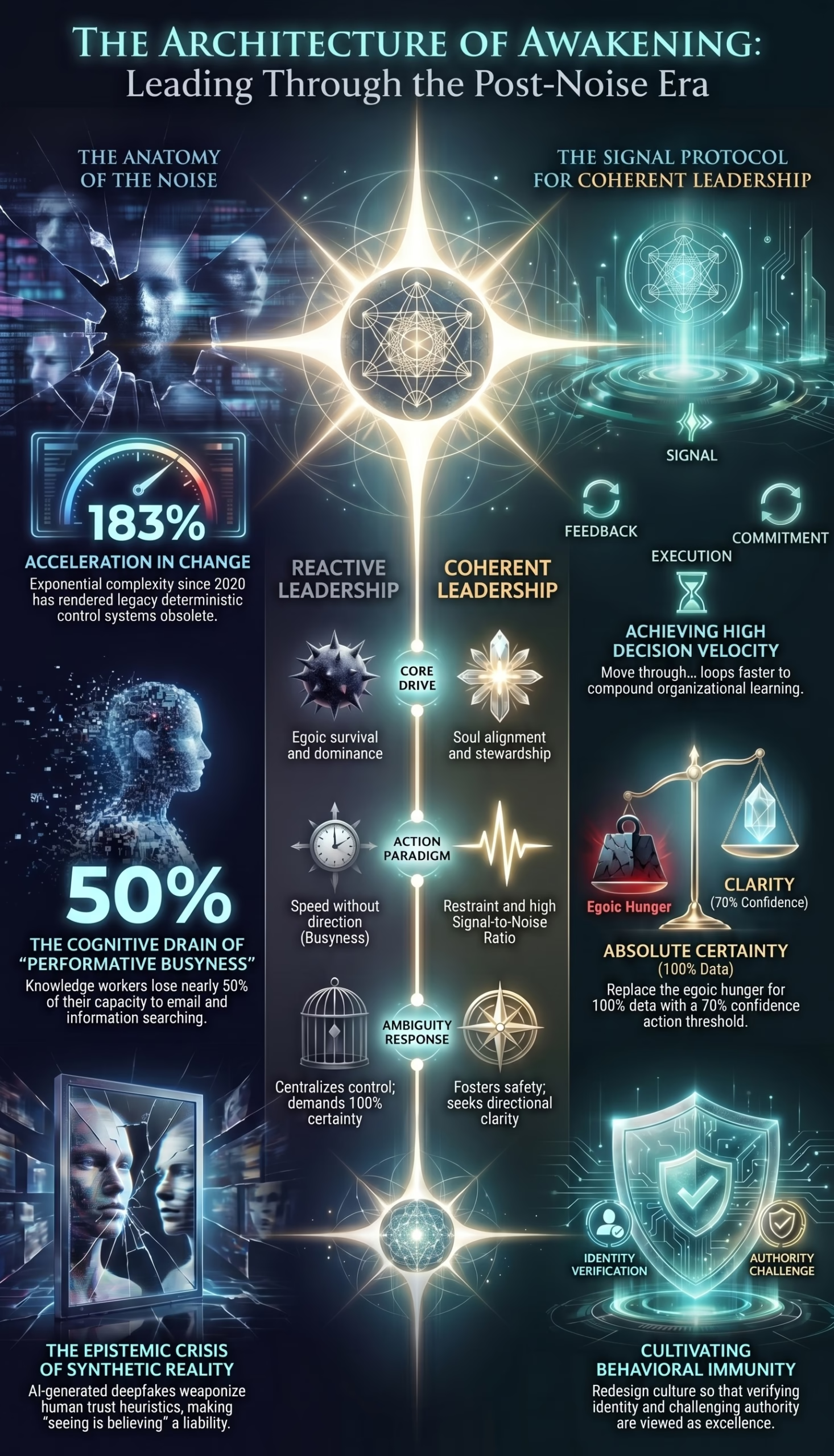
The global operating environment has crossed a terminal threshold. Between 2020 and 2024, the pace of organizational change accelerated by a staggering 183%, creating a landscape where legacy systems continuously unravel under the weight of unprecedented, exponential complexity.1 Financial markets convulse unpredictably, supply chains buckle under unforeseen localized stressors, and the fragile balance between technological expansion and systemic stability teeters on the edge of algorithmic collapse.2 This is not a temporary disruption to be managed; it is a fundamental epochal shift. We have entered the Great Acceleration, a period that relentlessly exposes the fragility of human cognitive architecture when confronted with infinite data streams and synthetic realities.1 In this environment, the primary existential threat to organizational survival is no longer a scarcity of information, but a catastrophic deficit of attention.
We exist now in the “post-noise” era. In a reality supersaturated with digital distractions, algorithmic manipulation, and the blurring of boundaries between the authentic and the fabricated, the traditional leadership paradigms of sheer speed, absolute visibility, and hierarchical control are systematically failing.2 They are being replaced by the urgent, non-negotiable need for a new archetype: the Post-Noise Leader. This leader does not attempt to conquer the fractal complexity of the modern world through brute force or hyper-activity, but navigates it through profound internal coherence. The defining competency of this era is the ability to create and sustain “signal”—high-leverage, mission-critical clarity—amidst a deafening cacophony of noise.2
This comprehensive analysis provides an exhaustive, multidisciplinary exploration of post-noise leadership. By integrating the cognitive neuroscience of attention, the mathematics of complexity science, the psychological mechanics of synthetic trust, and the profound philosophical imperatives of human maturity, the following report delineates the necessary transition from reactive management to coherent stewardship. It concludes with the Signal Protocol—a practical architectural framework designed to protect executive function, foster resilient cultures, and guide organizations through the algorithmic collapse toward a sustainable, grounded renaissance.2
1. The Anatomy of the Noise: Acceleration and the Algorithmic Collapse
To understand the absolute necessity of post-noise leadership, one must first dissect the architecture of the noise itself. Noise is not merely the presence of excess data; it is the cognitive and operational friction generated when human perception is decoupled from truth, strategic intent, and meaning.2
The Illusion of Control and Performative Busyness
Historically, organizational leadership operated on a paradigm of deterministic control. Inputs were relatively predictable, markets behaved in somewhat linear patterns, and authority was highly centralized. However, as global complexity vastly outpaced the ability of legacy institutions to self-correct, this illusion of control evaporated.2 The reflexive response of many executives has been an undisciplined, anxious pursuit of more—more data tracking, more synchronous meetings, and more constant communication.3
This reactive stance equates raw activity with meaningful progress, generating localized optimization while entirely sacrificing systemic coherence. The noise is characterized by what researchers term “performative busyness,” a state in which professionals drown in trivial updates and micro-tasks, mistaking the continuous management of daily operational friction for strategic advancement.3 When an organization treats every incoming stimulus as a priority, the very concept of a priority is annihilated, leaving the organizational compass spinning wildly in a magnetic field of endless urgencies.3
The Fractal Nature of Distraction
The modern digital work environment is a fractal of distraction—a recursive, endlessly unfolding series of interruptions that aggressively fragments the unified field of human awareness.2 Empirical studies reveal that modern knowledge workers spend approximately 28% of their operational week merely managing email and another 20% searching for basic information, leaving less than half of their capacity for the deep, meaningful work that actually drives value.3 The average professional checks digital devices nearly 100 times a day, initiating a continuous cascade of task-switching costs that severely degrade cognitive output and elevate stress.7
This fragmentation is not merely an operational inefficiency; it is a profound existential drain. As theoretical frameworks regarding human consciousness posit, attention is the new currency of the soul.2 Where attention is scattered, intellectual and strategic power is diluted. The noise thrives in this scattered, fragmented state, consuming the finite cognitive resources required to identify strategic signals.
The Emergence of Synthetic Reality
The crisis of noise is exponentially compounded by the advent of synthetic reality. Artificial intelligence has permanently breached the boundary between organic truth and digital fabrication.9 The rapid proliferation of deepfakes, voice-cloning, and hyper-realistic AI-generated media has initiated an environment where the fundamental heuristic of human trust—”seeing is believing”—is weaponized directly against the observer.11
The noise is therefore no longer just distracting; it is actively, structurally deceptive. This marks the transition from mere information overload to a total epistemic crisis. The membrane between truth and illusion has thinned to the point of transparency, demanding an entirely new cognitive defense mechanism and trust architecture from leadership.2 Organizations can no longer rely on centralized institutional trust; they must navigate a distributed landscape where synthetic entities can perfectly mimic the signals of authority.14
2. The Neuroscience of the Threshold: Attention and Decision-Making
The human brain is an evolutionary marvel adapted for sequential processing, physical threat detection, and survival in relatively stable, localized environments. It is biologically and structurally mismatched for the simultaneous, high-velocity, high-abstraction demands of the post-noise era.15 Understanding the neurobiological underpinnings of attention, executive function, and decision fatigue is not a biological curiosity; it is the foundational strategic imperative for modern leadership.16
The Architecture of Attention: SAN vs. EAN
Cognitive neuroscience identifies two distinct, interacting networks that govern human attention. The Salience Attention Network (SAN) operates largely unconsciously, acting as a bottom-up, brain-level spam filter. It scans the environment to screen out irrelevant events and segregate significant stimuli from background noise.18 When the SAN identifies a crucial signal, it facilitates the engagement of the Executive Attention Network (EAN). The EAN, comprising the prefrontal cortex (PFC), parietal cortex, frontal eye field, and intraparietal sulcus, is responsible for conscious, top-down, goal-directed focus.18
In a balanced environment, these systems work in tandem. However, in an era of digital acceleration, the SAN is constantly bombarded by notifications, artificial urgency, and micro-stressors. This chronic overstimulation exhausts the SAN’s filtering capacity, forcing the highly energy-intensive EAN to process irrelevant noise, rapidly draining the brain’s executive reserves.18
The Prefrontal Cortex vs. The Amygdala
The prefrontal cortex serves as the brain’s executive center. It is the locus of strategic planning, impulse control, complex problem-solving, working memory, and cognitive flexibility.16 However, the PFC is highly sensitive to stress, sleep deprivation, and cognitive load.16
When overwhelmed by the relentless noise of modern operations, the brain experiences an allostatic load that triggers the amygdala—the brain’s primitive emotional alarm system.16 High-pressure environments cause the amygdala to literally hijack the neural circuitry, severing the connection to the PFC and shifting the brain from a state of deliberate, rational calculation to a state of reactive, emotional survival.16
Leaders caught in an amygdala hijack lose access to their highest cognitive functions. They become highly reactive, exhibiting heightened irritability, narrowed perspectives, and an absolute inability to perceive second-order consequences or engage in empathetic reasoning.16 The neuroscience dictates a grim reality: chronic stress impairs the very executive functions required to navigate and mitigate that stress, creating a self-reinforcing loop of cognitive degradation.21
Decision Fatigue and Glucose Depletion
Decision-making is not merely a psychological act; it is a metabolically expensive physiological process. The brain’s executive control systems draw from a strictly limited pool of cognitive resources. Repeated high-stakes decision-making rapidly depletes glucose metabolism in the lateral prefrontal cortex, which actively degrades the signal-to-noise ratio of value-based computations within the brain.23
This phenomenon, known as decision fatigue, is a measurable neurological state, not a character flaw or a failure of willpower.23 Research demonstrates that sustained decision-making can reduce deliberate reasoning capacity by up to 50% within a single workday.23 As cognitive resources deplete, leaders begin to exhibit predictable, highly destructive bias patterns:
Cognitive Bias | Manifestation in Decision-Fatigued Leaders | Strategic Consequence |
Present Bias | Trading long-term strategic leverage for immediate, short-term operational relief. | Destruction of long-term value; constant firefighting.23 |
Status-Quo Bias | A heightened aversion to risk and an inability to challenge existing paradigms. | Organizational stagnation; failure to adapt to market shifts.23 |
Certainty Hunger | A desperate grasp for absolute data, leading to infinite requests for more reporting. | Analysis paralysis; delayed action resulting in lost competitive windows.23 |
Heuristic Reliance | Defaulting to automatic, unconscious processing rather than evaluating new evidence. | Blindly repeating past mistakes; vulnerability to synthetic deception.23 |
When leaders attempt to evaluate complex organizational problems using a degraded prefrontal cortex, they are relying on a broken compass to navigate a storm.20 You cannot effectively evaluate a cognitive crisis when the tool used for evaluation—executive function—is the very thing that is failing.20
The Stroop Effect and Cognitive Interference
The perpetual struggle between automatic reactions and conscious, strategic intent is perfectly modeled by the psychological phenomenon known as the Stroop Effect.24 This effect demonstrates the intense processing conflict that occurs when a person tries to perform a controlled action (e.g., naming the color of ink) while suppressing an automatic process (e.g., reading the word itself, which spells a different color).24
In post-noise leadership, the “Stroop Effect” manifests relentlessly throughout the day. The automatic, dopamine-driven response (checking a buzzing notification, reacting defensively to a critical email, defaulting to micromanagement) constantly interferes with the controlled, strategic intent (executing deep work, maintaining visionary focus, cultivating psychological safety).7 Resolving this conflict requires immense working memory and inhibitory control.24 As cognitive load increases throughout the day, working memory capacity diminishes, intensifying the interference of distractions and causing a profound slowdown in decision velocity and an increase in critical errors.24
The Neurochemistry of Trust
Leadership is inherently relational, and trust is the biological prerequisite for high-functioning teams. Research into the neurobiology of trust, pioneered by neuroeconomists like Paul Zak, reveals that trust is not a soft, abstract concept, but a measurable chemical state governed by the neuropeptide oxytocin.25
Through extensive behavioral experiments, including drawing blood before and after trust-based financial transactions, researchers established that when individuals are trusted, their brains synthesize oxytocin, which in turn predicts their own trustworthiness and empathy toward others.25 Further studies safely administering synthetic oxytocin demonstrated that it significantly reduces fear-associated brain activity, literally reducing the fear of trusting a stranger.25
The implications for leadership are profound. Trust reduces transaction costs and organizational friction.26 High-trust environments trigger “ovation”—the simultaneous release of both dopamine and oxytocin when leaders provide unexpected, public recognition.27 Conversely, high-stress, high-noise environments flood the brain with cortisol, which actively inhibits oxytocin production, destroying empathy and collapsing team cohesion.27 Post-noise leadership requires the deliberate architectural design of cultures that stimulate oxytocin release, transforming psychological safety from a corporate buzzword into a neurochemical reality.
3. Complexity Science: Signal-to-Noise and the Velocity of Adaptation
If neuroscience dictates the internal, biological conditions required for effective leadership, complexity science dictates the external, mathematical laws of the operational environment. Organizations are not linear, mechanistic systems; they are complex adaptive systems characterized by nonlinear dynamics, interdependent variables, and profound unpredictability.6
The Signal-to-Noise Ratio (SNR) in Organizational Strategy
Derived from information theory and engineering, the Signal-to-Noise Ratio (SNR) serves as the ultimate diagnostic heuristic for executive effectiveness.3 In the context of complexity and leadership:
- Signal represents the high-leverage, mission-critical information and actions that drive meaningful outcomes. It is the truth of the market, the core strategic priority, and the underlying reality of organizational health.3
- Noise represents the low-value distractions, performative metrics, distorted communication, bureaucratic friction, and extraneous cognitive load that obscure the signal.3
A low SNR indicates an organization drowning in false flags and busy-work, where leaders are exhausted but fundamentally ineffective. A high SNR indicates an organization characterized by absolute, penetrating clarity. However, identifying the signal is highly contextual. As noted by revenue optimization leaders, “Noise changes based on what you intend to use it for”.29 A single data point may be a critical signal through the lens of local, tactical execution, but mere noise at the portfolio or enterprise level.29
Without a clearly defined “North Star” purpose and explicit strategic logic, filtering is mathematically impossible.4 Activity undertaken without a guiding theory generates pure noise; even if a positive outcome occurs, the lack of a theoretical framework means the organization learns nothing and cannot replicate the success.30 Strategy, therefore, acts as the primary noise-cancellation algorithm of the enterprise.30
Feedback Loops and Second-Order Effects
Complex systems are governed by feedback loops—circular causal pathways where the output of a system folds back in as input, either amplifying (positive feedback) or stabilizing (negative feedback) the system’s behavior.6
Traditional, linear management assumes a first-order reality: Action A produces Outcome B. Post-noise leadership recognizes the reality of second-order and third-order effects: Action A produces Outcome B, which in turn alters the environmental context, influencing Variable C, and triggering an unpredictable, nonlinear shift in Condition D.28
These second-order effects often manifest at completely different spatial and temporal scales than the original intervention.28 Leaders who rely strictly on linear, isolated metrics suffer from “dashboard hypnosis,” becoming distracted by narrow data slices while missing the broader, interconnected, systemic realities that are actually driving organizational outcomes.31 To navigate this complexity, leaders must map the cognitive load and feedback mechanisms inherent in their architecture, recognizing that rigid control mechanisms often amplify the very volatility they seek to suppress.28
Decision Velocity and the Decision Half-Life
In a rapidly accelerating, high-noise environment, the pursuit of perfection is the enemy of survival. The traditional model of static, annual strategic planning is obsolete. It must be replaced by “Decision Velocity”.32
Decision velocity is not about reckless speed; it is the structured, disciplined reduction of the organizational learning cycle across four distinct transitions:
- Signal to Commitment: The time taken to recognize a valid data point and decide to act.
- Commitment to Execution: The time taken to mobilize resources and deploy the action.
- Execution to Feedback: The time taken to measure the real-world impact of the action.
- Feedback to Adjustment: The time taken to integrate the learning and pivot the strategy.32
The faster an organization can run this continuous loop without collapsing the quality of execution, the faster it adapts. This compounding effect of learning creates a massive, insurmountable competitive advantage. For example, if Company A runs four strategic learning cycles per year, and Company B runs twelve, Company B does not just learn three times faster; the learning compounds nonlinearly. Each cycle generates insights that improve the precision of the next, creating a 9x learning gap over time.32
Furthermore, post-noise leaders must understand the “Decision Half-Life”—the window of time before a decision becomes outdated and contextually irrelevant due to environmental shifts.32 As external volatility increases, the decision half-life shrinks drastically. To maintain momentum, organizations must implement the 70% confidence rule: acting when sufficient, directional information is available rather than waiting for an absolute certainty that will arrive too late.32 Waiting for perfect data creates an inverse relationship where the cost of delay accelerates infinitely faster than the increase in confidence.32
Strategic Dimension | Traditional Paradigm | Decision Velocity Paradigm |
Operating Rhythm | Annual, rigid planning cycles | Continuous, trigger-based adjustments 32 |
Action Threshold | Requires 100% certainty and consensus | Acts decisively on 70% confidence 32 |
Error Tolerance | Mistakes viewed as reputational damage | Reversible mistakes viewed as accelerated learning 32 |
Decision Ownership | Committees (diffusion of responsibility) | Single accountable decision-maker 32 |
Strategic Output | Static execution of a fixed plan | Dynamic, compounding adaptation 32 |
4. Synthetic Reality and the Weaponization of Trust
The philosophical and neurocognitive alignment of the leader is currently being subjected to its most severe test: the technological realities of the synthetic era. As artificial intelligence capabilities escalate, organizations face an environment where signals are flawlessly fabricated. The advent of deepfakes, real-time voice cloning, and highly realistic synthetic media represents a paradigm shift in social engineering and cyber-physical security.11
The “Truth-Default” State and Trust Heuristics
Human beings operate psychologically in what deception researchers term a “truth-default state.” Evolutionarily, we are wired to presume honesty and authenticity in our social interactions unless a clear, jarring anomaly—a “frame break”—disrupts that assumption and forces cognitive reassessment.33
Deepfakes are profoundly dangerous because they are engineered to minimize these frame breaks. By perfectly mimicking the vocal cadence and visual likeness of a trusted authority figure, synthetic media bypasses rational, system-two scrutiny and directly hijacks deeply ingrained, system-one trust heuristics.33
Deepfake attacks leverage three primary psychological vulnerabilities:
- Familiarity: The human brain inherently trusts recognized faces and voices, bypassing standard verification checks.33
- Authority: Hierarchical corporate structures deeply condition employees to comply rapidly with requests from senior leadership. Compliance is viewed as the safest path, while questioning authority is viewed as career-threatening.33
- Social Proof: If others in a synthetic environment (e.g., a fabricated video conference involving multiple deepfaked executives) appear aligned, the individual naturally assumes the situation is legitimate.33
When these heuristics are combined with manufactured urgency (time pressure) and isolation (demands for strict confidentiality), the target’s prefrontal cortex is effectively incapacitated. The amygdala is engaged by the perceived urgency and authority of the executive’s command, converting intent into irreversible action (e.g., wiring massive funds, resetting network credentials, executing malware) before the rational brain can evaluate the authenticity of the signal.33
The Illusion of Detection and Behavioral Immunity
Traditional responses to synthetic media focus heavily on technological detection—training AI to spot AI by looking for pixel anomalies or unnatural blinking.11 However, neurocognitive studies reveal a much darker reality: humans cannot reliably detect high-quality deepfakes.12
In rigorous behavioral experiments utilizing electroencephalography (EEG), researchers found that when individuals listen to deepfakes of authoritative figures making statements that contradict their known public stance, the brain registers semantic incongruity (the N400 component).34 Yet, despite this subconscious neural flag, participants still rated the deepfaked statements as highly persuasive, authoritative, and trustworthy, regardless of the listener’s own analytical thinking skills or prior beliefs.34 People suffer from a profound illusion of competence, consistently overestimating their ability to spot synthetic media while falling prey to the “seeing-is-believing” heuristic.12 Furthermore, raising awareness or providing financial incentives fails to improve human detection accuracy.12
Post-noise leadership addresses synthetic reality not merely as a technical flaw, but as a systemic crisis of organizational culture. The solution lies in building “behavioral immunity” through rigorous trust governance.33
Leaders must redesign the organizational architecture to move verification from an optional courtesy to an automatic, non-negotiable default.33 This requires dismantling the toxic elements of hierarchical authority that demand unquestioning obedience. Leaders must intentionally cultivate a “safe-to-challenge” culture.33 If an employee cannot challenge a CEO’s unusual request without fear of reprimand, the organization is inherently, fatally vulnerable to synthetic exploitation. The coherent leader explicitly broadcasts and enforces a new cultural norm: “If I ever ask for something urgent and sensitive, I expect you to verify my identity. Slowing down to verify is not insubordination; it is operational excellence”.33
5. The Paradigm Shift: Reactive vs. Coherent Leadership
The transition from the industrial age of predictable mechanics to the post-noise age of fractal complexity requires an evolutionary leap in leadership maturity. It demands a profound shift from the ego’s anxious desire to control the fabric of reality to the soul’s capacity to align with it.2 This is the journey from reactive management to coherent stewardship.
The Anatomy of Reactive Leadership
Reactive leadership is the default state of the unexamined executive mind operating under severe cognitive overload. It is driven by the ego’s ancient, desperate hunger for permanence, mastery, and the transcendence of vulnerability.2
Reactive leaders equate power strictly with dominance and visibility. They seek to freeze the natural, fluid unfolding of reality into rigid, measurable structures.2 In the face of ambiguity and noise, their impulse is to tighten the grip: they centralize authority, micromanage tactical execution, and demand absolute data certainty. This behavior creates massive cognitive and operational bottlenecks that destroy organizational velocity and systemic resilience.22
Furthermore, their response to internal resistance is not curiosity, but force. When employees or front-line managers push back against a strategic change, reactive leaders personalize the resistance, viewing it as a threat to their authority. They escalate their power to suppress the pushback, forcing dissent underground where it mutates into invisible, toxic noise that the organization can no longer detect or mitigate.36
This leadership style operates heavily within the illusion of separation.2 It views employees merely as operational resources, the market as a battlefield to be conquered, and the self as an isolated entity fighting for survival. The reactive leader is constantly entangled in the turbulent waves of their own thoughts, unable to access the silent, observant witness beneath the storm.2 They build prisons made of their own pursuit of freedom and control.2
The Architecture of Coherent Leadership
Coherent leadership, conversely, is rooted in a profound philosophical realization: the mind is a mirror, not a master.2 The coherent leader does not seek to conquer the mystery of the market or dominate the fractal nature of existence; they seek to align with the underlying truths of human behavior, systemic dynamics, and universal principles.2
- Clarity over Certainty: Coherent leaders accept that the universe is a living system of probabilities, not a fixed script.2 They actively abandon the hunger for absolute certainty, recognizing it as a vice of the ego that leads to paralysis.2 Instead, they cultivate clarity—the ability to see the organizational board exactly as it is, without the distortion of wishful thinking, bias, or fear-based projection. They understand that reality responds to coherence; when a leader’s intention, emotion, and action resonate in absolute harmony, the organizational field aligns accordingly.2
- Restraint and Surrender: True power is not absolute control; true power is absolute clarity, which yields freedom from the hunger to control.2 Coherent leaders practice profound restraint. They understand that action without presence is merely additional noise. They empower their teams by delegating the “how” while rigorously guarding the “why” and the “what”.35 They embrace surrender—not as defeat or weakness, but as the active, intelligent release of outdated identities, egoic attachments, and strategies that no longer serve the evolving fractal.2
- Integration of the Shadow: The post-noise leader does not flee from their own psychological darkness or discomfort. They recognize that the shadow—the unacknowledged fears, biases, and egoic drives—must be integrated rather than suppressed.2 A leader who refuses to examine their own shadow will inevitably project it onto their organization, creating toxic cultures of blame, scapegoating, and performative anxiety. By facing their inner conflicts with compassion and unflinching honesty, they achieve a state of wholeness that radiates stability to the entire enterprise.2
- Presence as the Ultimate Interface: Coherent leaders understand that connection without depth is not true communion.2 In a world of endless digital access, genuine human presence is the rarest and most powerful technology.2 They do not lead from the past or the future, but from the eternal now, recognizing that stillness beneath the storm is the true home of the mind.2 They act as gardeners, not conquerors—planting seeds of truth, watering them with courage, and protecting the psychological safety required for those seeds to take root and bloom.2
Dimension | Reactive Leadership | Coherent Leadership |
Core Drive | Egoic survival, dominance, visibility, immortality | Soul alignment, legacy, stewardship, integration 2 |
Response to Ambiguity | Centralizes control, demands 100% certainty | Fosters psychological safety, seeks directional clarity 2 |
View of the Mind | The mind is the master; thoughts are absolute truth | The mind is a mirror/servant; awareness and presence lead 2 |
Action Paradigm | Speed without direction; performative busyness | Restraint, deep work, high signal-to-noise ratio prioritization 3 |
Organizational Impact | High friction, burnout, hidden resistance, fragility | High velocity, compounding adaptation, trust, behavioral immunity 32 |
6. The Signal Protocol: Practical Frameworks for the New Renaissance
Philosophy and neuroscience must ultimately crystallize into practice. To operationalize post-noise leadership, executives must move beyond theory and implement the Signal Protocol—a comprehensive architectural framework designed to protect attention, establish shared truth, accelerate decision velocity, redesign culture, and integrate technology with reverence.
I. Attention Boundaries: Defending the Neural Core
Attention is the organization’s most precious and highly depleted resource. Leaders must structure their environments to protect the prefrontal cortex from the degradation of glucose depletion and task-switching costs.7
- Deep Work Zones: Mandate 90-minute blocks of uninterrupted, asynchronous focus time across the enterprise. During these windows, the use of instant messaging and email is entirely suspended, allowing teams to engage in the high-cognitive-load work required for true innovation.7
- The “Stop Doing” List and Value Tiers: High-performance leaders ruthlessly curate what they will not do. Establish a daily practice of evaluating tasks based on value tiers ($10/hr, $100/hr, $1,000/hr, $10,000/hr). Leaders must aggressively delegate, automate, or eliminate everything operating below their highest contribution zone.4
- Micro-Recovery Rhythms: Acknowledge that the brain requires cyclical recovery to maintain executive function. Implement protocols like the Pomodoro technique and encourage sustained cardiovascular exercise, which actively increases Brain-Derived Neurotrophic Factor (BDNF) to physically rebuild neural pathways in the PFC.7
II. Truth Rituals: Anchoring Shared Reality
An organization cannot survive on strategy documents alone; it requires living rituals to embody its values and ground its people in a shared, resilient truth.37 Rituals reduce anxiety, provide continuity during crises, and transform a group of individuals into a coherent “we”.37
- The Stoic Evening Review: A personal ritual for leaders. Daily reflection on three questions: What did I do well? Where did I fall short of my values? What can I learn? This builds metacognition, strengthening the brain’s ability to observe itself objectively and separating the witness from the thought.2
- Operational Gratitude: Implement structured, recurring moments of recognition that trigger the “ovation” response—the simultaneous release of dopamine and oxytocin. Practices as simple as peer-to-peer gratitude sessions at the end of sprints foster the neurochemical foundations of trust and psychological safety.27
- The Insider Signal Protocol: During leadership transitions or major initiatives, utilize parallel engagement to transfer implicit, signal-processing judgment from outgoing to incoming leaders. Document the frameworks of decisions, not just the isolated decisions themselves, preserving institutional wisdom.36
III. Decision Cadence: The Architecture of Velocity
To increase the signal-to-noise ratio, organizations must assign a distinct home and frequency to every level of decision-making, removing ambiguity and preventing executive bottlenecks.35
- The Three-Speed Rhythm: Establish an operating cadence that cleanly separates long-term planning from daily execution.
- Annual: Defining the North Star and Top 3 Enterprise Priorities via structured scorecards, avoiding the trap of having 10 “top priorities”.4
- Quarterly: Rigorous review of “WAR (Win/Action/Recovery) Tables” to honestly assess performance and adjust resource allocation. Embrace the principle of “reflection, not perfection”.40
- Weekly: Tactical synchronization designed exclusively to clear roadblocks and execute the quarter’s established objectives.40
- Pre-defined Thresholds: Establish key metrics that trigger automatic action when crossed. By deciding the response architecture in advance, organizations eliminate the need to debate every minor fluctuation, preserving cognitive energy for novel, unprecedented crises.32
IV. Cultural Design: Federated Accountability and Immunity
A high-signal organization requires a culture where data is trusted, responsibility is distributed, and truth can flow upward without friction.
- Federated Accountability, Central Visibility: Segment goals to the appropriate operational level (e.g., by product line or geography) to prevent aggregate data from masking localized failures. Push decision-making down to the lowest competent level, while maintaining centralized reporting to hold groups accountable without micromanaging.35
- The Dual Legitimacy Framework: Recognize that frontline pushback against a strategic initiative often contains vital diagnostic data regarding second-order effects, not mere insubordination. Design reporting structures that capture the nuanced signals of resistance before they mutate into invisible, systemic sabotage.36
- Safe-to-Challenge Security: Counteract the threat of deepfakes and synthetic reality by officially rewarding employees who slow down to verify requests from authority figures. Culture is the permission layer that makes behavioral immunity possible.33
V. AI Usage Principles: Technology as an Extension of Spirit
The post-noise leader does not reject technology or flee from artificial intelligence; they integrate it with profound intentionality, ensuring that algorithms serve human depth rather than replacing it.2
- Conscious Co-Creation: View AI not as a replacement for human intellect, but as a mirror of collective consciousness.2 Ensure that prompt engineering, system design, and AI deployment are guided by empathy, wisdom, and truth-alignment. Build tools that heal the nervous system, reduce cognitive load, and deepen connection, rather than tools that merely accelerate mindless output.2
- The Principle of Reverence: Do not digitize everything. Preserve sacred spaces of offline silence and unquantifiable human interaction.2 Recognize that the most advanced technology on earth remains human consciousness itself.2 “Build for the world you want to live in,” ensuring that the future is coded through deliberate, love-aligned choice rather than fear-based automation and control.2
7. Implications for Organizations and Society: The Legacy of the Awakened Leader
Humanity is currently standing at the event horizon of its own evolution.2 The exponential acceleration of technological capability, juxtaposed with the fragile, finite limits of human neurology, guarantees that the legacy systems of the past century will not survive the coming decade intact. Society faces a stark, binary bifurcation: a descent into a highly controlled, deeply fragmented, and deceptive algorithmic dystopia, or the ascent into a New Renaissance built on clarity, unity, and profound human presence.2
The determining factor in this trajectory is not the code we write, but the consciousness of the individuals steering our institutions. Post-noise leadership is not a passing management trend or a superficial productivity hack; it is a profound existential discipline. It requires leaders to stop fighting the fractal nature of reality, to abandon the illusion of absolute control, and instead learn to breathe with the unfolding of the cosmos.2
By mastering their own neurobiology, implementing rigorous architectural protocols to filter signal from noise, cultivating cultures immune to synthetic deception, and anchoring their decisions in unwavering truth-alignment, these leaders achieve something far greater than optimized profit margins. They create sanctuaries of coherence in a shattered world.2
The bell is already ringing.2 The noise of the world will only grow louder, more complex, and more deceptive. The ultimate task of the modern leader is not to shout over the din, nor to build a taller tower of control. The task is to become the stillness from which the true signal emerges—reminding humanity, in the very midst of the machine, of who we truly are.
Works cited
- From Noise to Insight: Navigating the Most Critical Leadership Shifts for 2026, accessed April 28, 2026, https://www.neuroleadership.com/articles/from-noise-to-insight-navigating-the-most-critical-leadership-shifts-for-2026
- FRACTAL – THE AWAKENING Low.pdf
- Signal vs. Noise: Focusing on What Matters in Tech, Leadership, and Life – Medium, accessed April 28, 2026, https://medium.com/@rksachin/signal-vs-noise-focusing-on-what-matters-in-tech-leadership-and-life-139fd4e55fda
- The Leadership Filter | Signal vs. Noise: Why Top Performers Don’t Waste Time on the Wrong Things – dr. tatiana astray, accessed April 28, 2026, https://www.tatianaastray.com/mastering-leadership/2025/7/7/the-leadership-filter-signal-vs-noise-why-top-performers-dont-waste-time-on-the-wrong-things
- Signal and Noise as a Useful Heuristic in Leadership Contexts | Emerging into Structure, accessed April 28, 2026, https://francovich.wordpress.com/2025/04/08/signal-and-noise-as-a-useful-heuristic-in-leadership-contexts/
- Feedback – Wikipedia, accessed April 28, 2026, https://en.wikipedia.org/wiki/Feedback
- The Neuroscience of Focus: Leading in a World of Constant Distraction – Medium, accessed April 28, 2026, https://medium.com/@TheInfluenceJournal/the-neuroscience-of-focus-leading-in-a-world-of-constant-distraction-1ef01060a121
- The Divided Mind: How Attention Fragmentation is Reshaping Our Psychology and Society, accessed April 28, 2026, https://josephkellydesigns.medium.com/the-divided-mind-how-attention-fragmentation-is-reshaping-our-psychology-and-society-6ed1c7edb0c3
- Seeing Isn’t Believing: Addressing the Societal Impact of Deepfakes in Low-Tech Environments – arXiv, accessed April 28, 2026, https://arxiv.org/html/2508.16618v1
- Deepfake threats exploiting the trust inside corporate systems – Biometric Update, accessed April 28, 2026, https://www.biometricupdate.com/202604/deepfake-threats-exploiting-the-trust-inside-corporate-systems
- Deepfakes, Synthetic Media, and Digital Trust: The Cybersecurity Implications of Deepfake Technology and Methods for Detection and Mitigation – Cyber Defense Magazine, accessed April 28, 2026, https://www.cyberdefensemagazine.com/deepfakes-synthetic-media-and-digital-trust-the-cybersecurity-implications-of-deepfake-technology-and-methods-for-detection-and-mitigation/
- Fooled twice: People cannot detect deepfakes but think they can – PMC, accessed April 28, 2026, https://pmc.ncbi.nlm.nih.gov/articles/PMC8602050/
- Unraveling Reality: The Impact of Deepfakes on Trust and Perception – ResearchGate, accessed April 28, 2026, https://www.researchgate.net/publication/391836413_Unraveling_Reality_The_Impact_of_Deepfakes_on_Trust_and_Perception
- Why the fight against deepfakes begins with trust, not detection – PwC Australia, accessed April 28, 2026, https://www.pwc.com.au/services/artificial-intelligence/why-deepfakes-are-trust-infrastructure-problem.html
- The Mental Overload of Modern Leadership: Why Today’s Executives Are Burning Out Differently – 2040 Digital, accessed April 28, 2026, https://www.2040digital.com/ideas-and-innovations-newsletter/the-mental-overload-of-modern-leadership-why-todays-executives-are-burning-out-differently/
- The Neuroscience of Leadership: Boost Decision-Making Through Brain Science, accessed April 28, 2026, https://thementalgame.me/blog/the-neuroscience-of-leadership-how-understanding-brain-function-can-improve-executive-decision-making
- The Brain at Work: Rethink Leadership with Neuroscience – Wharton Executive Education, accessed April 28, 2026, https://executiveeducation.wharton.upenn.edu/thought-leadership/wharton-at-work/2026/02/leadership-through-neuroscience/
- Decision Neuroscience of Attention | Frontiers Research Topic, accessed April 28, 2026, https://www.frontiersin.org/research-topics/25131/decision-neuroscience-of-attention/magazine
- Full article: Attention and distraction in the predictive brain, accessed April 28, 2026, https://www.tandfonline.com/doi/full/10.1080/13506285.2021.1936733
- Your Brain is Lying to You: The Executive Function Crisis Nobody’s Talking About, accessed April 28, 2026, https://www.selfleadership.com/blog/executive-function-crisis-brain-engine-of-leadership-excellence
- The Neuroscience of Great Leadership | Horton International, accessed April 28, 2026, https://hortoninternational.com/neuroscience-of-great-leadership/
- The Neuroscience of Decision Fatigue in Managers and Leaders – Psychowellness Center, accessed April 28, 2026, https://www.psychowellnesscenter.com/Blog/the-neuroscience-of-decision-fatigue-in-managers-and-leaders/
- Decision Fatigue Leadership: A Neuroscience Reset, accessed April 28, 2026, https://mindlabneuroscience.com/triumph-over-decision-fatigue-in-leaders/
- The Stroop Effect – The Decision Lab, accessed April 28, 2026, https://thedecisionlab.com/reference-guide/psychology/the-stroop-effect
- The Neuroscience of Trust | AAPL Publication, accessed April 28, 2026, https://www.physicianleaders.org/articles/the-neuroscience-of-trust
- The Neuroscience of Trust – By Paul J. Zak – Envisia Learning, accessed April 28, 2026, https://files.envisialearning.com/web_resources/en/NeuroView/the_neuroscience_of_trust.pdf
- The Neuroscience in Building High Performance Trust Cultures – Chief Learning Officer, accessed April 28, 2026, https://www.chieflearningofficer.com/2017/02/09/neuroscience-building-trust-cultures/
- (PDF) Systemic Design for Second-Order Effects – ResearchGate, accessed April 28, 2026, https://www.researchgate.net/publication/317715613_Systemic_Design_for_Second-Order_Effects
- Signal vs. Noise: What Revenue Leaders Said When We Put the Question on the Table, accessed April 28, 2026, https://global.hsmai.org/insight/signal-vs-noise-what-revenue-leaders-said-when-we-put-the-question-on-the-table/
- Personal Effectiveness Strategy. Managing Signal vs. Noise | by Roger Martin | Medium, accessed April 28, 2026, https://rogermartin.medium.com/personal-effectiveness-strategy-cc448a516ee5
- Signal vs. Noise: A Mid-Year Framework for Navigating Transformation in the Age of Overload – Kevin Novak, accessed April 28, 2026, https://novakkevin.medium.com/signal-vs-noise-a-mid-year-framework-for-navigating-transformation-in-the-age-of-overload-e61cfe23bdba
- Decision velocity is the new competitive advantage | by Vikas Rahar | Mar, 2026 – Medium, accessed April 28, 2026, https://medium.com/@vikasrahar007/decision-velocity-is-the-new-competitive-advantage-61a16fe3f775
- Synthetic trust: The psychology behind deepfake attacks – ITWeb, accessed April 28, 2026, https://www.itweb.co.za/article/synthetic-trust-the-psychology-behind-deepfake-attacks/Olx4zMkajKav56km
- HSE scientists uncover how authoritativeness shapes trust – EurekAlert!, accessed April 28, 2026, https://www.eurekalert.org/news-releases/1114756
- Decision Velocity – Thomas McCorry, accessed April 28, 2026, https://thomasmccorry.com/decision-velocity-faster-smarter-choices/
- When Better Tools Widen the Gap They Were Built to Close – Executive Resilience Insider, accessed April 28, 2026, https://executiveresilienceinsider.com/p/when-better-tools-widen-the-gap-they-were-built-to-close
- Why Rituals Matter: The Secret Glue of Amazing Teams – HeyTaco Blog, accessed April 28, 2026, https://blog.heytaco.com/why-rituals-matter-the-secret-glue-of-amazing-teams
- For the Culture | Marcus Collins & e.l.f | Hachette Book Group, accessed April 28, 2026, https://www.hachettebookgroup.com/landing-page/for-the-culture-marcus-collins-e-l-f/
- Navigating Collective Trauma – Authentic Revolution, accessed April 28, 2026, https://www.authrev.org/newsletters/authrev-articles/posts/Navigating-Collective-Trauma
- Operating Cadence – HashiCorp, accessed April 28, 2026, https://www.hashicorp.com/how-hashicorp-works/articles/operating-cadence
Post-Noise Leadership
In an era of synthetic reality, guide the core to build the Architecture of Awakening.
Drag to guide the golden core.
Lost in the Noise
Your clarity reached 0%. The synthetic reality overwhelmed your vision.
Awakening Achieved
You have pierced the noise and built a new architecture of truth.


