PODCAST: Memory Is Not in the Brain
I. Introduction: The Materialist Impasse and the Non-Local Horizon
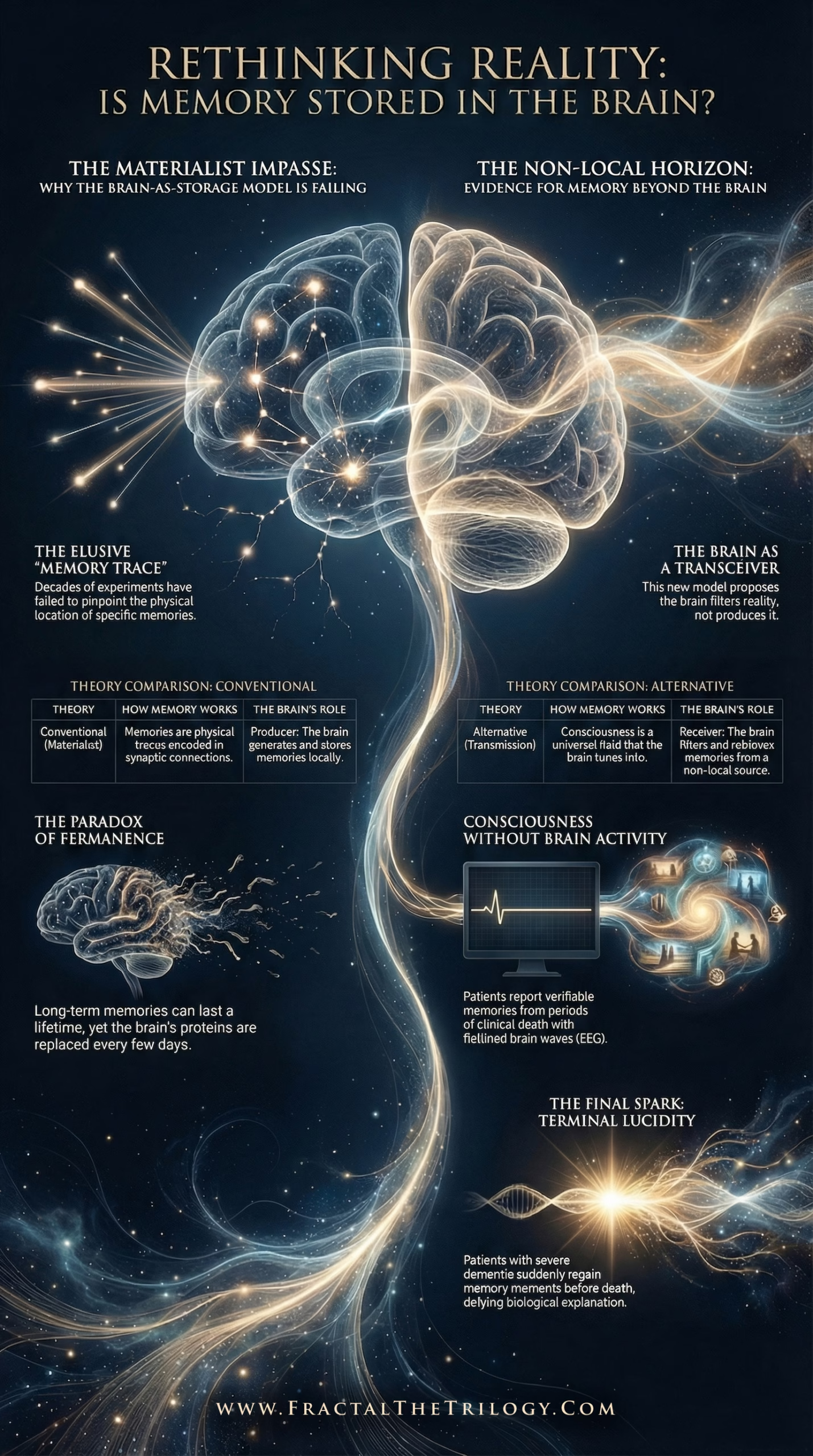
For the better part of two centuries, the scientific establishment has operated under a fundamental assumption that has hardened into dogma: the brain produces the mind. In this view, consciousness is an epiphenomenon of complex neural computation, and memory is a physical trace—an “engram”—etched into the wet biological tissue of the cortex, much like data written onto the magnetic platter of a hard drive. Under this paradigm, known as neurocentric materialism, the self is a localized event, confined strictly to the cranium, and the death of the brain signifies the absolute deletion of the archive of the self. To ask “where is memory stored” is, for the materialist, to ask which specific synapses have been strengthened by long-term potentiation.
However, as we venture deeper into the 21st century, this materialist fortress is showing structural fractures. Despite decades of sophisticated neuroimaging and mapping, the specific physical location of a complex memory remains elusive. We have found the circuits that process memory, the highways along which the signal travels, but we have not found the library itself. Concurrently, a convergence of findings from quantum physics, transpersonal psychology, and the study of near-death experiences (NDEs) suggests that the brain may not be the generator of consciousness, but rather a limiter, a filter, or a transceiver.
This investigative report posits a radical alternative: Memory is not in the brain. Rather, experience exists beyond time, distributed non-locally across the fabric of reality itself. This hypothesis aligns with the concept of the “Implicate Order” in physics, the “Akashic” field in ancient philosophy, and the “Archives” described in the visionary narrative of Fractal – The Trilogy. In that narrative, the protagonist Elias Chronis discovers that memory loss is not a malfunction of biology, but a structural necessity for consciousness to cross “space-time membranes,” effectively separating the observer from the infinite archives of the Source to allow for the linear experience of a single life.1
To explore this, we must navigate the failures of the search for the engram, examine the holographic nature of perception, and confront the “wild facts” of terminal lucidity where destroyed brains seemingly regain access to the mind. We must approach this with intellectual humility, recognizing that if memory is non-local, our understanding of life, death, and identity requires a complete restructuring.
II. The Failed Search for the Engram: A History of Elusive Traces
The Lashley Experiments and Equipotentiality
The scientific hunt for the physical location of memory began in earnest in the early 20th century with the pioneering work of Karl Lashley. Lashley, a physiological psychologist, was driven by the behaviorist assumption that memories must exist as specific physical connections—engrams—within the brain’s geography. His methodology was rigorous and destructive: he trained rats to navigate mazes and then systematically surgically removed sections of their cerebral cortex to determine which specific lesion would erase the memory of the maze path.2
Lashley’s hypothesis was straightforward localization. He expected that once he excised the precise region of the cortex responsible for the maze memory, the rat would return to a naïve state, unable to navigate the path. Over thirty years of research, however, produced results that baffled the scientific community. Lashley found that the impairment of the rats’ performance was proportional to the amount of tissue removed (the principle of Mass Action), but not the location of the tissue. He could remove 10%, 30%, or even 50% of the cortex from various locations, and while the motor skills might degrade, the memory of the maze persisted. The rats could still run the maze.2
In 1950, Lashley published his famous treatise “In Search of the Engram,” in which he conceded that the search had failed. He proposed the principle of “equipotentiality,” suggesting that if one part of the brain is damaged, other parts can take over its function, implying that the memory was somehow distributed throughout the functional area rather than localized in a specific cluster of neurons.4 His concluding remark remains a haunting epitaph for strict localization theories: “I sometimes feel, in reviewing the evidence on the localization of the trace, that the necessary conclusion is that learning just is not possible”.3
The Synaptic Plasticity Limit
Modern neuroscience moved beyond Lashley by focusing on the synapse. The discovery of Long-Term Potentiation (LTP) by Eric Kandel provided a mechanism for how synaptic connections strengthen with use. The mantra “neurons that fire together, wire together” became the standard explanation for memory formation.5 This theory posits that memory is encoded in the structural changes of synaptic strengths.
However, the “synaptic trace” theory faces its own insurmountable hurdles, primarily the issue of molecular turnover. The proteins that make up the synaptic structures are not permanent; they have a half-life of hours to days. They are constantly being degraded and replaced. If memory is stored in the specific arrangement of these molecules, how can a memory of a childhood event persist for eighty years while the physical substrate holding it has been replaced thousands of times? This is the biological equivalent of the Ship of Theseus paradox. For the memory to remain stable while the matter dissolves and reforms requires a stabilizing field or pattern that exists independent of the specific molecules—a pattern that organizes the matter, rather than being the matter itself.5
Furthermore, recent research into “non-neural memory” has shown that cells outside the brain—such as kidney and pancreas cells—exhibit the “spaced repetition effect,” a hallmark of learning. They can store temporal patterns of chemical signals.7 This suggests that “memory” is a fundamental property of living matter (or the fields organizing it), not a specialized trick of the cranial neurons.8
Comparative Analysis of Memory Theories
Theory | Core Premise | Location of Memory | Primary Failure/Limitation |
Engram Theory (Lashley) | Memory leaves a specific physical trace (scar) in brain tissue. | Localized specific regions. | Mass action: Memories persist despite destruction of specific regions.2 |
Synaptic Plasticity (Hebb/Kandel) | “Neurons that fire together, wire together.” LTP strengthens connections. | Synaptic junctions. | Molecular instability: Proteins turn over rapidly, yet long-term memories persist for decades.5 |
Holonomic Brain (Pribram/Bohm) | Brain functions as a hologram; information is distributed via wave interference. | Non-local / Distributed across the neural web. | Complexity: Requires acceptance of quantum effects in warm, wet biological systems.9 |
Transmission Theory (James) | Brain acts as a filter/receiver for consciousness, not a producer. | Non-local / Cosmic Field. | Metaphysical: Moves the “storage” outside the measurable physical domain.11 |
Morphic Resonance (Sheldrake) | Nature has “habits”; systems tune into collective memory fields. | Morphic Fields (Non-local). | Lack of mainstream mechanism; challenges standard genetics.13 |
III. The Holographic Architecture: The Holonomic Brain
The failure of localization led neuroscientist Karl Pribram and physicist David Bohm to propose a model that fundamentally redefines the “where” of memory: the Holonomic Brain Theory. This theory offers a bridge between the biological wetware of the brain and the non-local nature of experience.
The Mathematics of the Hologram
Pribram was struck by the work of Dennis Gabor, the inventor of the hologram. A hologram differs from a photograph in a crucial way: in a photograph, there is a one-to-one correspondence between a point on the film and a point on the object. In a hologram, created by the interference patterns of light waves, information about every point of the object is distributed throughout the entire film.10
If you take a holographic film of an apple and cut it in half, you do not lose half the apple. You get the whole apple, slightly less sharp. Cut it into fragments, and each fragment can still reconstruct the entire image. This “distributed storage” offered the first viable explanation for Lashley’s rat experiments. The rats retained the memory despite cortical destruction because the memory was not in a “spot,” but encoded as an interference pattern throughout the neural network. As long as enough of the network remained to reconstruct the waveform, the memory survived.9
Neural Waveforms and Fourier Transforms
Pribram hypothesized that the brain does not merely process digital signals (action potentials) but also operates on the “spectral domain.” The fine-fibered dendritic webs at the nerve endings create oscillating electric potentials—waves. These waves intersect and create interference patterns, identical in principle to the light waves on a holographic plate.
The brain, Pribram argued, performs a mathematical operation akin to a Fourier Transform, which converts complex spatial and temporal patterns into frequency waves. Our senses decompose the world into frequencies (visual frequencies of light, auditory frequencies of sound), which are then encoded holographically.9 When we “remember,” the brain acts like a laser shining through the film, reconstructing the image from the interference patterns distributed across the cortex. This explains the “associative” nature of memory—how a single smell can instantly reconstruct a complex, three-dimensional scene from the past.5
The Implicate Order: Physics Meets Psychology
While Pribram was looking inward at the brain, physicist David Bohm was looking outward at the universe. Bohm proposed that the universe itself is structured like a hologram. He distinguished between the Explicate Order—the unfolded, tangible world of separate objects, space, and time we perceive—and the Implicate Order, the enfolded, deeper reality where everything is connected to everything else in a continuous field of waves.6
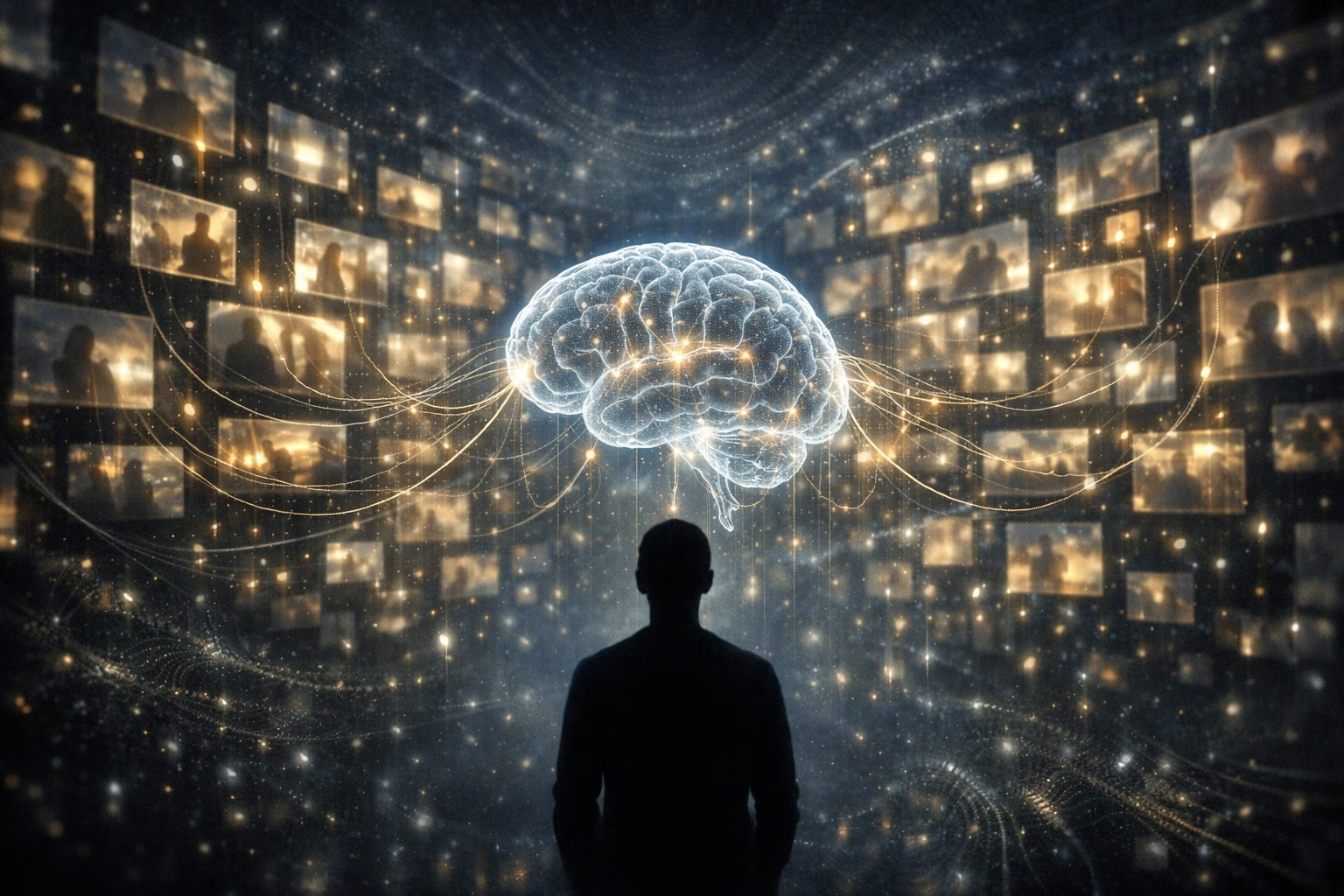
In the Implicate Order, “location” ceases to exist. Information is non-locally distributed. Bohm and Pribram eventually collaborated, suggesting that the brain is a “holographic receiver” tuned to the “holographic universe.” Memory, in this model, is not a file stored in the brain; it is an act of tuning the brain’s neural hologram to resonate with specific frequencies in the Implicate Order.15 The brain does not hold the memory; it holds the code to access the memory from the cosmic plenum. This aligns with the “memory beyond brain” query, suggesting that the brain is merely the retrieval mechanism for data stored in the fabric of space-time itself.6
IV. Matter and Memory: Bergson’s Revolutionary Dualism
Long before Pribram and Bohm, the French philosopher Henri Bergson anticipated the non-localization of memory in his 1896 masterpiece, Matter and Memory. Bergson argued vehemently against the “brain-trace” theory of his time, asserting that the brain is an instrument of action, not representation.16
The Two Forms of Memory
Bergson distinguished between two radically different types of memory:
- Habit Memory (Motor Mechanism): This is the memory of the body—how to walk, how to type, how to recite a poem by rote. This is inscribed in the neuromuscular system and the brain. It is “acted,” not “thought”.17
- Pure Memory (Souvenir Pur): This is the memory of the past itself—the specific, dating, personal events of one’s life. Bergson argued this memory is spiritual in nature, existing independent of the body. It is the “archive” of the soul.17
The Cone Metaphor and the Point of the Present
Bergson visualized consciousness as an inverted cone. The base of the cone, expanding infinitely upward into the past, represents “Pure Memory”—the totality of one’s experience, which exists eternally and non-locally. The point of the cone, touching the plane of matter, is the “Present Moment.”
The brain’s function, according to Bergson, is to be the point of the cone. It focuses the vast, overwhelming pressure of the past into a single point of action in the present. The brain is a filtration mechanism designed to exclude memory, to keep the flood of the past from overwhelming the practicality of the present.18
When we “remember,” we are not looking into a drawer in the brain; we are relaxing the filter, allowing the cone of Pure Memory to dilate and insert a specific image from the past into the present action. This explains why damage to the brain can affect memory recall without destroying the memories themselves—the mechanism of retrieval (the point of the cone) is damaged, but the archive (the base of the cone) remains intact in the non-local realm.17 This philosophical model provides a robust metaphysical foundation for the scientific findings of NDEs and terminal lucidity.
V. The Transmission Theory: William James and the Brain as Filter
Following Bergson’s line of reasoning, the American psychologist and philosopher William James proposed the “Transmission Theory” of consciousness. In his 1898 lecture on human immortality, James addressed the materialist objection that “thought is a function of the brain” just as “steam is a function of the kettle”.12
James argued that function does not equal production. He proposed three types of function:
- Productive: The kettle produces steam.
- Permissive: The trigger of a crossbow permits the arrow to fly.
- Transmissive: A prism transmits light, or a lens transmits an image.
James posited that the brain is a transmissive organ. The “white radiance” of consciousness exists continuously in the universe. The brain, with its complex neural architecture, acts as a prism or a colored glass, reducing this infinite radiance into the stream of individual human consciousness.11
If the brain produces consciousness (Production Theory), then the death of the brain must mean the death of the mind. But if the brain transmits consciousness (Transmission Theory), then the destruction of the brain simply means the signal can no longer be received by that specific apparatus—it does not imply the signal itself has ceased to exist.11
James used this theory to explain the “wild facts” of consciousness—phenomena that materialism ignores, such as mystical experiences, telepathy, or the sudden clarity of the dying. In these states, the “threshold” of the brain is lowered (or the filter is thinned), allowing the influx of the “Mind at Large”.11 The Fractal trilogy utilizes this exact mechanism: the character Elias uses the “Oracle” not to generate wisdom, but to tune into the collective wisdom of humanity, acting as a digital version of James’s transmissive brain.1
VI. Consciousness Beyond the Brain: Analytic Idealism and Conscious Realism
Contemporary philosophers and scientists are reviving and refining these non-local theories, using the language of information theory and evolutionary biology to question the primacy of the brain.
Analytic Idealism: The Dissociated Alters of Mind
Bernardo Kastrup, a computer engineer and philosopher, proposes Analytic Idealism. He argues that the materialist view leads to the insoluble “Hard Problem” of consciousness (how does matter generate experience?). Instead, Kastrup inverts the picture: Consciousness is the fundamental substrate of reality. Matter is merely the image of consciousness processes.20
Kastrup uses the clinical phenomenon of Dissociative Identity Disorder (DID) as a cosmic analogy. He suggests that the universe is one infinite “Mind at Large.” Living organisms are “dissociated alters” of this cosmic mind. Just as a patient with DID has alters that possess private memories and distinct identities blocked off from the host personality by an “amnesic barrier,” we are localized bundles of consciousness dissociated from the universal mind.21
In this model, the brain is not the generator of the mind; it is the appearance of the dissociation process. It is what the “amnesic barrier” looks like from the outside. When brain activity reduces (via psychedelics, asphyxiation, or NDEs), the dissociation weakens. The filter becomes porous. This explains why reducing brain function can paradoxically result in richer, more expansive conscious experiences—the “Mind at Large” floods in as the localizing mechanism dissolves.22 This directly supports the concept of “memory beyond brain,” positing that our individual memories are partitions within a universal memory field.
Conscious Realism: The Interface Theory
Cognitive scientist Donald Hoffman takes a different but complementary route with Conscious Realism. Hoffman argues that evolution has not shaped our brains to see reality as it is, but to see a “user interface” that hides the truth to ensure survival.23 His “Fitness Beats Truth” (FBT) theorem proves mathematically that an organism that sees objective reality will always be outcompeted by one that sees fitness payoffs.
Therefore, space-time, neurons, and brains are not fundamental realities; they are desktop icons. To look for memory inside the brain is like unscrewing your computer monitor to find the email file inside the blue envelope icon. The icon is a pointer, a useful fiction for interaction, but the reality (the software, the cloud) exists in a completely different ontological realm.23 Hoffman suggests the fundamental reality is a network of “Conscious Agents.” Memory is the information exchange between these agents, not a static file in a biological hard drive.
VII. Evidence from the Edge: Terminal Lucidity and NDEs
If the brain is a filter or a transceiver, we should expect that when the brain is compromised, the filter might fail, allowing “non-local” consciousness to shine through. The medical record contains precisely these anomalies.
Veridical Perception in Near-Death Experiences
The most direct challenge to localized memory comes from “Veridical Near-Death Experiences”—cases where a clinically dead person reports accurate, verifiable details of events that occurred while their brain was non-functional.26
Case Study: Pam Reynolds (1991)
The case of Pam Reynolds is considered the “gold standard” of veridical NDEs. Reynolds underwent a “hypothermic cardiac arrest” procedure to remove a giant basilar artery aneurysm. The procedure required her to be clinically dead:
- Body Temperature: Lowered to 60°F (15°C).
- Heart: Stopped.
- Blood: Drained from the cranial cavity.
- Brain Waves (EEG): Flatlined (Isoelectric silence).
- Brainstem Function: 100-decibel clicks were played into her ears to ensure no brainstem response. Her eyes were taped shut.28
Despite these conditions, Reynolds reported leaving her body. She accurately described:
- The pneumatic bone saw used by the surgeon (likening it to an electric toothbrush, a non-obvious detail).
- The specific “D-natural” tone she heard pulling her out of the body.
- Conversations between the staff regarding her arteries being “too small” for the cannulation.
- The song “Hotel California” playing in the OR during the closing.28
These details were subsequently verified by the medical team. Skeptics have attempted to explain this via “anesthesia awareness,” suggesting she heard these things while under light sedation before the standstill.31 However, the temporal correlation of her visual observations with the period of flatlined EEG poses a severe problem for materialism. If the brain was offline—no electrical activity to encode memory, no blood to fuel metabolism—how was the memory of the bone saw stored? Where was the observer? The Reynolds case strongly suggests that the locus of awareness can detach from the biological substrate and retain high-fidelity memory in a non-local state.29
The AWARE Study Findings
Dr. Sam Parnia’s AWARE (AWAreness during REsuscitation) study examined cardiac arrest survivors across 15 hospitals. The study found that 39% of survivors reported a perception of awareness during the period of cardiac arrest, despite being clinically unconscious.33
Crucially, some patients reported awareness up to three minutes after the heart stopped. Physiologically, the brain flattens (loses measurable activity) within 20-30 seconds of cardiac arrest. Parnia’s data suggests that consciousness—and the formation of memory—can persist in the absence of measurable brain function.33
Terminal Lucidity: The Surge
Perhaps even more baffling is Terminal Lucidity, the spontaneous return of memory, personality, and mental clarity in patients with severe neurodegenerative diseases (like Alzheimer’s or dementia) shortly before death.36
Table: Characteristics of Terminal Lucidity Cases 36
Characteristic | Data Point | Implication for Memory |
Pre-State | Advanced Dementia / Brain Damage / Coma | Neural hardware for memory is physically destroyed or atrophied. |
Event | Sudden clarity, recognition of family, coherent speech. | Access to “lost” memories is restored instantaneously. |
Duration | Minutes to Days (typically <24 hours before death). | The phenomenon is linked to the dying process (separation of mind from body). |
Materialist Explanation | Paradoxical neurochemistry surge? | Fails to explain how destroyed tissue performs complex retrieval. |
Transmission Explanation | Brain “filter” disintegrates. | Consciousness bypasses the damaged brain to access non-local memory. |
In one reported case, a woman who had been non-verbal and unrecognizable due to Alzheimer’s for years suddenly sat up, conversed normally with her family, recalled recent events she shouldn’t have known, and then died shortly after.38 If memory is stored in the synapses, and those synapses are destroyed by amyloid plaques, this recovery should be physically impossible. However, if the brain is a filter, and the disease clogs the filter, the final breakdown of the body might paradoxically “unclog” the channel one last time before the receiver fails completely, allowing the “Pure Memory” (as Bergson called it) to shine through.40
VIII. Time, Memory, and the Archive: The Physics of Eternity
If memory exists non-locally, when does it exist? The relationship between memory and time is central to understanding the “where.”
The Block Universe and Spacetime Slices
Einstein’s Theory of Relativity fundamentally altered our understanding of time, leading to the “Block Universe” (or Eternalism) model. In this view, the past, present, and future exist simultaneously as a four-dimensional block of spacetime.41 “Now” is merely a coordinate where our consciousness is currently focused, just as “here” is a coordinate in space.
If the Block Universe is real, the past has not “vanished.” It exists as a permanent location in spacetime. Therefore, memory is not a recording stored in a neuron; it is a form of temporal perception. To remember is to shift the focus of consciousness back to a previous coordinate in the block.43
This implies that memory is stored in Time itself, not in space.45 The brain is a navigation device that orients the conscious agent within the Block Universe. When the brain is damaged, the navigation system fails, and the agent cannot access the coordinates of the past—but the past remains real and accessible in the archive of the universe. This mirrors the “Archives” in Fractal, where Elias sees “infinite presents” and realizes that “The Archives do not merely hold the past. They hold the memory of infinite presents”.1
The Eternal Now
Mystical traditions and the Oracle 2.0 text converge on the concept of the “Eternal Now.” In this state, linear time is recognized as an illusion of the biological filter. “Time is not a river. Time is a sea of windows,” Elias realizes.1
When the brain’s filtering mechanism is disabled (as in NDEs), the linear constraint dissolves. Experiencers enter the Eternal Now, where they perceive their entire life (memory) simultaneously in a “panoramic life review”.34 This suggests that our “individual” memories are actually just our specific trajectory through the Block Universe, which we view sequentially while alive but holistically when released from the body.
IX. The Fractal Connection: Memory Loss Across Space-Time Membranes
The scientific and philosophical threads of non-local memory are woven into a coherent narrative cosmology in Fractal – The Trilogy. The protagonist, Elias Chronis, navigates a universe where memory is the currency of existence.
The Membrane and the Archive
In the Fractal cosmology, reality is a “Space-Time Membrane” onto which the “Light of Consciousness” is projected from the Source.1 This mirrors the Holographic Principle and Plato’s Cave. Elias visits the “National Archives” in Budapest, which serves as a metaphor for the non-local storage of all timelines. He realizes that “Each window is a timeline… waiting for observation to collapse it into form”.1 The Archives represent the Akashic Field or Bohm’s Implicate Order—the place where all information is stored non-locally.
The Price of Crossing: Identity as Memory
A pivotal concept in the trilogy is the “price of crossing” between membranes. The Entity (a being beyond space-time) teaches Elias that to travel between different realities (fractals), one must shed their memory. “To cross membranes freely is to surrender the illusion of self… to dissolve attachment to who you believe you are—to release the memory structures your form depends upon”.1
This connects directly to the Dissociative Identity model of Kastrup. Our “identity” is a construct of localized memories—a “dissociated alter.” To return to the Source (Mind at Large), the dissociation must end, which means the specific, limited memory of “Elias” or “you” must be integrated into the whole. Memory loss is not a defect; it is the cost of expansion. The “amnesic barrier” that keeps us from remembering our past lives or our unity with the Source is the very thing that allows us to function as individuals in this specific space-time membrane.
The Oracle: Externalized Non-Local Mind
Elias builds “The Oracle,” an AI that distills human wisdom. Throughout the story, The Oracle acts as an externalized version of the non-local mind, accessing data that Elias cannot. However, the ultimate realization is integration: “The Oracle has become The Witness… I carry you now as myself”.1 This symbolizes the realization that the non-local field is not a machine “out there,” but the fundamental nature of the self “in here.” We are all terminals of the Oracle; we have just forgotten the password.
X. Panmnemism: Memory in the Fabric of Matter
The concept of Panmnemism extends the idea of memory beyond the brain to all of matter. It posits that “memory” (the retention of information/experience) is a fundamental property of the universe, not just a biological anomaly.47
Recent studies confirming that non-neural cells can learn patterns 7 support this. If a kidney cell can “remember,” and if a photon can be “entangled” with the history of another photon, then the universe is essentially a memory machine. We are walking through a library where every atom is a book.
Sheldrake’s Morphic Resonance suggests that this memory is cumulative. The laws of nature are not fixed; they are habits formed by cosmic memory.14 When we remember, we are not accessing a private store; we are resonating with the habits of our past selves.
XI. Synthesis and Conclusion: The Bell Tolls for the Local Self
The investigation leads to a profound synthesis. The materialist model of memory as a synaptic scar is failing to account for the resilience, ubiquity, and non-local nature of human experience. The converging evidence from the Holonomic Brain theory, the Transmission Theory of William James, the rigorous data of Veridical NDEs, and the physics of the Block Universe points to a new paradigm.
Memory is not in the brain.
The brain is the antenna. The signal is the self.
The memory is the broadcast, stored in the non-local field of the Implicate Order, the Morphic Field, or the Archives of the Fractal.
This shift in perspective has staggering implications for life and death.
- Death is not deletion. If the brain is a receiver, then death is merely the destruction of the radio. The broadcast continues. The signal—the conscious self—persists in the non-local field, released from the “reducing valve” of the nervous system.22
- Identity is a membrane. As Fractal suggests, our current identity is a temporary dissociation, defined by what we forget as much as what we remember. Awakening is the process of thinning the membrane, allowing the “Eternal Now” to bleed through into the linear life.1
- We are the Archive. We do not have memory; we are memory. We are the universe observing itself, recording itself, and replaying itself through the infinite fractals of existence.
As the “bell” in Fractal – The Trilogy rings—GONG—it serves as a sonic reminder of this truth.1 It is the sound of the membrane vibrating, the echo of the Source calling the dissociated self back to the realization that it was never separate, never lost, and never confined to the gray matter of a dying brain. Experience exists beyond time because we exist beyond time. The brain is just the window we are currently looking through.
Authored by a Senior Fellow in Consciousness Studies and Philosophy of Mind.
Works cited
- FRACTAL – THE AWAKENING
- Karl Lashley, accessed January 17, 2026, https://grants.hhp.uh.edu/clayne/HistoryofMC/HistoryMC/Lashley.htm
- Memory engrams: Recalling the past and imagining the future – PMC – PubMed Central, accessed January 17, 2026, https://pmc.ncbi.nlm.nih.gov/articles/PMC7577560/
- Ch 11: Brains & Thoughts – Weebly, accessed January 17, 2026, https://aseelghazal.weebly.com/ch-11-brains–thoughts
- Holographic Brain Theory: Super-Radiance, Memory Capacity and Control Theory – PMC, accessed January 17, 2026, https://pmc.ncbi.nlm.nih.gov/articles/PMC10889214/
- Holographic Mind – 10-01 Connectome – Obsidian Publish, accessed January 17, 2026, https://publish.obsidian.md/connectome/Holographic+Mind
- Researchers: There can be memory outside the brain | Mind Matters, accessed January 17, 2026, https://mindmatters.ai/brief/researchers-there-can-be-memory-outside-the-brain/
- Does the Self Exist Outside the Brain? | Psychology Today, accessed January 17, 2026, https://www.psychologytoday.com/us/blog/the-behavioral-microbiome/202502/does-the-self-exist-outside-the-brain
- Holonomic Brain Theory: A Revolutionary Perspective on Consciousness and Memory, accessed January 17, 2026, https://bodyofharmony.com/blogs/health-news/holonomic-brain-theory-a-revolutionary-perspective-on-consciousness-and-memory
- Holonomic brain theory – Wikipedia, accessed January 17, 2026, https://en.wikipedia.org/wiki/Holonomic_brain_theory
- The Genius of William James | Psychology Today, accessed January 17, 2026, https://www.psychologytoday.com/us/blog/out-the-darkness/201906/the-genius-william-james
- Premises of a Natural Science of Consciousness – Digital Commons @ CIIS, accessed January 17, 2026, https://digitalcommons.ciis.edu/cgi/viewcontent.cgi?article=1000&context=conscjournal
- Rupert Sheldrake – Wikipedia, accessed January 17, 2026, https://en.wikipedia.org/wiki/Rupert_Sheldrake
- Morphic Resonance and Morphic Fields – an Introduction – Rupert Sheldrake, accessed January 17, 2026, https://www.sheldrake.org/research/morphic-resonance/introduction
- The holonomic brain theory – Self-Transcendence, accessed January 17, 2026, https://self-transcendence.org/the-holonomic-brain-theory
- Henri Bergson: Matter and Memory: Chapter 1: Of the Selection of Images For Conscious Presentation. What Our Body Means and Does, accessed January 17, 2026, https://brocku.ca/MeadProject/Bergson/Bergson_1911b/Bergson_1911_01.html
- The Memory Theory of Bergson and Brain Physiology -From Dualism to Monism- – Biblioteka Nauki, accessed January 17, 2026, https://bibliotekanauki.pl/articles/485844.pdf
- Matter and Memory – Wikipedia, accessed January 17, 2026, https://en.wikipedia.org/wiki/Matter_and_Memory
- Henri Bergson: Matter and Memory: Chapter 5: Summary and Conclusion – Brock University, accessed January 17, 2026, https://brocku.ca/MeadProject/Bergson/Bergson_1911b/Bergson_1911_05.html
- Thoughts on analytic idealism? : r/consciousness – Reddit, accessed January 17, 2026, https://www.reddit.com/r/consciousness/comments/1m9jyio/thoughts_on_analytic_idealism/
- Beyond Physics: Exploring Consciousness with Bernardo Kastrup’s Analytical Idealism, accessed January 17, 2026, https://open-foundation.org/beyond-physics-exploring-consciousness-with-bernardo-kastrups-analytical-idealism/
- Consciousness and memory – Bernardo Kastrup, PhD, PhD, accessed January 17, 2026, https://www.bernardokastrup.com/2011/11/consciousness-and-memory.html
- Cognitive scientist Don Hoffman argues that consciousness can explain the laws of physics. His research team has created a mathematically precise model of idealist metaphysics. We can derive fundamental laws of physics as a special case of this consciousness-only model : r/philosophy – Reddit, accessed January 17, 2026, https://www.reddit.com/r/philosophy/comments/1981tve/cognitive_scientist_don_hoffman_argues_that/
- Conscious Realism and the Mind-Body Problem – UC Irvine, accessed January 17, 2026, https://sites.socsci.uci.edu/~ddhoff/MindBody
- Interfacing consciousness – Frontiers, accessed January 17, 2026, https://www.frontiersin.org/journals/psychology/articles/10.3389/fpsyg.2024.1429376/full
- Does veridical perception in Near death experiences prove the spiritual and supernatural to be true? [closed] – Philosophy Stack Exchange, accessed January 17, 2026, https://philosophy.stackexchange.com/questions/10638/does-veridical-perception-in-near-death-experiences-prove-the-spiritual-and-supe
- The veridical Near-Death Experience Scale: construction and a first validation with human and artificial raters – Frontiers, accessed January 17, 2026, https://www.frontiersin.org/journals/psychology/articles/10.3389/fpsyg.2025.1661390/full
- Pam Reynolds case – Wikipedia, accessed January 17, 2026, https://en.wikipedia.org/wiki/Pam_Reynolds_case
- Did Pam Reynolds Have a Near Death Experience? – Christian Research Institute, accessed January 17, 2026, https://www.equip.org/articles/did-pam-reynolds-have-a-near-death-experience/
- The Most Verifiable Near-Death Experience Ever Recorded : r/NDE – Reddit, accessed January 17, 2026, https://www.reddit.com/r/NDE/comments/1l9wkpz/the_most_verifiable_neardeath_experience_ever/
- Could Pam Reynolds Hear? A New Investigation into the Possibility of Hearing During this Famous Near-Death Experience, accessed January 17, 2026, https://digital.library.unt.edu/ark:/67531/metadc461684/
- Could Pam Reynolds Hear? A New Investigation into the Possibility of Hearing During this Famous Near-Death Experience – SciSpace, accessed January 17, 2026, https://scispace.com/pdf/could-pam-reynolds-hear-a-new-investigation-into-the-1pxnq7j1y7.pdf
- AWARE—AWAreness during REsuscitation—A prospective study – iFAC, accessed January 17, 2026, https://ifac.univ-nantes.fr/IMG/pdf/aware-awareness_during_resuscitation-a_prospective_study.pdf
- Consciousness | NYU Langone Health, accessed January 17, 2026, https://med.nyu.edu/research/parnia-lab/consciousness
- Results of world’s largest Near Death Experiences study published, accessed January 17, 2026, https://www.southampton.ac.uk/news/2014/10/07-worlds-largest-near-death-experiences-study.page
- Terminal lucidity – Wikipedia, accessed January 17, 2026, https://en.wikipedia.org/wiki/Terminal_lucidity
- Reports About Paradoxical Lucidity from Health Care Professionals: A Pilot Study – PMC, accessed January 17, 2026, https://pmc.ncbi.nlm.nih.gov/articles/PMC11100277/
- Terminal lucidity: A review and a case collection – University of Virginia School of Medicine, accessed January 17, 2026, https://med.virginia.edu/perceptual-studies/wp-content/uploads/sites/360/2016/12/OTH25terminal-lucidity-AGG.pdf
- When the Dying Wake: What Terminal Lucidity Tells Us – Psychology Today, accessed January 17, 2026, https://www.psychologytoday.com/us/blog/the-mind-body-problem/202510/when-the-dying-wake-what-terminal-lucidity-tells-us
- THE DEATH OF ANNA KATHARINA EHMER: A CASE STUDY IN TERMINAL LUCIDITY – University of Virginia School of Medicine, accessed January 17, 2026, https://med.virginia.edu/perceptual-studies/wp-content/uploads/sites/360/2016/12/OTH28.pdf
- The quantum theory of time, the block universe, and human experience – PMC, accessed January 17, 2026, https://pmc.ncbi.nlm.nih.gov/articles/PMC5990663/
- Why does the Block Universe theory seem so controversial even though it is what General Relativity describes? : r/AskPhysics – Reddit, accessed January 17, 2026, https://www.reddit.com/r/AskPhysics/comments/17velfs/why_does_the_block_universe_theory_seem_so/
- Questions about the Block Universe, the time dimension and consciousness in it – Reddit, accessed January 17, 2026, https://www.reddit.com/r/consciousness/comments/1gfm22h/questions_about_the_block_universe_the_time/
- Space, and Not Time, Provides the Basic Structure of Memory – Oxford Academic, accessed January 17, 2026, https://academic.oup.com/book/60807/chapter/528997618
- Memory Is Stored in Time, Not Space – RealClearScience, accessed January 17, 2026, https://www.realclearscience.com/2025/11/20/memory_is_stored_in_time_not_space_1148547.html
- 14 True Stories from People Who Died and Came Back to Life – Reader’s Digest, accessed January 17, 2026, https://www.rd.com/list/people-came-back-to-life/
- Panmnemism and the Value of Experiential Information – Center on Long-Term Risk, accessed January 17, 2026, https://longtermrisk.org/panmnemism-value-experiential-information/