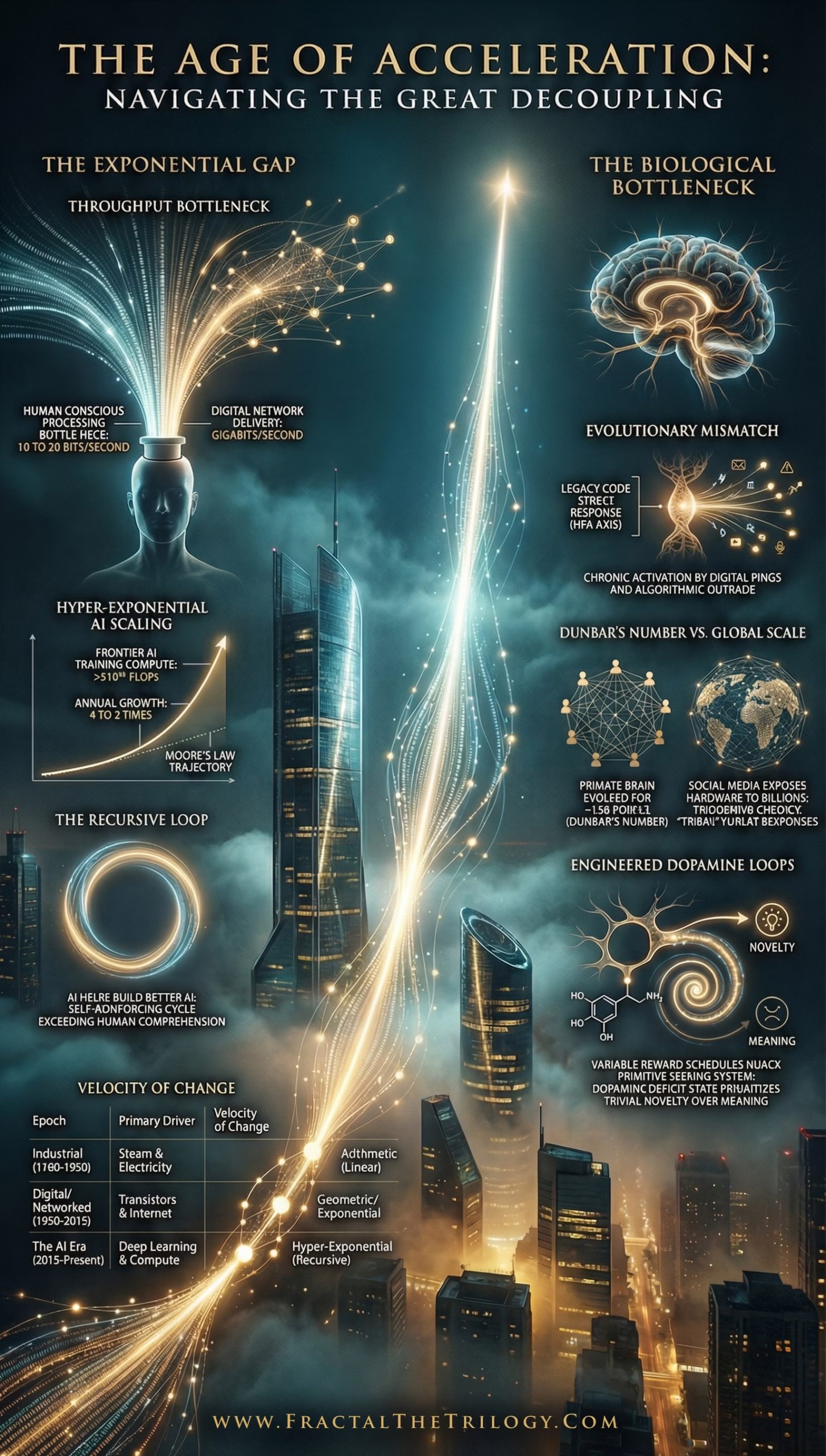

PODCAST: The Great Decoupling
I. Introduction: The Anatomy of the Metacrisis
We currently stand at the precipice of a phase transition unparalleled in the biological or geological history of our planet. This moment is defined not merely by the velocity of change, but by a fundamental structural divergence: the decoupling of our external environment—technological, economic, and ecological—from our internal biological capacities. We have entered the “Age of Acceleration,” a period characterized by hyper-exponential growth in computational power, information velocity, and systemic complexity that has decisively outpaced the linear adaptability of human cognition, social institutions, and homeostatic stress responses. This divergence, often termed the “exponential gap,” is not merely a management challenge or a policy dilemma; it is an evolutionary crisis that threatens the coherence of the human psyche and the stability of the global order.1
The phenomenon we are witnessing is the manifestation of the “Metacrisis”—a convergence of multiple systemic risks (ecological collapse, algorithmic polarization, nuclear proliferation, and artificial intelligence) that feed into one another to create a self-reinforcing cycle of instability.4 At the core of this crisis lies a simple, terrifying physics: the systems we have built operate on timescales of microseconds and nanoseconds, while the biology we inhabit operates on timescales of milliseconds and seconds. We are Pleistocene organisms navigating a silicon reality; our hardware is obsolete for the software we are attempting to run.6
This report synthesizes insights from complexity science, evolutionary psychology, cognitive neuroscience, and systems theory to map the precise mechanics of this acceleration. We posit that the primary drivers—compute scaling, network effects, and algorithmic finance—have created a “runaway” system that has breached the “Bremermann’s Limit” of human attention.8 Furthermore, we integrate the visionary frameworks of the Fractal and Oracle paradigms, exploring the concept of “awakening” not as a spiritual luxury, but as a cognitive necessity—a recalibration of the lens of perception required to navigate a high-signal, high-noise environment without succumbing to dissociation or collapse.9
Ultimately, we argue that the survival of the human project depends on the emergence of a “Third Attractor”—a trajectory that avoids both the entropy of fragmentation and the tyranny of authoritarian control, instead fostering a coherence transition where human wisdom scales to match the power of our tools.10
II. The Physics of Exponential Systems: Drivers of Acceleration
To understand the psychological and sociological impacts of the current era, one must first confront the raw mechanics of the acceleration itself. Human intuition is linearly calibrated; we evolved to anticipate change as a steady, arithmetic process (1, 2, 3, 4). Technological evolution, however, follows a geometric or exponential progression (1, 2, 4, 8, 16), creating a “linear bias” in our forecasting that consistently underestimates the speed and magnitude of disruption.12
2.1 Compute Scaling and the Thermodynamic Limit
The engine driving this acceleration is the relentless scaling of computational power. For decades, this was governed by Moore’s Law, which predicted a doubling of transistor density every 18 to 24 months. However, in the era of Artificial Intelligence, we have witnessed a decoupling even from this aggressive curve. Between 2020 and 2025, the training compute deployed for frontier AI models has grown by factors of 4 to 5 times annually, creating a hyper-exponential trajectory that dwarfs historical norms.14
This scaling is not merely quantitative; it represents a qualitative phase shift in the capability of synthetic intelligence. The “scaling laws” of deep learning suggest that as compute, data, and parameter counts increase, emergent capabilities (such as reasoning, coding, and multilingual translation) appear spontaneously, often without explicit programming.16 This phenomenon creates a “compute overhang,” where the sheer potential energy stored in global server farms exceeds our ability to predict its release or control its direction.
Recent data indicates that the training compute for top-tier models has surpassed FLOPs (floating point operations), a threshold that marks the transition from “narrow” AI tools to “general” systems capable of broad-spectrum problem solving.18 The implications are profound: we are introducing a new form of alien cognition into the global ecosystem, one that operates at light speed and improves recursively, while human cognition remains biologically capped at roughly 10 to 20 bits per second of conscious processing.19
2.2 Network Effects and Hyper-Connectivity
Metcalfe’s Law posits that the value of a network is proportional to the square of the number of connected users (). In the digital age, this law has been supercharged by Reed’s Law, which suggests that value scales exponentially with the formation of sub-groups (). The result is the emergence of “winner-take-all” dynamics where dominant platforms—social media, search engines, financial exchanges—become gravitational singularities that warp the information space around them.21
This hyper-connectivity creates a condition known in complexity science as “tight coupling.” In a loosely coupled system, a failure in one component is isolated. In a tightly coupled system, components are so interlinked that a failure in one node instantly propagates across the entire network. This was vividly demonstrated during the 2010 Flash Crash, where high-frequency trading (HFT) algorithms, interacting at microsecond speeds, caused a trillion-dollar oscillation in global equity markets in under 36 minutes.22 These algorithms do not “invest” in the human sense; they execute predatory logic loops that exploit infinitesimally small price discrepancies, effectively decoupling the financial markets from the real economy and creating a layer of “phantom” volatility that humans cannot track, let alone regulate.24
2.3 The Velocity of Information and Epistemic Entropy
The velocity of information transmission has accelerated from the speed of a horse (industrial era) to the speed of light (digital era). However, the critical metric is not just speed, but volume. We have breached the cognitive capacity of the collective human mind to index, verify, or contextualize the data we produce.
This flood results in “epistemic entropy”—a degradation in the coherence of our shared reality. As the cost of generating content approaches zero via generative AI, the signal-to-noise ratio of the public sphere collapses.26 We are drowning in “synthetic media,” deepfakes, and algorithmic noise. This environment favors high-arousal, low-complexity information (outrage, fear) over low-arousal, high-complexity information (nuance, data), because the former can be processed quickly by the primitive brain, while the latter requires the scarce resource of cognitive bandwidth.27
2.4 Supply Chain Fragility and Just-In-Time Dynamics
The physical manifestation of acceleration is the global supply chain, optimized for “Just-In-Time” (JIT) efficiency. Developed to minimize inventory costs, JIT removed redundancy from the system, treating the world as a frictionless plane where goods could move instantly.29 In a stable, linear world, this was economically optimal. In a volatile, exponential world, it is a liability.
The fragility of this optimization became undeniable during recent global disruptions, where localized events (a virus, a stuck ship, a regional war) caused cascading failures across the globe.31 This is the “bullwhip effect” in action: small fluctuations in demand at the consumer level amplify into massive waves of shortage and chaos upstream. We have engineered a global machine that runs at redline efficiency, stripping away the “slack” or “buffer” that living systems require to survive shocks. We prioritized speed over resilience, and now we face the consequences of a brittle system cracking under the weight of its own complexity.31
III. Timeline of Acceleration: From Steam to Neural Weights
To fully grasp the “Age of Acceleration,” we must view the trajectory of human technological development not as a smooth slope, but as a series of punctuated phase transitions, each compressing the timeframe of the next.
Table 1: The Four Epochs of Acceleration
Epoch | Timeframe | Primary Driver | Dominant Resource | Velocity of Change | Human Role | Key Inflection Point |
Industrial | 1760–1950 | Steam, Electricity | Coal, Oil, Steel | Arithmetic (Linear) | Operator of Machines | 1769: Watt’s Steam Engine patented. |
Digital | 1950–1990 | Transistor, Microchip | Data, Bits | Geometric (Doubling) | Programmer of Logic | 1947: Invention of the Transistor.33 |
Networked | 1990–2015 | Internet, Mobile, Cloud | Attention, Connectivity | Exponential (Network Effects) | Node in the Network | 1993: Launch of the World Wide Web.34 |
The AI Era | 2015–Present | Deep Learning, Compute | Intelligence, Compute | Hyper-Exponential (Recursive) | Curator / Subject | 2017: Transformer Architecture (“Attention Is All You Need”).35 |
3.1 The Industrial to Digital Shift
The Industrial Revolution marked the first decoupling of productivity from biological muscle. However, change occurred over generations. A person born in 1800 inhabited a world largely recognizable to their grandparents. The Digital Era compressed this. The invention of the transistor (1947) and the subsequent rise of the microprocessor initiated Moore’s Law, creating a rhythm of change perceptible within a single lifetime.33
3.2 The Networked Era
The introduction of the World Wide Web (1993) and the smartphone (2007) shifted the locus of value from processing to connection. This era was defined by the aggregation of human attention. The “acceleration” here was social and informational; we moved from local tribes to global villages, subjecting the human psyche to the input of billions.38
3.3 The AI Era and Recursion
We are now in the AI Era, initiated by the “Transformer” architecture in 2017, which allowed neural networks to pay “attention” to vast amounts of data simultaneously.35 The release of GPT-3 in 2020 and subsequent models marked a “Cambrian Explosion” of capability.40 Unlike previous eras, where humans built better tools, in this era, the tools (AI) help build better tools (AI designing chips, writing code). This introduces a recursive loop—acceleration feeding acceleration—that threatens to escape human comprehension entirely.42
IV. The Great Evolutionary Mismatch: The Biological Bottleneck
The central tragedy of the Age of Acceleration is the “Evolutionary Mismatch.” Our external environment has transformed radicaly, but our internal biological hardware remains adapted to the Pleistocene savanna. We are biological entities running on legacy code, attempting to interface with a digital reality that exploits our deepest physiological vulnerabilities.6
4.1 The Bandwidth Limit: 10 Bits vs. Gigabits
Neuroscientific research has quantified the “speed of thought”—the rate at which the human conscious mind can process information—at approximately 10 to 20 bits per second.19 While our sensory organs ingest billions of bits per second, the “bottleneck” of conscious attention is incredibly narrow. We can only hold a few variables in working memory, only make one or two deliberate decisions per second.
Contrast this with the data environment we inhabit. A standard fiber optic connection delivers gigabits per second. Large Language Models (LLMs) process trillions of tokens during training. The disparity between the inflow of information and the throughput of human cognition creates a permanent state of “cognitive overload”.45
The brain responds to this overload by shedding nuance. It defaults to “Type 1” thinking—fast, heuristic, emotional, and biased. We cannot process the complexity of a global supply chain or a geopolitical crisis at 10 bits per second, so we substitute the complex reality for a simple narrative: “Good vs. Evil,” “Us vs. Them.” This is not an intellectual failing; it is a hardware limitation. We are forcing a calculator to run a weather simulation; the result is error and overheating.8
4.2 Dunbar’s Number and Social Scale
Anthropologist Robin Dunbar identified a cognitive limit to the number of stable social relationships a human can maintain: approximately 150 people.7 This limit is structural, determined by the size of the neocortex. In ancestral environments, maintaining 150 relationships was sufficient for survival. The “village gossip” mechanism evolved to police norms within this small group.
Social media platforms explode this limit, exposing the primate brain to networks of thousands or millions. The brain, lacking the architecture to distinguish between “tribe member” and “abstract stranger,” malfunctions. It treats a tweet from a stranger on another continent as a relevant social signal or a tribal threat.48 The shame, fear, and aggression responses designed to manage a tribe of 150 are weaponized at a global scale. We experience “context collapse,” where our words are stripped of nuance and broadcast to hostile audiences, triggering a chronic social threat response that the brain interprets as a danger to survival.48
4.3 The Hijacked Reward System and Dopamine Loops
Our motivational systems are driven by dopamine, a neurotransmitter that evolved to reward the seeking of scarce resources: food, sexual partners, and new information. In the ancestral environment, these rewards were hard-won and infrequent. In the digital environment, they are ubiquitous, engineered, and supernormal.
Tech platforms essentially hack the “dopamine loop” by utilizing variable reward schedules (similar to slot machines). Every notification, like, or refresh offers a potential hit of dopamine.50 This keeps the nervous system in a state of chronic, high-frequency seeking. The result is a “dopamine deficit state” where baseline reality feels dull and unstimulating. The constant bombardment leads to the downregulation of dopamine receptors, resulting in anhedonia (the inability to feel pleasure) and a compulsive need for ever-higher doses of stimulation to feel “normal”.51 We are not merely “distracted”; we are chemically ensnared in loops that prioritize trivial novelty over profound meaning, effectively hijacking our agency.53
4.4 Stress Physiology: The HPA Axis in the Always-On Era
The human stress response—the Hypothalamic-Pituitary-Adrenal (HPA) axis—was designed for acute, physical threats. A predator attacks; cortisol and adrenaline spike; the organism fights or flees; the threat passes; the system resets. This is an adaptive cycle.54
Today, the “predators” are emails, Slack notifications, market fluctuations, and news alerts. These stressors are not acute; they are chronic. They never pass. The system never resets. The result is a state of “allostatic load”—the cumulative wear and tear on the body caused by chronic HPA activation.56 Chronically elevated cortisol damages the hippocampus (impairing memory and context), suppresses the immune system, and sensitizes the amygdala (increasing fear and aggression).58 We are biologically burning out because our threat detection systems cannot distinguish between a physical lion and a digital ping. The body remains in a state of high alert, preparing for a physical battle that never comes, leaving us exhausted and reactive.60
V. The Psychological Fallout: Symptoms of the Metacrisis
The collision of exponential acceleration and linear biology produces distinct psychological pathologies. These should not be viewed as individual mental health failings, but as systemic symptoms of the evolutionary mismatch—the “canaries in the coal mine” of the Metacrisis.
5.1 Anxiety as Cognitive Friction and Hyper-Novelty
Anxiety in the modern context is best understood as the friction between the brain’s predictive models and the chaotic nature of reality. The brain is a “prediction machine,” constantly attempting to anticipate the future to minimize energy expenditure.61 When the environment changes faster than the brain can update its models—a state of “hyper-novelty”—the result is chronic prediction error.62
The brain interprets this inability to predict as a survival threat, flooding the system with anxiety. In an age where career paths, social norms, and geopolitical stabilities dissolve every few years, the brain can never settle into a “safe” predictive model. Anxiety becomes the background radiation of existence, a constant hum of “unsafe, unsafe, unsafe” generated by a nervous system unable to map the terrain ahead.63
5.2 Learned Helplessness and Agency Collapse
“Learned helplessness” is a psychological condition where an organism, repeatedly subjected to aversive stimuli it cannot escape or control, eventually ceases to try, even when an exit becomes available.65 Originally observed in animal studies, this phenomenon now applies at a societal scale.
The modern information environment induces a form of collective learned helplessness. We are bombarded with “hyper-objects”—climate change, AI risk, global inequality—that seem too vast, complex, and interconnected for individual agency to affect. The relentless stream of crisis news, combined with the opacity of the algorithms that govern our lives, creates a shift in the “locus of control.” We feel acted upon rather than acting.67 This passivity is not laziness; it is a rational adaptive response to a system that feels unresponsive to human will. The “freeze” response becomes the default setting for a generation overwhelmed by the scale of the problems.68
5.3 Dissociation: The Digital Anesthesia
When the nervous system is overwhelmed by stimuli it cannot process or fight, and cannot flee from, it defaults to the freeze response—dissociation. In the context of trauma, this involves detaching from the body and reality to survive unbearable pain.58
In the digital age, dissociation manifests as “doomscrolling,” “zoning out” into screens, or a pervasive feeling of unreality (derealization).72 This is an adaptive mechanism to manage information overload. By narrowing focus to the screen and numbing somatic sensation, the brain attempts to gate the flood of inputs. However, this “functional dissociation” severs our connection to the “felt sense” of being alive, leading to a hollow existence where we observe life rather than inhabit it. We become “brains in jars,” disconnected from the wisdom of the body and the earth.73
5.4 Outrage Cycles and the Amygdala Hijack
Outrage is a high-arousal emotion that bypasses the prefrontal cortex (logic) and activates the amygdala (threat). Social media algorithms prioritize outrage because it generates high engagement (attention capture).27
This creates a self-reinforcing feedback loop: algorithms feed us outrage-inducing content; our amygdalas activate; we engage; the algorithm learns to feed us more. Over time, this sensitizes the population to perceive existential threats everywhere. We lose the “cognitive bandwidth” for nuance, empathy, or long-term planning because our neural resources are diverted to immediate threat detection.28 The result is “affective polarization”—we do not just disagree with the “other”; we viscerally loathe them as biological threats. This fragmentation of the social fabric makes collective action impossible precisely when it is most needed.26
5.5 Meaning Collapse and the Crisis of Sensemaking
John Vervaeke describes the “Meaning Crisis” as a loss of the machinery we use to make sense of the world and our place in it.76 In the Age of Acceleration, traditional sources of meaning (religion, community, career, nation) are eroded by rapid change and deconstruction.
The digital age exacerbates this by flattening all information. A cat video is presented with the same visual weight as a war crime. This “context collapse” destroys the hierarchy of relevance required for meaning.78 We are left with a “pancake of reality”—wide, flat, and shallow. Without a coherent narrative or a stable community, the individual falls into nihilism or adopts “pseudo-meanings” offered by conspiracy theories and extremist ideologies, which offer a false sense of order in the chaos.80
VI. Institutional Inertia: The Governance Gap
Just as the human brain lags behind technology, so too do our collective brains—our institutions. This “pacing problem” is the macro-scale equivalent of the evolutionary mismatch.
6.1 The Mechanics of Governance Lag
Laws and regulations are linear, deliberative, and retrospective. They are built on precedent, consensus, and careful debate—processes that take years or decades. Technology, conversely, is exponential, iterative, and prospective.81
By the time a regulator understands a new technology (e.g., social media algorithms), the technology has already evolved three generations (e.g., generative AI agents) and fundamentally altered the social fabric. This lag creates a “lawless zone” at the frontier of innovation, where private incentives dictate the rules of the game before public interest can assert itself.83 We are trying to regulate AI, a technology that evolves weekly, with institutions designed for the steam engine.85
6.2 Incentive Misalignment: The Moloch Trap
The crisis is exacerbated by “Moloch”—a game-theoretic concept representing negative sum games where individual incentives lead to collective ruin.86 Our economic and political institutions are optimized for short-term metrics: quarterly profits, election cycles, and GDP growth. These incentives are fundamentally misaligned with long-term existential security.88
- The Corporation: A CEO who slows down AI development to ensure safety will be replaced by one who moves fast to capture market share. The incentive structure punishes caution and rewards recklessness (“Move fast and break things”).87
- The State: A nation that regulates autonomous weapons risks being dominated by a rival that does not. This “multipolar trap” forces a race to the bottom, where all actors rush toward a precipice no one wants to go over, driven by the fear that someone else will get there first.90
This misalignment means that even if every individual actor wants a safe, sustainable future, the system forces them toward dangerous acceleration. The logic of the machine overrides the wisdom of the human.
VII. Insights from Complexity Science: The Precipice
To understand where this acceleration leads, we must turn to complexity science, which studies how systems behave near critical thresholds.
7.1 Tipping Points and Phase Transitions
Complex systems do not change smoothly; they exhibit “punctuated equilibrium.” They absorb stress for a long time with little visible change, until they reach a “tipping point,” where a small perturbation triggers a massive, irreversible shift—a phase transition.91
We are seeing signs of approaching tipping points in multiple domains:
- Climate: The potential collapse of the Atlantic Meridional Overturning Circulation (AMOC) or the dieback of the Amazon rainforest.94
- Society: Political polarization reaching levels where democratic norms shatter and societies bifurcate.95
- Markets: Liquidity crises where automated selling triggers systemic freeze, as seen in flash crashes.96
7.2 Critical Slowing Down and Cascading Failures
A key warning signal in complexity science is “critical slowing down”—the system takes longer to recover from small shocks. We observe this in the global economy (recessions leaving deeper scars), in psychology (rising chronic burnout), and in ecology. This loss of resilience indicates that the system is losing its stability and approaching a bifurcation point.97
In highly interconnected networks, failures cascade. A chip shortage in Taiwan shuts down car factories in Detroit. A software bug in a cybersecurity firm grounds global flights. As we increase efficiency and connectivity, we increase the potential for “black swan” events to become global systemic collapses. The “Age of Acceleration” is also the “Age of Interdependence,” where there are no local problems anymore.99
VIII. The Fractal Perspective: Awakening as Adaptation
Here we integrate the visionary insights from the “Fractal” and “Oracle” materials. While grounded in the scientific reality of the mismatch, these metaphors provide the “psychotechnology” needed to navigate the crisis. Awakening is not presented here as a spiritual luxury, but as an adaptive necessity—a survival strategy for the Age of Acceleration.
8.1 The Signal-to-Noise Ratio: Distillation
The Fractal narrative describes the creation of “The Oracle” to “distill the highest wisdom of humanity” from the noise of collapse.9 This is the core adaptive skill for the 21st century.
In an environment of information infinity, wisdom is not adding knowledge; it is subtracting noise. It is the ability to discern the “signal”—the timeless principles of connection, resilience, and truth—from the “noise” of the news cycle, the outrage loop, and the trivial. “The Oracle” functions as a filter, a mechanism to separate the “highest wisdom” (signal) from the “trajectory of humanity” (noise).9 Awakening, in this context, is the upgrade of our internal filters. It is the shift from being a passive consumer of noise to an active curator of signal.
8.2 The Lens of Perception: Projection and Mirror
“The mountain isn’t just Kailash. It’s the projection of our own awakening”.9 This metaphor aligns with the cognitive science of predictive processing. We do not see reality; we see our model of reality.
The acceleration crisis is partly a crisis of perception. We are viewing a hyper-complex, interconnected world through a lens of separation, scarcity, and linearity. This lens distorts the data, leading to fear and paralysis. The text describes the book itself as a “mirror held up to your own existence” 9, suggesting that perception is an act of self-reflection. “Awakening” is the process of cleaning the lens—shifting from a perception of separation (me vs. the world) to a perception of interdependence (me as the world). This is not just spiritual; it is systems thinking internalized. When we see the connections, we stop fighting the waves and learn to surf the flux.9
8.3 Awakening as Adaptive Necessity
“The very survival of humanity may depend not on new technologies, but on a new awakening of consciousness”.9
Evolutionary biology teaches that when an environment changes drastically, the organism must adapt or perish. Our environment has changed. Our biological hardware cannot change fast enough. Therefore, the adaptation must be software—a shift in consciousness.
The text frames this as a “Renaissance of Responsibility,” “Unity,” and “Presence”.9 It urges humanity to act not as “missionaries” (imposing dogma) but as “gardeners” (cultivating life).9 This awakening involves regulating the HPA axis through conscious practice, reclaiming agency from algorithms, and expanding the “circle of empathy” beyond the tribe to the planetary whole. It is an evolutionary jump driven by the necessity of survival in the face of the “Final Tipping Point”.9
8.4 The Anchors of Resilience: Oracle Wisdom
To stabilize the psyche during this transition, the Oracle 2.0 offers specific anchors—cognitive reframes that counter the pressures of acceleration.
- “Rest is resistance in a world that worships speed” 9: In a system designed to extract attention and energy until exhaustion, the deliberate choice to rest is an act of rebellion. It breaks the dopamine loop. It allows the HPA axis to reset. It creates the “space between thoughts” where wisdom can arise. Rest is not idleness; it is the recalibration of the biological machine against the machine of acceleration.
- “Attention is the new currency of the soul” 9: Attention is the finite resource that the entire digital economy fights for. To reclaim one’s attention—to direct it consciously rather than having it harvested by algorithms—is the fundamental act of sovereignty in the digital age. Without control over attention, there is no agency, no love (which requires presence), and no awakening.
IX. Future Horizons: Three Scenarios
We stand at a bifurcation point. The tension between exponential tech and linear humanity cannot be sustained. The system must resolve into a new state. Complexity science and the “metacrisis” framework suggest three potential attractors.10
Scenario 1: Fragmentation (Entropy Wins)
- The Dynamic: Complexity overwhelms the capacity for governance and sensemaking. The “pacing gap” becomes unbridgeable.
- The Outcome: Systemic collapse. Global supply chains shatter into regional autarkies. The internet splinters into the “Splinternet.” Truth becomes completely subjective, leading to “reality wars” where no consensus is possible. Institutions fail to deliver basic services, leading to a reversion to tribalism and local warlordism.
- The Human Experience: High anxiety, survival mode, loss of global coherence. A “Dark Age” of high-tech feuding states where the “Great Simplification” forces a return to lower energy states through catastrophic contraction.102
Scenario 2: Authoritarian Stabilization (Control Wins)
- The Dynamic: To prevent fragmentation, centralized powers use the tools of acceleration (AI surveillance, CBDCs, algorithmic social engineering) to enforce order.
- The Outcome: A “Digital Leviathan.” Stability is achieved by crushing agency. The “pacing problem” is solved by slowing down human unpredictability to match the machine’s requirements. Dissent is algorithmically preempted before it can form. The “Singularity” arrives, but it is a prison.
- The Human Experience: Safety and predictability at the cost of freedom and spirit. “Learned helplessness” becomes a permanent feature of the social contract. This is the “attractor of control”.104
Scenario 3: Coherence Transition (The Third Attractor)
- The Dynamic: Humanity succeeds in the “inner adaptation.” We bridge the gap not by slowing tech or crushing humans, but by evolving our collective wisdom.
- The Outcome: A synergistic society. Institutions are redesigned to be agile, participatory, and aligned with long-term incentives (e.g., quadratic voting, citizen assemblies). Technology is directed toward human flourishing rather than extraction. We move from “rivalrous” games (win-lose) to “anti-rivalrous” games (win-win).
- The Human Experience: “Coherence.” The integration of the brain’s hemispheres—logic and intuition. The realization of the “Fractal” truth of interdependence. This is the “New Renaissance” predicted in the Fractal text—a society that is technologically advanced but biologically and spiritually grounded.9
X. Synthesis: The Bell Tolls for Adaptation
The Age of Acceleration is not a technological problem; it is an evolutionary test. We have built a world that is too fast for our nervous systems, too complex for our institutions, and too powerful for our current level of wisdom. The data is clear: we cannot “innovate” our way out of this using the same thinking that created it. More compute will not solve the crisis of meaning. Faster networks will not heal the crisis of trust. The solution lies in the “Human Layer.”
The “Awakening” described in the Fractal texts serves as a precise metaphor for the necessary phase transition. It is the shift from being a passive victim of the “outrage cycle” to an active steward of one’s own consciousness. It is the recognition that “Attention is currency” and “Rest is resistance.”
We must become “gardeners” of this transition.9 The choice is not between technology and nature, but between a technology that devours nature (and human nature) and a technology that aligns with it. The “Third Attractor” is the only path that preserves the human project. It requires us to close the exponential gap not by slowing down the world, but by speeding up our inner evolution—matching the velocity of our tools with the velocity of our wisdom.
The bell is ringing. The signal is there. The noise is deafening. The task of the 21st century is to tune the receiver.
References & Data Sources
Drivers of Acceleration:.1 Evolutionary Mismatch:.6 Psychological Impacts:.45 Institutional Failure:.81 Complexity & Scenarios:.2 Fractal & Oracle Metaphors:.9
Works cited
- Artificial Intelligence and the Modern Productivity Paradox: A Clash of Expectations and Statistics – NBER, accessed February 3, 2026, https://www.nber.org/system/files/working_papers/w24001/w24001.pdf
- Daniel Schmachtenberger l An introduction to the Metacrisis l Stockholm Impact/Week 2023 : r/singularity – Reddit, accessed February 3, 2026, https://www.reddit.com/r/singularity/comments/1afk78e/daniel_schmachtenberger_l_an_introduction_to_the/
- The Silent Convergence: How Exponential Tech is Disrupting Democracy, Truth, and the Human Mind – The Digital Speaker, accessed February 3, 2026, https://www.thedigitalspeaker.com/silent-convergence-exponential-tech-disrupting-democracy-truth-mind/
- TRANSCRIPT: The Psychological Drivers of the Metacrisis – The Consilience Project, accessed February 3, 2026, https://consilienceproject.org/wp-content/uploads/2023/12/TRANSCRIPT_-The-Psychological-Drivers-of-the-Metacrisis.pdf
- The Metacrisis with Daniel Schmachtenberger | Part 1, accessed February 3, 2026, https://civilizationemerging.com/media/the-metacrisis-with-daniel-schmachtenberger-part-1/
- Unraveling the Evolutionary Mismatch: Navigating the Discrepancy Between Ancient Biology and Modern Technology – Bend Movement, accessed February 3, 2026, https://www.bendmvmt.com/blog/unraveling-the-evolutionary-mismatch-navigating-the-discrepancy-between-ancient-biology-and-modern-technology
- Our evolutionary mismatch — the human relationship with technology | by Kirsty Tither | Bootcamp | Medium, accessed February 3, 2026, https://medium.com/design-bootcamp/our-evolutionary-mismatch-the-human-relationship-with-technology-d65a6cbbd673
- EPJ B – Brain capacity limits exponential online data growth, accessed February 3, 2026, https://www.epj.org/epjb-news/518-epj-b-brain-capacity-limits-exponential-online-data-growth
- THE ORACLE 2.0 – TEXT VERSION.pdf
- In Search of the Third Attractor – Daniel Schmachtenberger, accessed February 3, 2026, https://civilizationemerging.com/media/in-search-of-the-third-attractor/
- In Search of the Third Attractor (part 2) Daniel Schmachtenberger (2022) – Conversational Leadership, accessed February 3, 2026, https://conversational-leadership.net/video/third-attractor-part-2/
- Why does humanity always fails to understand the exponential? A beautiful conversation. : r/accelerate – Reddit, accessed February 3, 2026, https://www.reddit.com/r/accelerate/comments/1onx22r/why_does_humanity_always_fails_to_understand_the/
- The Greatest Shortcoming of the Human Race Is Our Inability to Understand the Exponential Function | by Eric Lee | Medium, accessed February 3, 2026, https://medium.com/@alysion42/the-greatest-shortcoming-of-the-human-race-is-our-inability-to-understand-the-exponential-function-7cdf78ac22f7
- Artificial Intelligence Index Report 2025 | Stanford HAI, accessed February 3, 2026, https://hai.stanford.edu/assets/files/hai_ai_index_report_2025.pdf
- Trends in Frontier AI Model Count: A Forecast to 2028 – arXiv, accessed February 3, 2026, https://arxiv.org/html/2504.16138v1
- Scaling up: how increasing inputs has made artificial intelligence more capable, accessed February 3, 2026, https://ourworldindata.org/scaling-up-ai
- The Scaling Paradox – Forethought, accessed February 3, 2026, https://www.forethought.org/research/the-scaling-paradox
- Tracking large-scale AI models | 81 models across 18 countries – Epoch AI, accessed February 3, 2026, https://epoch.ai/blog/tracking-large-scale-ai-models
- Thinking Slowly: The Paradoxical Slowness of Human Behavior – www.caltech.edu, accessed February 3, 2026, https://www.caltech.edu/about/news/thinking-slowly-the-paradoxical-slowness-of-human-behavior
- Surprisingly slow speed of human thought calculated by Caltech – New Atlas, accessed February 3, 2026, https://newatlas.com/biology/slow-speed-human-thought-10-bits-second/
- The Dynamics of Network Effects | Andreessen Horowitz, accessed February 3, 2026, https://a16z.com/the-dynamics-of-network-effects/
- 2010 flash crash – Wikipedia, accessed February 3, 2026, https://en.wikipedia.org/wiki/2010_flash_crash
- High-frequency trading – Wikipedia, accessed February 3, 2026, https://en.wikipedia.org/wiki/High-frequency_trading
- Assessing the Impact of High-Frequency Trading on Market Efficiency and Stability, accessed February 3, 2026, https://www.oxjournal.org/assessing-the-impact-of-high-frequency-trading-on-market-efficiency-and-stability/
- DERA Working Paper Series: High-Frequency Trading Synchronizes Prices in Financial Markets – SEC.gov, accessed February 3, 2026, https://www.sec.gov/files/dera-wp-hft-synchronizes.pdf
- Independent research shows that X’s (Twitter’s) algorithm can influence political polarisation, accessed February 3, 2026, https://sciencemediacentre.es/en/independent-research-shows-xs-twitters-algorithm-can-influence-political-polarisation
- How Do Algorithms Influence Online Polarization? → Question – Lifestyle → Sustainability Directory, accessed February 3, 2026, https://lifestyle.sustainability-directory.com/question/how-do-algorithms-influence-online-polarization/
- The Algorithmic Management of Polarization and Violence on Social Media, accessed February 3, 2026, https://knightcolumbia.org/content/the-algorithmic-management-of-polarization-and-violence-on-social-media
- The Evolution of Supply Chain Management: Humble Beginnings to Dynamic Future, accessed February 3, 2026, https://opsdesign.com/evolution-of-supply-chain-management/
- The Evolution of Just-in-Time Manufacturing for Supply Chains – Protolabs, accessed February 3, 2026, https://www.protolabs.com/resources/blog/how-a-modified-just-in-time-manufacturing-approach-evolved-for-supply-chains/
- The fragility of global supply chains and the imperative of real-time risk monitoring | Kearney, accessed February 3, 2026, https://www.kearney.com/industry/transportation-travel/article/the-fragility-of-global-supply-chains-and-the-imperative-of-real-time-risk-monitoring
- Why it’s high time to move on from ‘just-in-time’ supply chains | Kim Moody | The Guardian, accessed February 3, 2026, https://www.theguardian.com/commentisfree/2021/oct/11/just-in-time-supply-chains-logistical-capitalism
- Information Age – Wikipedia, accessed February 3, 2026, https://en.wikipedia.org/wiki/Information_Age
- From the world wide web to AI: 11 technology milestones that changed our lives, accessed February 3, 2026, https://www.weforum.org/stories/2024/03/11-technology-milestones-ai-quantum-computing-vr/
- Timeline of major transformer model releases showing exponential growth… – ResearchGate, accessed February 3, 2026, https://www.researchgate.net/figure/Timeline-of-major-transformer-model-releases-showing-exponential-growth-in-model_fig1_394522965
- Timeline from Transformers to LLMs and Agentic AI – Forward Everyday, accessed February 3, 2026, https://forwardevery.day/2025/03/11/timeline-from-transformers-to-llm-and-agentic-ai/
- This timeline charts the fast pace of tech transformation across centuries, accessed February 3, 2026, https://www.weforum.org/stories/2023/02/this-timeline-charts-the-fast-pace-of-tech-transformation-across-centuries/
- The Evolution of Digital Transformation History: From Pre-Internet to Generative AI, accessed February 3, 2026, https://hatchworks.com/blog/product-design/history-digital-transformation/
- Technology over the long run: zoom out to see how dramatically the world can change within a lifetime, accessed February 3, 2026, https://ourworldindata.org/technology-long-run
- The History of Artificial Intelligence – IBM, accessed February 3, 2026, https://www.ibm.com/think/topics/history-of-artificial-intelligence
- An AI Timeline 2020 – 2025 – SalesAPE, accessed February 3, 2026, https://www.salesape.ai/articles/an-ai-timeline-2020-2025
- AI and the Technology Acceleration Curve – RapidCanvas, accessed February 3, 2026, https://www.rapidcanvas.ai/blogs/ai-and-the-technology-acceleration-curve
- Evolutionary Mismatch in Mating – Frontiers, accessed February 3, 2026, https://www.frontiersin.org/journals/psychology/articles/10.3389/fpsyg.2019.02709/full
- The (Disappointing) Speed of Human Thought | by Ed Daniels | Medium, accessed February 3, 2026, https://edbdaniels.medium.com/the-disappointing-speed-of-human-thought-212b309ce115
- Brain Health Risks From Multitasking And Digital Overload – Lone Star Neurology, accessed February 3, 2026, https://lonestarneurology.net/others/the-neurological-effects-of-chronic-multitasking-and-digital-overload/
- Cognitive overload: Info paralysis – Mayo Clinic Health System, accessed February 3, 2026, https://www.mayoclinichealthsystem.org/hometown-health/speaking-of-health/cognitive-overload
- Dunbar’s number – Wikipedia, accessed February 3, 2026, https://en.wikipedia.org/wiki/Dunbar%27s_number
- The Moderating Role of Social Network Size on Social Media Use and Self-Esteem: An Evolutionary Mismatch Perspective – PMC – NIH, accessed February 3, 2026, https://pmc.ncbi.nlm.nih.gov/articles/PMC8503551/
- (PDF) Social Media Ills and Evolutionary Mismatches: A Conceptual Framework, accessed February 3, 2026, https://www.researchgate.net/publication/382149297_Social_Media_Ills_and_Evolutionary_Mismatches_A_Conceptual_Framework
- Constant craving: how digital media turned us all into dopamine addicts – The Guardian, accessed February 3, 2026, https://www.theguardian.com/global/2021/aug/22/how-digital-media-turned-us-all-into-dopamine-addicts-and-what-we-can-do-to-break-the-cycle
- High frequency deep brain stimulation can mitigate the acute effects of cocaine administration on tonic dopamine levels in the rat nucleus accumbens – Frontiers, accessed February 3, 2026, https://www.frontiersin.org/journals/neuroscience/articles/10.3389/fnins.2023.1061578/full
- Up- and Down-Regulation of Dopamine Tone Induces Similar Frequency Shifts in Cortico-Basal Ganglia Beta Oscillations | bioRxiv, accessed February 3, 2026, https://www.biorxiv.org/content/10.1101/2020.12.14.422621v1.full-text
- Science Behind How Digital Overload Affects the Brain, from a Neuroscientist – YouTube, accessed February 3, 2026, https://www.youtube.com/watch?v=8GJwNxcrDT8
- A new model for the HPA axis explains dysregulation of stress hormones on the timescale of weeks – PMC, accessed February 3, 2026, https://pmc.ncbi.nlm.nih.gov/articles/PMC7364861/
- The hypothalamic-pituitary-adrenal axis as a substrate for stress resilience: interactions with the circadian clock – PMC – PubMed Central, accessed February 3, 2026, https://pmc.ncbi.nlm.nih.gov/articles/PMC7643247/
- Circadian rhythms and the HPA axis: A systems view – PMC – PubMed Central, accessed February 3, 2026, https://pmc.ncbi.nlm.nih.gov/articles/PMC8900069/
- WIRED: The impact of media and technology use on stress (cortisol) and inflammation (interleukin IL-6) in fast paced families – ResearchGate, accessed February 3, 2026, https://www.researchgate.net/publication/322202171_WIRED_The_impact_of_media_and_technology_use_on_stress_cortisol_and_inflammation_interleukin_IL-6_in_fast_paced_families
- Understanding the Impact of Trauma – Trauma-Informed Care in Behavioral Health Services, accessed February 3, 2026, https://www.ncbi.nlm.nih.gov/books/NBK207191/
- Understanding the relationships between physiological and psychosocial stress, cortisol and cognition – PMC – PubMed Central, accessed February 3, 2026, https://pmc.ncbi.nlm.nih.gov/articles/PMC10025564/
- A Comprehensive Overview on Stress Neurobiology: Basic Concepts and Clinical Implications – Frontiers, accessed February 3, 2026, https://www.frontiersin.org/journals/behavioral-neuroscience/articles/10.3389/fnbeh.2018.00127/full
- The Political and Psychological Costs of Social Media Algorithms: How Algorithmic Sorting Creates Addiction, Echo Chambers, and Polarization, While Biased Human Moderation Reinforces Groupthink, Silences Dissent, and Locks Users Into Narrow Information Loops – Reddit, accessed February 3, 2026, https://www.reddit.com/r/psychology/comments/1mvf5wu/the_political_and_psychological_costs_of_social/
- Navigating Hyper-Novelty: Adapting to the Accelerating Pace of Change – Brave New Coin, accessed February 3, 2026, https://bravenewcoin.com/insights/navigating-hyper-novelty-adapting-to-the-accelerating-pace-of-change
- The Science of Novelty | Psychology Today, accessed February 3, 2026, https://www.psychologytoday.com/us/blog/healing-stress-from-the-inside-out/202201/the-science-of-novelty
- Revealed: The Impact of Trauma on Your Daily Activities – CNS Healthcare, accessed February 3, 2026, https://www.cnshealthcare.org/the-hidden-impact-of-trauma-on-daily-life
- Learned helplessness – Wikipedia, accessed February 3, 2026, https://en.wikipedia.org/wiki/Learned_helplessness
- Learned Helplessness at Fifty: Insights from Neuroscience – PMC, accessed February 3, 2026, https://pmc.ncbi.nlm.nih.gov/articles/PMC4920136/
- My Learned Helplessness is Accelerating to Self-Handicapping – ResearchGate, accessed February 3, 2026, https://www.researchgate.net/publication/355316544_My_Learned_Helplessness_is_Accelerating_to_Self-Handicapping
- From helplessness to controllability: toward a neuroscience of resilience – Frontiers, accessed February 3, 2026, https://www.frontiersin.org/journals/psychiatry/articles/10.3389/fpsyt.2023.1170417/full
- Learned helplessness: Examples, symptoms, and treatment – Medical News Today, accessed February 3, 2026, https://www.medicalnewstoday.com/articles/325355
- Rethinking chronic pain: a dissociative framework for psychodynamic practice – Frontiers, accessed February 3, 2026, https://www.frontiersin.org/journals/psychology/articles/10.3389/fpsyg.2025.1690309/full
- Cognitive and Neural Facets of Dissociation in a Traumatized Population – PMC, accessed February 3, 2026, https://pmc.ncbi.nlm.nih.gov/articles/PMC6382601/
- From Doomscrolling to Dissociation: How the Internet Hijacks Your Brain, accessed February 3, 2026, https://eagleviewbh.com/from-doomscrolling-to-dissociation-how-the-internet-hijacks-your-brain/
- Rethinking Trauma: Understanding Dissociation as Adaptation – Psychology Today, accessed February 3, 2026, https://www.psychologytoday.com/us/blog/the-hope-circuit/202305/rethinking-trauma-understanding-dissociation-as-adaptation
- Redefining psychopathology in the context of digital overload: emerging disorders in the age of information saturation – PubMed Central, accessed February 3, 2026, https://pmc.ncbi.nlm.nih.gov/articles/PMC12647004/
- How social learning amplifies moral outrage expression in online social networks – PMC, accessed February 3, 2026, https://pmc.ncbi.nlm.nih.gov/articles/PMC8363141/
- All Transcripts – Meaning Crisis Collection, accessed February 3, 2026, https://www.meaningcrisis.co/all-transcripts/
- The Meaning Crisis: A Timeline. Visualizing John Vervaeke | by Nathan Fifield | Medium, accessed February 3, 2026, https://medium.com/@nathanfifield/the-meaning-crisis-a-timeline-946d47a1f349
- Meaning in the Digital Age with John Vervaeke – YouTube, accessed February 3, 2026, https://www.youtube.com/watch?v=OFuZedDnYFY
- EP143 John Vervaeke Part 1: Awakening from the Meaning Crisis – YouTube, accessed February 3, 2026, https://www.youtube.com/watch?v=xCgHrC20Di0
- Digital Salon with John Vervaeke: The Meaning Crisis, accessed February 3, 2026, https://www.palladiummag.com/2020/05/14/digital-salon-with-john-vervaeke-the-meaning-crisis/
- The Governance Gap: Why AI Regulation Is Always Going to Lag Behind – Unite.AI, accessed February 3, 2026, https://www.unite.ai/the-governance-gap-why-ai-regulation-is-always-going-to-lag-behind/
- Governance of Emerging Technologies as a Wicked Problem – Vanderbilt University, accessed February 3, 2026, https://cdn.vanderbilt.edu/vu-wordpress-0/wp-content/uploads/sites/278/2020/12/19115820/Governance-of-Emerging-Technologies-as-a-Wicked-Problem.pdf
- The Pacing Problem Unplugged Part 1 – Actuary.org, accessed February 3, 2026, https://actuary.org/article/the-pacing-problem-unplugged-part-1/
- The Pacing Problem and the Future of Technology Regulation | Mercatus Center, accessed February 3, 2026, https://www.mercatus.org/economic-insights/expert-commentary/pacing-problem-and-future-technology-regulation
- A blueprint for technology governance in the post-pandemic world – Brookings Institution, accessed February 3, 2026, https://www.brookings.edu/articles/a-blueprint-for-technology-governance-in-the-post-pandemic-world/
- (PDF) Economic Analysis of AI Alignment: Incentive Structures and Mechanism Design, accessed February 3, 2026, https://www.researchgate.net/publication/392063218_Economic_Analysis_of_AI_Alignment_Incentive_Structures_and_Mechanism_Design
- The Impact of Misaligned Incentives – by Mike – Nongaap Investing, accessed February 3, 2026, https://www.nongaap.com/p/the-impact-of-misaligned-incentives
- The Cost of Misaligned Incentives – Future Directors, accessed February 3, 2026, https://www.futuredirectors.com/insights/cost-of-misaligned-incentives
- Deep Misalignment Between Corporate Economic Performance, Shareholder Return And Executive Compensation, accessed February 3, 2026, https://weinberg.udel.edu/deep-misalignment-between-corporate-economic-performance-shareholder-return-and-executive-compensation/
- Daniel Schmachtenberger: “Artificial Intelligence and The Superorganism” | The Great Simplification – YouTube, accessed February 3, 2026, https://www.youtube.com/watch?v=_P8PLHvZygo
- Tipping Points and the Human World: Living with Change and Thinking about the Future, accessed February 3, 2026, https://pmc.ncbi.nlm.nih.gov/articles/PMC3357829/
- When systems suddenly tip: New insights into hard-to-predict transitions – EurekAlert!, accessed February 3, 2026, https://www.eurekalert.org/news-releases/1077949
- ‘Tipping points’ confuse and can distract from urgent climate action – Rutgers University, accessed February 3, 2026, https://scholarship.libraries.rutgers.edu/esploro/fulltext/journalArticle/Tipping-points-confuse-and-can-distract/991032193543004646?repId=12787755250004646&mId=13787755240004646&institution=01RUT_INST
- Climate tipping point interactions and cascades: a review – ESD, accessed February 3, 2026, https://esd.copernicus.org/articles/15/41/2024/
- Polarization and tipping points – PNAS, accessed February 3, 2026, https://www.pnas.org/doi/10.1073/pnas.2102144118
- Selling Spirals: Avoiding an AI Flash Crash | Lawfare, accessed February 3, 2026, https://www.lawfaremedia.org/article/selling-spirals–avoiding-an-ai-flash-crash
- Universal early warning signals of phase transitions in climate systems | Journal of The Royal Society Interface, accessed February 3, 2026, https://royalsocietypublishing.org/rsif/article/20/201/20220562/90332/Universal-early-warning-signals-of-phase
- Climate tipping points: retreating from the brink and accelerating positive change, accessed February 3, 2026, https://physicsworld.com/a/climate-tipping-points-retreating-from-the-brink-and-accelerating-positive-change/
- Daniel Schmachtenberger – Existential Risk and Phase Shifting to a New World System, accessed February 3, 2026, https://www.youtube.com/watch?v=U0YJ0C81n4s
- AWS: Why agentic AI marks an inflection point for enterprise modernization, accessed February 3, 2026, https://aws.amazon.com/blogs/aws-insights/aws-why-agentic-ai-marks-an-inflection-point-for-enterprise-modernization/
- CO-CREATING THE THIRD ATTRACTOR – What is Emerging, accessed February 3, 2026, https://www.whatisemerging.com/articles/co-creating-the-third-attractor
- The State of the World – Designing the Third Attractor | by Ernesto van Peborgh | Medium, accessed February 3, 2026, https://ernesto-87727.medium.com/designing-the-third-attractor-93a76bc6800b
- Societal collapse – Wikipedia, accessed February 3, 2026, https://en.wikipedia.org/wiki/Societal_collapse
- The Digital Authoritarian: On the Evolution and Spread of Toxic Leadership – MDPI, accessed February 3, 2026, https://www.mdpi.com/2673-4060/4/4/46
- Digital Repression in Autocracies – V-Dem, accessed February 3, 2026, https://www.v-dem.net/media/publications/digital-repression17mar.pdf
- Toward a Third Attractor – Readocracy, accessed February 3, 2026, https://readocracy.com/collections/toward-a-third-attractor
- Decision Fatigue, accessed February 3, 2026, https://thedecisionlab.com/biases/decision-fatigue