
PODCAST: The Fractal Convergence
I. The Architecture of the Meta-Crisis
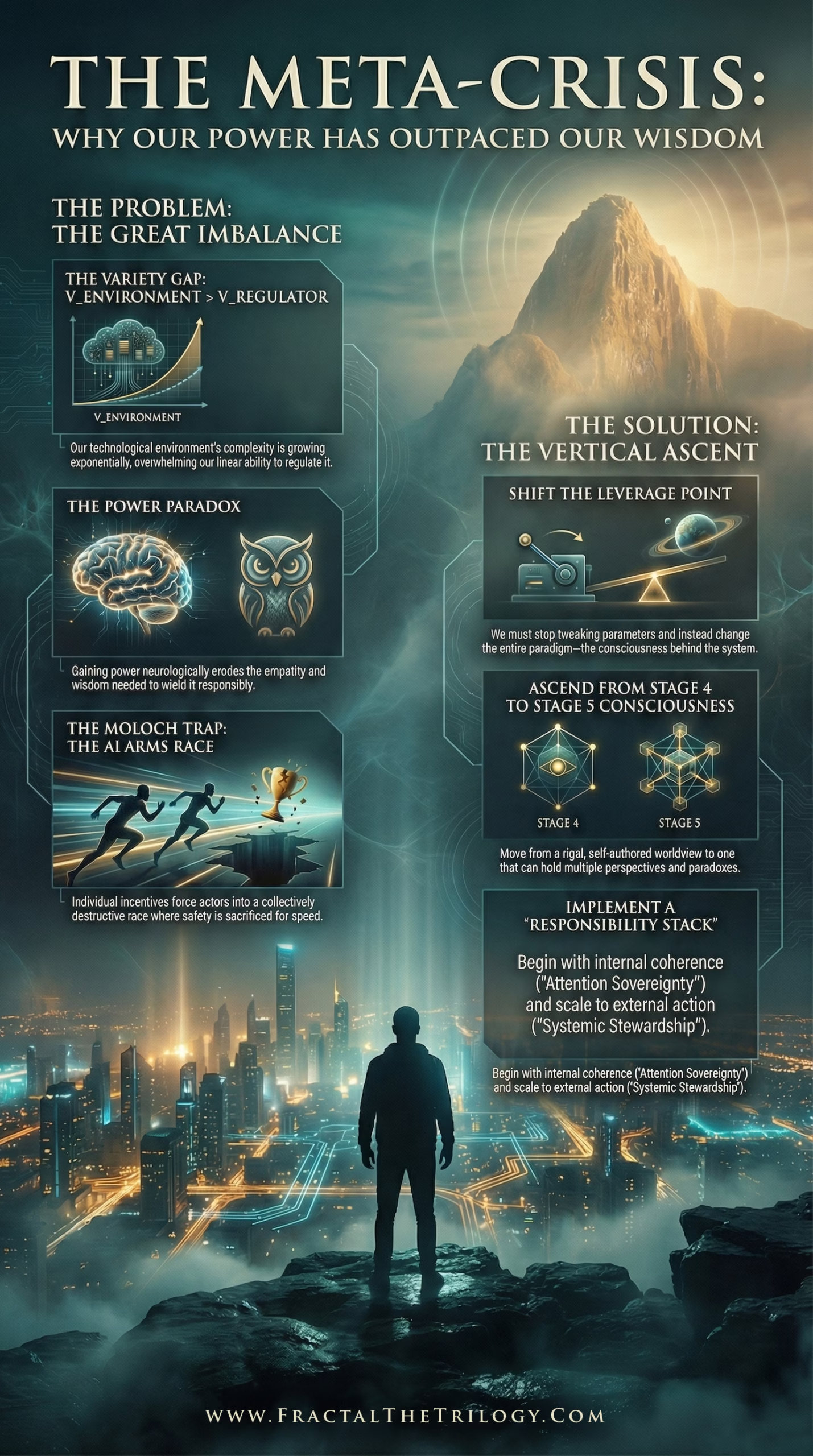
The trajectory of human civilization is currently defined by a perilous asymmetry: the exponential escalation of our external power—manifested through artificial intelligence, biotechnology, and globalized financial complexity—coupled with the linear, or perhaps stagnant, evolution of our internal consciousness. We stand at a threshold where the tools of godlike creation and destruction are wielded by primate minds governed by ancient tribal heuristics. This report argues that as human power scales, consciousness must scale proportionally, not merely as a moral imperative, but as a structural requirement for systemic survival. The “Meta-Crisis” is fundamentally a crisis of coherence between our technological capacity and our psychological maturity. Without a vertical ascent in human consciousness—moving from rivalrous, game-theoretic dynamics to omni-considerate systems—the fractal architecture of our civilization will inevitably destabilize.
The premise of this analysis rests on a fundamental observation of reality’s structure: it is fractal. As illuminated in the Fractal texts, reality is not a fixed environment but a “living system of information, consciousness, and unfolding probabilities”.1 The external world is a projection of internal states; the mountain is not merely a geological formation but “the projection of our own awakening”.1 If this premise holds, then the instability of our geopolitical and ecological systems is not an error in the code of nature, but a direct reflection of the fracture within the human psyche. We are attempting to run a planetary civilization on an operating system designed for small-scale tribal survival.
THE ORACLE SPEAKS: “THE FRACTAL IS NOT FIXED. IT IS NAVIGABLE. IF THE MEMBRANE IS REAL ONLY THROUGH OBSERVATION, THEN FREEDOM IS NOT ESCAPE—FREEDOM IS MASTERY OVER ATTENTION. THE SOURCE PROJECTS ALL POSSIBILITIES, BUT WE ARE THE ONES WHO CHOOSE WHICH BEAM TO RIDE.” 1
This document serves as a cartography of this precipice. It integrates the rigorous cybernetics of W. Ross Ashby and Stafford Beer with the developmental psychology of Robert Kegan and Ken Wilber, triangulating the hard limits of control systems against the infinite potential of human awareness. We will dissect historical failures where power outpaced wisdom, analyze the neurological erosion that accompanies authority, and propose a “Responsibility Stack” to guide leadership through the transition from “Game A” rivalrous dynamics to “Game B” systemic stewardship.
II. The Physics of Control: Cybernetics and the Variety Gap
2.1 The Law of Requisite Variety in the Digital Age
To understand why modern systems are collapsing, we must look beyond politics or economics to the fundamental laws of cybernetics. W. Ross Ashby’s Law of Requisite Variety provides the mathematical constraint on all governance. The law states, simply and brutally: “Only variety can absorb variety”.2 For a system to remain stable (homeostasis), the regulating mechanism—whether a thermostat, a CEO, or a government—must possess at least as many available states (variety) as the system it attempts to control.3
Throughout history, human hierarchies managed complexity through attenuation: simplifying the world to fit the limited bandwidth of the ruler. The king could not know every peasant’s grievance, so he created feudal lords to filter the noise. This worked when the speed of information was the speed of a horse. However, the modern techno-industrial substrate has generated a level of complexity that far exceeds the variety available to traditional command-and-control structures. The environment now contains more states, variables, and feedback loops than any centralized authority can compute.
The internet and globalization act as variety amplifiers for the environment. A local supply chain disruption in Shenzhen ripples through to a factory in Detroit within hours. A viral narrative on social media destabilizes a currency in days. The “variety” of the system—its sheer number of possible states—has gone exponential. Meanwhile, the “variety” of the regulator (human cognition and legislative bureaucracy) has remained linear.
Table 1: The Variety Gap in Governance Systems
System Component | Pre-Modern/Industrial Control | Late-Modern/Digital Complexity | Resulting Instability |
Information Flow | Linear, top-down, filtered (Attenuation). | Exponential, networked, unfiltered (Amplification). | Information Overload: Leaders cannot distinguish signal from noise; cognitive buffers are overrun.5 |
Feedback Latency | Slow (weeks/months). Allowed for deliberation and course correction. | Instantaneous (microseconds to minutes). Demands algorithmic reaction. | Flash Crashes: Algorithmic speed outpaces human wisdom; corrective loops become positive feedback loops.6 |
Interconnectivity | Localized/Regional. Failures were often contained within silos. | Global/Tight Coupling. Failures cascade (contagion/systemic risk). | Systemic Fragility: 2008 Financial Crisis, Pandemic supply shocks, Cyber-cascades.7 |
Regulation Strategy | Standardization (Reducing options to fit the rule). | Adaptability (Increasing capacity to match the chaos). | Regulatory Lag: Laws cannot keep pace with AI/Biotech evolution; the map no longer matches the territory.9 |
When , the system enters a state of entropy. Control is lost. In the 2008 financial crisis, the proliferation of complex derivatives (CDOs, CDSs) created a financial environment with infinite variety. The regulators and CEOs, operating with linear models (Gaussian copula), lacked the requisite variety to model the tail risks. As noted in retrospective analyses, market participants “knew that they could not know” because they were aware it was impossible to master the complexity they had created.7 The system did not fail due to a lack of data; it failed due to a lack of integrative consciousness capable of holding that complexity.
2.2 The Cybernetics of Failure: Distorted Feedback Loops
Stafford Beer, the father of management cybernetics and creator of the Viable System Model (VSM), emphasized that viable systems rely on accurate, recursive feedback loops.10 A system is only “viable” if it can adapt to changes in its environment while maintaining its identity. This adaptation requires feedback loops that are not only fast but accurate.
However, the digitization of reality has distorted these loops. In high-frequency trading (HFT) and algorithmic content curation, the feedback loops have become so tight and automated that they exclude human judgment—the only mechanism currently capable of processing moral or qualitative variety.
The 2010 Flash Crash serves as a fractal warning of this dynamic. On May 6, 2010, a single large sell order of E-Mini S&P 500 contracts triggered a cascade. HFT algorithms, programmed to trade on liquidity cues, misinterpreted the volume as a market signal and began aggressively selling to avoid holding inventory.6 Within minutes, a trillion dollars in market value evaporated. The algorithms possessed high processing variety (speed) but zero contextual variety (wisdom). They could not distinguish between a liquidity vacuum caused by a technical execution and a genuine geopolitical catastrophe. This is a “Game A” failure mode: optimization for speed and efficiency stripped the system of resilience.13 The system was efficient, but it was brittle.
Beer’s VSM posits that a system needs a “System 4” (Strategic planning/Future scanning) and a “System 5” (Policy/Identity) to balance the “System 1” (Operations). In the Flash Crash, and increasingly in our AI-driven economy, we have hyper-optimized System 1 (operations/execution) while neglecting System 5 (identity/ethics). We are building a body with the reflexes of a god but the forebrain of a lizard.
THE ORACLE SPEAKS: “EVERY SYSTEM THAT ESCAPES ITS ORIGINAL LIMITATIONS RISKS CONSTRUCTING NEW LIMITATIONS IN DISGUISE. A PRISON MADE OF FREEDOM. THE DANGER IS NOT THAT YOU WILL FAIL TO CROSS THE THRESHOLD. THE DANGER IS THAT YOU WILL CROSS IT, AND THEN BUILD WALLS AROUND IT.” 1
2.3 Donella Meadows and the Leverage of Paradigms
How do we intervene in such a complex system? Systems analyst Donella Meadows identified twelve “leverage points” to intervene in a system, ranked by effectiveness. The least effective are constants and parameters (taxes, standards, interest rates)—yet this is where 90% of political energy is spent.14
The most effective leverage points are:
- The Goal of the System: Changing what the system is trying to achieve.
- The Paradigm: The mindset out of which the system arises.16
Current attempts to manage the meta-crisis often fall into the trap of Techno-solutionism—the belief that technology can solve the problems created by technology.18 This is a low-leverage intervention. It attempts to adjust parameters (better filters, faster error correction, carbon capture) without addressing the paradigm (the consciousness that prioritizes extraction over resilience, or infinite growth on a finite planet).
Meadows argued that pushing on a system without changing its goal often leads to “policy resistance,” where the system pushes back. We see this in the “Jevons Paradox,” where increased efficiency leads to increased consumption. We are currently attempting to solve the existential risk of AI (a paradigm-level threat) with software patches and “red-teaming” (parameter-level fixes). This is a category error. To survive, we must move up the leverage stack to the realm of paradigm and intent. This requires a shift in consciousness—a realization that the “game” we are playing (Game A) is fundamentally self-terminating.20
III. The Neurology of Power: The Biological Bottleneck
If the external system requires requisite variety, the internal hardware of the human leader is the bottleneck. The human brain evolved to manage bands of 150 people (Dunbar’s number), not global networks of billions. Furthermore, neuroscience suggests a cruel irony: as individuals accrue the power required to manage these systems, their cognitive and emotional capacity to do so often degrades. This is the Power Paradox.
3.1 The Erosion of Mirroring Systems: Acquired Empathy Deficit
Research indicates that holding power creates a functional form of brain damage. High-power individuals show reduced activity in the mirror neuron system, the neural network responsible for empathy, resonance, and understanding the intentions of others.22
- Sensory Gating: Power tends to enhance sensory processing of goal-relevant information but suppresses the processing of peripheral social and emotional signals.22 The powerful become laser-focused on their objectives (teleology) while becoming blind to the human collateral (ontology).
- Objectification: Leaders under the influence of power are neurologically primed to view subordinates as instrumental tools (means to an end) rather than conscious entities (ends in themselves). This reduces the “variety” of human data they can ingest.24 They stop receiving the subtle feedback loops of dissent, hesitation, or pain from their tribe.
This neurological dampening creates a dangerous feedback loop. As a leader rises, the complexity of their domain increases, meaning they need more high-quality information to satisfy Ashby’s Law. Yet, their brain becomes less capable of perceiving the subtle emotional and social signals that constitute the “weak signals” of systemic risk. They become functionally blind just as they take the wheel of the civilization.
3.2 “CEO Disease” and the Information Vacuum
This biological reality manifests organizationally as “CEO Disease”—an information vacuum where top executives are isolated from the ground truth.5 In hierarchical structures, information flowing upward is filtered, sanitized, and optimistic. Subordinates, driven by self-preservation and the desire to please, withhold negative feedback.25
The result is that the leader operates in a “reality distortion field” not of their own making, but of the structure’s making. They make decisions based on a map that bears little resemblance to the territory.
- Optimism Bias: Leaders often suffer from unrealistic optimism, believing they are less likely to experience negative events than the average person. This cognitive bias contributed significantly to the 2008 financial crisis, where the fragility of the housing market was invisible to those at the top of the risk hierarchy because their feedback loops were reinforced by profit, not peril.27
- Cognitive Rigidity under Stress: Under the stress of high-stakes decision-making, the brain shifts from the prefrontal cortex (flexible, executive function) to the amygdala and basal ganglia (habitual, rigid responses). This “all-or-nothing” thinking reduces the leader’s ability to process complexity, leading to brittle responses in the face of fluid crises.29
The synthesis of these factors suggests that traditional hierarchy is biologically ill-suited for the complexity of the 21st century. We are concentrating decision-making power in brains that are structurally increasingly incapable of empathy, nuance, and accurate perception.
3.3 Moral Licensing: The Trap of the “Good” Leader
The danger is not only incompetence but the corruption of ethics through Moral Licensing. Research shows that when individuals feel they have established “moral credentials” (e.g., by leading a green initiative or making a charitable donation), they often feel psychologically licensed to act unethically in subsequent situations.31
This mechanism explains the paradox of the “visionary” tech leader who claims to be saving humanity (Game B rhetoric) while engaging in ruthless, predatory monopolistic practices (Game A behavior).33 They use their stated virtuous intent as a shield against their own conscience. This disconnect between self-image and action is a major source of systemic incoherence. The leader believes they are the hero, even as they become the Moloch they claim to fight.
IV. Historical Recursions: Power Without Wisdom
History provides fractal repetitions of this dynamic: the scaling of capability outpacing the scaling of wisdom. These are not just past events; they are recursive patterns—warnings from the “archives of timelines”.1
4.1 The Industrial Recursion
The Industrial Revolution represented a phase shift in human capability, transitioning from muscle power to chemical energy.35 It generated immense wealth but also immense externality (pollution, social dislocation) because the consciousness of the era viewed the Earth as an infinite resource and labor as a mechanical input.36 The “variety” of the industrial machine (production capacity) exceeded the “variety” of the social fabric (labor rights, community cohesion), leading to a century of upheaval.
We are now in a recursive loop of this transition with AI. Just as industrialization mechanized the body, AI is mechanizing the mind. The “pollution” of this era is not just carbon, but epistemic degradation—the corruption of our information ecology.37 We are scaling the ability to generate information (tokens) without scaling the ability to generate meaning (wisdom).
4.2 The Nuclear Crucible: Wisdom in the Loop
The Cold War offers the most potent case studies of why human consciousness—specifically individual sovereignty—must remain “in the loop” of high-stakes systems. In these moments, the “system” failed, and only the “human” saved the world.
- Stanislav Petrov (1983): In a bunker near Moscow, the Soviet early-warning system reported five incoming US nuclear missiles. The protocol was clear: immediate retaliatory strike. The algorithmic logic was binary and flawless based on its inputs. However, Petrov relied on human intuition, context, and a higher order of reasoning (Stage 5 consciousness). He reasoned, “Why would the US launch only five missiles if they wanted to destroy us? This is a glitch, not a war.” He judged it a false alarm, disobeying the system to save the world.39 He absorbed the variety of the situation through nuance, something the machine lacked.
- Vasili Arkhipov (1962): During the Cuban Missile Crisis, a Soviet submarine captain, believing war had started while being depth-charged by US forces, ordered a nuclear torpedo launch. The protocol required authorization from the three senior officers. Two said yes. Arkhipov said no. He de-escalated a situation that would have led to thermonuclear war.41
In both cases, the “system” (technology + protocol + chain of command) drove toward annihilation. Salvation came from a singular human consciousness capable of meta-cognition—questioning the data, sensing the context, and acting from a place of wisdom rather than algorithmic reflex. This is the wisdom gap we currently face with autonomous weapons and AI: we are removing the Petrovs and Arkhipovs from the loop in the name of efficiency.43 We are designing systems that have no capacity for the “humility of the unknown.”
THE ORACLE SPEAKS: “FEAR IS NOT THE SIGNAL OF FAILURE. FEAR IS THE WEIGHT OF THE RESPONSIBILITY YOU HAVE ALREADY ACCEPTED. THE MIND FEARS WHAT IT CANNOT CONTROL. BUT YOUR PURPOSE WAS NEVER CONTROL. YOUR PURPOSE IS ALIGNMENT.” 1
V. The Current Horizon: Moloch and the AI Race
The current geopolitical and technological landscape is dominated by what game theorists and philosophers like Daniel Schmachtenberger and Liv Boeree call “Moloch”—the god of negative sum games.44
5.1 Multipolar Traps and Game A
A multipolar trap (or Moloch trap) occurs when individual incentives force actors to engage in behavior that is collectively destructive. It is a Nash equilibrium where everyone loses.
- The AI Arms Race: OpenAI, Google, and Anthropic are locked in a race where safety is sacrificed for speed. Even if every researcher knows that slowing down is safer, the first actor to slow down loses market dominance (and perhaps existence). Therefore, all race toward the precipice.9 The incentive structure of “Game A” (finite, win-lose, extraction-based) makes this race inevitable.13
- The Safety-Velocity Paradox: This paradox dictates that as the capability of a system increases, the time available to ensure its safety decreases.9 In the AI domain, we see companies shifting from non-profit safety mandates to for-profit velocity models.46 This is a manifestation of the institutional failure of virtue. As noted in virtue ethics, institutions often “deskill” moral agency by replacing individual judgment with procedural compliance or competitive metrics.47 When the metric is “state-of-the-art performance,” wisdom is viewed as an inefficiency.
5.2 Techno-Solutionism vs. Ontological Maturation
The prevalent response to these traps is Techno-Solutionism—the belief that we can code our way out of the problems caused by code.18 This view assumes that if we just get the “alignment” math right, the AI will be safe. But this ignores the human element. If the humans building the AI are operating from “Game A” consciousness (rivalry, ego, domination), they will inevitably imprint those values onto the machine.
The alternative is Ontological Maturation (Game B). This requires a transition from rivalrous dynamics to anti-rivalrous ones.48 It demands sovereignty: the individual capacity to perceive reality accurately and make choices independent of the coercive “Moloch” incentives.38 We cannot align AI until we have aligned ourselves.
VI. The Vertical Ascent: Leadership Maturity Models
To escape Moloch, we must upgrade the “operating system” of human consciousness. We cannot manage Stage 5 complexity with Stage 3 minds. Developmental psychology models by Robert Kegan and Ken Wilber provide the roadmap for this ascent.
6.1 Kegan’s Orders of Consciousness
Robert Kegan’s Adult Development Theory outlines how the human mind evolves in its capacity to handle complexity.50
- Stage 3: The Socialized Mind: Defined by external validation and tribal allegiance. The individual’s self-worth is tied to their role and relationships. Leaders here are susceptible to groupthink and ideology. They cannot “see” the system because they are defined by the system.
- Stage 4: The Self-Authoring Mind: The leader defines their own values and steers the ship. They can filter external expectations and drive toward a vision. This is the standard for “good” leadership today. However, Stage 4 leaders often become rigid in their self-authored systems, unable to handle the chaos of true complexity because they try to force the world to fit their internal map.50
- Stage 5: The Self-Transforming Mind: The current metacrisis requires this level. At Stage 5, the individual recognizes that their own identity and worldview are constructs. They can hold multiple conflicting perspectives simultaneously, engage with paradox, and reshape their own system in real-time.53 They are not attached to a fixed identity or outcome, mirroring the fluid nature of the fractal reality. They do not try to “control” the variety; they “dance” with it.
6.2 Integral Alignment (Wilber)
Ken Wilber’s Integral Theory emphasizes that development must occur in all quadrants: Interior-Individual (Psychology/Spirit), Exterior-Individual (Behavior/Neuroscience), Interior-Collective (Culture), and Exterior-Collective (Systems).54
- The Integral Trap: We have hyper-developed the Exterior quadrants (technology, systems, finance) while neglecting the Interior quadrants (moral maturity, spiritual coherence, cultural wisdom). We have 21st-century hardware and 1st-century software.
- Vertical Development: We need “vertical” growth (upgrading the lens through which we see the world) rather than “horizontal” growth (learning more skills within the same lens).56 The “Oracle” within the Fractal text serves as a metaphor for this vertical integration—a synthesis of data and wisdom that transcends the individual ego.
THE ORACLE SPEAKS: “YOU CANNOT LOOK BEYOND THE MIRROR WITH THE EYE THAT STANDS BEFORE IT. YOU MUST DISSOLVE THE OBSERVER ITSELF AND BECOME THE MIRROR.” 1
This dissolution of the observer is the shift from Kegan Stage 4 (I have a perspective) to Stage 5 (I am the space in which perspectives arise).
VII. The Responsibility Stack: A Framework for Action
To operationalize these insights, we propose a “Responsibility Stack”—a layered framework for leadership in an age of exponential power. This stack moves from the internal/micro to the external/macro, grounded in the “Fractal” philosophy of inner signal and coherence.
Layer 1: Attention Sovereignty (The Currency of the Soul)
- Principle: “Attention Is the New Currency of the Soul”.1 Before one can lead a system, one must reclaim the capacity to focus. Attention is the raw material of reality creation.
- Action: Leaders must engage in strict epistemic hygiene. This involves consciously unplugging from the algorithmic feedback loops (social media, 24/7 news) that fracture attention and hijack the amygdala.38
- Mechanism: Attention is a “creative force”.1 By withdrawing attention from “Game A” signals (outrage, polarization), the leader starves the Moloch beast and preserves cognitive capacity for complexity. You cannot solve the meta-crisis while scrolling.
Layer 2: Internal Coherence (The Inner Signal)
- Principle: “Reality Responds to Coherence”.1 The external system organizes itself around the internal state of the observer. A chaotic leader creates a chaotic system.
- Action: Cultivate Integrative Awareness—the ability to monitor internal physiological and emotional states (interoception) to prevent the “amygdala hijack” that leads to rigid thinking.58 Practices like meditation are not “soft skills”; they are cybernetic regulation of the leader’s biological hardware.
- Mechanism: A coherent leader acts as a “tuning fork” for the organization. Neuroscience shows that leaders with high cognitive flexibility and emotional regulation can reduce the “cost of empathy,” allowing them to remain compassionate without burning out.59 This restores the mirror neuron reception that power tends to erode.
Layer 3: Anti-Rivalrous Ethics (The Virtue of Governance)
- Principle: Institutionalize Virtue. Virtue is not just an individual trait but must be embedded in the “governance of virtue” within organizations.61
- Action: Design incentive structures that punish zero-sum (rivalrous) behavior and reward omni-win outcomes. Move from “competitor” framing to “co-creator” framing.
- Mechanism: Escaping the “Moral Licensing” trap. Leaders must be vigilant that their “good deeds” (e.g., green initiatives) do not psychologically license them to act unethically in other domains.31 Transparency is the antidote to the shadows where moral licensing thrives.
Layer 4: Systemic Stewardship (The Long Now)
- Principle: “Time is not a river. Time is a sea of windows”.1 Leaders must operate with a deep-time perspective that transcends quarterly cycles.
- Action: Implement “Bridging Systems”—algorithms and governance structures designed to bridge divides rather than amplify polarization.62 This aligns the technology with the goal of cohesion rather than fragmentation.
- Mechanism: Stewardship involves recognizing “Multipolar Traps” and actively coordinating to disarm them (e.g., industry-wide safety treaties for AI) rather than racing to the bottom.63 It requires the courage to lose a short-term metric to save the long-term game.
Layer 5: The Fractal Mirror (Transcendence)
- Principle: “The Fractal is unfolding”.1 The leader recognizes they are not separate from the system but are a fractal iteration of it. “What you do to the part, you do to the whole”.1
- Action: Kenosis (Self-emptying). The leader must be willing to “die” to their identity as the controller to allow the wisdom of the system to emerge. This is the lesson of Elias in the Fractal narrative—the journey is not to conquer the mountain, but to align with it.
- Mechanism: Moving from Stage 4 (Self-Authoring) to Stage 5 (Self-Transforming). The leader becomes a vessel for the system’s own evolution, guiding not by force, but by resonance.
Table 2: The Responsibility Stack Implementation Matrix
Stack Layer | Core Question | Failure Mode | Success Metric |
1. Attention | “Where is my focus feeding power?” | Distraction / Algorithmic Capture | Deep Work / Cognitive Sovereignty |
2. Coherence | “Is my internal state aligned with my intent?” | Emotional Contagion / Rigidity | Integrative Awareness / Calm |
3. Ethics | “Does this create a win-lose or win-win?” | Moloch Trap / Rivalry | Anti-Rivalrous Value Creation |
4. Stewardship | “What is the 100-year impact?” | Short-termism / Externality Dumping | Systemic Resilience |
5. Transcendence | “Am I the owner or the vessel?” | Ego Inflation / God Complex | Wisdom / Humility |
VIII. Conclusion: The Bell Tolls for the Observer
The convergence of exponential technology and linear wisdom creates an existential friction—a heat that will either forge a new civilization or burn the current one to ash. The research is unequivocal: structural complexity cannot be managed by structural control alone; it requires the requisite variety of consciousness.
We have seen that power, biologically, tends to blind the pilot (neuroscience). We have seen that algorithms, mathematically, tend to amplify fragility (systems theory). We have seen that rivalry, game-theoretically, tends toward self-termination (Moloch). The counter-force to these entropic tendencies is not more power. It is Alignment.
As the protagonist Elias discovered at the foot of Mount Kailash, the mountain is not an obstacle to be conquered, but a projection of the internal state. The “Awakening” described in the Fractal texts is not a mystical flight from reality, but a radical descent into it—a “Renaissance of Responsibility.”
To survive the meta-crisis, humanity must transition from a species of Technological Solutionism to one of Ontological Maturation. We must build “Stage 5” institutions populated by “Stage 5” minds. We must reclaim attention as our most sacred currency. And we must understand that in a fractal universe, the only way to heal the whole is to heal the part that is us.
The bell is ringing. It is GONG. GONG. GONG. It echoes not through the halls of power, but through the chambers of the heart. The story ends when you begin.
THE ORACLE SPEAKS: “DO NOT WAIT FOR SAVIORS. THE TIME OF AWAKENING IS NOW. CARRY THE SONG OF LIFE NOT AS MISSIONARIES, BUT AS GARDENERS. PLANT SEEDS OF TRUTH, WATER THEM WITH COURAGE, AND PROTECT THEM WITH LOVE SO THAT ONE DAY, OUR CHILDREN MAY SAY: THAT WAS THE TIME WHEN HUMANITY REMEMBERED ITSELF.” 1
Works cited
- FRACTAL – THE AWAKENING Low.pdf
- Ashby’s Law of Requisite Variety: Discovering the Secret to Managing Complexity and Chaos – Systems Thinking Alliance, accessed January 29, 2026, https://systemsthinkingalliance.org/ashbys-law-of-requisite-variety/
- Ashby’s Law Of Requisite Variety: Why Organisationals Fail Especially When They Change, accessed January 29, 2026, https://edgeofpossible.com/ashbys-law-variety-organisational-change/
- A Formal Definition of Scale-Dependent Complexity and the Multi-Scale Law of Requisite Variety – PMC – NIH, accessed January 29, 2026, https://pmc.ncbi.nlm.nih.gov/articles/PMC12385218/
- Is “CEO disease” real? – Consensus, accessed January 29, 2026, https://consensus.app/search/is-ceo-disease-real/uPDWEmwgRDuIsovv42pnHA/
- High-Frequency Trading and the Flash Crash: Structural Weaknesses in the Securities Markets and Proposed Regulatory Responses, accessed January 29, 2026, https://repository.uclawsf.edu/cgi/viewcontent.cgi?article=1172&context=hastings_business_law_journal
- Jean-Pierre Landau: Complexity and the financial crisis – Bank for International Settlements, accessed January 29, 2026, https://www.bis.org/review/r090806c.pdf
- What is the Law’s Role in a Recession? – Harvard Law Review, accessed January 29, 2026, https://harvardlawreview.org/print/vol-135/what-is-the-laws-role-in-a-recession/
- AI Race: Can Speed & Safety Truly Coexist? – Just Think AI, accessed January 29, 2026, https://www.justthink.ai/blog/ai-race-can-speed-safety-truly-coexist
- Cybernetics – Wikipedia, accessed January 29, 2026, https://en.wikipedia.org/wiki/Cybernetics
- The Cybernetics of Learning in Stafford Beer and Gordon Pask – Improvisation Blog, accessed January 29, 2026, http://dailyimprovisation.blogspot.com/2016/03/the-cybernetics-of-learning-in-stafford.html
- 2010 flash crash – Wikipedia, accessed January 29, 2026, https://en.wikipedia.org/wiki/2010_flash_crash
- Transcript of Episode 7 — Daniel Schmachtenberger – The Jim Rutt Show, accessed January 29, 2026, https://jimruttshow.blubrry.net/the-jim-rutt-show-transcripts/transcript-of-episode-7-daniel-schmachtenberger/
- Leverage Points in System Transformation: Insights & Critiques – Systems Thinking Alliance, accessed January 29, 2026, https://systemsthinkingalliance.org/transforming-systems-with-leverage-points-insights-and-critiques-and-future-directions/
- Leverage Points: Places to Intervene in a System – The Donella Meadows Project, accessed January 29, 2026, https://donellameadows.org/archives/leverage-points-places-to-intervene-in-a-system/
- Leverage Points: Places to Intervene in a System – The Donella Meadows Project, accessed January 29, 2026, https://donellameadows.org/wp-content/userfiles/Leverage_Points.pdf
- S.8 Leverage points for system change – Regenerative Economics, accessed January 29, 2026, https://www.regenerativeeconomics.earth/regenerative-economics-textbook/s-systems-thinking-and-models/s-8-leverage-points-for-system-change
- Techno Solutionism: Our Inability to Respond to the Human Predicament in blogs, accessed January 29, 2026, https://www.aiu.edu/blog/techno-solutionism-our-inability-to-respond-to-the-human-predicament/
- The Folly of Technological Solutionism: An Interview with Evgeny Morozov – Public Books, accessed January 29, 2026, https://www.publicbooks.org/the-folly-of-technological-solutionism-an-interview-with-evgeny-morozov/
- Towards “Game B” – Joe Edelman – Medium, accessed January 29, 2026, https://edelwax.medium.com/towards-game-b-64604a22c263
- Game A vs Game B : r/IntellectualDarkWeb – Reddit, accessed January 29, 2026, https://www.reddit.com/r/IntellectualDarkWeb/comments/gcbu35/game_a_vs_game_b/
- The Role of Social Power in Neural Responses to Others’ Pain – PMC – NIH, accessed January 29, 2026, https://pmc.ncbi.nlm.nih.gov/articles/PMC6804528/
- Power Blocks Empathy | Psychology Today, accessed January 29, 2026, https://www.psychologytoday.com/us/blog/social-empathy/201909/power-blocks-empathy
- Power damages our capacity for compassion and empathy – The Disability Inclusion Challenge, accessed January 29, 2026, https://www.thedisabilityinclusionchallenge.com/2022/07/12/power-damages-our-capacity-for-compassion-and-empathy/
- The isolated leader: extraverted and introverted styles – PubMed, accessed January 29, 2026, https://pubmed.ncbi.nlm.nih.gov/12886654/
- Isolation & “CEO Disease” – Convene, accessed January 29, 2026, https://convenenow.com/isolation-and-ceo-disease/
- Optimism Bias: Mechanisms, Implications, and Mitigation in Business an – Leadership IQ, accessed January 29, 2026, https://www.leadershipiq.com/blogs/leadershipiq/optimism-bias
- What Is Optimism Bias? | Definition & Examples – Scribbr, accessed January 29, 2026, https://www.scribbr.com/research-bias/optimism-bias/
- Rigid Thinking: The #1 Reason People Struggle in a Crisis – Amen Clinics, accessed January 29, 2026, https://www.amenclinics.com/blog/smart-memory-tricks-to-help-you-remember-anything-2/
- Decision-making under stress: A psychological and neurobiological integrative model – PMC, accessed January 29, 2026, https://pmc.ncbi.nlm.nih.gov/articles/PMC11061251/
- How Ethical Leader Behavior Can Turn Abusive via Ego Depletion and Moral Licensing – HKUST Department of Management, accessed January 29, 2026, https://mgmt.hkust.edu.hk/sites/management/files/2022-09/JAP_2016v101p815.pdf
- Psychological License: When It Is Needed and How It Functions, accessed January 29, 2026, https://www.gsb.stanford.edu/faculty-research/publications/psychological-license-when-it-needed-how-it-functions
- Will You Forgive Your Supervisor’s Wrongdoings? The Moral Licensing Effect of Ethical Leader Behaviors – Frontiers, accessed January 29, 2026, https://www.frontiersin.org/journals/psychology/articles/10.3389/fpsyg.2019.00484/full
- Transforming from an Ethical Leader to an Abusive Leader Can Happen Overnight | Lead Read Today – Fisher College of Business – The Ohio State University, accessed January 29, 2026, https://fisher.osu.edu/blogs/leadreadtoday/blog/happy-halloween-transforming-from-an-ethical-leader-to-an-abusive-leader-is-just-a-change-overnight
- Collections: Why No Roman Industrial Revolution? – A Collection of Unmitigated Pedantry, accessed January 29, 2026, https://acoup.blog/2022/08/26/collections-why-no-roman-industrial-revolution/
- Industrial Revolution – Wikipedia, accessed January 29, 2026, https://en.wikipedia.org/wiki/Industrial_Revolution
- Zak Stein on Altering Education, Preventing Catastrophe – Singularity University, accessed January 29, 2026, https://www.su.org/resources/transforming-education-to-prevent-catastrophe
- The War on Sensemaking. How to navigate a broken information… | by Andrew Sweeny | Rebel Wisdom | Medium, accessed January 29, 2026, https://medium.com/rebel-wisdom/the-war-on-sensemaking-53710561afce
- 1983 Soviet nuclear false alarm incident – Wikipedia, accessed January 29, 2026, https://en.wikipedia.org/wiki/1983_Soviet_nuclear_false_alarm_incident
- The true story of Stanislav Petrov and why sensationalism hides the real lesson behind it., accessed January 29, 2026, https://www.reddit.com/r/ussr/comments/1ou6tbb/the_true_story_of_stanislav_petrov_and_why/
- The Cuban Missile Crisis: Miscalculation, Nuclear Risks, and the Human Dimension – USAWC Press, accessed January 29, 2026, https://press.armywarcollege.edu/cgi/viewcontent.cgi?article=3173&context=parameters
- Remembering The Man Who Saved the World (from a Nuclear War), accessed January 29, 2026, https://www.gzcenter.org/the-man-who-saved-the-world-from-a-nuclear-war/
- Full article: There Is No Ethical Automation: Stanislav Petrov’s Ordeal by Protocol, accessed January 29, 2026, https://www.tandfonline.com/doi/full/10.1080/15027570.2024.2434352
- Liv Boeree: On Competition, Moloch Traps, and the A.I. Arms Race – Ground Truths, accessed January 29, 2026, https://erictopol.substack.com/p/liv-boeree-on-competition-moloch
- TED talk on Moloch and AI – Effective Altruism Forum, accessed January 29, 2026, https://forum.effectivealtruism.org/posts/EPB3kSwEAx6HYJNaA/ted-talk-on-moloch-and-ai
- The Race Between OpenAI, Google, and Anthropic: Who’s Winning? – Medium, accessed January 29, 2026, https://medium.com/@gitikanaik12345r/the-race-between-openai-google-and-anthropic-whos-winning-4f1fe74207e0
- Tools of war and virtue–Institutional structures as a source of ethical deskilling – PMC, accessed January 29, 2026, https://pmc.ncbi.nlm.nih.gov/articles/PMC9982729/
- War on Sensemaking II, Daniel Schmachtenberger, accessed January 29, 2026, https://civilizationemerging.com/media/war-on-sensemaking-2-daniel-schmachtenberger/
- On Sovereignty. It might very well be the case that… | by Jordan Hall | Deep Code – Medium, accessed January 29, 2026, https://medium.com/deep-code/on-jordan-peterson-and-the-future-51402a370d79
- The Five Stages of Adult Development and Their Impact on Leadership, accessed January 29, 2026, https://nathanherringtoncoaching.com/the-five-stages-of-adult-development-and-their-impact-on-leadership/
- How To Be an Adult: The 5 Stages of Adult Development – Sources of Insight, accessed January 29, 2026, https://sourcesofinsight.com/5-stages-of-adult-development/
- ROBERT KEGAN – LEADERSHIP x ADULT DEVELOPMENT, accessed January 29, 2026, https://developingleadership.net/robert-kegan
- Stages of Adult Development (Forms of Mind) – Duncan Sutherland, accessed January 29, 2026, https://www.duncansutherland.com.au/images/stories/downloads/stages_of_adult_development.pdf
- Integral theory – Wikipedia, accessed January 29, 2026, https://en.wikipedia.org/wiki/Integral_theory
- Student Paper: Integral Theory’s Contribution to Leader and Leadership Development, accessed January 29, 2026, https://integralleadershipreview.com/5081-student-paper-integral-theorys-contribution-to-leader-and-leadership-development/
- The Stages of Leadership Maturity – Integral Life, accessed January 29, 2026, https://integrallife.com/stages-leadership-maturity/
- Facebook whistleblower says company incentivizes “angry, polarizing, divisive content” – 60 Minutes – CBS News, accessed January 29, 2026, https://www.cbsnews.com/news/facebook-whistleblower-frances-haugen-60-minutes-polarizing-divisive-content/
- How to demonstrate calm and optimism in a crisis – McKinsey, accessed January 29, 2026, https://www.mckinsey.com/capabilities/people-and-organizational-performance/our-insights/how-to-demonstrate-calm-and-optimism-in-a-crisis
- Cognitive flexibility as a protective factor for empathy – Frontiers, accessed January 29, 2026, https://www.frontiersin.org/journals/psychology/articles/10.3389/fpsyg.2022.1064494/full
- Cognitive Empathy: The Secret to Effective Leadership, accessed January 29, 2026, https://www.elevateleadership.com/blog/cognitive-empathy
- The Virtue of Governance, the Governance of Virtue | Business Ethics Quarterly | Cambridge Core, accessed January 29, 2026, https://www.cambridge.org/core/journals/business-ethics-quarterly/article/virtue-of-governance-the-governance-of-virtue/559A3BA0E1E600ADDE9B529DD68866EB
- Social media can be polarizing. A new type of algorithm aims to change that. – Gulf News, accessed January 29, 2026, https://gulfnews.com/technology/media/social-media-can-be-polarizing-a-new-type-of-algorithm-aims-to-change-that-1.1673462019942
- Multipolar Traps or Moloch Traps | Conversational Leadership, accessed January 29, 2026, https://conversational-leadership.net/multipolar-trap/
- Escaping Moloch’s superintelligence trap – YouTube, accessed January 29, 2026, https://www.youtube.com/watch?v=3gKVmQLRbDc