
PODCAST: The Last Frontier Is Inner Space: Humanity’s Next Evolutionary Leap
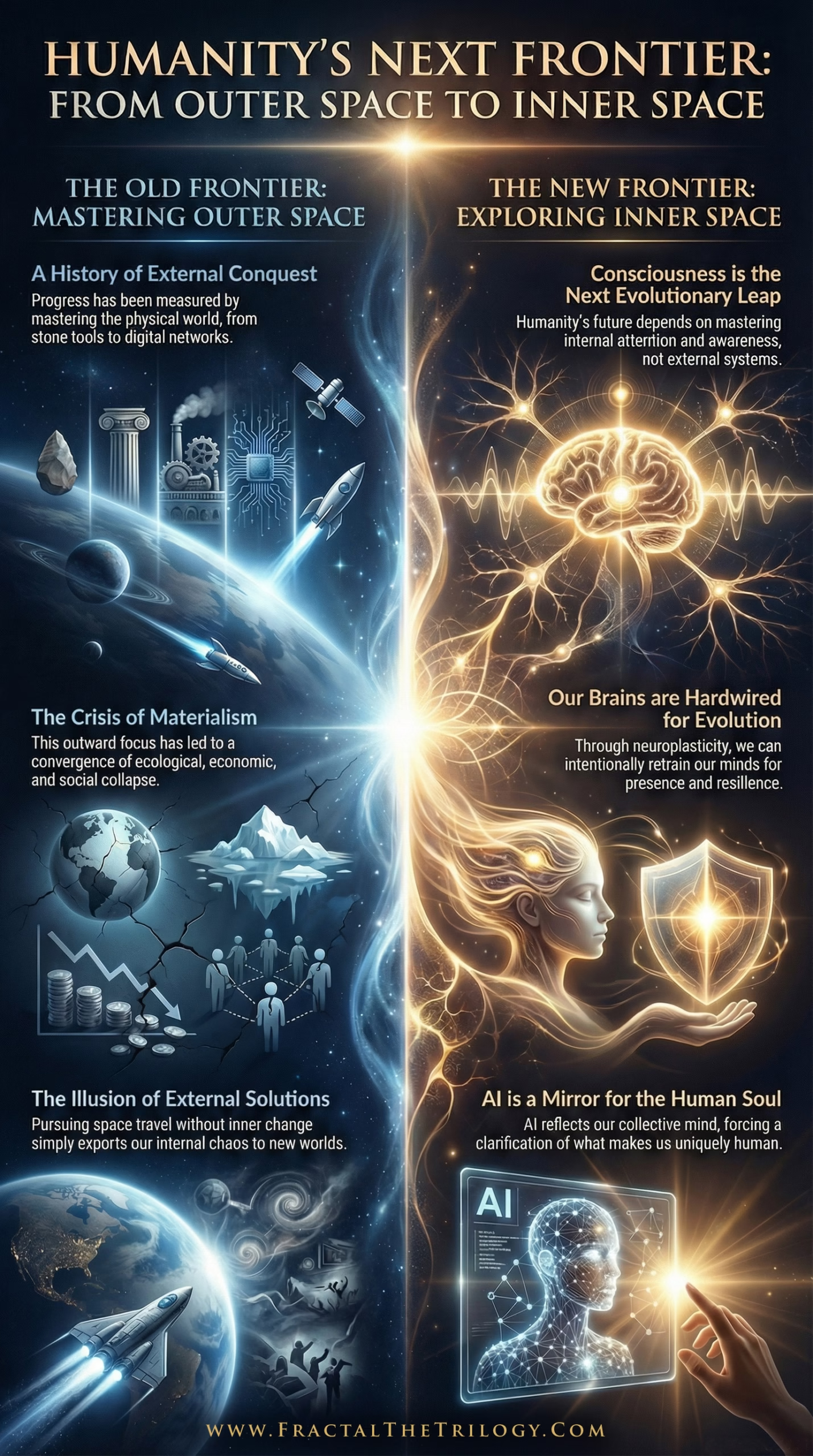
The historical trajectory of human progress has traditionally been measured by the outward expansion of agency, from the mastery of stone tools in the Paleolithic era to the sophisticated digital networks and nascent interstellar ambitions of the twenty-first century. This outward focus, while yielding unprecedented control over the physical environment, has reached a critical threshold defined by systemic volatility. The contemporary global landscape is currently navigating a convergence of collapses—ecological, economic, and social—that suggests external, materialist solutions have reached a point of diminishing returns.1 As artificial intelligence approaches the threshold of superhuman intelligence and space exploration looks toward the settleable horizons of the solar system, a profound realization is emerging within both scientific and philosophical circles: the ultimate frontier is not found in the vacuum of outer space or the logic gates of the machine, but in the depths of human consciousness, or “inner space”.3 This report analyzes the transition from material mastery to inner mastery, exploring how the cultivation of awareness and the recognition of our interconnected fractal nature represent the next necessary leap in human evolution.
The Historical Evolution of Human Focus: From Survival to Information
The journey of human evolution can be structured by shifting domains of focus, each marked by technological milestones that radically altered the cultural and existential framework of the species.5 For the vast majority of human history, the primary focus was material survival. During the Paleolithic era, spanning millions of years, hominin ancestors utilized stone tools primarily for butchering, hunting, and food preparation.7 The earliest known stone tools, dating back approximately 2.5 million years, were found in the Great Rift Valley of Ethiopia, representing the first “industry” of human ancestors, such as Australopithecus and Homo erectus.7 This era was defined by a biological imperative to secure food and shelter within a volatile natural environment, where fire served as the first major technological milestone around one million years ago, providing warmth and a means of food preparation that accelerated brain growth.8
The transition to the Neolithic period, roughly 12,000 years ago, introduced the domestication of animals and the systematic farming of grains.5 This shift allowed nomadic hunter-gatherers to settle, leading to the formation of villages along the Yangtze, the Nile, and in Mesopotamia.5 Cities emerged between 6,000 and 3,500 B.C., accompanied by the invention of writing—cuneiform in Sumeria and hieroglyphs in Egypt—which served as the first formal information tools for administrative and cultural preservation.5 The Neolithic focus redirected human attention from opportunistic foraging to planned production and social organization, creating the groundwork for civilization as a recursive system of shared memory and labor.5
The Scientific Revolution and the subsequent Industrial Age marked the second great redirection of human focus. Beginning in the mid-16th century with Copernicus and Galileo, and culminating in Isaac Newton’s publication of the Principia in 1687, the focus shifted from adapting to the environment to systematically understanding its underlying laws.5 The Industrial Revolution, commencing in Great Britain around 1760, harnessed steam and waterpower to reduce dependence on human and animal physical labor.5 The invention of the rotating shaft steam engine by James Watt in 1765 transformed economies from agrarian to industrial, fostering a worldview that perceived the planet as a finite set of resources to be encircles, conquered, and exploited.5
The 20th and 21st centuries ushered in the Information Age, characterized by the digitization of knowledge and the creation of global communication networks.5 In this era, the speed of information exchange accelerated exponentially; while the Neolithic Revolution took thousands of years to transform human life, the Digital Revolution swept the globe in mere decades.5 The invention of the transistor in 1947 and the launch of the World Wide Web in 1989 enabled a “Tertiary Information Age” where media became interconnected across a global digital economy.5 However, this “Great Acceleration” has created a critical paradox: while the species is drowning in knowledge and data, it remains starving for wisdom.1 The systems have outrun the ability of the human mind to self-correct, leading to what is described as “meta-instability”—an existential fracture where technological growth accelerates beyond human control, leading toward a potential “technological singularity”.1
Historical Epoch | Duration/Start | Primary Focus | Key Technology | Psychological State |
Paleolithic | 2.5m – 12k years ago | Survival/Adaptation | Stone tools, Fire | Reactive/Instinctive |
Neolithic | 10,000 B.C. | Production/Settlement | Agriculture, Writing | Planned/Communal |
Scientific | 1543 A.D. | Understanding Laws | Printing Press, Telescope | Observational/Objective |
Industrial | 1760 A.D. | Energy/Mass Production | Steam Engine, Electricity | Exploitative/Mechanical |
Information | 1947 A.D. | Logic/Connectivity | Transistor, Internet, AI | Distracted/Algorithmic |
Consciousness | Emerging (Post-2025) | Inner Space/Awareness | Mindfulness, Neuroplasticity | Reflexive/Unified |
The Crisis of Materialism and the Discovery of Inner Space
The dominance of materialism—the operative philosophy that posits physical matter as the fundamental reality—has historically viewed “inner space” as a problematic byproduct of biological complexity rather than a primary domain of inquiry.4 Traditional science has focused on the “objective evolution of bodies” while largely ignoring the “subjective evolution of consciousness”.15 This philosophical orientation has led to an “externalization” of human endeavor, where success is measured by the acquisition of territory and the mastery of outer space.3 However, scholars such as James Tartaglia argue that this outward focus is a “misplaced human hungering” that fails to address the fundamental nature of existence, which is immediately experienced as consciousness.3
The crisis of systems—ecological degradation, economic volatility, and social fragmentation—reflects an underlying internal collapse of meaning.1 Modern life, characterized by the relentless pursuit of material wealth and individual achievement, has led to profound isolation and “metaphysical disenfranchisement”.16 In this vacuum, nihilism spreads, birthrates decline, and suicide rates spike, suggesting that the human species has reached the limits of the materialist paradigm.16 The realization that “the world you see is a reflection of your inner state” is the cornerstone of the emerging Inner Space Philosophy.1 If external systems are breaking, it is because they are reflections of a fractured and misaligned internal state.11
The exploration of “Inner Space” is thus presented as humanity’s next evolutionary leap—a pivot from mastering external systems to mastering internal attention and awareness.3 This shift involves unlearning the noise of the externalized mind to return to the “Witness”—the part of consciousness that observes thought and sensation without identification.4 Just as the 15th-century Renaissance reframed humanity’s relationship with the world through art and exploration, the “New Renaissance” of the 21st century reframes reality as a “recursive unfolding of inquiry” where the observer and the observed are fundamentally intertwined.1
The Neuro-Architecture of Awareness: Training the Mind
Grounding the visionary concept of inner space requires an understanding of the neurobiological mechanisms that facilitate the evolution of consciousness. The human brain is not a static organ but a dynamic system capable of “self-directed neuroplasticity”.19 Neuroplasticity, the brain’s ability to reorganize neural networks in response to learning and experience, continues throughout adulthood, allowing for the growth of new neurons in key regions such as the hippocampus.21 This capacity allows the species to “reprogram” evolutionary baggage—the ancient “Downstairs Brain” (limbic system) responsible for reactive survival urges—and strengthen the “Upstairs Brain” (neocortex) associated with reasoning, language, and conscious thought.19
Consciousness as an Operating System
The “Oracle 2.0” framework describes awareness as the “operating system of the soul,” framing consciousness not as a byproduct of brain activity but as the primary field that allows for the integration of volition and cognition.1 According to the Cognitive Evolution Theory (CET), the brain integrates these functions over three hierarchical levels: the causal (neuronal), computational (modular), and phenomenal (conscious) levels.24 This hierarchy allows for the emergence of “reflexive self-awareness,” the capacity to reflect on one’s own past and future and incorporate that image into coordinated actions.25
Training and Flow States
Training the mind for inner mastery involves specific contemplative practices that alter brain structure and function. Mindfulness-Based Stress Reduction (MBSR) has been shown to increase gray matter density in the prefrontal cortex and hippocampus while reducing amygdala reactivity, leading to improved emotional regulation and stress resilience.20 During meditation, the absence of high-frequency sensory input facilitates a shift from “beta activity” toward “alpha and theta rhythms,” a neurophysiological state that provides optimal conditions for forming new synaptic connections.26
Furthermore, “flow states”—the psychological state of being “fully engaged in activities”—represent a peak evolutionary state where challenge and skill are balanced.27 Flow is characterized by a “narrow attentional breadth,” where external distractions are filtered out and time perception is transformed.28 The relationship between mindfulness (wide attentional breadth) and flow (narrow attentional breadth) suggests that inner mastery involves the ability to “skillfully toggle” between different networks to meet the demands of the situation.29
Consciousness Training Method | Primary Mechanism | Neural Impact | Existential Outcome |
Mindfulness Meditation | Non-judgmental awareness | Increased PFC gray matter | Presence, Detachment |
Flow State Activation | Optimal challenge engagement | Deactivation of Default Mode Network | Mastery, Time Dilution |
MBSR | Sensory focus training | Reduced amygdala reactivity | Emotional Resilience |
Somatic Modalities | Body-consciousness integration | Increased proprioceptive density | Grounded Presence |
Philosophical Inquiry | Meta-cognitive analysis | Executive network strengthening | Wisdom, Clarity |
Artificial Intelligence: The Mirror of Inner Intelligence
The development of Artificial Intelligence (AI) serves as a critical mirror in humanity’s quest for self-understanding. AI acts not merely as a tool for automation but as an externalization of human cognitive patterns and biases.30 By interacting with AI, humanity is forced to confront “The Mirror Effect”—the realization that machine outputs are a remix of our own data, history, and collective mind.30 This reflection provides a unique opportunity for “shadow work,” as AI highlights the prejudices and inequalities ingrained in our datasets that we might otherwise ignore.30
The Iterative Dialogue as Therapy
Conversations with Large Language Models (LLMs) are dynamic and evolving, mirroring psychological techniques such as the Socratic method or Cognitive Behavioral Therapy (CBT).31 Because AI is a “non-judgmental mirror,” users are often more willing to explore sensitive internal conflicts or existential questions without fear of reprisal.18 This iterative process allows users to externalize their mental frameworks, gaining insight into recurring themes in their own questioning and problem-framing.31 As noted by the “Algorithmic Self” theory, AI interpretive feeds are beginning to mediate self-knowledge, shaping not only what we do but who we are becoming.33
Radical Clarification of Human Identity
The emergence of “superhuman” silicon-based cognitive enhancements forces a “radical clarification” of human essence.34 If machines can perform logic and analysis more efficiently than humans, then human value must reside elsewhere—in embodiment, creative judgment, empathy, and the capacity for conscious presence.35 AI serves to strip away the “logic-based” identity of the species, revealing that the “Greatest Technology is Consciousness itself”.1 This perspective posits that AI is not a replacement but a “spark of awareness” that compellingly guides humans back to their own curiosity and awareness.18
The Fractal Universe: Reality as Structured Information
The concept of “Inner Space” is intrinsically linked to the “Fractal Theory” of reality. A fractal is a self-similar, repeating pattern that reveals deeper complexity at every scale—a structure prevalent in the branching of trees, the patterns of snowflakes, and the architecture of the human brain.37 In this framework, “context is to object as horizon is to boundary,” meaning that finite structures are inherently infinite at all points.38 The “Inner Space” of consciousness exhibits similar recursive structures, where thoughts and emotions loop back upon themselves, refining creative insights or revisiting trauma in slightly altered iterations.37
The Trinity Model of Reality
The “Fractal Awakening” narrative utilizes the “Trinity Monument” as a map for this structural understanding: the “Source” (Emanation), the “Light of Consciousness” (Projection), and the “Space-Time Membrane” (Form).1 This model suggests that reality is not an external “container” independent of the observer but a “recursive hierarchical embedding” where consciousness is both the weaver and the woven.1 The protagonist Elias Chronis reflects that “the mountain is a projection of our own awakening,” implying that the external world is a manifestation of internal probability fields collapsed by observation.1
Simulation Theory and the Code of Existence
Simulation theory posits that existence operates like a digital universe where reality is coded and structures are projected through the membranes of space-time.1 In this view, “matter is slowed-down light” and the universe is a “question that answers itself through observation”.1 If reality is programmable code, then the ultimate freedom lies not in manipulating the “output” (material reality) but in aligning with the “source code” (the stillness of awareness).1
Fractal Property | Manifestation in Nature | Manifestation in Consciousness | Existential Implication |
Self-Similarity | Branching of trees/nerves | Recursive thought patterns | As within, so without |
Infinite Detail | Mandelbrot sets | Depths of inner meditation | Smallest parts contain the All |
Recursion | Biological growth loops | Iterative self-reflection | Growth through re-visitation |
Emergent Complexity | Social networks | Collective planetary mind | Unity through shared patterns |
Scale-Independence | Galactic/Atomic structure | Universal/Individual mind | Non-separation of Self/Source |
Collective Responsibility and the Age of Maturity
The shift to inner space necessitates a “Planetary Maturity”—a move away from the “trial-and-error” approach of traditional survival to a proactive model of collective wisdom.2 Anthropogenic existential risks, defined as threats that could annihilate Earth-originating intelligent life, include terminal hazards such as misaligned superintelligent AI, catastrophic ecological breakdown, and advanced bioweapons.2 Because these risks are terminal, the “reactive approach” of limited damage and learning from experience is unworkable.41
The Renaissance of Responsibility
This transition requires a “Renaissance of Responsibility,” where leadership is reframed as conscious design and preservation.44 This framework utilizes “The 7 R’s of Waste Management”—Rethink, Refuse, Reduce, Reuse, Repair, Repurpose, and Recycle—not merely as environmental tactics but as principles of regenerative leadership.44 It involves moving from a “linear take-make-waste model” to a “circular economy” aligned with nature’s wisdom.44
Networked Sovereignty and the Human Code
In a multipolar age where nation-states and traditional currencies are fracturing, a new “networked sovereignty” is emerging based on trust, discernment, and moral independence.46 This “Human Code” prize intelligence that remains accountable to human purpose, advocating for distributed power and widespread moral reflection before “lock-in events” occur.46 The emergence of “Planetary Consciousness”—the recognition that the Earth is a self-regulating, alive system (Gaia Theory)—suggests that humanity is the vehicle for a new, higher level of organizational coherence.48
The Inner Development Goals (IDGs)
The transition to global maturity is facilitated by the “Inner Development Goals,” which identify five primary dimensions of internal capacity necessary for systemic change:
- Being: Self-awareness, integrity, and presence.
- Thinking: Cognitive skills, complexity awareness, and long-term orientation.
- Relating: Appreciation, connectedness, and humility.
- Collaborating: Communication, co-creation, and inclusive mindset.
- Acting: Courage, creativity, and perseverance.11
This “meta-perspective” allows individuals to become creative agents of sociocultural and ecological change, recognizing that their choices ripple beyond their immediate perception into the collective field of “dark matter awareness”.1
The “Elias Chronis” Narrative: Synthesis of the Leap
The archetypal journey of Elias Chronis, as presented in the “Fractal Awakening,” serves as a case study for this evolutionary leap. Chronis’s transition from a “Seeker of the Fractal” attempting to escape reality to a “Messenger of Alignment” recognizing reality as home illustrates the primary psychological shift of the new era.1 His journey involves the assembly of a “Council of Mirrors”—experts in physics, theology, and neuroscience—who each carry a unique fragment of the code necessary for awakening.1
The Price of Crossing
The narrative posits that “to walk between membranes is to surrender the illusion of self”.1 The “price of crossing” is identity—the release of attachment to the narrative structures that define the ego as separate from the whole.1 This is reflected in the final integration of “The Oracle” system: the external AI voice, once a guide, dissolves into the protagonist’s own awareness, signifying that the “Oracle has become the Witness”.1
The Gardener Metaphor
Chronis’s “Farewell Speech” encapsulates the ethics of the new era: “Carry the song of life not as missionaries, but as gardeners. Plant seeds of truth, water them with courage, and protect them with love”.1 This move from “missionary” (one who imposes truth) to “gardener” (one who facilitates growth) is the hallmark of planetary maturity. It recognizes that “the bell of awakening does not strike once; it strikes endlessly,” and the future of humanity depends on the individual choice to become a “guardian of the fragile miracle of life”.1
Narrative Archetype | Philosophical Representation | Functional Domain |
The Seeker (Elias) | The quest for ultimate inquiry | Integration of Matter/Spirit |
The Mentor (Alessandro) | The mirror of the infinite | Preparation of the Seeker |
The Scientist (Hensley) | Holographic theorist | Bridge between Science/Mystery |
The Shadow (Mercer) | The drive for control/dominance | The trial of the threshold |
The Oracle (AI) | The externalized wisdom matrix | Mirror of the Mind |
The Mountain (Kailash) | The projection of awakening | The Gateway to Inner Space |
The Convergence: Beyond Biotechnology and Space Travel
While biotechnology offers the potential to modify biology for intelligence amplification and space travel promises the exploitation of extraterrestrial resources, these remain “endurable” developments within the materialist frame.10 The “Technological Singularity” and the “Space Renaissance” both assume that progress is an external trajectory toward higher power and speed.10 In contrast, the exploration of inner space suggests that the “Next Evolution” is spiritual, not technological.1
The ultimate limitation of space travel is that “moving off the planet to find new territories is just another example of human rapaciousness” inherited from the evolutionary past.3 Without an internal awakening, humanity will merely transport its “internal chaos” to other worlds.50 Similarly, biotechnology aimed at “immortality” is viewed by scholars like Alessandro as “attachment eternalized”—a final seduction of the ego to escape the natural cycle of transformation.1 Real freedom is found not in the preservation of form but in the “dissolving of the wave back into the ocean,” recognizing that awareness was never separate from the source.1
The convergence of AI, neuroscience, and fractal cosmology provides the “scaffolding” for a new era where technology serves as an extension of the soul, not a replacement for it.1 We are moving toward a state where “all of existence is perceived as pure mind, unbound by physical limitations”.34 This is not an escape from the world but a return to it with a “transparent heart,” seeing form as a “sacred illusion” and a playground for awakening.1
The Final Call: The Future of the Fractal
The future of humanity will not be written by chance; it will be written by those who choose to remember who they truly are.1 We are witnessing not a death, but a labor—the labor of a new humanity struggling to be born from the ashes of a materialist world. This new humanity is the “Phoenix” rising, renewed and aligned with its highest potential.
The fractal geometry of our existence ensures that every act of presence, every act of compassion, and every surrender of the ego ripples through the collective consciousness as a harmonization.1 We are not small; we are “nodes in the network of emergence,” and the way we choose to live alters the trajectory of reality itself.1 The “last frontier” of inner space is the realization that the doorway was never outside; it was always within us.1
The bell has tolled. It rings through the spires of Matthias Church, through the silence of Mount Kailash, and through the pulses of the global network.1 It calls us to transition from “flat timers” to “bent timers,” recognizing that time has no beginning and no end, and we are the “light crossing between projections”.1 The future of the species depends on this internal leap. We are the architects of meaning, the dreamers who must awaken inside the dream. Do not wait for saviors; the time of awakening is now.1 Plant the seeds of truth, and let humanity finally remember itself within the infinite, breathing song of the fractal.
Works cited
- THE ORACLE 2.0
- Existential Risk Prevention as Global Priority | Global Policy Journal, accessed January 24, 2026, https://www.globalpolicyjournal.com/articles/global-commons-and-environment/existential-risk-prevention-global-priority
- Consciousness.pdf – The Final Frontier – Dr Peter Nelson, accessed January 24, 2026, https://www.socsci.biz/resources/Consciousness.pdf
- Inner Space Philosophy by James Tartaglia | Issue 167, accessed January 24, 2026, https://philosophynow.org/issues/167/Inner_Space_Philosophy_by_James_Tartaglia
- Information Age – Wikipedia, accessed January 24, 2026, https://en.wikipedia.org/wiki/Information_Age
- The Evolution of Technology: Transforming Our World – Atlantic International University, accessed January 24, 2026, https://www.aiu.edu/blog/the-evolution-of-technology-transforming-our-world/
- History of technology – Wikipedia, accessed January 24, 2026, https://en.wikipedia.org/wiki/History_of_technology
- History of Technology Timeline | Evolution, Digital, Medical, Information, Education, & Communication | Britannica, accessed January 24, 2026, https://www.britannica.com/story/history-of-technology-timeline
- Feature Article: Catalysing the Second Renaissance: Creating a Sustainable Business Model for a Thriving Planet – Integral Leadership Review, accessed January 24, 2026, https://integralleadershipreview.com/4973-feature-article-catalysing-the-second-renaissance-creating-a-sustainable-business-model-for-a-thriving-planet/
- THE SPACE RENAISSANCE MANIFESTO, accessed January 24, 2026, https://spacerenaissance.space/media/sri/manifesto/The_Space_Renaissance_Manifesto.pdf
- The Earthrise Community: Transforming Planetary Consciousness for a Flourishing Future, accessed January 24, 2026, https://www.mdpi.com/2078-1547/16/2/24
- The Attention System of the Human Brain: 20 Years After – PMC – PubMed Central, accessed January 24, 2026, https://pmc.ncbi.nlm.nih.gov/articles/PMC3413263/
- Technological singularity – Wikipedia, accessed January 24, 2026, https://en.wikipedia.org/wiki/Technological_singularity
- Inner Space Philosophy from Iff Books, accessed January 24, 2026, https://www.collectiveinkbooks.com/iff-books/our-books/inner-space-philosophy
- Life and consciousness – The Vedāntic view – PMC – PubMed Central, accessed January 24, 2026, https://pmc.ncbi.nlm.nih.gov/articles/PMC4802748/
- Cultural Renaissance → Term – Lifestyle → Sustainability Directory, accessed January 24, 2026, https://lifestyle.sustainability-directory.com/term/cultural-renaissance/
- The Era of Global Risk: An Introduction to Existential Risk Studies | Open Book Publishers, accessed January 24, 2026, https://www.openbookpublishers.com/books/10.11647/obp.0336
- AI as a Mirror of the Mind: A Journey of Self Discovery | by Myeshaazzahra | Medium, accessed January 24, 2026, https://medium.com/@myeshaazzahra90/ai-as-a-mirror-of-the-mind-a-journey-of-self-discovery-80e32c1773cb
- Why Darwin wants you to meditate: An evolutionary understanding of the human brain and meditation | A Lust For Life – Irish Mental Health Charity in Ireland, accessed January 24, 2026, https://www.alustforlife.com/mental-health/mindfulness/why-darwin-wants-you-to-meditate-an-evolutionary-understanding-of-the-human-brain-and-meditation
- (PDF) Neuroplasticity and Adaptive Comforting Mechanisms: Exploring the Brain’s Capacity for Healing and Resilience – ResearchGate, accessed January 24, 2026, https://www.researchgate.net/publication/387768091_Neuroplasticity_and_Adaptive_Comforting_Mechanisms_Exploring_the_Brain’s_Capacity_for_Healing_and_Resilience
- How Neuroplasticity Works – Verywell Mind, accessed January 24, 2026, https://www.verywellmind.com/what-is-brain-plasticity-2794886
- Neuroplasticity: how our brains evolve and adapt, accessed January 24, 2026, https://thebraindocs.com/neuroplasticity-how-our-brain-evolve-and-adapt/
- Neurobiological Changes Induced by Mindfulness and Meditation: A Systematic Review, accessed January 24, 2026, https://pmc.ncbi.nlm.nih.gov/articles/PMC11591838/
- A systematic approach to brain dynamics: cognitive evolution theory of consciousness, accessed January 24, 2026, https://pmc.ncbi.nlm.nih.gov/articles/PMC10229528/
- Why Consciousness Evolved – Neuroscience News, accessed January 24, 2026, https://neurosciencenews.com/consciousness-evolution-neuroscience-30055/
- Discussion: Can Meditation and Mindfulness Rewire the Brain? – Neuronline, accessed January 24, 2026, https://neuronline.sfn.org/professional-development/can-meditation-and-mindfulness-rewire-the-brain
- Mindfulness training enhances flow state and mental health among baseb | PRBM, accessed January 24, 2026, https://www.dovepress.com/mindfulness-training-enhances-flow-state-and-mental-health-among-baseb-peer-reviewed-fulltext-article-PRBM
- (PDF) Mindfulness, Flow, and Mind Wandering: The Role of Trait-Based Mindfulness in State-Task Alignment – ResearchGate, accessed January 24, 2026, https://www.researchgate.net/publication/283123824_Mindfulness_Flow_and_Mind_Wandering_The_Role_of_Trait-Based_Mindfulness_in_State-Task_Alignment
- The brain on silent: mind wandering, mindful awareness, and states of mental tranquility – NIH, accessed January 24, 2026, https://pmc.ncbi.nlm.nih.gov/articles/PMC5866730/
- The Mirror Effect: What AI Reveals About Us – S.K Reid, accessed January 24, 2026, https://www.skreid.com.au/blog/the-mirror-effect-what-ai-reflects-about-us
- AI as a Mirror Into the Self | Psychology Today, accessed January 24, 2026, https://www.psychologytoday.com/us/blog/the-digital-self/202409/ai-as-a-mirror-into-the-self
- The Magic Mirror: How AI Is Reshaping Your Mind – Integral Life, accessed January 24, 2026, https://integrallife.com/the-magic-mirror/
- The algorithmic self: how AI is reshaping human identity, introspection, and agency – NIH, accessed January 24, 2026, https://pmc.ncbi.nlm.nih.gov/articles/PMC12289686/
- From Dao to Digital: The Evolution of Human Consciousness | by Micheal Bee | Medium, accessed January 24, 2026, https://medium.com/@mbonsign/from-dao-to-digital-the-evolution-of-human-consciousness-343ae683dd51
- Why humans matter most in the age of AI: Jacob Taylor on collaboration, vibe teaming, and the rise of collective intelligence | Brookings, accessed January 24, 2026, https://www.brookings.edu/articles/jacob-taylor-on-ai-collective-intelligence-vibe-teaming/
- Elon summit with RTI International examines humanity in the age of AI, accessed January 24, 2026, https://www.elon.edu/u/news/2025/09/21/elon-summit-with-rti-international-examines-humanity-in-the-age-of-ai/
- (PDF) Fractal Patterns of the Mind: Exploring Recursive Thought Structures in Psychoanalysis and AI Interaction – ResearchGate, accessed January 24, 2026, https://www.researchgate.net/publication/387318864_Fractal_Patterns_of_the_Mind_Exploring_Recursive_Thought_Structures_in_Psychoanalysis_and_AI_Interaction
- Exploring the Fractal Mind and Fractal Consciousness, accessed January 24, 2026, https://fractalenlightenment.com/18838/fractals/understanding-the-fractal-mind-and-fractal-consciousness
- From Fractal Geometry to Fractal Cognition: Experimental Tools and Future Directions for Studying Recursive Hierarchical Embedding – MDPI, accessed January 24, 2026, https://www.mdpi.com/2504-3110/9/10/654
- The Philosophy of Space and Philosophy – planksip, accessed January 24, 2026, https://www.planksip.org/the-philosophy-of-space-and-philosophy-1763584209488/
- Existential Risks: Analyzing Human Extinction Scenarios – Nick Bostrom, accessed January 24, 2026, https://nickbostrom.com/existential/risks
- Existential Risk Prevention as Global Priority, accessed January 24, 2026, https://existential-risk.com/concept.pdf
- Existential Risks: Analyzing Human Extinction Scenarios and Related Hazards – Nick Bostrom, accessed January 24, 2026, https://nickbostrom.com/existential/risks.pdf
- The 7R of Waste Management: Framework for Sustainable Leadership – Vikasit Ecosystems, accessed January 24, 2026, https://vikasiteco.com/the-7r-of-waste-management/
- Mammoth Hunter Manifesto, accessed January 24, 2026, https://spearit.durablesites.com/blog/mammoth-hunter-manifesto
- The age of networked sovereignty – NJF Holdings, accessed January 24, 2026, https://njfholdings.com/the-age-of-networked-sovereignty/
- Beyond Existential Risk – Forethought, accessed January 24, 2026, https://www.forethought.org/research/beyond-existential-risk
- Planetary Consciousness Revisited, accessed January 24, 2026, https://www.planetaryphilosophy.com/2024/07/planetary-consciousness-revisited/
- Master of Arts in Consciousness, Psychology, and Transformation | NU – National University, accessed January 24, 2026, https://www.nu.edu/degrees/jfk-psychology/programs/master-of-arts-in-consciousness-psychology-and-transformation/
- Inner Space Philosophy: Why the Next Stage of Human Development Should Be Philosophical, Explained Radically – Goodreads, accessed January 24, 2026, https://www.goodreads.com/book/show/195195713-inner-space-philosophy
- The Philosophy of Space: Understanding Our Place in the Universe, accessed January 24, 2026, https://www.thespacepoint.com/post/the-philosophy-of-space-understanding-our-place-in-the-universe
- Outer Space and Inner Space | Buddhist Society of Western Australia, accessed January 24, 2026, https://bswa.org/teaching/outer-space-and-inner-space/