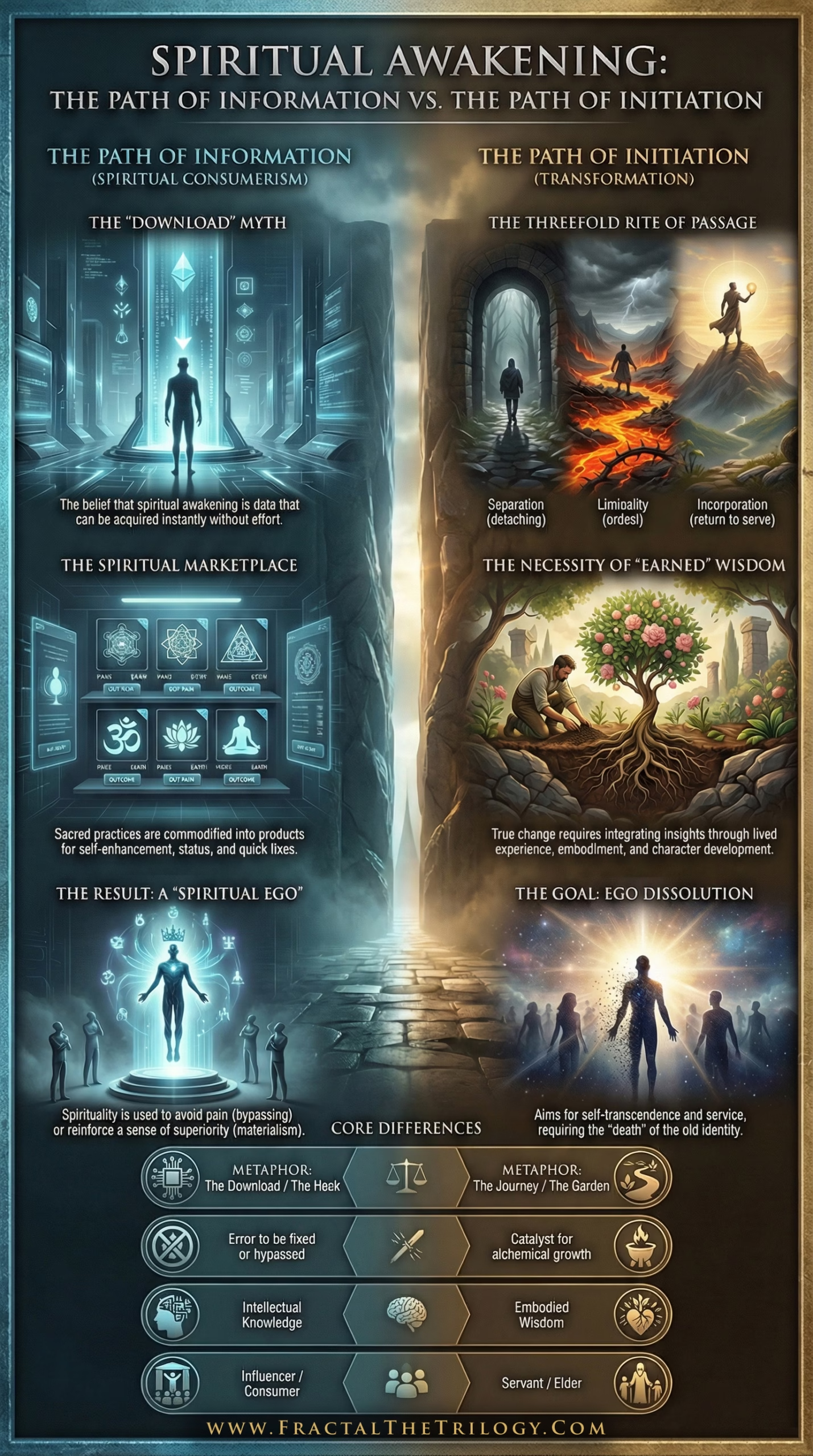

PODCAST: Initiation vs Information: Why Awakening Cannot Be Downloaded
1. Introduction: The Ontology of the Download
1.1 The Paradox of Access and Atrophy
We inhabit a historical moment characterized by a profound and disorienting paradox: the democratization of esoteric knowledge coexists with a palpable atrophy of spiritual depth. In the digital age, the barriers to entry for ancient wisdom traditions have been obliterated. A teenager in a suburban bedroom can, within seconds, access the translated texts of the Nag Hammadi library, the intricate diagrams of the Kabbalistic Tree of Life, the meditative instructions of Dzogchen, or the neuroscientific underpinnings of altered states of consciousness. The “secret” teachings that once required a perilous journey across the Himalayas or years of servitude in a monastery are now available as PDFs, podcasts, and streaming video courses. Yet, despite this deluge of information, the markers of genuine transformation—psychological resilience, ethical coherence, and community cohesion—appear to be fraying.1
This discrepancy reveals a fundamental category error in the modern conception of human development: the conflation of knowing about a thing with becoming that thing. We have imported the computational metaphor of the “download” into the domain of the soul.3 The “download” implies a frictionless transfer of data from an external source to an internal drive, a process that requires bandwidth but not effort, storage space but not structural reorganization. When applied to spirituality, this metaphor suggests that enlightenment is a packet of information—a “secret code” or a “frequency”—that can be acquired, installed, and executed without the messy, biological necessity of metabolism.4
However, the anthropological and psychological record suggests that true awakening is not an additive process of accumulating data, but a subtractive process of dismantling illusion—a process that is inherently traumatic to the ego and requires a total immersion of the organism in the crucible of experience. As articulated in the The Oracle 2.0, “The Mind Learns, But Consciousness Remembers”.5 This distinction is critical: learning is horizontal, an expansion of the library of the intellect; remembrance is vertical, a deepening of the roots of being into the substrate of reality. This report argues that the “download” is a myth of the information age, a consumerist fantasy that seeks to bypass the necessary ordeal of initiation.
1.2 The Crisis of Meaning and the Rise of the Spiritual Marketplace
The collapse of traditional religious metanarratives has left a vacuum of meaning in the West, a “homelessness” of the soul that late-stage capitalism has rushed to fill.6 In the absence of established rites of passage, the market offers “lifestyle spirituality,” a commodified simulation of the sacred that promises the fruits of discipline without the discipline itself.7 We see the rise of “spiritual consumerism,” where the seeker behaves as a shopper, browsing the shelves of the world’s wisdom traditions for aesthetic accessories to adorn the ego rather than tools to dismantle it.9
This report, drawing upon a synthesis of transpersonal psychology, anthropology, and the narrative framework of Fractal – The Trilogy, offers a critical analysis of this phenomenon. It posits that the “download” mentality creates a fragility in the modern psyche, leading to “spiritual bypassing”—the use of metaphysical ideas to avoid unresolved emotional pain—and “spiritual materialism,” the co-optation of spirituality to bolster the ego.10 By contrasting the transactional nature of the marketplace with the transformational nature of the initiation rite, we illuminate why awareness cannot be purchased or installed, but must be “earned” through the lived encounter with the Shadow, the Threshold, and the Silence.
2. The Anatomy of Spiritual Consumerism
2.1 The Commodification of the Ineffable
Spiritual consumerism operates on the premise that the “sacred” can be packaged, priced, and distributed like any other good. This represents a fundamental inversion of the spiritual logic found in most wisdom traditions, which posit that truth is inherent and free, obscured only by the seeker’s own attachments. The market reverses this, suggesting that truth is external and scarce, available only to those with the means to acquire it.12
The mechanisms of this commodification are subtle and pervasive. We witness the rebranding of ancient technologies of the self into “wellness products.” Yoga, once a rigorous ascetic discipline designed to yoke the individual consciousness to the universal, is frequently reduced to a fitness regimen or a fashion statement, stripped of its ethical precepts (Yamas and Niyamas) and severed from its soteriological goals.8 Similarly, mindfulness, originally a Buddhist technique for cultivating insight into the impermanence of the self (vipassana), has been secularized into “McMindfulness”—a corporate productivity tool designed to help employees cope with stress without questioning the structural causes of that stress.7
The danger of this commodification is not merely that it is tacky or disrespectful, but that it actively neutralizes the transformative potential of the practice. When a spiritual technique is sold as a means to “get ahead,” “manifest wealth,” or “optimize performance,” it reinforces the very egoic structures it was meant to transcend. It becomes a tool for “The Seduction of Power,” a theme central to Chapter 5 of Fractal – The Awakening, where the protagonist faces the temptation to use his deepening knowledge for control rather than liberation.5
2.2 The “Instant Enlightenment” Industry
The digital age is defined by the speed of access. We have grown accustomed to “on-demand” satisfaction—same-day delivery, instant streaming, algorithmic curation. It is inevitable that this expectation of immediacy would bleed into our spiritual lives. The market responds with the promise of “Instant Enlightenment,” “Quantum Leaps,” and “DNA Activations” that claim to bypass years of meditation or therapy.13
This “techno-solutionism” applied to the soul posits that spiritual ignorance is a technical problem that can be “fixed” with the right hack.15 We see this in the proliferation of “spiritual biohacking,” where enthusiasts use nootropics, neurofeedback, and microdosing to engineer states of ecstasy or flow.17 While these interventions can indeed alter consciousness, they often fail to alter character. A drug or a device can provide a glimpse of the mountaintop, but it cannot cultivate the muscular endurance required to climb it, nor the humility required to descend and serve.
The “download” narrative creates a dangerous dependency. If enlightenment is something that happens to you via an external agent (a guru, a substance, a device), you remain a passive recipient. Authentic initiation, by contrast, demands active agency; it is an act of will and surrender that must be generated from within.19 The “instant” fix leaves the seeker developmentally arrested, a “spiritual infant” with the vocabulary of a sage but the emotional maturity of a child, susceptible to “The Permanency Trap” of believing they have “arrived” when they have merely peeked through the keyhole.20
2.3 The Illusion of the “Spiritual Ego”
The ultimate product of spiritual consumerism is the “Spiritual Ego.” This is a psychic structure that wears the trappings of spirituality as a defense mechanism against vulnerability. The Spiritual Ego is often more rigid and harder to dismantle than the ordinary ego because it is armored in righteousness and metaphysical certainty.21
- The Identification Trap: This occurs when the ego identifies with spiritual roles or labels—”I am a healer,” “I am an empath,” “I am a Starseed.” The identity becomes a commodity to be curated on social media, creating a performative spirituality where the appearance of holiness takes precedence over the reality of kindness.20
- The Superiority Trap: The belief that one’s spiritual knowledge makes them “better” or “more evolved” than the “sleeping masses.” This manifests as judgment, exclusion, and a lack of empathy for those who are struggling with “lower vibration” problems.24
In Fractal, this trap is dramatized through the “Missionary vs. Gardener” distinction. The Missionary operates from the Spiritual Ego, seeking to convert and control, imposing their truth upon others. The Gardener operates from the authentic Self, tending to the conditions of growth with patience and humility, recognizing that they cannot force the flower to bloom, only water the soil.5
2.4 Data Analysis: The Commercialization of the Sacred
|
Aspect |
Traditional Spirituality |
Spiritual Consumerism |
|
Primary Goal |
Self-transcendence & Service |
Self-enhancement & Status |
|
Mechanism |
Discipline, Surrender, Initiation |
Purchase, Consumption, Affirmation |
|
Role of Pain |
Essential catalyst for growth |
Pathology to be avoided/bypassed |
|
Time Horizon |
Lifelong/Eternal |
Immediate/Weekend Workshop |
|
Community |
Sangha/Congregation (Obligation) |
Audience/Followers (Validation) |
|
Authority |
Lineage/Internal Wisdom |
Influencer/Market Trends |
3. The Anthropology of Initiation: The Lost Art of Crossing Thresholds
3.1 The Tripartite Structure of Rites of Passage
To understand what is missing in the “download” model, we must turn to the anthropological study of initiation. Arnold van Gennep, in his seminal work The Rites of Passage, identified a universal structure underlying all transformative rituals, from the vision quests of indigenous tribes to the induction ceremonies of secret societies. This structure consists of three distinct phases: Separation, Liminality (Transition), and Incorporation.25
Modern spiritual consumerism attempts to sell the result of the rite (the new status, the wisdom) while excising the process. It offers a “rite of passage” without the passage.
3.1.1 Separation (The Departure)
The first stage of initiation involves a radical break from the familiar. The initiate is stripped of their former identity, social status, and comforts. They are removed from the community and often taken to a place of isolation—the forest, the desert, or the mountain.25
- Psychological Function: This separation serves to destabilize the ego’s attachment to its persona. It signals to the psyche that “business as usual” is over.
- Modern Deficit: In the digital age, we attempt to “awaken” while remaining embedded in our comfort zones. We listen to non-dual teachings while commuting to work; we meditate with apps that gamify silence. There is no true separation, no severance from the feedback loops of the ordinary world that sustain the old self.
- In Fractal: Elias Chronis undergoes a profound separation. He leaves the safety of academia and the city to journey to the remote, hostile environment of Mount Kailash. This physical displacement mirrors his psychological departure from the “consensus reality”.5
3.1.2 Liminality (The Threshold)
The second stage, liminality (from the Latin limen, meaning threshold), is the “betwixt and between” state. The initiate is no longer who they were, but not yet who they will become. This is the realm of the “anti-structure,” characterized by ambiguity, disorientation, and ordeal.26
- The Ordeal: Authentic initiation always involves an ordeal—a test of physical endurance, psychological resilience, or moral courage. This is not cruelty; it is necessity. The ordeal generates the “psychological heat” required to melt the rigid structures of the ego.26
- The Belly of the Whale: Joseph Campbell describes this as the descent into the “Belly of the Whale,” a symbolic death where the hero is swallowed by the unknown.29 It is a place of darkness, where the initiate must confront their deepest fears (The Shadow) without the possibility of escape.
- Modern Deficit: Consumer spirituality abhors the ordeal. It sells “bliss,” “ease,” and “flow.” When pain arises, it is viewed as a mistake or a failure of “manifestation,” rather than the essential work of the threshold.
- In Fractal: Chapter 7 describes “The Fractal Beyond Sight – The Threshold of the True Encounter.” Elias faces “The Price of Crossing,” a direct confrontation with the annihilation of his identity. The text emphasizes that this threshold cannot be crossed by the intellect (The Oracle AI) but only by the naked soul.5
3.1.3 Incorporation (The Return)
The final stage is the return to the community with a new identity and a new responsibility. The initiate is re-integrated, but they are forever changed. The wisdom gained in the liminal space must now be embodied and used for the benefit of the collective.25
- Service: True initiation leads to service (The Bodhisattva Vow). The “Ultimate Boon” is not for the hero’s hoard but for the healing of the wasteland.
- Modern Deficit: Because the “spiritual consumer” views awakening as a private acquisition, there is often no incorporation. The insights remain narcissistic, trapped in the individual’s “spiritual ego,” leading to isolation or a sense of superiority rather than service.11
3.2 The Necessity of “Earned” Wisdom
Carl Jung famously warned, “Beware of unearned wisdom“.30 This aphorism cuts to the heart of the “download” fallacy. Wisdom that is acquired without the corresponding development of moral character and psychological capacity is dangerous. It is like high-voltage electricity poured into a wire not rated for the load; it burns out the system.
Jung argued that when we access the contents of the collective unconscious (the realm of archetypes and gods) without the stability of a mature ego and the grounding of lived experience, we risk inflation (believing we are the god) or fragmentation (psychosis).33 The “earning” of wisdom is the process of building the vessel—the nervous system, the ethical framework, the emotional resilience—that can hold the charge of the numinous.
In Fractal, the concept of “earned remembrance” is central. The protagonist does not simply “get” the answer; he must become the answer through the integration of his experiences. The text suggests that the “Fractal” (reality) yields its secrets only to those who have aligned their internal geometry with its truth through the friction of the journey.5
4. Psychological Transformation vs. Intellectual Knowledge
4.1 The Gap Between Map and Territory
A central theme in both The Oracle 2.0 and the critique of modern spirituality is the distinction between intellectual knowledge (gnosis as data) and embodied realization (gnosis as state of being). As the snippet from The Oracle 2.0 states, “The Mind Learns, But Consciousness Remembers“.5
- Intellectual Knowledge: This is the map. It is conceptual, linear, and dualistic. It allows us to talk about reality. The spiritual consumer collects maps, mistaking the accumulation of books, certificates, and terminology for the journey itself.35
- Lived Experience (Realization): This is the territory. It is non-conceptual, holographic, and non-dual. It is the direct taste of the orange, not the chemical formula for citric acid. Realization requires the integration of the insight into the body and the behavior.37
Neuroscience supports this distinction. Intellectual understanding largely involves the neocortex (declarative memory). Embodied transformation involves the limbic system (emotional regulation) and the basal ganglia (habitual behavior).38 To move from information to transformation, the neural pathways must be physically rewired through repetition, intense emotion, or the neuroplasticity induced by “ordeal”.39 You cannot “think” your way into a new state of being; you must “live” your way there.
4.2 Embodied Cognition: The Body as Portal
The “download” metaphor implies a disembodied transfer of data, akin to software moving between servers. However, human spirituality is inherently embodied. Embodied Cognition theory posits that our cognitive processes are deeply rooted in the body’s interactions with the world.40
Authentic spiritual traditions have always known this. They use ritual—posture, breath, chanting, fasting, dancing—to bypass the intellect and speak directly to the “body-mind.” The body is the vessel of alchemical transmutation. As noted in The Oracle 2.0, “The Body Is a Temple, Not an Obstacle“.5 Practices that ignore the body (such as excessive reading or purely mental meditation) often lead to dissociation, where the “spiritual” person becomes ungrounded, flighty, and disconnected from physical reality.42
In Fractal, the journey is intensely physical. Elias must climb the mountain. He experiences cold, exhaustion, and physical danger. These are not incidental details; they are the mechanisms of his initiation. The physical strain exhausts the defenses of the discursive mind, creating the opening for the “True Encounter”.5
5. The Psychology of the Inner War: Ego Traps and Shadows
The path of self-development is a minefield of “Ego Traps”—defense mechanisms the ego employs to survive the threat of its own dissolution.
5.1 Spiritual Bypassing
Coined by psychologist John Welwood, Spiritual Bypassing is the “tendency to use spiritual ideas and practices to sidestep or avoid facing unresolved emotional issues, psychological wounds, and unfinished developmental tasks”.10
- Manifestations:
- Toxic Positivity: “Good vibes only.” Refusing to acknowledge anger, grief, or systemic injustice.46
- Premature Transcendence: Acting “detached” or “above it all” to avoid the messiness of human relationships and intimacy.44
- Intellectualization: Using concepts like “it’s all an illusion” to dismiss the very real pain of others or oneself.24
This trap is prevalent in the “instant awakening” culture because facing trauma is slow, painful, and unglamorous. Bypassing offers a shortcut to a “spiritual high,” but it builds a house on sand. The repressed emotions (The Shadow) eventually erupt, often leading to the collapse of the spiritual persona.47
5.2 Spiritual Materialism
Chögyam Trungpa Rinpoche described Spiritual Materialism as the ego’s ultimate defense. Instead of being dismantled by spirituality, the ego takes charge of it. It turns spirituality into a project of self-aggrandizement.11
- The Three Lords of Materialism:
- Physical Materialism: Collecting spiritual objects (crystals, robes) to feel secure.
- Psychological Materialism: Collecting beliefs and dogmas to feel superior or safe.
- Spiritual Materialism: Collecting mental states (bliss, trances) and defending them against the intrusion of reality.11
In Fractal, Chapter 5 (“The Seduction of Power”) explicitly addresses this. Elias confronts “The Hunger for Immortality” and “The Battle for the Soul”.5 He is tempted to use the power of the Fractal not for liberation, but for domination—to secure the ego against death. This mirrors the trap of the “Magician” archetype who seeks to bend reality to his will, rather than the “Mystic” who surrenders to reality.27
5.3 The Shadow and the Mirror
The “Shadow” (Jung) is the collection of all the parts of ourselves we have rejected or repressed. Spiritual consumerism often sells “light” without “shadow work.” However, true initiation requires a descent into the underworld to retrieve the Shadow.
In Fractal Chapter 7, “The Shadow War for the Fractal,” Elias engages in “The Last Hour of Power”.5 This is the confrontation with his own repressed desire for control. The text suggests that the Shadow is not an external enemy but an internal projection. As The Oracle 2.0 states, “The Shadow Holds the Gifts You Least Want to See“.5 Awakening requires integrating this darkness, not excising it. Without this integration, the “enlightened” individual is merely a fragmented being casting a very long shadow.
6. Suffering, Thresholds, and the Inner Death
6.1 The Alchemy of Suffering
“Suffering” is a word that the wellness industry attempts to sanitize. Yet, in the alchemy of transformation, suffering (nigredo) is the essential first step. It is the heat that breaks down the rigid structures of the conditioned self.48
Psychological research on “Post-Traumatic Growth” and “Spiritual Emergency” confirms that profound transformation often follows periods of intense turmoil.33 Suffering shatters the illusion of control. It forces the individual to let go of their maps because the maps no longer match the territory. In Fractal, Elias experiences “The Spiritual Crisis – The Loss of Meaning”.5 This existential despair is not a sign of failure; it is the sign that the ego is running out of road. It is the “dark night of the soul” that precedes the dawn.
6.2 The Price of Crossing: Ego Death
The transition from information to initiation requires the payment of a price. That price is Identity. To become something new, you must cease to be who you were. This is the “Inner Death” or “Ego Death” described in mysticism and psychedelic research.34
It is the experience of the self dissolving into the whole—a terrifying prospect for the ego, which equates survival with separateness. In Fractal, “The Price of Crossing” 5 represents this ontological surrender. Elias must release his attachment to being “Elias the Seeker” or “Elias the Savior” to merge with the Fractal reality.
This is why awakening cannot be downloaded. A download adds to the hard drive; initiation wipes the operating system. You cannot buy a product that requires you to pay with your life (metaphorically). The consumer wants the benefits of rebirth without the cost of death.
7. Conclusion: From Consumer to Gardener
The analysis of spiritual consumerism versus authentic initiation reveals a stark divergence in trajectory. The consumerist path—driven by the “download” myth, techno-solutionism, and the avoidance of pain—leads to a superficial spirituality that reinforces the ego and fragments the psyche. It offers information without transformation.
The authentic path—marked by separation, ordeal, and incorporation—leads to embodied wisdom. It requires the courage to face the Shadow, the resilience to endure the Inner Death, and the humility to serve.
7.1 Tie-in to Fractal – The Trilogy: Awakening as Earned Remembrance
The conclusion of our inquiry aligns perfectly with the thematic resolution of Fractal – The Trilogy. The protagonist, Elias Chronis, discovers that the “Secret” of the mountain is not an external technology or a magic frequency that can be acquired. It is a state of being that must be “remembered” through the arduous process of stripping away the false self.5
The definition of “Awakening as Earned Remembrance” encapsulates the thesis of this report:
- Remembrance: Implies that the truth is already within (immanent), not an import (transcendent download). We are not learning something new; we are recalling our original nature.5
- Earned: Implies that accessing this memory requires effort (“sweat equity”). It requires the “price of crossing”—the dismantling of the barriers we have built against our own wholeness.5
As Elias concludes, we must shift from being “Missionaries” (who broadcast information/ideology) to “Gardeners” (who cultivate presence/life).5 The gardener understands that growth cannot be forced or downloaded; it must be nurtured in alignment with the organic cycles of nature.
The bell that rings in Fractal 5 is not a notification to be swiped away. It is the tolling of the present moment, inviting us to stop consuming the map and start walking the territory. Awakening is not a product to be bought; it is a life to be lived.
Summary Table: The Divergence of Paths
|
Dimension |
The Path of Information (Consumerism) |
The Path of Initiation (Transformation) |
|
Metaphor |
The Download / The Hack |
The Journey / The Garden |
|
Primary Tool |
Intellect / Tech / App |
Body / Ritual / Ordeal |
|
View of Pain |
Error to be fixed/bypassed |
Catalyst / Alchemical Fire |
|
Ego Dynamic |
Ego Inflation (Spiritual Materialism) |
Ego Dissolution (Inner Death) |
|
Shadow |
Ignored / Repressed (“Good Vibes”) |
Confronted / Integrated |
|
Outcome |
Knowledge (Accumulation) |
Wisdom (Embodiment) |
|
Social Role |
Influencer / Consumer |
Servant / Elder |
|
Reference |
3 |
5 |
Final Insight: The greatest danger of the “download” culture is not that it doesn’t work at all, but that it works superficially. It creates a veneer of enlightenment that insulates the ego from the very transformation it claims to seek. True awakening remains, as it always has been, an inside job—an earned remembrance of the light that was never lost, only forgotten.
Works cited
- Wisdom Isn’t About Right or Wrong; It’s About Left or Right – Michael Kelley, accessed January 20, 2026, https://michaelkelley.co/2024/10/wisdom-isnt-about-right-or-wrong-its-about-left-or-right/
- Love before Knowledge – Begin with the Heart, accessed January 20, 2026, https://astonishingsecret.org/love-before-knowledge/
- AI’s Knowledge – Wisdom Gap – Newsletter, accessed January 20, 2026, https://newsletter.ericbrown.com/p/ai-knowledge-vs-wisdom
- What is a spiritual download? – Reddit, accessed January 20, 2026, https://www.reddit.com/r/spirituality/comments/15qm7er/what_is_a_spiritual_download/
- FRACTAL – THE AWAKENING
- Virtual Transcendence and Homelessness of the Heart: Culture and the Witness of Presence – Direction Journal, accessed January 20, 2026, https://directionjournal.org/28/2/virtual-transcendence-and-homelessness.html
- The Commodification of Awakening: How Modern Spirituality Became a Lifestyle Brand : r/enlightenment – Reddit, accessed January 20, 2026, https://www.reddit.com/r/enlightenment/comments/1o93av3/the_commodification_of_awakening_how_modern/
- The Business of Enlightenment: Commodification of Spirituality – Her Campus, accessed January 20, 2026, https://www.hercampus.com/school/flame-u/the-business-of-enlightenment-commodification-of-spirituality/
- Signs of Spiritual Consumerism: Do You Recognize Them?, accessed January 20, 2026, https://www.cornerstonepc.org/post/signs-of-spiritual-consumerism-do-you-recognize-them
- Spiritual Bypassing: How Spirituality Sabotaged My Growth – HighExistence, accessed January 20, 2026, https://www.highexistence.com/spiritual-bypassing-how-spirituality-sabotaged-my-growth/
- Spiritual materialism – Wikipedia, accessed January 20, 2026, https://en.wikipedia.org/wiki/Spiritual_materialism
- Is Spirituality Being Commercialized? | by Emmanuel Moses – Medium, accessed January 20, 2026, https://medium.com/@imanmoses/is-spirituality-being-commercialized-d06f644a4cf5
- The Dark Side of the Shroom: Unveiling Myths and Facts About Psilocybin, accessed January 20, 2026, https://nanohemptechlabs.com/the-dark-side-of-the-shroom-unveiling-myths-and-facts-about-psilocybin/
- Bali Spiritual Tourism: The Hype, The Healing, and The Things Everyone Gets Wrong, accessed January 20, 2026, https://heybali.info/bali-spiritual-tourism-journey/
- Fintech and Techno-Solutionism – Digital Commons @ American University Washington College of, accessed January 20, 2026, https://digitalcommons.wcl.american.edu/context/facsch_lawrev/article/3273/viewcontent/Fintech_and_Techno_Solutionism.pdf
- Solutionism and techno-solutionism – what is it (not)?, accessed January 20, 2026, https://www.techandsd.com/solutionism-and-techno-solutionism/
- Biohacking as a Spiritual Quest – John Templeton Foundation, accessed January 20, 2026, https://www.templeton.org/news/biohacking-as-a-spiritual-quest
- Exposing the dark foundation of extreme biohacking | Magazine Features, accessed January 20, 2026, https://www.premierchristianity.com/features/exposing-the-dark-foundation-of-extreme-biohacking/895.article
- Understanding Initiation: More Than Just a Beginning – Oreate AI Blog, accessed January 20, 2026, https://www.oreateai.com/blog/understanding-initiation-more-than-just-a-beginning/1e250172f342e2c3a8ecd76082ff3ef9
- The Five Ego Traps To Avoid In Meditation | Awaken, accessed January 20, 2026, https://awaken.com/2025/04/the-five-ego-traps-to-avoid-in-meditation-2/
- Why does it seem a lot of people into spirituality are self-centered? – Reddit, accessed January 20, 2026, https://www.reddit.com/r/spirituality/comments/1i0zq6g/why_does_it_seem_a_lot_of_people_into/
- Spiritual Materialism and How to Avoid It – Mindworks Meditation & Buddhist Path, accessed January 20, 2026, https://mindworks.org/blog/spiritual-materialism-avoid-it/
- How to Spot a Spiritual Narcissist – Verywell Mind, accessed January 20, 2026, https://www.verywellmind.com/how-to-spot-a-spiritual-narcissist-8572536
- 11 Deceptive Spiritual Traps Sabotaging Your Growth – LonerWolf, accessed January 20, 2026, https://lonerwolf.com/spiritual-traps/
- Initiation Rites: Meaning & Examples | StudySmarter, accessed January 20, 2026, https://www.studysmarter.co.uk/explanations/religious-studies/rituals-and-ceremonies/initiation-rites/
- Rite of passage – Initiation, Transition, Separation – Britannica, accessed January 20, 2026, https://www.britannica.com/topic/rite-of-passage/Theoretical-perspectives
- The Hero’s Journey: A 2025 Guide to Joseph Campbell’s Monomyth – Sudowrite, accessed January 20, 2026, https://sudowrite.com/blog/the-heros-journey-a-2025-guide-to-joseph-campbells-monomyth/
- initiation rites | Encyclopedia.com, accessed January 20, 2026, https://www.encyclopedia.com/medicine/encyclopedias-almanacs-transcripts-and-maps/initiation-rites
- The Hero’s Journey We All Need to Take, accessed January 20, 2026, https://www.sacredearthjourneys.ca/blog/the-heros-journey-we-all-need-to-take/
- The perils of unearned wisdom | Philippos Aristotelous, accessed January 20, 2026, https://philarist.com/the-perils-of-unearned-wisdom/
- Beware Unearned Wisdom | Diego Bittencourt, accessed January 20, 2026, https://diegobittencourt.org/2025/12/20/beware-unearned-wisdom/?pdf=4361
- Beware of Unearned Wisdom – Carolyn Mahboubi, accessed January 20, 2026, https://www.carolynmahboubi.com/blog/beware-of-unearned-wisdom
- Breakdowns and ‘Shift-Ups’ | Psychology Today, accessed January 20, 2026, https://www.psychologytoday.com/us/blog/out-the-darkness/201602/breakdowns-and-shift-ups
- Ego death – Wikipedia, accessed January 20, 2026, https://en.wikipedia.org/wiki/Ego_death
- Cutting Through Spiritual Materialism by Chögyam Trungpa – Ryan Delaney, accessed January 20, 2026, https://www.ryandelaney.co/book-notes/cutting-through-spiritual-materialism-summary
- EMBODIED AWAKENING – WHAT IS IT? – Embodied Awakening Academy, accessed January 20, 2026, https://embodiedawakeningacademy.com/embodied-awakening/
- is it a realization or only an intellectual understanding? | by Vic Shayne – Medium, accessed January 20, 2026, https://vicshayne.medium.com/is-it-a-realization-or-only-an-intellectual-understanding-25d7ffe98cf0
- Embodied understanding – Frontiers, accessed January 20, 2026, https://www.frontiersin.org/journals/psychology/articles/10.3389/fpsyg.2015.00875/full
- Rituals decrease the neural response to performance failure – PMC – PubMed Central, accessed January 20, 2026, https://pmc.ncbi.nlm.nih.gov/articles/PMC5452956/
- Embodied Cognition and the Neurology of Religion (Chapter 4), accessed January 20, 2026, https://www.cambridge.org/core/books/neurology-and-religion/embodied-cognition-and-the-neurology-of-religion/B2CEFDB7D761EAD3FB096CFF587998AB
- Embodied Cognition | Internet Encyclopedia of Philosophy, accessed January 20, 2026, https://iep.utm.edu/embodied-cognition/
- What Does It Mean to Live a Fully Embodied Spiritual Life? – Digital Commons @ CIIS – California Institute of Integral Studies, accessed January 20, 2026, https://digitalcommons.ciis.edu/cgi/viewcontent.cgi?article=1179&context=ijts-transpersonalstudies
- The Foundations of Embodied Spirituality – The Wellness Universe Blog, accessed January 20, 2026, https://blog.thewellnessuniverse.com/the-foundations-of-embodied-spirituality/
- On Spiritual Bypassing and Relationship – Science and Nonduality (SAND), accessed January 20, 2026, https://scienceandnonduality.com/article/on-spiritual-bypassing-and-relationship/
- Spiritual Bypassing as a Defense Mechanism – Verywell Mind, accessed January 20, 2026, https://www.verywellmind.com/what-is-spiritual-bypassing-5081640
- Are You Really Healing Or Is It Just Spiritual Bypassing? – Bay Area CBT Center, accessed January 20, 2026, https://bayareacbtcenter.com/are-you-really-healing-or-is-it-just-spiritual-bypassing/
- Spiritually Bypassing Hard Feelings | Psychology Today, accessed January 20, 2026, https://www.psychologytoday.com/us/blog/next-change-is-inevitable-growth-is-optional/202504/spiritually-bypassing-hard-feelings
- Pain, suffering and the consumption of spirituality: a toe story | Request PDF – ResearchGate, accessed January 20, 2026, https://www.researchgate.net/publication/330251106_Pain_suffering_and_the_consumption_of_spirituality_a_toe_story
- Religious and spiritual struggles – American Psychological Association, accessed January 20, 2026, https://www.apa.org/topics/belief-systems-religion/spiritual-struggles