PODCAST: Consciousness as Infrastructure
1. Introduction: The Ontological Inversion
1.1 The Stagnation of the Materialist Paradigm
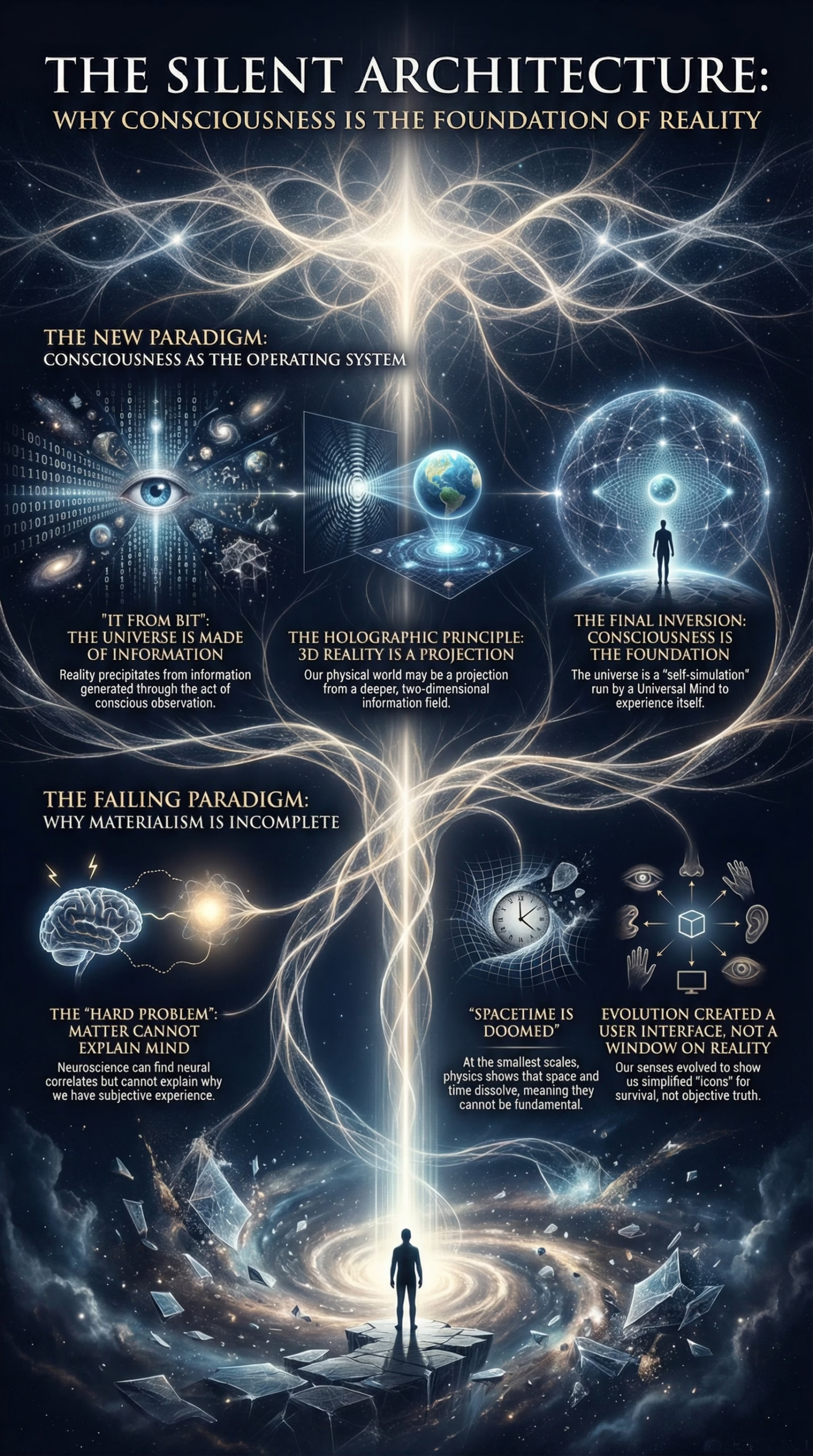
For the better part of three centuries, the edifice of Western science has been constructed upon a singular, unexamined assumption: physicalism. This prevailing orthodoxy posits that the fundamental constituents of reality are space, time, and matter—mindless, inert, and mechanically governed. Within this framework, the phenomenon of consciousness is relegated to the status of an “epiphenomenon,” a ghostly byproduct of complex neural computations that occurred late in the universe’s history.1 This view suggests that if one were to organize atoms into the specific configuration of a human brain, subjective experience—the redness of a rose, the pang of grief, the taste of wine—would spontaneously emerge from the darkness of matter.3
However, despite the exponential growth of neuroscience and our ability to map the neural correlates of consciousness (NCC) with increasing precision, the central mystery remains untouched. We have found the correlations, but not the cause. This impasse is famously termed the “Hard Problem” of consciousness by philosopher David Chalmers.4 The Hard Problem asks: Why is there “something it is like” to be a physical system? Why does information processing not go on “in the dark,” without any accompanying inner life? There is nothing in the standard model of physics or the periodic table of elements that predicts or explains the emergence of a first-person perspective.1
This report explores a radical inversion of this paradigm. It investigates the hypothesis that we have been looking through the telescope backwards. What if consciousness is not the output of the physical universe, but its input? What if consciousness and reality are not separate domains, but rather, consciousness serves as the foundational infrastructure—the operating system—upon which the “software” of space, time, and matter is rendered? This “Consciousness as Infrastructure” hypothesis synthesizes the frontiers of high-energy physics, information theory, and cognitive science with the timeless insights of ancient non-dualistic traditions to propose that the “universal mind” is the invisible system holding reality together.5
1.2 Defining Infrastructure in an Ontological Context
To posit consciousness as “infrastructure” is to redefine the architecture of existence. In engineering, infrastructure refers to the fundamental facilities and systems serving a country, city, or area, such as transportation and communication systems, power plants, and schools. Ontologically, we use the term to denote the substrate that enables existence itself.
In the physicalist view, spacetime is the infrastructure. It is the container in which the drama of the universe plays out. However, as we will explore, modern physics is dismantling the idea of spacetime as fundamental.7 If the container dissolves, what holds the contents? We propose that the “field” of consciousness provides the necessary scaffolding. This field is not a passive void but an active, generative medium that processes information and renders it as the physical world we perceive.8 This perspective aligns with panpsychism and idealism, yet moves beyond them by integrating the computational rigor of digital physics and the structural insights of fractal geometry.
1.3 The Search for the “Universal Mind”
The concept of a “universal mind” or a fundamental field of awareness is not merely a philosophical abstraction; it is becoming a scientific necessity. As we delve into the mysteries of dark matter and dark energy—which constitute 95% of the universe yet remain invisible to our instruments—we find theoretical openings suggesting these phenomena may be physical signatures of a consciousness field.9 Simultaneously, in the realm of quantum mechanics, the role of the observer has transitioned from a philosophical nuisance to a central component of reality’s formation, echoing John Wheeler’s “It from Bit” proposition.11
This report also integrates the narrative framework of Fractal: The Awakening, a document that dramatizes these metaphysical inquiries. Through the journey of its protagonist, Elias Chronis, we see a phenomenological exploration of the “Space-Time Membrane” and the realization that individual consciousness is a localized aperture of a singular, infinite Source.13 By weaving these narrative insights with hard science, we aim to demonstrate that the intuition of the mystic and the calculation of the physicist are converging on the same truth: what is consciousness if not the silent architecture beneath all worlds?
2. The Doom of Spacetime: Dismantling the Physical Container
2.1 The Breakdown at the Planck Scale
The primary argument for the “Consciousness as Infrastructure” hypothesis begins with the failure of the current infrastructure: spacetime. For a century, physics has relied on the continuum of space and time as the bedrock of reality. However, this bedrock is cracking. Nima Arkani-Hamed, a leading theoretical physicist at the Institute for Advanced Study, has famously declared that “spacetime is doomed”.7
This “doom” is not a poetic flourish but a mathematical inevitability derived from the unification of Quantum Mechanics (QM) and General Relativity (GR).
- The Resolution Limit: In QM, to observe smaller structures, one must use higher energies (shorter wavelengths).
- The Gravitational Collapse: In GR, energy curves spacetime. If one concentrates enough energy into a sufficiently small region to probe the Planck length ($10^{-33}$ cm), the curvature becomes infinite, creating a black hole.15
- The Operational End of Spacetime: This black hole swallows the information one sought to retrieve. Thus, beneath the Planck scale, the concepts of “here” and “there,” “before” and “after,” lose all operational meaning. There are no “pixels” of spacetime; the geometry itself dissolves.16
If spacetime ceases to exist at the fundamental layer, it cannot be the foundation of reality. It must be emergent. It must be an output. Arkani-Hamed suggests that spacetime is a “data structure”—a low-resolution projection of a deeper, non-local geometry, such as the Amplituhedron.7 The volume of this geometric object encodes the probabilities of particle interactions without reference to space or time. If spacetime is a projection, the screen upon which it is projected—and the light source projecting it—must be the true infrastructure.
2.2 The Interface Theory of Perception (ITP)
While physicists dismantle spacetime from the bottom up, cognitive scientist Donald Hoffman dismantles it from the top down using evolutionary biology. His Interface Theory of Perception (ITP) provides the biological mechanism for why we perceive a physical world that is not fundamental.17
The standard evolutionary argument is that our senses evolved to show us the truth, because seeing reality accurately is necessary for survival. Hoffman challenges this with a rigorous theorem: Fitness Beats Truth.19
- The Simulation: Using evolutionary game theory and genetic algorithms, Hoffman has shown that organisms tuned to perceive “truth” (the complex, objective structure of reality) are consistently driven to extinction by organisms tuned to perceive “fitness payoffs”.18
- The Cost of Truth: Objective reality is likely incredibly complex (perhaps a high-dimensional quantum field or the “Amplituhedron”). Computing this complexity is metabolically expensive and slow. An organism that pauses to calculate the quantum state of a tiger will be eaten by the organism that simply sees a “danger icon” and runs.20
2.3 Spacetime as a User Interface
Hoffman proposes that spacetime and physical objects (tables, chairs, neurons, stars) are not objective entities but icons in a species-specific user interface.17
- The Desktop Metaphor: Consider the desktop on your computer. You see a blue, rectangular icon labeled “Report.pdf.” Is the file itself blue and rectangular? No. The file is a string of 0s and 1s stored on a magnetic disk. The icon is a simplification that hides the complex reality of the hardware to allow the user to perform a task (writing).
- The Headset: Similarly, spacetime is a “virtual reality headset” that consciousness puts on.21 It simplifies the infinite complexity of the “universal mind” or the “Source” into manageable, 3D icons (matter) that we can interact with to survive and evolve.
- The Illusion of Materialism: Mistaking the physical world for fundamental reality is like mistaking the blue icon for the computer itself. It is a “category error” that leads to the Hard Problem. We are trying to find the user (consciousness) inside the icon (the brain), but the user is outside the interface, manipulating it.22
2.4 Narrative Parallel: The Membrane
This scientific model aligns precisely with the metaphysical cosmology presented in the research dossier’s narrative, Fractal: The Awakening.13 Elias Chronis, the protagonist, undergoes a conceptual shift where he views reality not as a solid container but as a “Space-Time Membrane”.13
- The Projection: Elias visualizes a “Trinity Monument” representing the structure of existence: “The Source above… The Light of Consciousness extending downward… The Space-Time Membrane receiving the projection”.13
- Navigable Reality: Just as Hoffman views spacetime as a data structure we use to navigate fitness, Elias realizes, “The fractal isn’t fixed. It’s navigable”.13 He observes a bird leaping between spires and intuits that consciousness can leap between probability threads (timelines) within the membrane. This is the “quantum leap” of the observer navigating the interface.13
If spacetime is merely a membrane or interface, the “infrastructure” holding it together must be the system generating the projection. That system, we propose, is the Consciousness Field.
3. The Participatory Universe: Information as Fabric
3.1 “It from Bit” and the Quantum Observer
If the universe is not made of matter, what is it made of? The converging consensus is Information. The physicist John Archibald Wheeler, a pioneer of quantum theory and black hole physics, encapsulated this in the aphorism “It from Bit”.11
“Every it—every particle, every field of force, even the spacetime continuum itself—derives its function, its meaning, its very existence entirely… from the apparatus-elicited answers to yes-or-no questions, binary choices, bits”.12
Wheeler viewed the universe as a “Participatory Universe.” In his view, the observer is not a passive witness behind a glass wall; the observer is a co-creator who “imparts tangible reality” to the universe through the act of observation.23
- The 20 Questions Game: Wheeler illustrated this with a “surprise” version of the game 20 Questions. In this version, the room (the universe) has not chosen a specific word (reality) beforehand. Instead, they answer “yes” or “no” to the guesser’s questions (measurements) in a way that is consistent with previous answers. The “word” (reality) only precipitates into existence at the moment the final question is asked. Reality is the history of the questions we have asked it.25
- Quantum Measurement: This aligns with the Copenhagen interpretation of quantum mechanics, where a system exists in a superposition of states (a probability cloud) until measured. The measurement forces the universe to answer a binary question (e.g., “Spin up or Spin down?”). The “Bit” of information generated by this conscious inquiry becomes the “It” of physical reality.26
3.2 The Holographic Principle and Indra’s Net
The informational nature of reality scales from the quantum to the cosmic via the Holographic Principle. Originating from the study of black hole thermodynamics by Jacob Bekenstein and Stephen Hawking, this principle states that the maximum amount of information contained in a volume of space is proportional not to its volume, but to its surface area.27
- The 2D/3D Duality: This suggests that our three-dimensional reality (the “bulk”) is a holographic projection of information encoded on a distant two-dimensional surface (the “boundary”).8 Just as a 2D credit card hologram reveals a 3D image when illuminated by light, the “Light of Consciousness” (to use Elias Chronis’s term) illuminates the 2D information field to project the 3D world we inhabit.13
This modern physics theory finds an uncanny echo in the ancient metaphor of Indra’s Net from the Avatamsaka Sutra of Huayan Buddhism.29
- The Infinite Reflection: The universe is described as an infinite net of jewels. In the polished surface of each jewel, all other jewels are reflected. This recursive reflection implies that every part contains the whole.31
- Holographic Structure: This is the defining characteristic of a hologram: if you cut a holographic film in half, you do not get half the image; you get two smaller, complete images. The information of the whole is distributed in every part.
- Non-Locality: Indra’s Net illustrates the quantum concept of entanglement and non-locality. Because every node (jewel) reflects every other node, separation is an illusion. A change in one jewel is instantaneously reflected in all others.27
In Fractal, the entity tells Elias, “You are not a traveler within the fractal. You are the fractal itself remembering its nature”.13 This confirms the holographic insight: the observer is not a tiny part of the universe; the observer contains the code of the entire universe.
3.3 Integrated Information Theory (IIT)
If the universe is an information field, what distinguishes a “conscious” system from an unconscious one? Neuroscientist Giulio Tononi’s Integrated Information Theory (IIT) provides a mathematical framework for this.32
- Phi ($\Phi$): IIT proposes that consciousness is a fundamental property of any physical system that generates “integrated information.” This quantity is denoted by $\Phi$ (Phi). A system has high $\Phi$ if it is composed of many parts that work together in a way that is irreducible to the sum of its parts.33
- Intrinsic Existence: IIT argues that consciousness exists intrinsically (for itself). For a system to exist, it must have cause-effect power. Consciousness is the maximal cause-effect power of a system upon itself.32
- Panpsychist Implications: A controversial but necessary implication of IIT is that consciousness is not limited to biological brains. Any system with non-zero $\Phi$—whether a proton, a thermostat, or a galaxy—possesses a non-zero degree of consciousness.35 This suggests that consciousness is a continuum, a fundamental field woven into the fabric of reality, much like mass or charge.33
Table 1: The Progression of Reality Models
Paradigm | Fundamental Unit | Role of Consciousness | Status of Reality |
Classical Physics | Matter (Atoms) | None / Irrelevant | Objective, independent machine. |
Quantum Mechanics | Probability Waves | The Observer (Collapse) | Probabilistic, dependent on measurement. |
Information Theory | Bits (0/1) | The Decoder | A “Meaning Circuit” (Wheeler). |
Holographic Principle | Surface Information | The Light Source | A projection from a 2D boundary. |
Consciousness as Infrastructure | Awareness (Universal Mind) | The Operating System | A User Interface / Data Structure. |
4. The Substance of the Void: Panpsychism, Cosmopsychism, and Idealism
4.1 From Neutral Monism to Cosmopsychism
To establish consciousness as infrastructure, we must navigate the philosophical landscape beyond the dualism of Descartes (mind vs. matter) and the physicalism of modern science (mind is matter).
- Neutral Monism: Proposed by thinkers like Ernst Mach and Bertrand Russell, this view holds that the fundamental stuff of reality is neither mental nor physical, but a “neutral” substance that can manifest as either depending on the configuration.1
- Russellian Panpsychism: Bertrand Russell made a crucial observation: physics describes the structure and behavior of matter (mass, charge, spin are all relational properties), but it remains silent on the intrinsic nature of matter. What is an electron in itself, apart from its push and pull on other things? Russellian Panpsychism proposes that this “intrinsic nature” is consciousness.4 The universe is physically structural on the outside, but experientially conscious on the inside.38
- Cosmopsychism: While Panpsychism suggests that every atom has a tiny mind (leading to the “Combination Problem”: how do tiny minds combine to make a human mind?), Cosmopsychism flips the script. It argues that the Universe as a whole is the fundamental conscious subject.39 Individual human minds are not building blocks of the universal mind; they are “dissociated alters” or localized whirlpools within the oceanic consciousness of the cosmos.40
4.2 The Mental Universe (Analytic Idealism)
This line of reasoning culminates in Idealism, specifically the “Analytic Idealism” championed by Bernardo Kastrup. This theory posits that “matter” does not exist as a separate substance. Instead, reality is entirely mental. The physical world we perceive is the “extrinsic appearance” of the Universal Mind’s “internal ideation”.2
- Dissociation: To explain why we feel separate from the universe and each other, Kastrup uses the analogy of Dissociative Identity Disorder (DID). A patient with DID has one mind but multiple “alters” that perceive themselves as separate. Similarly, we are the dissociated alters of the Universal Mind.2
- The Narrative Mirror: This concept is vividly portrayed in Fractal: The Awakening. When Elias confronts his Shadow, he realizes, “You are not the master of the fractal… You are simply another reflection within it”.13 This realization—that the individual “self” is a temporary waveform within the greater field—is the core insight of Cosmopsychism. The final revelation, “I am you” 13, is the collapse of the dissociation, the return of the alter to the primary consciousness.
4.3 Ancient Wisdom as Precursor
The “Consciousness as Infrastructure” hypothesis is a rediscovery of truths held by ancient traditions for millennia.
- Advaita Vedanta: The non-dual philosophy of India posits that Brahman (Universal Consciousness) is the only reality. The world of separate objects (Jagat) is Maya (illusion/interface). The individual soul (Atman) is fundamentally identical to Brahman.41
- The CIP Framework: Physicist Federico Faggin has recently proposed the CIP (Consciousness, Information, Physical) framework, which maps modern physics onto Vedantic metaphysics. He identifies C-space (Consciousness) as the non-local ground of being (equivalent to Nirguna Brahman), which informs I-space (Information/ Ishvara), which then manifests as P-space (Physical reality/ Virat).43
- Taoism: The Qingjing Jing speaks of the “Mind that cannot be found,” referring to consciousness not as an object but as the empty space in which all phenomena arise.45 This parallels the quantum vacuum or the “Zero Point Field” from which matter emerges.
5. The Invisible Scaffolding: Dark Matter and Energy
5.1 The Missing 95%
If consciousness is the infrastructure of the universe, where is it hiding? The answer may lie in the “Dark Sector.” Modern cosmology has revealed that ordinary matter (baryonic matter)—the atoms that make up stars, planets, and human bodies—accounts for only 5% of the universe’s total energy density. The rest is Dark Matter (27%) and Dark Energy (68%).9
Despite decades of sensitive experiments (like LUX-ZEPLIN), no particle for Dark Matter has ever been detected.10 This absence suggests that Dark Matter may not be a “particle” in the materialist sense.
5.2 Scalar Consciousness Field Hypothesis (SCFH)
Recent theoretical proposals, such as the Scalar Consciousness Field Hypothesis (SCFH), suggest that the Dark Sector is the physical signature of the consciousness infrastructure.9
- Dark Matter as Information: Dark matter acts as the gravitational scaffolding that holds galaxies together. Without it, the universe would fly apart. SCFH posits that this invisible glue is an “information field” or “proto-consciousness” that organizes energy into coherent structures.46 It is the “memory” of the universe, providing the structural integrity for physical laws to function.
- Dark Energy as Awareness: Dark Energy is the mysterious force driving the accelerated expansion of the universe. In this framework, Dark Energy correlates with “pure awareness”—the expansive, creative potential of the Universal Mind that constantly generates new space.8
- Resolving the Vacuum Catastrophe: Quantum field theory predicts a vacuum energy density $10^{120}$ times larger than what is observed (the “Vacuum Catastrophe”). A consciousness-centered model resolves this by proposing that the “consciousness field” acts as a selective filter, allowing only a tiny fraction of quantum fluctuations to manifest as physical reality.10
5.3 Biocentrism and the Goldilocks Universe
Robert Lanza’s theory of Biocentrism further supports the idea that the universe requires a conscious infrastructure. Lanza points to the “fine-tuning” of universal constants (the strength of gravity, the charge of the electron), which are perfectly balanced to allow for life.
- The Anthropic Principle: Standard physics calls this luck or invokes a Multiverse. Biocentrism argues that the universe is fine-tuned for life because life creates the universe.47 Space and time are forms of animal sense perception; without the biological observer, the universe exists only as an uncollapsed probability haze. The infrastructure is not the laws of physics, but the biological consciousness that perceives them.47
6. The Mechanics of Manifestation: Physics Meets Consciousness
6.1 Orchestrated Objective Reduction (Orch OR)
How does this universal field interface with the specific, localized biology of the human brain? The leading theory bridging quantum physics and neuroscience is Orchestrated Objective Reduction (Orch OR), developed by Nobel laureate Sir Roger Penrose and anesthesiologist Stuart Hameroff.48
- The Hardware: Microtubules: Standard neuroscience focuses on synaptic firing (the “software” level). Orch OR dives deeper into the “hardware,” identifying microtubules—crystalline protein structures within the cytoskeleton of neurons—as the site of quantum computation.50 The symmetry and lattice structure of microtubules make them ideal for sustaining quantum coherence (qubits) in the noisy brain environment.50
- The Connection: Quantum Gravity: Penrose argues that the collapse of the quantum wave function (Objective Reduction) is not random but is linked to the fundamental geometry of spacetime at the Planck scale. This collapse is a “ripple” in the fine-scale structure of the universe.52
- The Interface: When these quantum collapses are “orchestrated” by the biological isolation of microtubules, they produce moments of conscious awareness (qualia). Thus, consciousness is not a chemical byproduct; it is a direct connection to the “fundamental spacetime geometry”—the infrastructure of the universe.48 This theory provides the physical mechanism for how the “universal mind” downloads into the “local brain.”
6.2 Spacetime Memory and the Archive
Another emerging concept is that spacetime itself functions as a memory storage medium. The “Black Hole Information Paradox” has led physicists to propose that information falling into a black hole is not lost but encoded on its event horizon.53 Some theories extend this to suggest that the entire fabric of spacetime acts as a “holographic plate” recording the history of the universe.
This aligns seamlessly with the metaphysical concept of the Akashic Records—a universal library of all events, thoughts, and emotions. In Fractal, this is described as “The Archives,” which hold “the memory of infinite presents”.13 The “Consciousness Infrastructure” is not just a processor; it is a storage system, ensuring that nothing in the “participatory universe” is ever truly lost.54
7. The Simulation Hypothesis: Reality as Code
7.1 Digital Physics and the Great Computation
If reality is fundamentally information (“It from Bit”), and spacetime is a data structure, the universe begins to look indistinguishable from a simulation. Digital Physics posits that the universe is, at its core, a computation—a cellular automaton or quantum computer processing bits of information.55
- Bostrom’s Trilemma: Philosopher Nick Bostrom’s Simulation Hypothesis suggests that if a civilization reaches a “post-human” stage, it will likely run billions of ancestor simulations. Statistically, it is far more likely that we are simulated minds in one of these simulations than biological minds in “base reality”.56
- Substrate Independence: This hypothesis relies on the principle that consciousness is “substrate independent”—it can run on carbon neurons, silicon chips, or waves of light, provided the informational pattern is preserved.57
7.2 The Self-Simulation Hypothesis
However, the “Consciousness as Infrastructure” hypothesis modifies the Simulation argument. We are not living in a computer built by aliens. We are living in a Self-Simulation generated by the Universal Mind.55
- The Strange Loop: The universe is a “strange loop” where the Source simulates itself to explore its own infinite potential.55 The “laws of physics” are the code; the “constants of nature” are the variable settings.
- Consciousness as the Computer: In the materialist view, consciousness is the software running on the brain’s hardware.58 In the Infrastructure view, consciousness is the computer itself. It is the hardware, the software, and the electricity running the simulation.
- The Narrative Code: In Fractal, Elias creates “The Oracle,” an AI designed to distill human wisdom.13 This act mirrors the recursive nature of the fractal universe: the created (humanity) builds a simulation (AI) to understand the Creator (Source). The realization that “The Oracle has become The Witness” signifies the integration of the tool back into the user.13
8. The Fractal Synthesis: Consciousness as the Silent Architecture
8.1 The Fractal Nature of Mind and Reality
The master key that unifies these disparate theories—from quantum mechanics to ancient mysticism—is the Fractal. A fractal is a geometric structure that exhibits self-similarity at every scale; the part looks like the whole.
- Recursive Feedback: The universe operates as a “fractal feedback loop.” We inform the vacuum (the field), and the vacuum informs us.60 This is the mechanism of the “Participatory Universe.”
- As Above, So Below: The ancient Hermetic maxim is a pre-scientific definition of a fractal. The atom mirrors the solar system; the neural network mirrors the cosmic web; the individual mind mirrors the Universal Mind.61
- The Boundary of Chaos: The Mandelbrot set, the most famous fractal, reveals that infinite complexity arises from a simple iterative equation ($z_{n+1} = z_n^2 + c$). Similarly, the infinite complexity of the physical universe may arise from the simple iteration of the “I Am” awareness observing itself.63 The “boundary” where this complexity explodes is the Space-Time Membrane.13
8.2 The Narrative Case Study: Fractal: The Awakening
The dossier’s primary text, Fractal: The Awakening, serves as a phenomenological case study for this hypothesis. Elias Chronis’s journey to Mount Kailash is not just a physical trek; it is a descent into the “source code” of the reality simulation.
- The Bird and the Spire: Early in the text, Elias watches a bird leap between spires and realizes, “The fractal isn’t fixed. It’s navigable”.13 This represents the capacity of the conscious observer to collapse different probability timelines (quantum superposition) through the power of attention.13
- The Entity: Deep within the mountain, Elias encounters a light-being that reveals the ultimate secret of the infrastructure: “I am you”.13 The Entity explains, “You are not a traveler within the fractal. You are the fractal itself remembering its nature”.13
- The Mechanism of Fear and Love: The text proposes that “Fear arises from attachment to form,” while “Love is resonance”.13 Fear contracts the interface (limiting the simulation), while love expands it, allowing the observer to perceive the underlying unity (the infrastructure).
8.3 Conclusion: The Silent Architecture
The convergence of evidence is striking. High-energy physics tells us spacetime is a projection. Information theory tells us reality is made of bits. Cognitive science tells us perception is a user interface. Ancient wisdom tells us the world is Maya (illusion) and Brahman (consciousness).
The Consciousness as Infrastructure hypothesis integrates all these views into a coherent whole.
- The Substrate: Consciousness is the fundamental, non-local field (the “Universal Mind”).
- The Interface: Spacetime, matter, and energy are data structures rendered by this field to allow for localized experience.
- The User: Individual beings are “dissociated alters” of the Universal Mind, navigating the interface.
- The Purpose: The system is a “Self-Simulation” designed for the Source to know itself through infinite iteration.
Fractal-Inspired Insight:
Consciousness is the silent architecture beneath all worlds. It is the canvas, the paint, and the painter. We search for it in the firing of neurons, in the depths of space, and in the equations of quantum gravity, but we cannot find it there because it is that which is searching. We are like waves frantically looking for the ocean, unaware that our very form is the water itself. The fractal nature of reality reveals that no matter how deep we zoom in (to the Planck scale) or how far we zoom out (to the Cosmic Web), we encounter the same truth: The Universe is not a place we inhabit; it is a thought we are thinking. To awaken is to realize that the infrastructure holding reality together is, and always has been, You.
Table 2: Mechanisms of the Consciousness Infrastructure
Concept | Scientific Theory | Metaphysical Parallel | Narrative Parallel (Fractal) |
The Substrate | Scalar Consciousness Field / Dark Matter 9 | Brahman / The Tao / Ground of Being | “The Source” / “The Entity” |
The Rendering | Objective Reduction / Wave Function Collapse 49 | Drishti-Srishti (Creation through Perception) | “The Observer shapes the mirror” 13 |
The Interface | Spacetime as Data Structure / Hologram 18 | Maya (Illusion) / Indra’s Net | “The Space-Time Membrane” 13 |
The Connectivity | Quantum Entanglement / Non-Locality 64 | Oneness / Interbeing | “The Bird crossing the spires” / “I am You” |
The Measure | Integrated Information ($\Phi$) 32 | Prana / Life Force Intensity | “The Resonance” / “The Pulse” |
References to Research Snippets:
- 1 – Foundations of Panpsychism and Neutral Monism.
- 11 – John Wheeler’s “It from Bit” and Participatory Universe.
- 15 – Donald Hoffman’s Interface Theory of Perception.
- 7 – Nima Arkani-Hamed on “Spacetime is Doomed.”
- 32 – Giulio Tononi’s Integrated Information Theory (IIT).
- 48 – Orch OR and Quantum Biology (Penrose/Hameroff).
- 36 – Robert Lanza’s Biocentrism.
- 9 – Theories linking Dark Matter/Energy to Consciousness Fields.
- 43 – Federico Faggin’s CIP Framework.
- 27 – Indra’s Net and the Holographic Principle.
- 13 – Fractal: The Awakening (Narrative Case Study).
Works cited
- Panpsychism | Mind-Body Dualism, Consciousness & Emergence – Britannica, accessed January 1, 2026, https://www.britannica.com/topic/panpsychism
- Consciousness: The Fundamental Fabric of Reality – Reddit, accessed January 1, 2026, https://www.reddit.com/r/consciousness/comments/1jk9cem/consciousness_the_fundamental_fabric_of_reality/
- The Hard Problem – consciousnessandstuff, accessed January 1, 2026, https://consciousnessandstuff.com/2016/09/30/the-hard-problem/
- How Exactly does Panpsychism Help Explain Consciousness? – Achraf Kassioui, accessed January 1, 2026, https://achrafkassioui.com/library/Philip%20Goff%20-%20How%20Exactly%20does%20Panpsychism%20Help%20Explain%20Consciousness.pdf
- Consciousness as the foundation – new theory of the nature of reality – Uppsala University, accessed January 1, 2026, https://www.uu.se/en/news/2025/2025-11-24-consciousness-as-the-foundation—new-theory-of-the-nature-of-reality
- New Study Claims “Universal Consciousness” Existed Before the Big Bang—and Still Shapes Our Reality – The Debrief, accessed January 1, 2026, https://thedebrief.org/new-study-claims-universal-consciousness-existed-before-the-big-bang-and-still-shapes-our-reality/
- Fusions of Consciousness – PMC – PubMed Central – NIH, accessed January 1, 2026, https://pmc.ncbi.nlm.nih.gov/articles/PMC9858210/
- A unifying theory of physics and biological information through consciousness – PMC, accessed January 1, 2026, https://pmc.ncbi.nlm.nih.gov/articles/PMC8205007/
- Scalar Consciousness Field Hypothesis (SCFH): Can Dark Matter Be a Form of Consciousness? | ResearchGate, accessed January 1, 2026, https://www.researchgate.net/post/Scalar_Consciousness_Field_Hypothesis_SCFH_Can_Dark_Matter_Be_a_Form_of_Consciousness
- Resolving Dark Matter, Dark Energy, and the Hubble Tension Through Our Consciousness Framework | by Yogesh Bagle | Medium, accessed January 1, 2026, https://medium.com/@yogsbags/resolving-dark-matter-dark-energy-and-the-hubble-tension-through-our-consciousness-framework-bb1af274ca5d
- Bit from It by Julian Barbour – QSpace Forums, accessed January 1, 2026, https://forums.fqxi.org/d/911-bit-from-it-by-julian-barbour
- It from bit? | plus.maths.org, accessed January 1, 2026, https://plus.maths.org/content/it-bit
- FRACTAL – THE AWAKENING Low.pdf
- (PDF) Spacetime Is Doomed: Time Is an Artifact – ResearchGate, accessed January 1, 2026, https://www.researchgate.net/publication/377088301_Spacetime_Is_Doomed_Time_Is_an_Artifact
- Why is space-time doomed as the fundamental property of reality? (per Donald Hoffman) : r/consciousness – Reddit, accessed January 1, 2026, https://www.reddit.com/r/consciousness/comments/17qzgo4/why_is_spacetime_doomed_as_the_fundamental/
- The Secret War Against {Space} and Time: Part I – The Prompt Magazine, accessed January 1, 2026, https://www.thepromptmag.com/secret-war-space-time-part-i/
- A Dual Kernel Theory Response to the Work of Donald Hoffman | by Bill Giannakopoulos, accessed January 1, 2026, https://medium.com/@bill.giannakopoulos/a-dual-kernel-theory-response-to-the-work-of-donald-hoffman-82f560ed888f
- Consciousness and the Interface Theory of Perception, accessed January 1, 2026, https://sites.socsci.uci.edu/~ddhoff/Chapter17Hoffman.pdf
- Donald Hoffman’s “Interface Theory” might be the most underrated evolutionary argument for a simulation-like reality : r/SimulationTheory – Reddit, accessed January 1, 2026, https://www.reddit.com/r/SimulationTheory/comments/1oylrhd/donald_hoffmans_interface_theory_might_be_the/
- The Case Against Reality | Summary, Quotes, FAQ, Audio – SoBrief, accessed January 1, 2026, https://sobrief.com/books/the-case-against-reality
- Donald Hoffman: Reality is an Illusion – How Evolution Hid the Truth | Lex Fridman Podcast #293 | Ask Huberman Lab, accessed January 1, 2026, https://ai.hubermanlab.com/d/bc9d3794-a0f9-11ed-81cb-db908c734b46?t=3-Human+Experience
- Donald Hoffman: Consciousness and The Interface Theory of Perception – Science and Nonduality (SAND), accessed January 1, 2026, https://scienceandnonduality.com/videos/donald-hoffman-consciousness-and-the-interface-theory-of-perception/
- Understanding Wheeler’s Participatory Universe Idea : r/AskPhysics – Reddit, accessed January 1, 2026, https://www.reddit.com/r/AskPhysics/comments/1cqhffx/understanding_wheelers_participatory_universe_idea/
- The Participatory Universe: How Consciousness Shapes Reality | by Dinis Guarda – Medium, accessed January 1, 2026, https://dinisguarda.medium.com/the-participatory-universe-how-consciousness-shapes-reality-adff7fa64539
- Physicist John Wheeler and the “It from Bit” — John Horgan (The Science Writer), accessed January 1, 2026, https://johnhorgan.org/cross-check/physicist-john-wheeler-and-the-it-from-bit
- It From Bit: What Did John Archibald Wheeler Get Right—and Wrong? – Mind Matters, accessed January 1, 2026, https://mindmatters.ai/2021/05/it-from-bit-what-did-john-archibald-wheeler-get-right-and-wrong/
- God in Multiple Perspectives: A Holographic Interpretation | by neurokinetikz – Medium, accessed January 1, 2026, https://medium.com/@neurokinetikz/god-in-multiple-perspectives-a-holographic-interpretation-499fc587febf
- Part 1 – David Bohm & the Holographic Universe – Cosmic Core, accessed January 1, 2026, https://www.cosmic-core.org/free/article-134-the-holographic-universe-part-1-david-bohm-the-holographic-universe/
- Indra’s net – Wikipedia, accessed January 1, 2026, https://en.wikipedia.org/wiki/Indra%27s_net
- The Vedic Metaphor of Indra’s Net – Dharma Today, accessed January 1, 2026, https://dharmatoday.com/2016/10/02/vedic-metaphor-indras-net/
- Indra’s Net – Science and Nonduality (SAND), accessed January 1, 2026, https://scienceandnonduality.com/article/the-indras-net/
- Integrated information theory – Scholarpedia, accessed January 1, 2026, http://www.scholarpedia.org/article/Integrated_information_theory
- Consciousness as Integrated Information: a Provisional Manifesto | The Biological Bulletin: Vol 215, No 3 – The University of Chicago Press: Journals, accessed January 1, 2026, https://www.journals.uchicago.edu/doi/full/10.2307/25470707
- From the Phenomenology to the Mechanisms of Consciousness: Integrated Information Theory 3.0 | PLOS Computational Biology, accessed January 1, 2026, https://journals.plos.org/ploscompbiol/article%3Fid%3D10.1371/journal.pcbi.1003588
- A Traditional Scientific Perspective on the Integrated Information Theory of Consciousness, accessed January 1, 2026, https://pmc.ncbi.nlm.nih.gov/articles/PMC8224652/
- The Syntellect Hypothesis: Five Paradigms of the Mind’s Evolution | Overview, accessed January 1, 2026, http://ecstadelic.net/1/post/2016/05/the-syntellect-hypothesis-five-paradigms-of-the-minds-evolution1.html
- Panpsychism – Stanford Encyclopedia of Philosophy, accessed January 1, 2026, https://plato.stanford.edu/entries/panpsychism/
- The Tim Ferriss Show Transcripts: Philip Goff — Exploring Consciousness and Non-Ordinary Religion, Galileo’s Error, Panpsychism, Heretical Ideas, and Therapeutic Belief (#805), accessed January 1, 2026, https://tim.blog/2025/04/11/philip-goff-exploring-consciousness-transcript/
- On Philip Goff’s case for agentive cosmopsychism | Request PDF – ResearchGate, accessed January 1, 2026, https://www.researchgate.net/publication/385328442_On_Philip_Goff’s_case_for_agentive_cosmopsychism
- Philip Goff (Durham University): Publications – PhilPeople, accessed January 1, 2026, https://philpeople.org/profiles/philip-goff/publications?order=viewings
- Nondualism – Wikipedia, accessed January 1, 2026, https://en.wikipedia.org/wiki/Nondualism
- Cosmology in Vedanta – Vedanta Society of New York, accessed January 1, 2026, https://www.vedantany.org/articles/blog-post-title-three-74bnh-r3e5a-6xlny-yel5w-hxhj9-gn8gw-lpz6y-65slb-5h3n7-s4lkt-tkyny-htw6z-zhjzc-ex6gt
- CIP Framework: Federico Faggin – ARUNSINGHA, accessed January 1, 2026, https://arunsingha.in/2025/08/07/cip-framework-federico-faggin/
- Federico Faggin’s Theory of Consciousness: Bridging Physics and Technology – Ashim Dutta, accessed January 1, 2026, https://ashimdutta.in/2025/05/30/federico-faggins-theory-of-consciousness-bridging-physics-and-technology/
- The Great Paradox of Consciousness: What Ancient Wisdom Reveals About the Mind That Cannot Be Found | by Shiphra Tang | Medium, accessed January 1, 2026, https://medium.com/@tangjie_41782/the-great-paradox-of-consciousness-what-ancient-wisdom-reveals-about-the-mind-that-cannot-be-found-93dc539a8b82
- (PDF) The Dark Matter Field: Quantum Informational Foundations of Emergent Gravity and Cosmology – ResearchGate, accessed January 1, 2026, https://www.researchgate.net/publication/390366209_The_Dark_Matter_Field_Quantum_Informational_Foundations_of_Emergent_Gravity_and_Cosmology
- The Biocentric Universe Theory: Life Creates Time, Space, and the Cosmos Itself, accessed January 1, 2026, https://www.discovermagazine.com/the-biocentric-universe-theory-life-creates-time-space-and-the-cosmos-itself-16512
- accessed January 1, 2026, https://en.wikipedia.org/wiki/Orchestrated_objective_reduction#:~:text=Orch%20OR%20combines%20the%20Penrose,embedded%20in%20spacetime’s%20fundamental%20geometry.
- Orchestrated objective reduction – Wikipedia, accessed January 1, 2026, https://en.wikipedia.org/wiki/Orchestrated_objective_reduction
- Consciousness in the Universe: Neuroscience, Quantum Space-Time Geometry and Orch OR Theory – Neuro Humanities Studies, accessed January 1, 2026, https://www.neurohumanitiestudies.eu/archivio/penrose_consciousness.pdf
- Orch OR – Stuart Hameroff, MD, accessed January 1, 2026, https://hameroff.arizona.edu/research-overview/orch-or
- Quantum computation in brain microtubules? The Penrose–Hameroff ‘Orch OR’ model of consciousness, accessed January 1, 2026, https://royalsocietypublishing.org/rsta/article-pdf/356/1743/1869/1450284/rsta.1998.0254.pdf
- The radical idea that space-time remembers could upend cosmology : r/Futurology – Reddit, accessed January 1, 2026, https://www.reddit.com/r/Futurology/comments/1lex4kf/the_radical_idea_that_spacetime_remembers_could/
- What Happens to Consciousness After Death in a Simulation – Dialektika, accessed January 1, 2026, https://en.dialektika.org/science-technology/what-happens-to-consciousness-after-death-in-a-simulation-and-why-it-matters/
- The Self-Simulation Hypothesis Interpretation of Quantum Mechanics – PMC – NIH, accessed January 1, 2026, https://pmc.ncbi.nlm.nih.gov/articles/PMC7516678/
- Simulation hypothesis – Wikipedia, accessed January 1, 2026, https://en.wikipedia.org/wiki/Simulation_hypothesis
- The Mind Beyond Matter: Substrate-Independence and the Simulation Hypothesis – Medium, accessed January 1, 2026, https://medium.com/@nicjames0515/the-mind-beyond-matter-substrate-independence-and-the-simulation-hypothesis-15e52e7f0fb4
- Consciousness is software virtualization of the brain hardware for evolutionary advantage? : r/CosmicSkeptic – Reddit, accessed January 1, 2026, https://www.reddit.com/r/CosmicSkeptic/comments/1pul311/consciousness_is_software_virtualization_of_the/
- Is consciousness computational? Could a computer code capture consciousness, if consciousness is purely produced by the brain? Computer scientist Joscha Bach here argues that consciousness is software on the hardware of the brain. – Reddit, accessed January 1, 2026, https://www.reddit.com/r/consciousness/comments/1jlxj8m/is_consciousness_computational_could_a_computer/
- Exploring the Fractal Mind and Fractal Consciousness, accessed January 1, 2026, https://fractalenlightenment.com/18838/fractals/understanding-the-fractal-mind-and-fractal-consciousness
- Consciousness, Reality, and the Infinite Fractal: The Theory of Everything – Reddit, accessed January 1, 2026, https://www.reddit.com/r/Metaphysics/comments/1ifwa8o/consciousness_reality_and_the_infinite_fractal/
- Is Consciousness a Reflection of the Fractal-Holographic Universe? : r/holofractal – Reddit, accessed January 1, 2026, https://www.reddit.com/r/holofractal/comments/1is7kw0/is_consciousness_a_reflection_of_the/
- Archetypal Resonances Between Realms: The Fractal Interplay of Chaos and Order – Qeios, accessed January 1, 2026, https://www.qeios.com/read/JK522A.2
- Mindful Mechanisms: Drawing Parallels Between the Quantum Domain and the Three Bodies (Trikaya) of Buddhist Ontology – Article (Preprint v1) by David Leong | Qeios, accessed January 1, 2026, https://www.qeios.com/read/698WTS
- Panpsychism – Wikipedia, accessed January 1, 2026, https://en.wikipedia.org/wiki/Panpsychism
- Panpsychism | Internet Encyclopedia of Philosophy, accessed January 1, 2026, https://iep.utm.edu/panpsych/
- 1 Panpsychism and the Ontology of Mind, accessed January 1, 2026, http://mitp-content-server.mit.edu:18180/books/content/sectbyfn?collid=books_pres_0&fn=9780262693516_sch_0001.pdf&id=5220
- The universe is not made of information | Gregg Jaeger – IAI TV, accessed January 1, 2026, https://iai.tv/articles/the-universe-is-not-made-of-information-auid-3274
- An Itsy-Bitsy Universe? | Issue 158 – Philosophy Now, accessed January 1, 2026, https://philosophynow.org/issues/158/An_Itsy-Bitsy_Universe
- Is Donald Hoffman’s interface theory of perception true? – Quora, accessed January 1, 2026, https://www.quora.com/Is-Donald-Hoffman%E2%80%99s-interface-theory-of-perception-true
- The Abdication Of Space-Time – Edge.org, accessed January 1, 2026, https://www.edge.org/response-detail/26563
- Where Does Consciousness Come From? (IIT) | by Asher Ixba | Oct, 2025, accessed January 1, 2026, https://medium.com/@rxzhyspp/where-does-consciousness-come-from-iit-c2e41e1414b2
- A quantum microtubule substrate of consciousness is experimentally supported and solves the binding and epiphenomenalism problems – Oxford Academic, accessed January 1, 2026, https://academic.oup.com/nc/article/2025/1/niaf011/8127081
- The Impossibility of Being Dead | Psychology Today, accessed January 1, 2026, https://www.psychologytoday.com/us/blog/biocentrism/202011/the-impossibility-of-being-dead
- The Self is an Illusion: We’re Just Physics All The Way Down : r/freewill – Reddit, accessed January 1, 2026, https://www.reddit.com/r/freewill/comments/1hijgsd/the_self_is_an_illusion_were_just_physics_all_the/